
Today, I would like to talk about an Austrian brand that is still very little known, but one that clearly deserves a closer look. If I say independent Austrian watch, 100% European manufacturing, and an ambitious value proposition, the more knowledgeable among you may already have recognised Blütezeit. Before presenting one of the latest variations of its first model, let me take a closer look at the person behind this project, his background, the birth of the brand, and the vision that now seems to guide each of its creations.
Because behind Blütezeit stands a profile one does not necessarily expect to find in independent watchmaking. Its founder, Dieter Altenburger, is first and foremost a lawyer by profession, a law lecturer, and the author of numerous specialist works, and he still pursues that career today alongside his watchmaking project. After studying law, earning his master’s degree, joining a law firm, and then completing a doctorate, he also undertook studies in environmental management. He became a lawyer in 2007, then a partner in a law firm in 2012, and for many years has taught environmental law and procedural law at several Austrian universities. In the main legal rankings, he has long been listed among Austria’s leading environmental law specialists. In other words, at first glance, nothing seemed to point him toward founding a watch brand. And it is precisely that contrast that makes his path so interesting.
A watch enthusiast for many years, he does not collect hundreds of pieces, but only around a dozen, each chosen for the meaning it holds for him. In 2017, reading an article about 3D printing became an initial turning point. Fascinated by the idea of designing an object on a computer and then holding it in his hands, he began teaching himself CAD, first through relatively simple software such as 123Design and SketchUp. His earliest creations were small pieces of jewellery designed for his wife, before a more ambitious idea gradually took hold: why not design a watch for himself? He quickly realised, however, that watchmaking demanded an entirely different level of precision, especially at the micrometric scale. He then tested several more advanced tools, including SolidWorks, Solid Edge and FreeCAD, before ultimately focusing his efforts on SolidWorks. The learning process was slow and difficult, carried out in the evenings and often at night, alongside an already demanding professional life. But he kept moving forward.
In 2019, he printed his first watch case, designed around an ETA movement. From a technical point of view, the result worked, but the quality of the printed case was not considered satisfactory. The surface was too rough and would have required additional machining that would have been far too costly. So the project was set aside. Then the pandemic arrived. As it did for many people, that period acted as a revelation. Work at the law firm slowed down, and he began reflecting more seriously on what he had always wanted to do. That was when he decided he would finally see the idea through. One thing had by then become clear in his mind: if he was going to accept the cost of producing a mechanical watch made in Europe, it would not be to house an ordinary movement inside it. That reflection not only led him to take the project seriously, but also made him understand that he could not simply make a watch for himself. To carry it through properly, he needed to create a brand.
That is how Blütezeit was born. A name that is far from accidental. Pronounced [ˈblyːtətsaɪ̯t], it refers to the peak of a cultural or economic development, something that could be linked to the idea of a golden age. Choosing that name immediately anchors the project in a broader vision, one that is cultural, historical and aesthetic at once. Because behind Blütezeit there is also a desire, on its own scale, to contribute to the renewed visibility of Austrian watchmaking. Long overshadowed internationally by Switzerland and Germany, Austria nevertheless had notable watchmaking figures in the past before going through a long period of relative disappearance. With Blütezeit, the aim is not only to create a beautiful watch, but also to contribute to that revival by offering refined pieces made in Europe, incorporating features not always found at this price level.
And then there is Vienna. Because Blütezeit cannot be fully understood without its connection to the Austrian capital. For Dieter Altenburger, Vienna is not just a city, but an atmosphere, a way of being, a crossroads of cultures where Slavic melancholy meets Mediterranean lightness, where the intensity of Eastern Europe meets the elegance of Western Europe. That richness, sometimes paradoxical, can be felt in the food, the architecture, the music and the Viennese way of life. And it is precisely that spirit that the watch seeks, in its own way, to capture. Blütezeit is therefore not merely a technical or horological project. It is also an attempt to translate a cultural sensibility into an object worn on the wrist.
Officially launched at the end of 2021, the project stands out as much for its substance as for its origin. Self-funded and conceived as a parallel project alongside an already very demanding career, the brand offers a personal vision of independent watchmaking, driven by the desire to create watches that are thoughtful, poetic and coherent. It is within this context that the piece that interests us today takes shape: the Blütezeit 2.1. Now let us turn to the presentation of this watch.
Table of Contents – Blütezeit 2.1
What are the key features of the Blütezeit 2.1?
Case
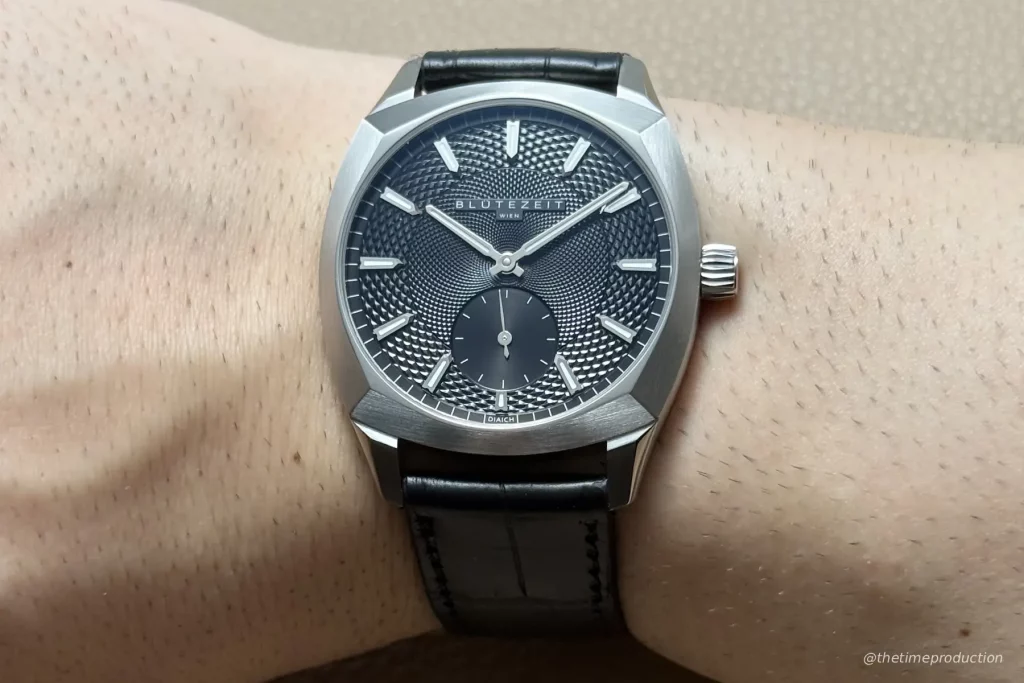
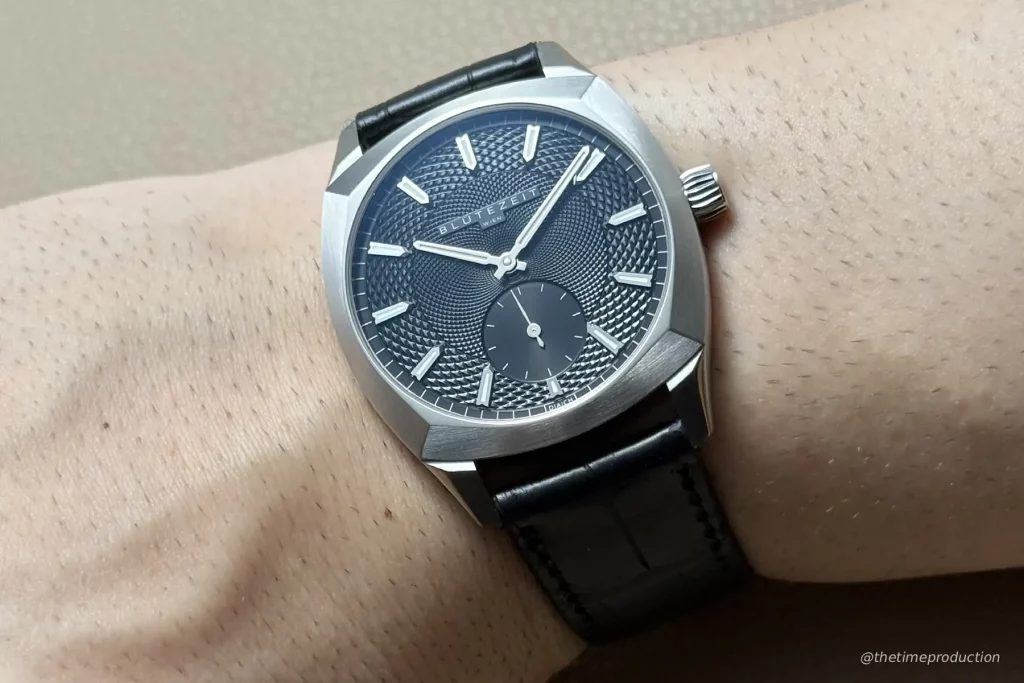
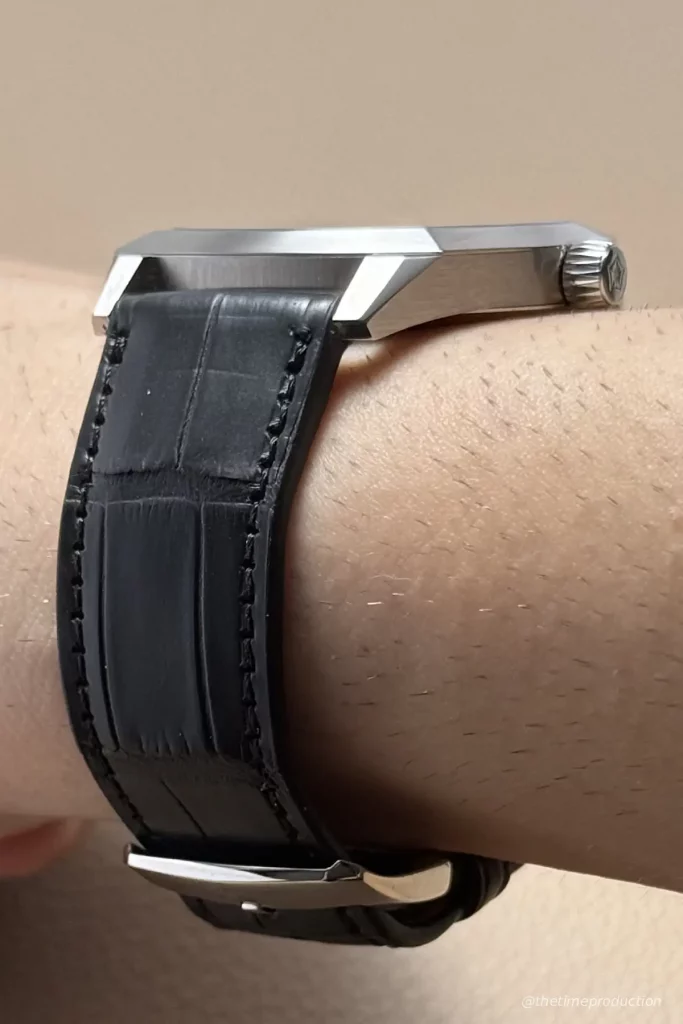
For this Blütezeit 2.1, Dieter Altenburger opted for a particularly slim stainless steel cushion case measuring 37 mm across and just 6.9 mm thick, or 7.1 mm including the crystal. And that is probably what struck me first about this watch. On the wrist, that thinness immediately changes the perception of the piece. The watch sits very naturally, slips easily under a cuff, and gives off something very elegant, almost discreet, without ever feeling ordinary. Added to that is the choice of a cushion shape which, without being revolutionary in itself, brings real visual softness here while still remaining highly structured.
What I particularly appreciated is the way this case has been worked. There is a very successful alternation between brushed surfaces on the upper side and a fully polished case middle, which gives the whole much more relief than one might imagine at first glance. The case is quite rich in its construction, with several angles, several breaks in the lines, and a real dialogue between the different surfaces. That gives it a presence that is both elegant and very deliberately drawn. I also really liked the work done on the lugs. They are well integrated into the case, yet they almost give the impression of being separate elements because their design is so clearly defined. Their slightly softened finish underneath also contributes greatly to comfort on the wrist.
The crown also deserves to be mentioned. Well proportioned, neither too small nor too imposing, it offers good grip and integrates very naturally into the whole. There also appears to be a small logo on it, a discreet detail but always appreciated on this type of watch. Overall, I found this case not only very pleasant to wear, but also interesting to look at, which is not always the case with pieces this thin. There is real design work here, a real intention in the lines, and above all solid execution from RP Uhrengehäuse.
With its 3 ATM of water resistance, the Blütezeit 2.1 is obviously not intended to be a versatile sports watch, but that is not its purpose anyway. On the contrary, this case feels entirely coherent with the overall identity of both the watch and the brand. There is something very architectural in the way it is constructed, something very precise in its lines, almost very Viennese in its relationship to form and rigor. And that is probably what I appreciate most here: this case does not try to impress through artificial tricks, but through a worked-out elegance, refined thinness, and a design language perfectly aligned with the world that Blütezeit is trying to establish.
Dial
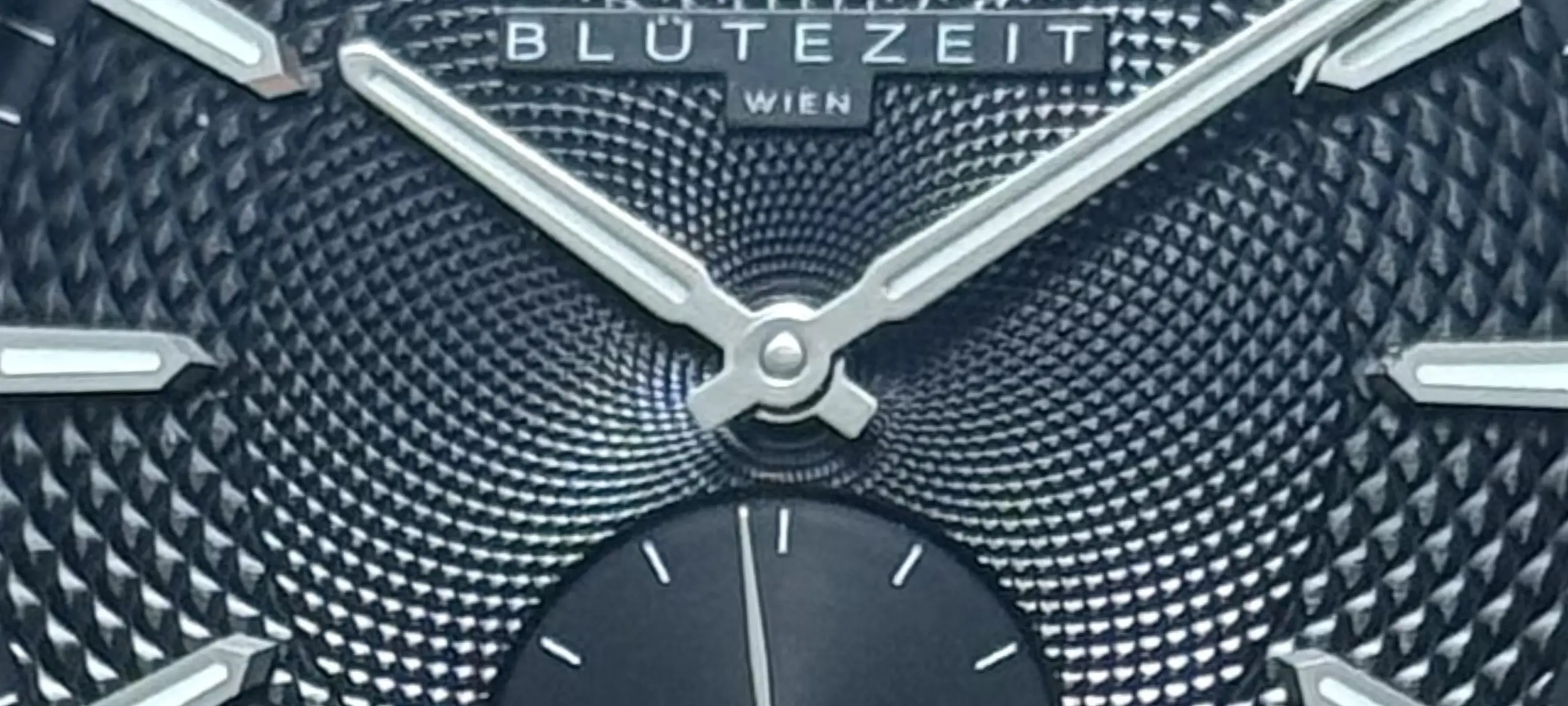
To my eyes, the dial of this Blütezeit 2.1 is one of the watch’s strongest points. More precisely, it is of course the guilloché work that immediately draws the eye. Executed by hand by Jochen Benzinger, a figure well known among enthusiasts for the quality of his work, this dial plays with multiple levels and multiple patterns with genuine finesse in execution. In particular, there are two distinct motifs, close to fish scales or an ultra-fine barleycorn pattern, which give the dial remarkable visual richness without ever making it feel heavy or overly demonstrative. This is exactly the kind of detail that instantly changes the perception of a watch when you have it in hand.
What I particularly liked is the way this dial is built visually through successive layers. First comes the small seconds subdial, then the central section, then the outer ring, followed by the applied indexes and the hands, without forgetting the rehaut. All of this creates real depth and gives the dial a much richer presence than a simple black dial might suggest at first glance. The applied indexes contribute enormously to that sensation. They bring relief, light and real visual precision, especially since they were cut one by one by CNC and then polished by hand. The level of detail is genuinely impressive.
On top of that, there is excellent anti-reflective treatment on the sapphire crystal, which allows you to fully enjoy the work done on the dial. Legibility remains very good, which is always welcome on a watch that is visually this elaborate. The rhodium-plated hands with blue Super-LumiNova work very well within the overall design and maintain clear readability without stealing attention from the dial itself. I also like the fact that the logo at 12 o’clock is applied, and that the brand did not unnecessarily overload this part of the watch. Here, the dial is allowed to speak, and that seems to me the right decision.
If I had to qualify one point, I would simply say that the inscription at 6 o’clock “DIAICH” may deserve an explanation, because it can raise questions at first glance. Other than that, I find this dial genuinely very accomplished. It works perfectly, it is legible, it is rich, and above all it adds real value to the watch. In this price range, being able to offer a true guilloché dial made by Jochen Benzinger is clearly a strength. And above all, this dial never feels pasted onto the watch: it integrates very well with the case just discussed, which further reinforces the overall coherence of the piece.
Movement
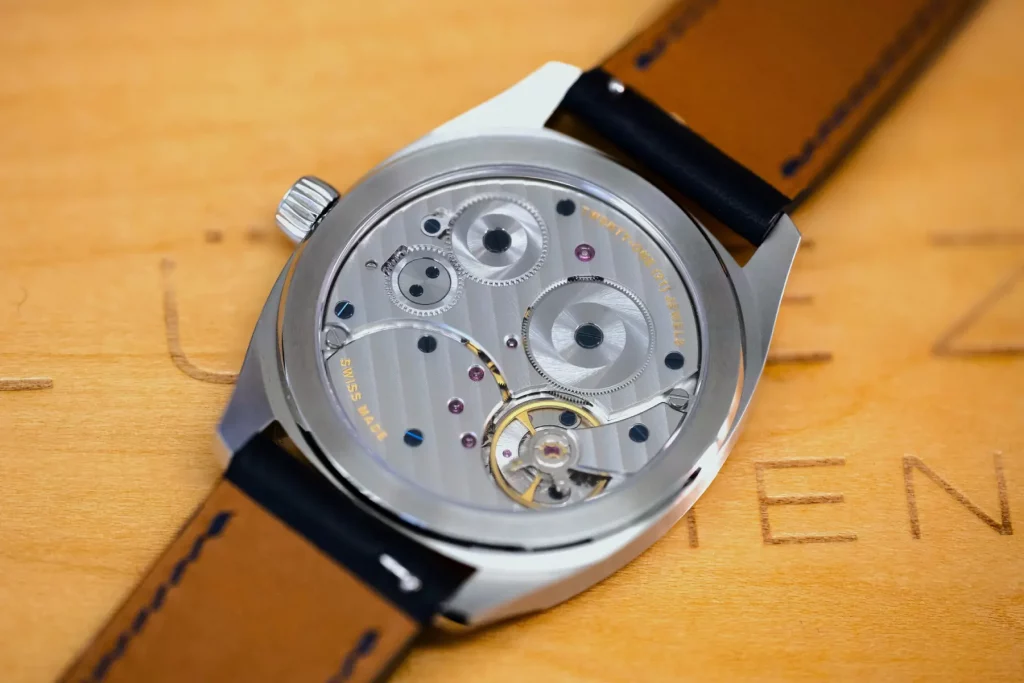
At the heart of this Blütezeit 2.1 beats the La Joux-Perret 7380 calibre, a hand-wound movement that, in my view, adds real value to the watch. We are talking here about a calibre measuring 30 mm in diameter and only 2.7 mm thick, equipped with two barrels and above all delivering a very impressive 90-hour power reserve. And honestly, when you consider that in relation to the overall dimensions of the watch and its thinness on the wrist, I find it a particularly relevant choice. It is not just a technically coherent base, it is a movement that genuinely contributes to the overall quality of the proposition.
What a serious collector will probably retain first is precisely that balance between thinness, power reserve and level of execution. At this price point, offering a La Joux-Perret movement of this type, with that kind of autonomy, seems to me a real strength. Of course, we are still looking at a movement from a well-known industrial supplier rather than something developed specifically for the brand, but that does not bother me here. On the contrary, I think the choice is intelligent. It makes it possible to offer a serious, recognised base, well proportioned for the project, while maintaining a certain economic coherence.
The finishing is also very much in line with what one can expect in this context. There are Geneva stripes, blued screws, palladium-coated surfaces and counter-rotating wheels, all accompanied by adjustment in five positions, which adds to the credibility of the whole in everyday use. This is not a movement trying to impress through excessive visual showmanship, but it is decorated as it should be, seriously, in a clean and convincing register. I do not expect more from it, but clearly not less either.
The absence of hacking seconds may surprise some, but personally it is not something that bothers me here. For the rest, I think Blütezeit made a very good choice with this La Joux-Perret 7380. In this watch, it plays its role perfectly: it brings thinness, a strong power reserve, serious execution and above all real coherence with the watch’s overall proposition.
Strap
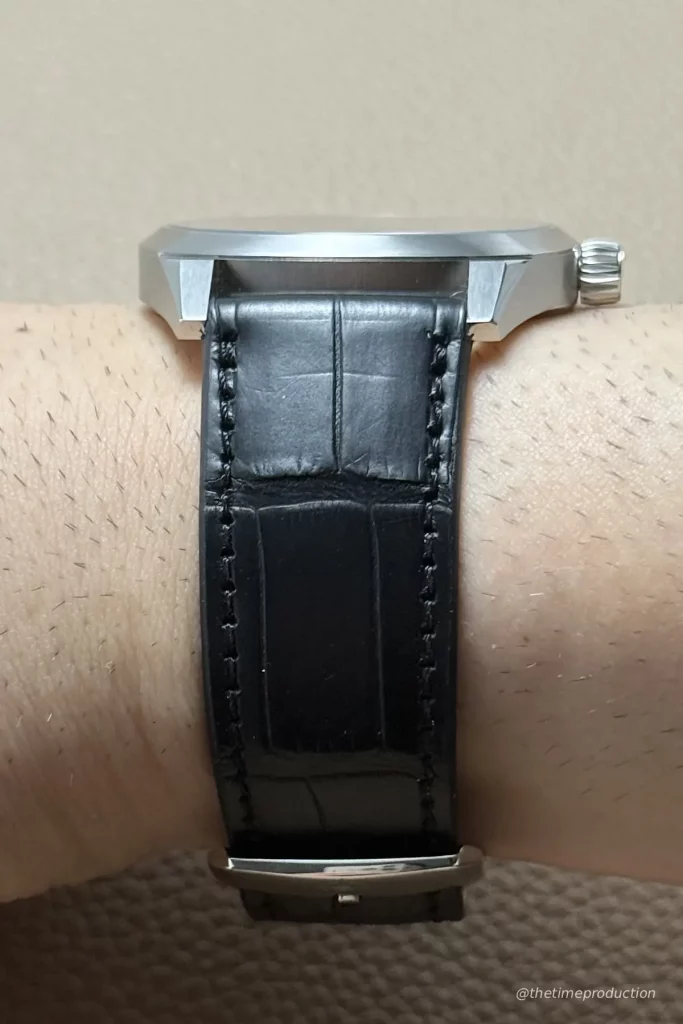
To accompany the Blütezeit 2.1, the brand chose a black leather strap that works, in my view, very well with the overall watch. It may not be the most spectacular element of the piece, but it fulfils its role perfectly. In terms of comfort, I found it genuinely convincing. It sits well on the wrist, naturally follows the thinness of the case, and never breaks the watch’s overall elegance. At this price level, I find the proposition entirely coherent.
Of course, this is not a top-tier handmade strap in the most artisanal sense of the term, but I find it well made and entirely up to the level of the watch. The perceived quality is good, the black stitching remains discreet, and the whole keeps a real sobriety, which feels like the right choice on a piece like this. I have not seen this watch on other options such as nylon or rubber, but personally I think leather suits it perfectly. It extends the watch’s dressier and more refined side without overplaying anything.
I also quite liked the buckle. Fully polished, with a small logo in the centre, it remains simple but well executed, and integrates naturally with the whole. Once again, nothing demonstrative, but something clean, coherent and well thought through. In the end, that is a little bit the impression left by the strap as a whole: it does not try to attract attention for its own sake, but accompanies the watch with just the right balance. And in that respect, I think it does the job very well.
What is the price of the Blütezeit 2.1?
The Blütezeit 2.1 is priced at €5,000 excluding taxes. To my eyes, that price is entirely coherent with the overall proposition of the watch. When you look at the level of detail, the quality of construction, the thinness of the case, the true guilloché dial made by Jochen Benzinger, and the choice of the La Joux-Perret movement, it becomes quite clear that this is not a watch meant to compete on the ground of standardised production or empty stylistic exercises. On the contrary, you can feel that behind this piece there is real coherence, real care in both the technical and aesthetic choices, and that is logically reflected in its positioning.
What also seems important to underline is that the Blütezeit 2.1 is not necessarily aimed at someone simply looking for yet another dress watch. To me, it will speak more to someone looking for an everyday watch, elegant enough to be worn with a suit, yet distinctive enough not to disappear into the crowd. It is also a watch that may appeal to someone sensitive to the cultural proposition behind the project, to this way of infusing a little of Vienna and Austria into a horological object. In that sense, it sits at the opposite end of what can be found in many more established major brands.
Another interesting point is that the Blütezeit 2.1 is not a limited edition in the strict sense, but neither is it produced without constraints. Since the project is self-funded, only the quantities that are financially feasible at any given time are available. And I think that is precisely something worth highlighting. It reminds you that this is a human-scale project, far removed from volume logic or large-scale industrial production. You are therefore buying a watch that is not intended to be seen everywhere, not because of any artificial marketing strategy, but simply because it comes from an independent project built in a measured and reasoned way.
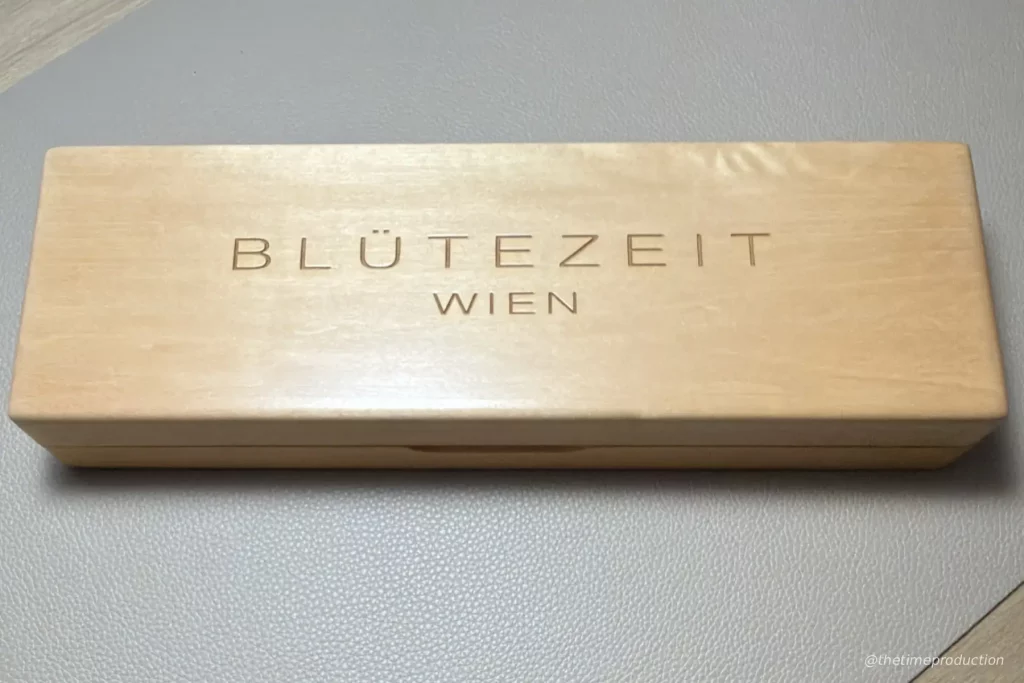
Finally, it is also worth saying a word about the packaging, which I find particularly coherent with the rest. The watch is delivered in a 100% natural wood and linen box, without foam or synthetic fibres. It is, of course, a detail, but a detail that contributes to the overall experience and once again shows that the project was thought through with a certain consistency all the way to the end. Here too, you can feel the desire to offer something careful, distinctive and sincere, without falling into unnecessary artifices.
Blütezeit 2.1: a coherent watchmaking project that deserves to find its trajectory
With this Blütezeit 2.1, Dieter Altenburger has, in my view, delivered a very strong first iteration. We are still looking here at the brand’s very first model, offered in several versions, and yet the overall level of coherence is already particularly convincing. The watch is well thought out, well built, surrounded by quality partners, and above all driven by an approach that I find sincere. I also greatly appreciate the transparency of the project, whether in terms of suppliers, manufacturing, or more broadly the way the watch is presented. In the end, I think that anyone who buys this watch will get real value for their money and will be wearing something a little unique, something you will not see on every wrist. And in today’s watch landscape, that already means a great deal.
What I find especially interesting here is that everything breathes a certain sense of rigor. You can feel that this watch was conceived by someone who is not a watchmaker by trade, but who approached the project with method, patience and exacting standards. And in a way, that almost shows in the product itself. Everything feels considered, weighed, structured. There is real coherence between the foundation of the project, the cultural universe it seeks to evoke, the level of the chosen partners, and the final result. For a first watch, I find that frankly remarkable.
And precisely for that reason, I think it is important to underline just how strongly Blütezeit relies on a particularly solid ecosystem. The watch is designed in the heart of Vienna and entirely manufactured in Europe, with more than 90% of its production spread across Austria, Germany and Switzerland. Around Dieter Altenburger, one finds a group of recognised partners such as ABSaphir, Aaubry, Atelier Decoster, Jochen Benzinger, Cador, Cadratec, Cadranor, Décors Guillochés, Dexel, GenevaProd, HolzArt, Kmetyko, KMLT, La Pratique, La Joux-Perret, Meislitzer, RIOS, RP Uhrengehäuse and Wittka. Added to that is the moral and, above all, technical support of Habring² throughout the development process. When you look at that list, it becomes easier to understand why the watch already gives off such a level of seriousness for a first model. Blütezeit is not an improvised project. It is a project built with credible interlocutors, within a logic of quality and complementarity.
Of course, that does not mean everything is already perfectly in place. My main question concerns what comes next. Since the project is self-funded, the real issue now is how Blütezeit intends to position itself in the future. Is the idea to remain a confidential brand, producing little but producing very well, with an almost artisanal logic? Or is there a broader ambition, with the gradual development of a true collection and a more assertive presence on the market? Both approaches can make sense, but they imply very different trajectories. And at this stage, that is probably where an important part of the brand’s future will be decided.
I also have the feeling that, despite the obvious quality of the watchmaking project, the brand-building side could be thought through more carefully over time. Today, I see above all a very good watchmaking project, more than a watch brand that is already fully structured. And that is not a criticism of the substance, but rather an observation. In my opinion, there are probably things to refine in the marketing trajectory, in the way the different versions are brought to life, in the rhythm of releases, or in the continuity of the narrative around the watch. When several versions of a first model are proposed, it can sometimes be more effective to spread them out over time rather than reveal everything at once, in order to build stronger momentum and gradually install desire.
That said, I still believe in the potential of Blütezeit. Because the foundations are good. Very good, in fact. And because behind this watch there is real personality, real coherence and real seriousness. With 100% European manufacturing, components all made to measure apart from the movement, an already very high-quality network of partners, and such an accomplished first proposition, the brand clearly does not lack credibility. What remains to be seen now is how this first stone will be developed over time. But as a market debut, I think Blütezeit already offers something distinctive, well executed and intellectually very interesting.
Blütezeit 2.1 – Watch Specifications
- Brand: Blütezeit
- Model: 2.1
- Case Material: Stainless Steel
- Dial: Black Guilloché (Made by Jochen Benzinger)
- Functions: Hours, Minutes, Small Seconds
- Movement: La Joux Perret 7380, Manual-Winding, 21’600vph frequency (3Hz), 21 jewels
- Power Reserve: 90 Hours
- Water Resistance: 3 ATM
- Crystal: Sapphire
- Case Back: Sapphire
- Case Dimension: 37mm (Diameter) × 6.9 mm (Thickness)
- Strap: Black Leather with Stainless Steel Pin Buckle
- Availability: Limited by production capacity
- Retail Price: €5,000 (excluding VAT)
And what do you think of this Blütezeit 2.1 and, more broadly, of this young Austrian brand that is trying to propose a different reading of independent watchmaking?
If this article added value or sparked a discovery, you can support the project HERE. Your contribution helps me keep weekly articles and a biweekly newsletter free, accessible, and independent for everyone.
For more information about Blütezeit, click here.