Today, I would like to talk about a French brand whose journey has been particularly eventful since its creation, but which may well be opening a new chapter in its story. If I say French elegance and French manufacturing, a design that is soft in its curves yet rigorous in its angles, and a recent relaunch led by an Alsatian watchmaker, you may already have guessed Apose. Before presenting the Apose N°3 Radial Vert Cendré in greater detail, it seems important to go back to the origins of the brand, the ambitions of its original founders, the difficulties it went through, and the new momentum it now appears to have found under the leadership of Romain Thiriet.
Created in November 2020 in eastern France, Apose was born from the shared desire of Didier Finck and Ludovic Zussa, two profiles from the Swatch Group ecosystem, to go against the grain of a luxury watch industry they felt had become increasingly demonstrative. In their view, technical sophistication and visual excess had gradually moved part of the industry away from what they believed defined the strength of French style: purity, understated elegance, attention to detail, and a sense of restraint capable of turning a watch into a refined object without ever slipping into ostentation. Their ambition was therefore clear: to restore the noble status of the elegant French watch, while proposing a vision able to bring tradition and modernity into dialogue. Even the brand’s name reflects that intention. Apose comes from the idea of “apposer”, of placing or imprinting a new style onto watchmaking, a way of claiming a recognizable, soothing signature deeply rooted in a certain idea of French elegance.
Behind this project, the two men brought highly complementary expertise. Didier Finck, who was in charge of design, worked within the Swatch Group from 2012 to 2020, contributing both to product design and to advertising and digital communication for several of the group’s major brands, including Omega, Longines, Hamilton and Swatch. Ludovic Zussa, for his part, is a physicist specializing in laser technologies and a recognized expert in innovation applied to horological products. After serving as head of technological innovation within the Swatch Group, he also led the industrialization strategy of the watchmaking division of the Sandoz Foundation, working with houses such as Parmigiani Fleurier, TAG Heuer, Zenith and IWC. Both from Alsace, they gradually grew closer over the years, especially during train journeys between Biel and Mulhouse, and eventually decided to launch a watch brand together.
Their challenge was twofold, and ambitious. On one hand, they wanted to reconnect with a certain idea of French high watchmaking, built on discretion, rigor and refinement. On the other, they wanted to prove that it was still possible to produce a genuinely high-end watch in France, something many observers considered nearly impossible. From that point on, Apose relied on a production logic that was as French as possible, bringing together a network of around fifteen partners drawn not only from watchmaking, but also from other fields of excellence such as leather goods, eyewear and high-end writing instruments. The idea was not simply to put forward a patriotic narrative or claim a superficial “made in France,” but to highlight a real ecosystem of French craftsmanship.
From the beginning, the brand also claimed a strong formal identity. Didier Finck explained that he sought to soften overly marked geometric figures in order to reconcile the softness of curves with the rigor of angles, creating a form that could feel both contemporary and timeless. Ludovic Zussa, for his part, explained that the Apose design was meant to remain stable in its main balances, with different variations standing out above all through combinations of materials, finishes and color harmonies. This desire to create a design that was immediately recognizable, not ostentatious but still identifiable, formed one of the foundations of the original project. In August 2021, the brand introduced its N°3 collection, conceived as a sport chic watch that was simple, elegant and easy to wear every day.
Despite the coherence of its proposition and the quality of the product it developed, Apose then entered a far more difficult period. Before coming to a halt, the brand had still managed to sell nearly 3,000 watches, proof that there was genuine interest in the project. But over time, the issue was not so much the product itself as the brand’s communication and deployment. Apose remained a very Franco-French brand, with real legitimacy in both its message and its manufacturing, but without managing to establish itself sustainably in other markets. The company was ultimately placed into judicial liquidation in July 2025, bringing a brutal stop to a brand that had sought precisely to embody a revival of high-end French watchmaking.
This is where the new chapter of its story begins. That new chapter is called Romain Thiriet. Originally from Mulhouse and trained in watchmaking in Rennes, Romain joined the Apose adventure only a few months after the brand was founded, initially as an external contractor in charge of assembly and after-sales service. His own background also deserves a moment of attention. At first, nothing destined him to become a watchmaker. After graduating from high school, he initially headed toward studies related to renewable energy, before a gift from his father, a Hamilton chronograph with a transparent caseback, triggered a real turning point. Fascinated by the inner workings of the watch, he completely changed direction and entered the watchmaking school in Rennes, where he went on to complete a CAP, then a BMA, then a DMA. Fully committed, he gradually developed a strong sensitivity for watchmaking with a real personality, close to the world of independent creators and the métiers d’art, a path notably reinforced by his exchanges with Richard Mille, who sponsored his graduating class.
After working alongside independent watchmaker Thomas Prescher, Romain ultimately chose to return to Alsace with the idea of building something in France, as close as possible to local craftsmanship. When he discovered Apose, he was intrigued by the brand’s promise and decided to meet its founders. Very quickly, however, he realized that the first pieces produced suffered from numerous issues, and he first took charge of getting them back into proper working order. Gradually, his role expanded: assembly, after-sales service, then global oversight of design, industrialization, manufacturing and process structuring. When the original company collapsed, he eventually decided to take over the brand, buy its business assets and become its main driving force.
Today, Apose is therefore entering a new phase in its history. Under the leadership of Romain Thiriet, the goal is to preserve the soul of the brand while giving it new momentum, with the intention not only of continuing to manufacture in France in a concrete way, relying on a real ecosystem located notably between Morteau, Besançon and eastern France, but also of giving the brand a broader reach than it has had so far. More than a simple repositioning, this relaunch seems intent on strengthening Apose’s distinctive identity while correcting the limits of its first development cycle. It is in this context that the watch that concerns us today comes into play, the Apose N°3 Radial Vert Cendré, a piece that fits within the sport chic vision of the N°3 collection and makes it possible to measure exactly what the brand has sought to defend since the beginning.
Table of Contents – Apose N°3 Radial Vert Cendré
What are the key features of the Apose N°3 Radial Vert Cendré?
Case
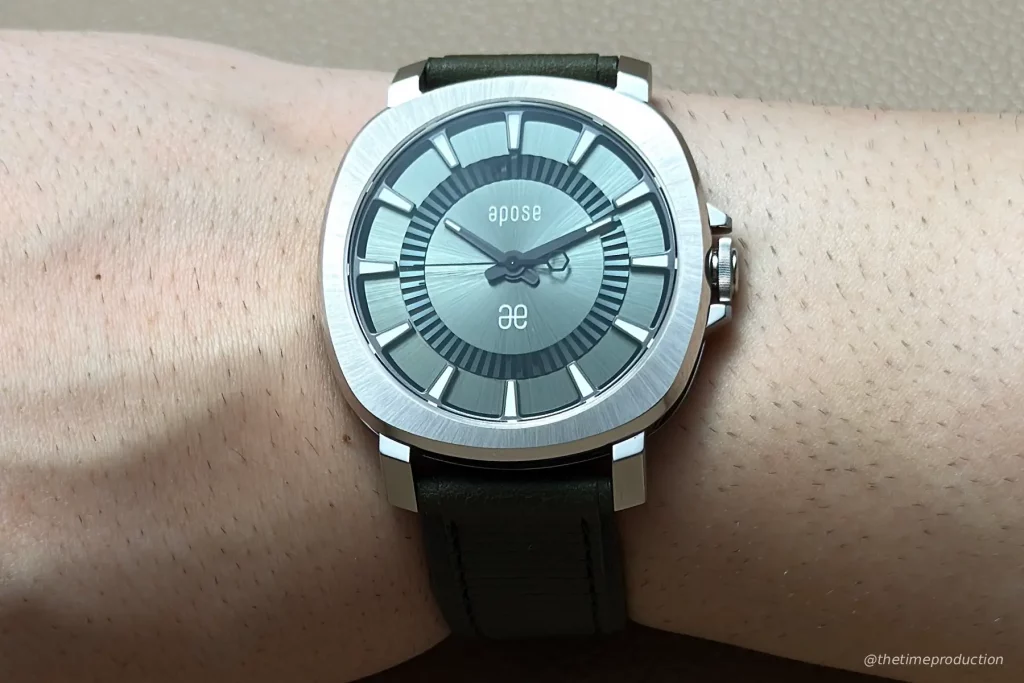
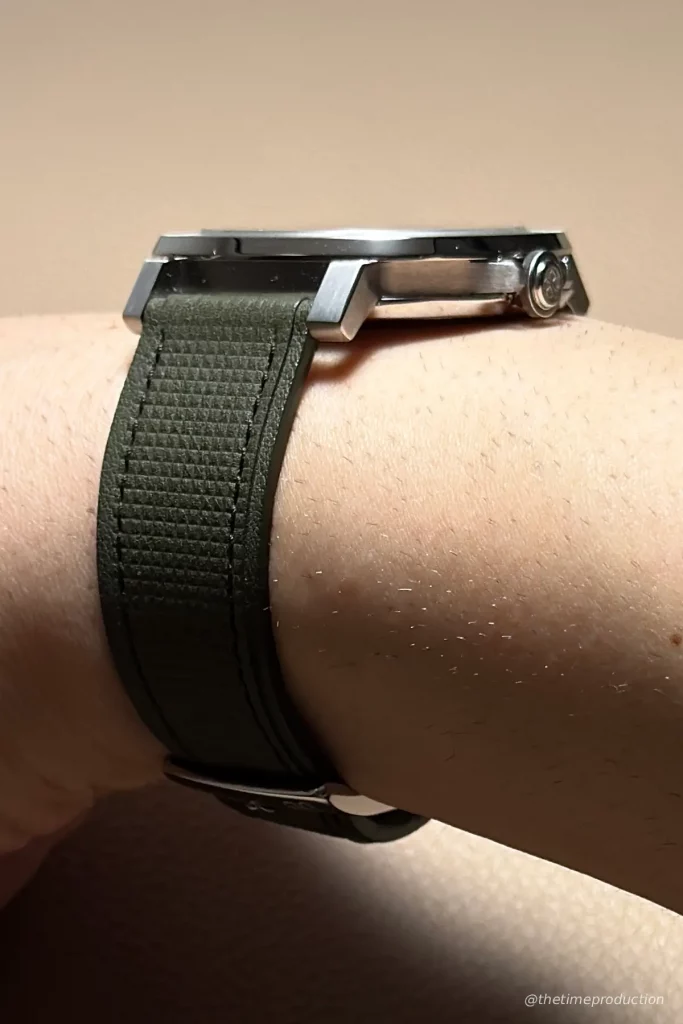
With this N°3 Radial Vert Cendré, Apose remains faithful to what has defined the brand’s identity from the very beginning: a case that is instantly recognizable, neither truly round nor truly square, and one that seeks to reconcile the rigor of angles with the softness of curves. That is probably what struck me first about this watch. Beyond the shape itself, what I was especially sensitive to was the level of finishing and all the small details that enrich the perception of the case. On the upper surface, there is a particularly successful sunray brushing, while a fine polished edge subtly outlines the whole with a great deal of elegance. The lugs, fairly short and nicely curved, also allow the watch to sit very naturally on the wrist, which immediately contributes to the positive first impression.
What I also found particularly interesting is the construction of the case itself. You really get the feeling that material has been removed from the case middle in order to visually slim down the whole. It adds relief, character and a real singularity to the case. It is the kind of detail that gives the watch a more elaborate presence than it might suggest at first glance. The crown guard, even if primarily decorative, also contributes to that impression. I find it quite aesthetic, and it brings an extra layer of personality to a watch that already stands out thanks to its very distinctive form. The crown itself is also worth mentioning. Engraved with the brand’s monogram and fitted with 120 notches, it was clearly designed with real attention to detail, almost like a small jewel completing the watch.
In terms of proportions, Apose has chosen a fairly balanced format here, with a width of 40 mm and a thickness of 8.95 mm. On paper, that could suggest a watch with quite a presence, but in reality the short, downward sloping lugs soften that impression and contribute to a rather natural fit on the wrist. The 10 bar water resistance is also appreciable, as is the presence of an anti-reflective and hydrophobic sapphire crystal. These are the kinds of elements that reinforce the versatility of the piece and its clearly stated sport chic character. Overall, I therefore find this case to be very high in perceived quality, with real attention paid to execution.
If I had to qualify one point, I would say that my main regret concerns less the shape or the finishing than the choice of a closed caseback at this price level. For a watch in this segment, I find that frankly a shame, especially since there is a French movement inside that genuinely deserves to be shown and highlighted. Romain also told me that future evolutions should feature an open caseback, which strikes me as a very good decision. On a more secondary note, I also felt that the winding experience did not quite match the level of the rest of the watch. The feel of the crown, as well as the sound produced when winding, did not seem as refined as the case leads you to expect visually.
Despite that, this case feels entirely coherent with the overall identity of both the watch and the brand. It reprises the very distinctive shape that Apose has defended since its first model, and even if it will not appeal to everyone, it at least has the merit of being instantly identifiable. In a market where many propositions end up looking alike, that is a genuine strength. And that is probably what makes this case interesting: it is not trying to please everyone, but to impose a formal language of its own, with a real singularity.
Dial
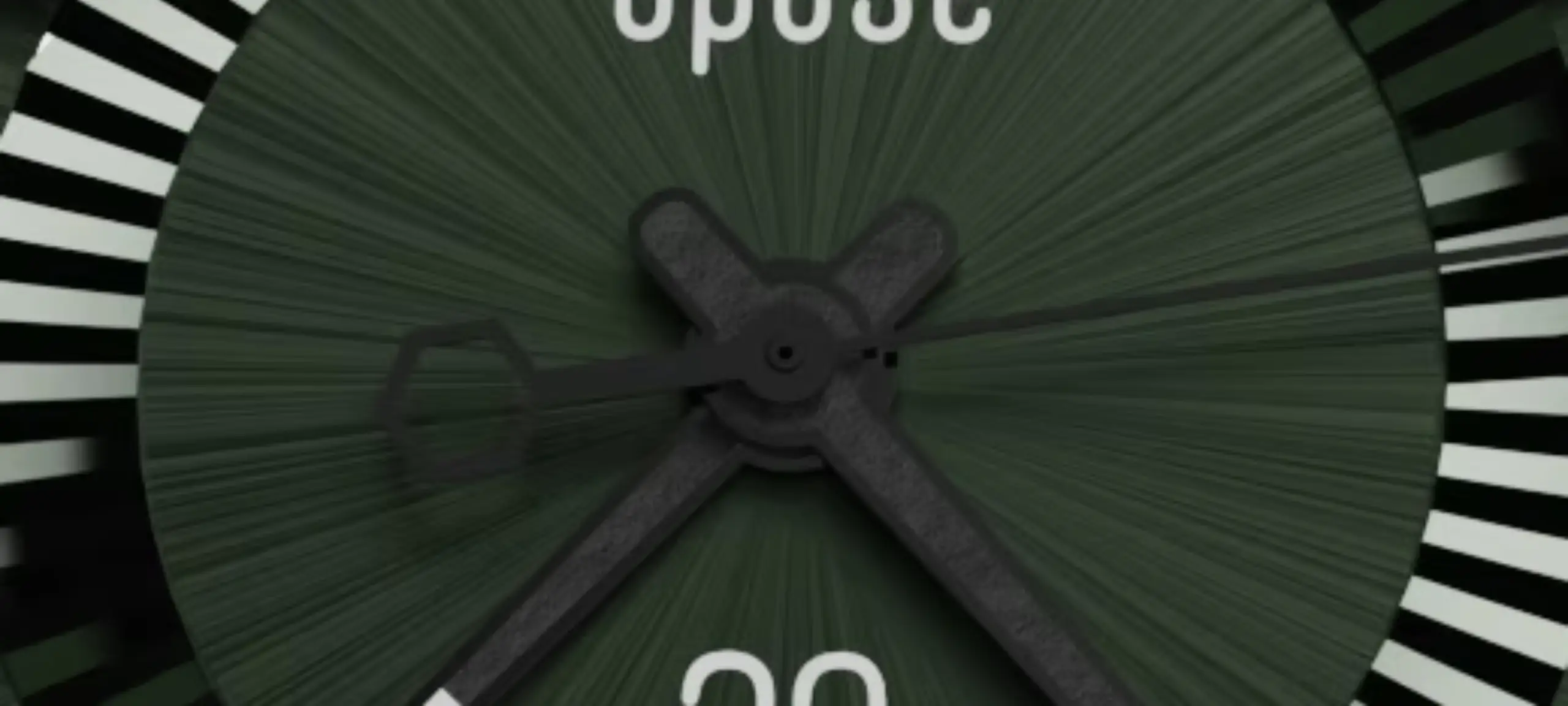
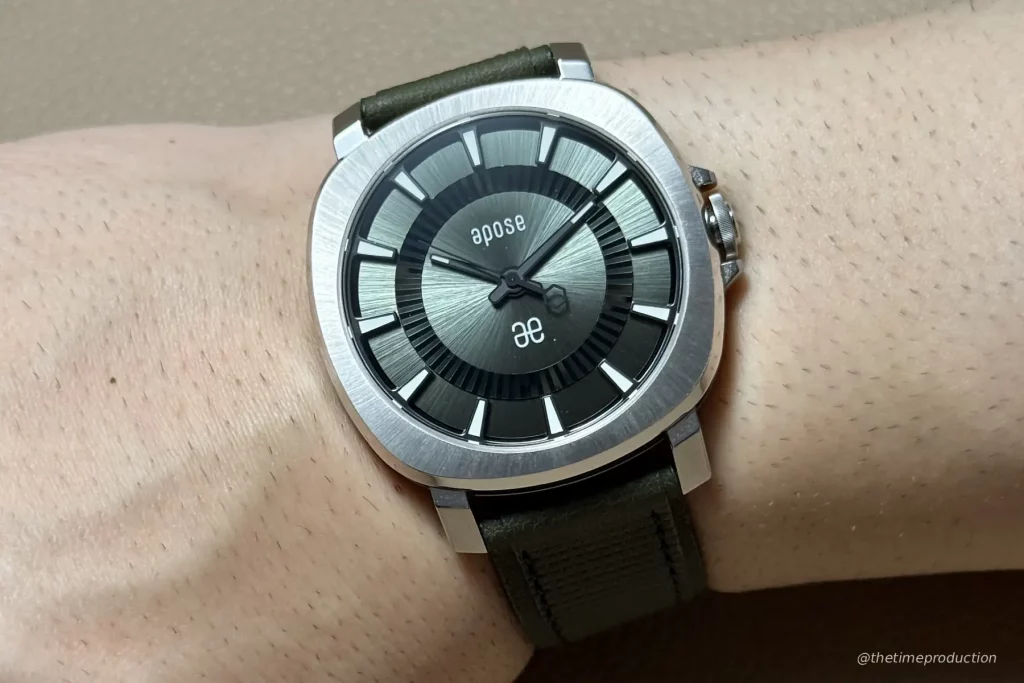
To my eyes, the dial of this Apose N°3 Radial Vert Cendré is one of the watch’s strongest points. From the very first glance, what struck me most was the small fluted ring placed at the center of the dial, which immediately adds relief and captures the light in a particularly attractive way. Produced using a diamond-cutting technique on a brass base, then reworked through various treatments before the final PVD layer is applied, it plays a central role in the watch’s visual identity. Positioned on top of a dial base that itself features a sunray-brushed finish, it creates a very lively whole that constantly evolves depending on the lighting.
That is probably what makes this dial so successful. Thanks to the quality of the anti-reflective treatment, the way its nuances read on the wrist is genuinely superb. It shifts from a very dark green, almost black, to lighter reflections that can appear almost silvery at times, with constant variation depending on angle and light. The result is both understated and very elegant, yet also far richer than it first appears from a distance. There is real work here on the surfaces, on depth, and on the way light moves across each element. Added to this is the unusual structure of the indexes, which are not simply applied to the dial but integrated into an intermediate piece between the dial and the bezel. That floating effect brings extra depth, and I find it genuinely very successful.
I also really liked certain more discreet details that nevertheless contribute to the coherence of the whole. The hexagonal counterweight on the seconds hand, for instance, works very well and adds another small note of singularity without upsetting the overall balance. The hands, with their polished edges, textured centers and integrated lume, remain highly legible, while the overall construction of the dial, rehaut and indexes shows just how seriously this part was thought through. When you know that more than five different contributors are involved in the making of the dial alone, it becomes easier to understand why the result feels so thoroughly resolved.
If I had to nuance one point, I would say that the simultaneous presence of the textual logo at 12 o’clock and the brand emblem at 6 o’clock may be a little too much. Individually, both elements are coherent, but together on the same dial they can create a slight sense of overload. In the same spirit, I also found myself questioning the choice of applying lume to the brand logo. In night-time conditions, what one primarily expects from a watch is a clear reading of the time, more than the visual identity of the brand itself. It is of course only a detail, but it is probably one of the very few dial choices that left me slightly unconvinced.
Other than that, I find this dial particularly distinctive within its category. It does not try to impress through unnecessary tricks, but through genuine quality of execution, beautiful depth and an immediately recognizable visual identity. And in a watch like this N°3, which relies heavily on its overall design and the balance of its volumes, that is obviously essential.
Movement
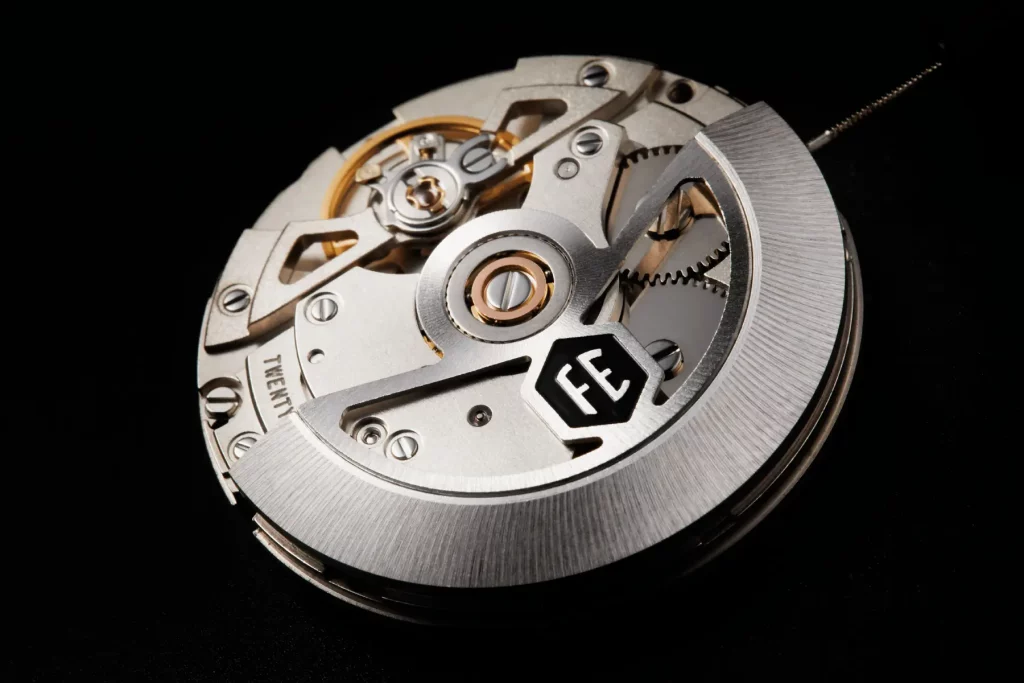
Inside this Apose N°3 Radial Vert Cendré is an automatic France Ébauches movement beating at 4 Hz and offering 44 hours of power reserve, with hacking seconds for precise time setting. On paper, it is not a spectacular movement in terms of architecture or functions, but it still brings, in my opinion, a real sense of coherence to the watch. And that is probably how it should be read. In a brand that has, from the outset, claimed French manufacturing and a desire to help restore credibility to French watchmaking, the choice of a France Ébauches movement makes sense. This is not simply about casing up a standard base, but about placing the watch within a broader approach.
That is in fact what a serious collector should mainly take away here: less the movement’s purely technical side than what it represents within the wider Apose project. The brand worked with the technical teams of the industrial division of the Festina Group in order to take part in the revival of France Ébauches, the historic manufacture based in Maîche. The movement used here draws inspiration from the house’s original calibres while having been reworked to offer greater reliability, precision and aesthetic coherence. In absolute terms, then, this is not a movement that will impress through any particular sophistication, but it fully aligns with the brand’s ambition to offer a French watch all the way down to its mechanical heart.
Where I do have a real reservation is first of all the power reserve. At 44 hours, it remains perfectly acceptable, but today it does feel a little limited when compared with what certain Swiss movements can offer at sometimes lower price levels. It is not a deal breaker, far from it, but it is a point that feels worth mentioning honestly. The other limitation, in my view, concerns the choice of a closed caseback. I understand the idea of keeping a solid back so as not to distract attention from the architecture of the case, but at this price level, and in a watch that explicitly claims a French movement, I find that regrettable. All the more so because the movement is aesthetically pleasing and would genuinely benefit from being shown more openly.
To that, I would add another somewhat debatable point: all the text present on the caseback. Between the model name and the various inscriptions such as “designed, manufactured, assembled in France” or “so very French,” the overall effect feels a bit too busy to me. I like the idea of fully embracing the brand’s French identity, and the fact that all of this is written in French remains coherent with the project, but personally I would have preferred something more discreet, more refined, and perhaps the inclusion of a more useful piece of information such as the watch’s water resistance. As it stands, it feels a little too much for my taste.
Romain also explained to me that future versions, as well as this watch in time, should be offered with an open caseback, which strikes me as a very good decision. Because even if this France Ébauches movement is not the main argument of the watch at this stage, it clearly contributes to its identity and deserves, in my opinion, to be shown. At this point, I would therefore say that it is a serious, coherent and well-regulated base, one that brings value through its origin and through what it represents within the Apose project, but that would gain even more interest if the brand were to fully embrace putting it on display.
Strap
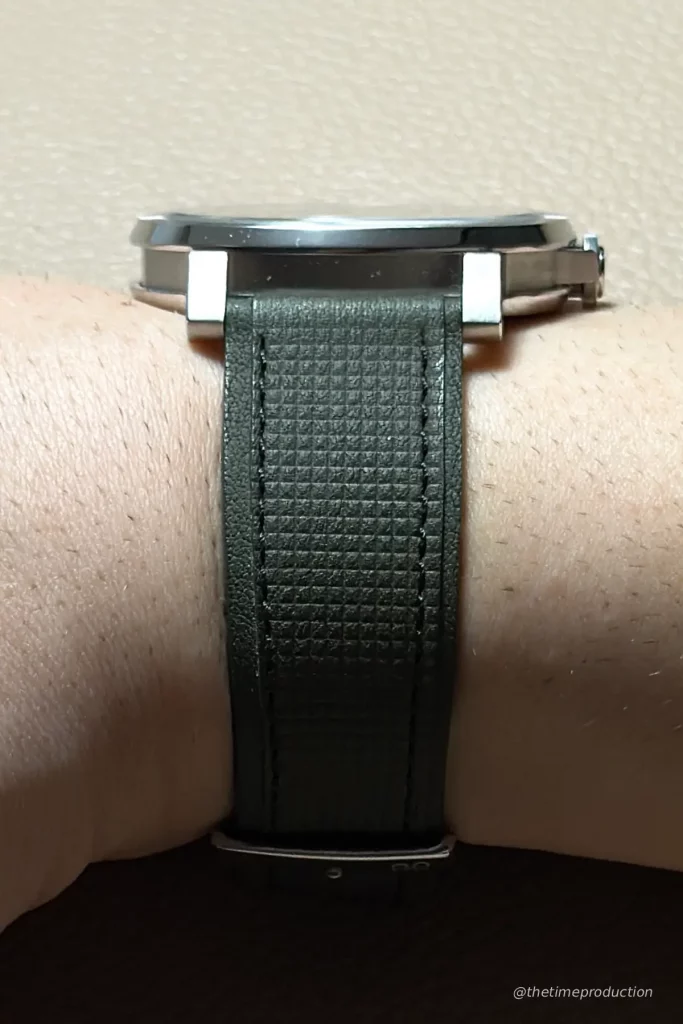
To accompany this Apose N°3 Radial Vert Cendré, the brand offers a leather strap that is particularly coherent with the overall spirit of the watch. On the wrist, I found it genuinely very successful: it is comfortable, integrates well with the whole, and above all its tone works perfectly with the dial and the watch’s overall identity. The perceived quality is also there, which is not insignificant when you know that Apose has chosen to make its straps from leather offcuts supplied by Longchamp, then entrusted to French leather craftsmen. Beyond the narrative, this results in a strap that feels meaningful, both in its origin, in its making and in its coherence with the broader philosophy of the brand.
What I also appreciate is that the strap does not simply act as a functional accessory. It genuinely contributes to the personality of the watch. Its construction, with that stitched strip running through the center and the hot-stamped Clou de Paris inspired pattern, gives it a real visual presence without pushing into something overly demonstrative. Once again, you find this desire to seek out detail, material and a certain idea of French elegance even in elements that many brands tend to treat as secondary.
There is, however, one point I do regret, and that is clearly the buckle. At this price level, I find the use of such a simple buckle somewhat frustrating. I understand that compromises sometimes have to be made, but here I would have liked something more developed, more distinctive, perhaps a buckle capable of echoing the language of the case in one way or another. That would have allowed the watch to finish on a stronger note and pushed the coherence of the project even further. It is all the more unfortunate because the rest of the strap is genuinely convincing. It is also worth noting that the watch is available on a steel bracelet as well, an alternative I have not seen in person, although its construction looked fairly original in the images I was able to discover.
What is the price of the Apose N°3 Radial Vert Cendré?
This Apose N°3 Radial Vert Cendré is not a limited edition. It is priced at 2,700 euros on a leather strap and 2,950 euros on a steel bracelet. That positioning places it in a particularly competitive price bracket, where enthusiasts can also turn to well-established Swiss names.
Even so, the price feels coherent to me in relation to the overall proposition of the watch. Between the overall perceived quality, the work done on the case and dial, the French manufacturing, and the broader approach the brand is taking around local craftsmanship, this is a product with real substance. It is not simply a watch trying to stand out through its discourse, but a piece that concretely expresses an ambition in terms of design, manufacturing and identity.
That is probably where everything comes down to for Apose. At this price level, it is not enough simply to offer a good product; the brand must also succeed in clearly explaining the approach behind it. Because when faced with Swiss brands whose legitimacy often feels more immediate to many buyers, Apose also needs to make clear what it is actually trying to defend through this watch. And in my view, that is exactly what makes this N°3 interesting: it is not trying to play by the same codes as its direct competitors, but to propose another reading of the high-end sport chic watch, with an openly assumed French identity.
Apose N°3 Radial Vert Cendré: a project that deserves to reach a wider audience
With this N°3 Radial Vert Cendré, Apose offers, in my view, a watch that already brings together many qualities. The project is coherent, the approach is serious, and above all you can feel that behind this piece there is a genuine desire to build something solid and meaningful, far removed from the opportunistic approaches one can sometimes see when a French brand claims local roots without truly translating them into the product itself. Here, on the contrary, there is real substance, real rigor in the industrial construction, real attention paid to the partners involved, and a real desire to defend another vision of French watchmaking.
What I find particularly interesting about Apose, beyond the watch itself, is precisely this ability to bring together around the same project people who do not all come from watchmaking in the strictest sense. That is probably one of the brand’s great strengths. By drawing on expertise from other worlds, while trying to put it at the service of a coherent and high-quality product, Apose opens up a different path, a less conventional one, but one that is potentially very rich. And in a landscape where many brands end up looking alike, that deserves to be highlighted.
Of course, everything is not yet perfect. In my opinion, the watch still has a few limitations, which I have already mentioned, notably in the way the movement is presented, certain caseback choices, and a few finishing and execution details that can still evolve. But what seems important to me here is that these reservations do not call into question the interest of the project itself. They rather give the impression of a brand that is still in the process of structuring and refining itself, and that needs to keep progressing in order to move beyond a positioning that still feels a little too Franco-French. Because in my view, that is now one of the real challenges for Apose: to explain its approach more clearly, to better highlight its partners, to better tell its story, and above all to give the project a broader international reach.
That is precisely why I find the takeover of the brand by Romain Thiriet particularly interesting. His background, his seriousness, his natural closeness to the independent watchmaking scene, and his clear desire to build a French watchmaking brand that is credible, modern and well executed all give this new chapter real legitimacy. You can also sense, through the projects already mentioned for the coming years, that the goal is not simply to keep the brand alive, but to give it a new ambition. Between a future more high-end watch planned for early 2027, a more accessible 37 mm format, and a more innovative project built around display, already protected by a patent filing, there is clearly a real continuity of ideas.
Deep down, that is probably what makes me want to highlight Apose today to my community. Not because everything is already perfectly in place, but precisely because there is here a sincere, ambitious and deeply human project that seems to me to deserve greater visibility and support. In a world where people often talk about reshoring, authenticity and craftsmanship, Apose is one of those rare projects that is genuinely trying to give real substance to those words. And for that reason alone, I think it is worth keeping a close eye on what the brand is preparing next.
Apose N°3 Radial Vert Cendré – Watch Specifications
- Brand: Apose
- Model: N°3 Radial Vert cendré
- Case Material: Stainless Steel
- Dial: Sun-brushed finish with ash green PVD coating ; Integration of a grooved ring with ash green PVD coating
- Functions: Hous, Minutes, Seconds
- Movement: France Ébauches, Self-Winding, 28’800vph frequency (4Hz),
- Power Reserve: 44Hours
- Water Resistance: 10ATM
- Crystal: Sapphire
- Case Back: Solid
- Case Dimension: 40mm (Diameter) × 8.95mm (Thickness)
- Strap: Green Leather with “Clous de Paris” embossed pattern and Stainless Steel Pin Buckle
- Availability: Core Collection
- Retail Price: EUR 2,700 (including FR VAT)
What do you think of this Apose N°3 Radial Vert cendré and, more broadly, of this desire to revive a credible and ambitious French watchmaking scene?
If this article added value or sparked a discovery, you can support the project HERE. Your contribution helps me keep weekly articles and a biweekly newsletter free, accessible, and independent for everyone.
For more information about Apose, click here.