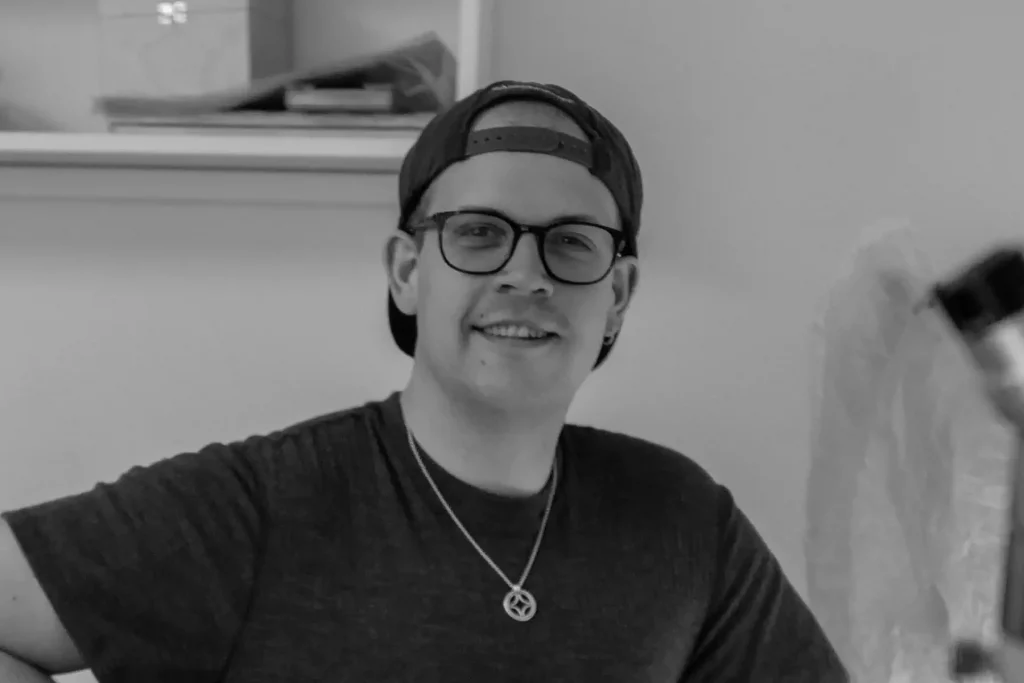
Today, I would like to talk about a young Danish talent whom I first had the opportunity to meet over video call, and then in person in Geneva during Watches and Wonders 2026. If I say young Danish talent, heritage restoration, and the revival of a Copenhagen watchmaking language, the more knowledgeable among you may already have recognised Bakkendorff. Before presenting his latest model, let me first take a closer look at Rune Hjorth Bakkendorff, the man behind the project, his background, how he built himself as a watchmaker, and the vision that now seems to guide each of his creations.
With Rune Hjorth Bakkendorff, watchmaking is neither a late interest, nor a career change, nor a simple entrepreneurial project. It is something much deeper, almost organic. Since childhood, he has been fascinated by watches, clocks, dials, hands, and more broadly by every object with a moving display. In his family, they even say that his first word was not “mama” or “papa,” but “ur,” the Danish word used for both clock and watch. It sounds almost too perfect to be true, and yet it is entirely consistent with what he conveys today when he speaks about his work. In his case, watchmaking is not simply a passion. It is a calling. He says it very clearly himself: he never really wanted to do anything else. Repairing, making, understanding, preserving and creating horological objects has always felt, to him, like the obvious path.
When he reached the end of his standard school education in Denmark, he had to complete a one-week work experience placement. At the time, he simply opened the phone book, looked for watchmakers and clockmakers, and started making calls. Most of the people he contacted showed little interest, until one watchmaker eventually agreed to let him spend a week in his workshop. That experience acted as a revelation. Up to that point, he had read whatever he could about watchmaking, as best he could, in English or Swedish books, with very little material available in Danish. But for the first time, he saw this craft come alive in front of him as something real, tangible, almost within reach. From that point on, there was really no more doubt.
Before starting watchmaking school directly, however, he was advised to strengthen his technical foundations. He therefore entered a programme called HTX, a kind of secondary education strongly focused on science and technology, with a curriculum centred around mathematics, physics, chemistry and engineering. It was an important step, because it gave him solid foundations before he properly began his watchmaking apprenticeship. Once he had completed that diploma, and after escaping mandatory military service thanks to a favourable lottery draw, he was finally able to devote himself fully to what had always driven him: watchmaking.
He then began his apprenticeship in Denmark with the same watchmaker who had first welcomed him during that discovery placement. For four years, he trained in an environment focused above all on repair, service and bench work. But very quickly, that was not enough for him. He already wanted to go further, to learn more, to understand fabrication beyond maintenance. During his training, he had the opportunity to take part in an exchange with the A. Lange & Söhne in Glashütte as well as a study trip to Switzerland. It was in that context that he met Thomas Prescher, with whom he began exchanging regularly. Prescher answered his many questions, guided him, helped him, and gradually became an important figure in his development. At the same time, Rune also pursued his own personal projects, such as a moonphase complication built into a Unitas pocket watch and a small table clock based on a train and escapement taken from a Unitas movement.
His apprenticeship culminated in a final examination where he achieved the highest possible mark. Thanks to this result, and because his master belonged to the Copenhagen Guild of Watchmakers, Rune received the silver medal of the Copenhagen Craftsmen’s Association, the highest distinction available for a young journeyman. This moment, which he still recalls with emotion, even gave him the chance to meet Queen Margrethe II. It was a symbolically strong recognition, confirming not only his technical level, but also the seriousness with which he had approached his craft from the very beginning.
After finishing his studies, he moved to Switzerland to work with Thomas Prescher. And that stage was fundamental. There, he discovered from the inside what true high-level independent watchmaking can be. It was no longer simply about repairing or servicing, but about understanding what it really means to create within a small workshop, at the highest level of artisanal standards. That period allowed him to learn enormously, to deepen his understanding of independent watchmaking codes, and also to build an initial real network within that world. It was there, in his own words, that he saw the very best of what artisanal watchmaking can be.
After Switzerland, he returned to Denmark. From 2014 to 2017, he created a company with a friend called Heisel & Bakkendorff ApS. Together, they operated as a central workshop for several retailers, handling after-sales service, subcontracting, restoration, maintenance and conservation for watches and clocks. This activity put him in contact with an extremely broad spectrum of objects, clients and situations. He worked for private collectors, several museums, public collections, and even government institutions with significant horological heritage of their own. It was an incredibly formative period that deeply shaped his current vision. Because through restoration, he was not only gaining technical skill. He was also developing an intimate relationship with the history of watchmaking, with the great masters of the past, with old constructions, and with the ideas of transmission and preservation. And it is precisely this heritage-oriented work that still seems to feed his creativity today.
At the same time, the desire to create his own watches never disappeared. It matured slowly, almost naturally, as Rune combined what he had learned from Thomas Prescher with everything he was discovering through historic mechanisms. The real turning point came in 2017, when an important Danish collector approached him through a recommendation and asked whether he could make him a watch. At that moment, Rune understood that it might be time to turn that long-held desire into a real project. He happened to have access to a stock of unused new old stock Peseux 7001 movements that had remained untouched for decades. He used them as the base for his first watch, called Byrja, an Old Norse word meaning “beginning.” The name was perfectly chosen. This first piece allowed him to lay the foundations of his approach, to work on the case, the hands, the overall aesthetics, and above all to understand that he did not want to make a watch simply inspired by an existing language. He wanted to propose something that genuinely belonged to him. Byrja led to a first series, then to a 38 mm version, opening the first chapter of his personal work.
At the end of 2021, Rune also presented Moonwork, a large floor clock designed together with the design duo Ahm & Lund. This project, very different from a wristwatch, already showed the breadth of his universe. Moonwork uses the lunar cycle to represent the passage of time and seeks to question our relationship with it, moving away from the speed and stress of everyday life. Beyond the object itself, the project revealed another side of Rune: his interest in astronomy, in natural rhythms, in broader forms of temporality, and more generally in a kind of watchmaking capable of conveying an emotion or an idea, not just information.
But it is with his next project that his thinking reaches another level. Rune no longer wants simply to build around an existing movement. He now wants to develop a more personal, more ambitious proposition that also brings to light a Danish and Copenhagen watchmaking language long left aside. Through his restoration work, he had realised that there truly was a watchmaking history in Copenhagen and Denmark, a real heritage, real craftsmen, influential families passionate about horology, and a DNA that gradually faded, especially from the 1950s, 1960s and 1970s onward, with the standardisation brought about by cheaper Swiss and French movements and ébauches. His idea then became very clear: to reinterpret, in a contemporary language, what a great Copenhagen watchmaking tradition might have looked like if it had never been interrupted.
It is precisely from that reflection that Ætt was born. The name, taken from Old Norse, can be translated as family, lineage or direction. It is an especially coherent choice, since the whole project is about reviving a Copenhagen watchmaking DNA and placing it within a living continuity. The initial inspiration came from a tower clock designed in the early twentieth century by the famous Danish watchmaker and astrophysicist Jens Olsen. Observing the mechanism that allowed the clockmaker to set the time from inside the tower, using two rotating dials and fixed hands, Rune immediately felt that such a display would be extraordinary when transposed into a wristwatch. What was initially supposed to be a simple module added to an existing movement gradually evolved into a much larger project, requiring the development of a dedicated calibre in order to preserve the elegance, thinness and overall coherence of the piece.
It quickly becomes clear, then, that Rune Hjorth Bakkendorff is not simply trying to make one more beautiful watch. Through his work, he is trying to make his childhood, his apprenticeship, heritage restoration, high independent watchmaking and a Danish history he sincerely wants to bring back into the light all speak to one another. And it is precisely within that context that the piece that interests us today takes shape. Let us now turn to the presentation of this watch.
Table of Contents – Bakkendorff Ætt
What are the key features of the Bakkendorff Ætt?
Case
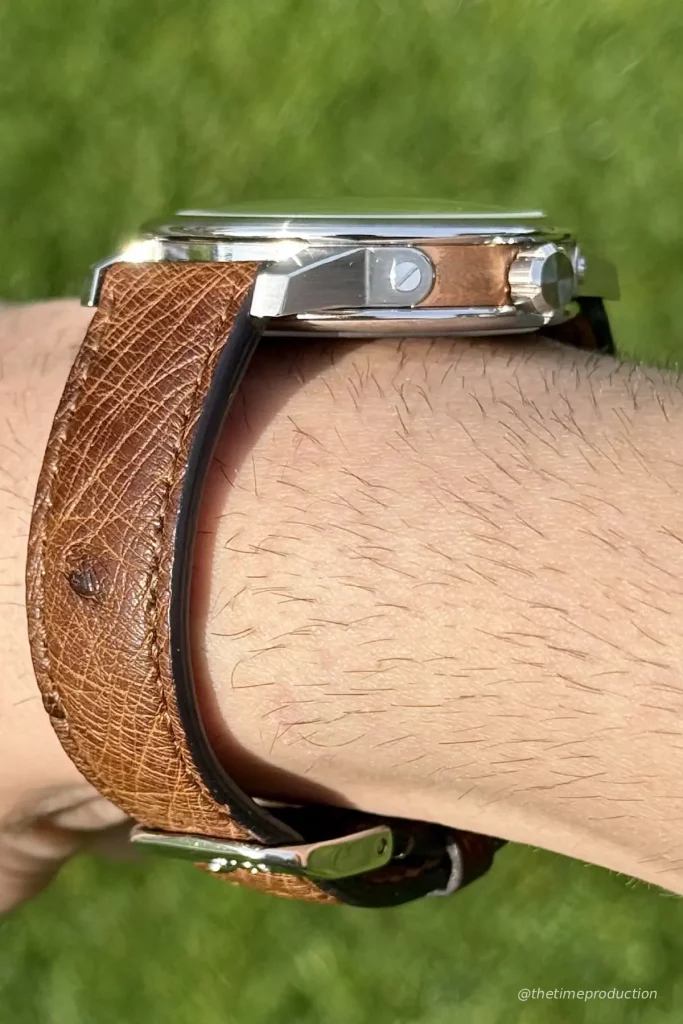
For this Bakkendorff Ætt, Rune Hjorth Bakkendorff chose a 39 mm case combining stainless steel and bronze, a pairing that immediately gives the watch a very particular presence. And that is probably what struck me first, both visually and on the wrist. Despite a diameter that could suggest something fairly present, it actually wears very well, even on a rather slim wrist like mine. That sense of balance comes largely from the overall construction of the case, but also from the way the lugs have been designed.
That is precisely one of the aspects I found most interesting here. Unlike many watches where the lugs extend underneath the caseback, that is not the case with the Ætt. You almost get the impression of looking at a watch that was first conceived as a very pure object, almost like a small pocket watch transposed onto the wrist, to which four lugs were then added. And to me, that is a large part of its charm. From the side, this construction becomes even more legible: you can clearly distinguish the bezel, then this sort of central bronze structure, before the caseback, which opens widely onto the movement. The four lugs appear to be attached on either side of that framework, giving the case a real personality and a very different visual reading from what we usually see.
I also greatly appreciated the overall purity of this case. There is no unnecessary inscription, no superfluous element, and that truly reinforces the sense of a coherent object, almost timeless. The crown also deserves to be highlighted. It offers excellent grip while being far more interesting than a standard crown. Its design even reminded me slightly of certain clock winding systems, with that feeling of a utilitarian yet elegant part, designed with purpose. I do not know whether that was intentional, but in any case, the shape works extremely well within the overall universe of the watch.
What I also like here is that Rune does not try to overplay the finishing. This is not a case multiplying bevels, decorative tricks or stylistic effects. On the contrary, there is something very direct, very authentic, almost very historical in the approach. And that is exactly what makes the case so convincing. It feels like a watch that could have existed in the past, while still being entirely credible today. The use of bronze contributes strongly to that impression. It brings a singular, living touch that will evolve over time, patinating differently depending on humidity, the wearer and the use. And the fact that the bronze is not placed directly against the wrist avoids the inconveniences some might fear, while preserving all the visual and organic appeal of the material.
Finally, this case feels entirely coherent with the overall identity of both the watch and the project. It expresses perfectly that artisanal approach, almost archaeological in the best sense of the term, where you can feel both the weight of history, a respect for old constructions, and a real desire to create something personal. It is also worth remembering that Rune had already worked on bronze cases during his time with Thomas Prescher, which probably explains why this material returns here so naturally in his own work. In the end, this case is not trying to impress through gratuitous sophistication. It is simply trying to be right, coherent and lasting. And to my eyes, it succeeds very well.
Dial
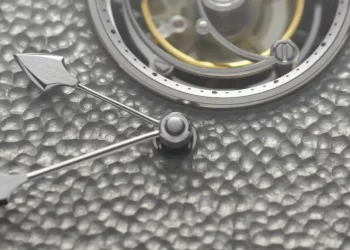
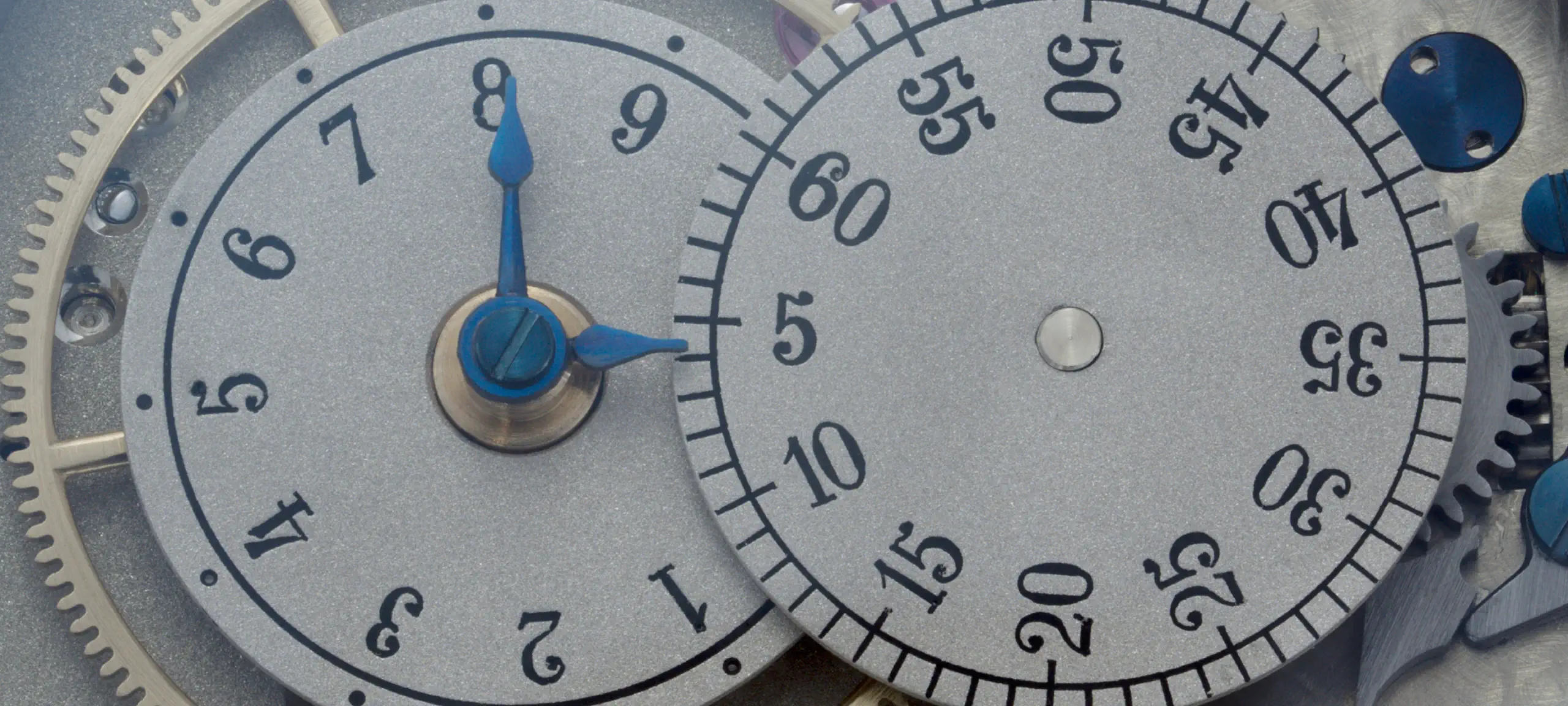
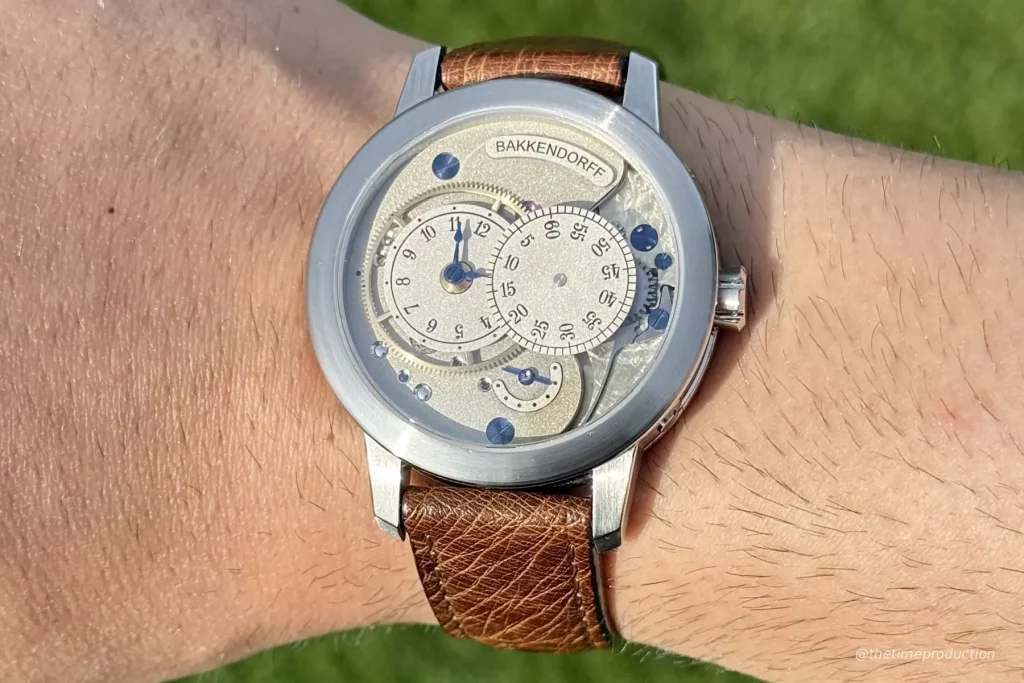
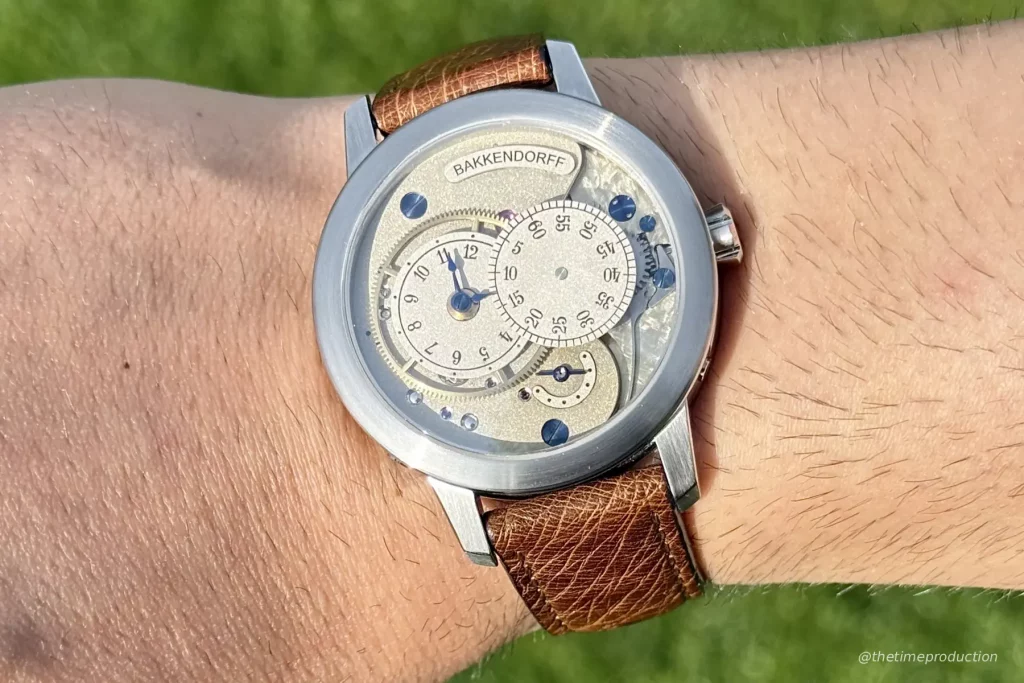
The dial of this Bakkendorff Ætt is without any doubt one of the strongest elements of the watch, both visually and conceptually. What struck me immediately was, of course, the decision to keep fixed hands while making the hour and minute discs rotate to display the time. Honestly, I think the idea is absolutely brilliant. On one hand, it is highly original and very unusual in a wristwatch. On the other, the reading remains surprisingly simple and intuitive. The hands never move, they always stay in the same place, and it is the two subdials that move beneath them. It is playful, very intelligent, and above all instantly memorable.
What I particularly like here is also the way all of this has been staged. The two central discs, which are of similar size, create a very pleasing symmetry in the overall construction of the dial. You almost get the feeling that the whole watch is organised around a horizontal axis running from 9 o’clock to 3 o’clock. But beyond that very structured reading, the dial also works through successive layers, giving it real depth. You first have the fixed hands, then the minute disc, then the hour disc, which slightly overlaps it, followed by a large exposed wheel, and then a broad plate that seems almost to float above the rest of the movement. On that plate, you find blued screws, jewels, a small plaque bearing the name of the brand, and an indication for the small seconds.
And that small seconds deserves to be mentioned. It was not designed here to provide ultra-precise seconds reading, but rather to animate the dial and visually remind you that the watch is alive and in motion. I find that approach very relevant. It contributes to the overall impression that the dial is not merely a display surface, but a genuine mechanical stage. Beneath this main plate, you can also make out another layer, with elements of the movement partially visible, including some components related to winding and regulation. All of that gives the dial something very airy, very open, very alive, without ever becoming excessive.
I also really liked the blend of strong historical references with much more contemporary choices. The discs, or at least certain parts of the dial, appear to rely on ceramic elements supplied by a Japanese partner with whom Rune has worked for many years. That choice brings a very interesting modern touch to a whole that otherwise clearly echoes the world of old clocks. There is also the typography, which I found particularly successful. It seems to draw from an older vocabulary, probably connected to the world of historic Danish clocks or watches, while still retaining a strong personality of its own. And above all, you feel that nothing has been over-smoothed here. The numerals are not “perfect” in the industrial sense of the word, and that is precisely what gives them charm. You really sense the hand of the craftsman behind all of it.
What I also appreciate enormously is the dial’s overall harmony. It is not symmetrical in the strict sense, it does not try to reproduce a cold or purely mathematical perfection, and yet everything feels right. It is a very pure dial in its intention, but also very technical in its construction. There is a real balance between legibility, singularity and depth. And to my eyes, that is very difficult to achieve. The blued screws, with their slightly irregular nuances, fully contribute to that sense of living craftsmanship. This is not a clinical or sterile execution. It is something done to a very high level, but which fully embraces its human dimension.
In the end, this dial feels genuinely unique in its category. Because it does not simply use an original display in order to stand out. It is built on a precise historical reference, namely a Jens Olsen clock, and translates it into a contemporary horological object with remarkable coherence. When looking at this watch, you feel at once the world of antique clocks, a true aesthetic research, and a desire to propose something you will find nowhere else. To my eyes, that is exactly what makes this dial so strong: it is at once very pure, very technical, very cultural and deeply personal.
Movement
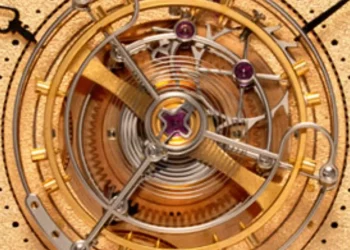
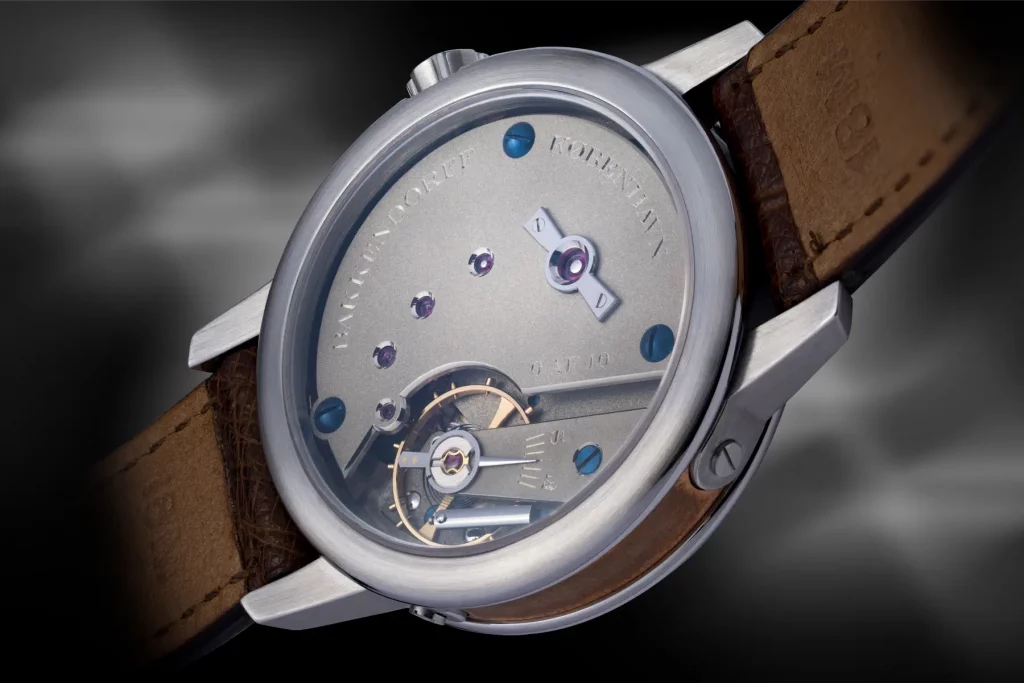
Turning the Bakkendorff Ætt over, one discovers a movement that, to my eyes, adds real value to the watch. And not simply because it is visible through a sapphire caseback or because it presents an interesting architecture, but above all because it is inseparable from the display Rune Hjorth Bakkendorff wanted to develop on the dial side. Without this movement, or rather without this very specific way of conceiving it, the watch simply would not have this singular reading of time. It is therefore far more than a technical base reworked in a clever way. It is a construction designed to serve a precise horological idea.
What a serious collector should take away first is precisely that approach. Rune started from old AS 1130 movements originating from Danish railway service watches. Within that movement, he identified what he considered the right elements, especially the gear train and the escapement. Almost everything else had to be rethought. And that is where the project becomes especially interesting. He did not simply reuse an old movement for aesthetic or romantic reasons. He selected what seemed to him reliable, relevant and durable, and then rebuilt around it a calibre capable of answering the needs of his display while remaining coherent with his philosophy. Behind that choice, you can feel the real thinking of a watchmaker-restorer: to create something beautiful, of course, but also reliable, repairable and, above all, capable of standing the test of time.
That is probably what I like most about this movement. Rune is not trying to impress with a high frequency, demonstrative sophistication or an accumulation of unnecessary technical solutions. He is trying instead to create something meaningful, something that can last, be maintained, be passed on, and leave a trace. And I think that intention can really be felt in the way the movement has been conceived. It beats at 18,000 vibrations per hour and offers 40 hours of power reserve, which remains perfectly coherent with the overall spirit of the watch. This is not about raw performance. It is about continuity, coherence and longevity.
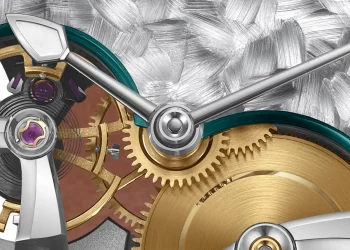
Aesthetically, I found this movement very well executed and, above all, very right in its language. It does not overdo anything, but what has been done is done well. You find a very legible and fairly airy architecture, with real coherence with both the case and the dial. There is a very vintage feeling to the whole, one that immediately recalls certain old pocket watches, or even older horology still, but without ever slipping into pastiche. The finishes are not numerous in a demonstrative sense, but those that are there are truly of high quality. There are notably some very beautiful inward angles, not many, but very well executed, which is always appreciable. In that regard, it is also worth mentioning that Rune took part in a workshop with Philippe Narbel focused on anglage, which probably explains part of this sensitivity in execution.
I also greatly appreciated certain more specific details, such as the engravings on the plate, including the brand name, the individual number of the watch, and the mention København, which is Copenhagen in Danish. These are details which, once again, reinforce the feeling that this is a piece deeply rooted in a place, a tradition and a personal vision. The blued screws also deserve a special mention. These are not the standard blued screws one often sees in contemporary watchmaking. Their design evokes instead certain elements one might find in old pocket watches, or even in table clocks or antique regulators. They are small details, but they contribute strongly to the very particular visual identity of the movement.
In the end, I find this calibre entirely coherent with the rest of the watch. It extends the dial, it speaks to the case, it expresses something important about the way Rune thinks about his work. It is not a movement trying to seduce through showy virtuosity. It is a movement trying to be right, rooted, durable, and to bring a certain spirit of Danish watchmaking into a contemporary object. And to my eyes, that is precisely what makes it so interesting.
Strap
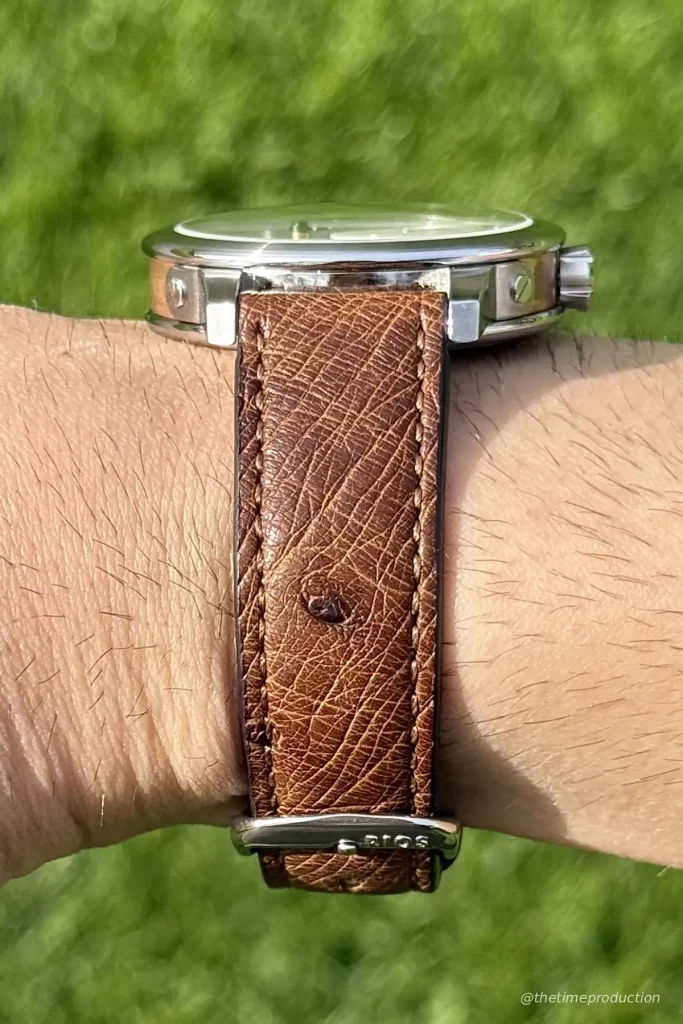
The strap of this Bakkendorff Ætt is probably, to my eyes, the least convincing element of the watch. That obviously does not call into question the overall interest of the piece, but it is likely the area where I felt the greatest gap compared with the general level of the project. We are dealing here with a hand-worked brown leather strap, whose tone remains coherent with the steel and bronze pairing of the case. On that point, there is nothing to criticise: visually, it integrates rather well with the whole and does not break the overall harmony of the watch.
In terms of perceived quality, however, I find that this strap remains fairly basic. It does not really give the impression of matching the level of singularity or refinement that the watch otherwise seeks to offer. At first glance, the leather almost suggests an ostrich-like grain, but the whole lacks a bit of presence and, above all, a bit of character. It is not a bad strap by any means, but for a watch this specific and this carefully thought out, I think there would clearly be room for something better in order to reinforce the overall experience and comfort on the wrist.
That is also how I see its place within the overall proposition. Whereas the case, dial and movement all carry a genuine vision, the strap feels more secondary. It accompanies the watch without really contributing to its personality. And that is a bit of a shame, because a more developed strap, more coherent in its shape or texture, could probably push the identity of the piece even further. The choice of an 18 mm lug width, which is rather specific, does not necessarily help in giving it a stronger presence either, even if that can of course be corrected by the future owner with another strap.
As for the buckle, it seemed correctly executed to me, but once again fairly standard. It is a polished steel pin buckle, clean and functional, but without any real singularity. Personally, I would probably have preferred something a little more classical in spirit, but also more specific in its shape, in order to better dialogue with the watch’s historical and artisanal vocabulary. That being said, it is also worth keeping in mind that the piece I saw was still a prototype. It is therefore entirely possible that this point will evolve in the final version. As things stand, the strap clearly sits below the level of the rest of the watch, which operates on a far higher plane.
What is the price of the Bakkendorff Ætt?
The Bakkendorff Ætt was offered at a price of 26,000 euros and produced in a limited edition of 10 pieces. At the time of writing, the watch is completely sold out.
To my eyes, that pricing makes sense quite easily when one looks at the very nature of the project. This is not a watch conceived as a simple aesthetic variation around an existing base, but an extremely worked-out piece, driven by a genuine historical reflection, an original display, a movement specifically developed for that architecture, and a very artisanal level of making. In that context, the limitation to 10 pieces only reinforces the exclusive and highly confidential nature of the proposition.
The fact that the watch is now sold out also feels fairly logical to me. The Ætt was clearly not aimed at a broad public, but at collectors sensitive to an auteur-driven approach, to a project with real intellectual depth, and to a watch offering something genuinely different. And in that regard, Rune Hjorth Bakkendorff has quite clearly succeeded in convincing the right people.
Bakkendorff Ætt: a sincere approach that already promises a great deal for the future
With this Ætt, Rune Hjorth Bakkendorff has, in my view, created a truly striking piece, and I have to say I was very pleasantly surprised by the project as a whole. I had already been very drawn to the aesthetic of his work before even knowing him, but being able to speak with him afterwards, understand his background, see the watch up close and grasp the logic that underpins his entire approach only convinced me further. You immediately feel that this is not an opportunistic project or a proposition simply trying to stand apart in a superficial way. There is real depth here, real watchmaking culture, and real thought behind the object. And above all, there is a sincerity that is impossible to miss.
That is probably what struck me most about Rune. You can feel that he genuinely lives watchmaking, that it is deeply rooted in him, not only in his practice, but also in the way he thinks, conceives and transmits. His work also fits perfectly with what I like to highlight: watchmakers who have something to say, who are not simply trying to produce a beautiful watch, but to propose a vision, a continuity, a dialogue between past and present. With Ætt, Rune is not making a simple nod to Danish watchmaking heritage. He takes hold of it in order to propose a piece that is truly his own, one that does not copy the past but interprets it through his eye, his technical culture and his sensibility. And that is precisely what makes his watch interesting: it is rooted, but never nostalgic. It is cultivated, but never frozen.
His greatest strength, to my eyes, lies in this ability to give the very best of himself in everything he undertakes, while also maintaining real lucidity about what he should make himself and what is better entrusted to specialists. I find his position extremely healthy. He is not trying to do absolutely everything alone out of dogma or in order to feed some artificial narrative of total independence. On the contrary, he seems guided by a very simple idea: to do what is best for the piece. If a component can be better made by a specialist, he accepts that. If, in time, he can learn to do more himself, he probably will. But his priority remains the coherence and quality of the final result. And in independent watchmaking, that lucid humility strikes me as a real strength.
Of course, if I had to formulate one question, it would concern less the watch itself than the future development of the project. Not because I have doubts about his talent, quite the opposite, but because I feel that we are still only at the beginning of his path. Everything he has already demonstrated makes you want to see what comes next. And precisely for that reason, the question now is how he will continue to structure this adventure without betraying what currently makes it strong. In my view, his desire to remain within very controlled volumes, on the order of a few dozen pieces per year, is not only coherent but desirable. I see him much more within an artisanal, controlled and demanding logic than in any ambition for rapid growth. And I sincerely think he is right. He has absolutely no reason to dilute what he has built just to chase greater volume.
I fully believe in his trajectory for the future, precisely because he has already laid extremely solid foundations. Because he combines genuine watchmaking skill, deep experience as a restorer, a technical culture nourished by historical pieces, the ability to think of his watches as coherent wholes, and above all that discipline of work which makes all the difference over time. In my opinion, he also has the profile of those craftsmen who can become important figures in independent watchmaking, not because they seek the spotlight, but precisely because they do not. I really appreciated in him that sense of restraint, that way of moving forward seriously, producing, delivering, thinking about the next step, without trying at all costs to attract attention to himself.
The prospects he speaks about are also particularly interesting. Between the Series II of the Ætt, which should explore the watchmaking DNA of Copenhagen even further, both in the movement and in the visual identity, his desire to produce more components in his own workshop, and his obvious interest in displays, calendars, moonphases and other more singular complications, there is clearly every reason to be curious about what comes next. I also found it very interesting that he continues to maintain part of his restoration activity. Here again, that feels very right to me. It allows him to stay in contact with technical challenges, to nourish his creativity, to remain alert to old horology, and to feed his future creations with a living rather than theoretical body of knowledge.
Finally, there is also a more human dimension that touched me deeply in the way he speaks about his work, especially since the birth of his daughter. You can feel that his relationship to time, to family, and to the quality of the time available has become even sharper. And in the end, that resonates perfectly with his profession. To preserve is to honour the past. To create is to shape the future. And I have the feeling that Rune is moving precisely along that line, with a great deal of conviction, meaning and sincerity. That may also be why his project seems so interesting to me today: because beyond the watch itself, there is in him a genuine vision of time, of the craft, and of what he wants to leave behind.
Bakkendorff Ætt – Watch Specifications
- Brand: Bakkendorff
- Model: Ætt
- Case Material: Stainless Steel, Bronze
- Dial: Proprietary mechanism with time indication via revolving dials
- Functions: Hours, Minutes, Seconds
- Movement: In-House with wheel train and escapement from the historical cal. AS 1130, Manual-Winding, 18’000vph frequency (2.5Hz), 19 jewels
- Power Reserve: 40 Hours
- Water Resistance: 3 ATM
- Crystal: Sapphire
- Case Back: Sapphire
- Case Dimension: 39mm (Diameter)
- Strap: Brown Ostrich with Stainless Steel Pin Buckle
- Availability : Limited edition of 10 pieces (SOLD OUT)
- Retail Price: CHF 26,000 (excluding VAT)
And what do you think of this Bakkendorff Ætt and, more broadly, of Rune Hjorth Bakkendorff’s approach as he seeks to revive a Copenhagen watchmaking DNA in a contemporary language?
If this article added value or sparked a discovery, you can support the project HERE. Your contribution helps me keep weekly articles and a biweekly newsletter free, accessible, and independent for everyone.
For more information about Bakkendorff, click here.