Today, I would like to talk about a particularly singular independent watchmaking project, one whose approach clearly deserves a closer look. If I say fully manual manufacturing, restored vintage machines, and a project matured over nearly thirty years, the most informed among you may already have recognised Oscillon and its Fundamentum Mosaic. Before presenting this watch in more detail, let me first go back to the two men behind the project, the path that led them here, their vision of watchmaking, and the way this watch goes far beyond being a simple three-hand piece.
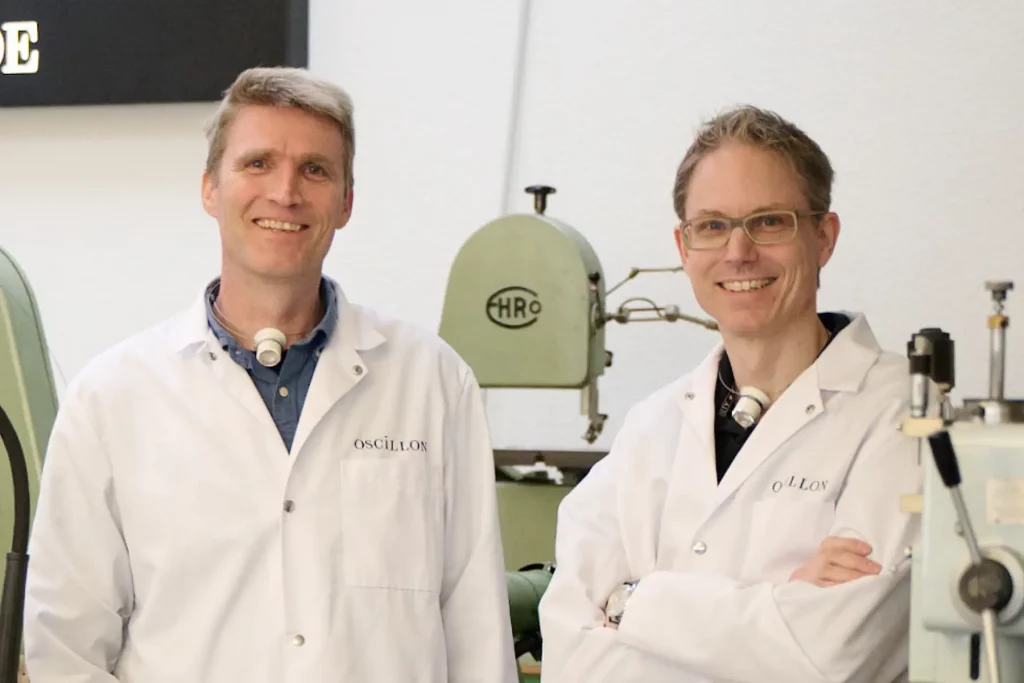
The story begins in the early 1990s at the watchmaking school in Solothurn, Switzerland, where Dominique Buser and Cyrano Devanthey met while still apprentices. Very quickly, they became friends, connected not only by their horological training, but also by a shared fascination with old machines, traditional tools, and everything related to a more historical, more mechanical, more material form of watchmaking. At a time when they were still in their first year, they were already discussing an idea that seemed almost naïve, or at the very least hugely ambitious: one day making their own watch entirely from scratch. The seed was planted very early. But between that first conversation and its realisation, nearly thirty years would pass.
After graduating in 1994, their paths diverged, without their bond or their shared vision disappearing. Cyrano Devanthey first worked in Zurich at Les Ambassadeurs, where he repaired and sold high-end wristwatches. He then joined Omega in Biel, where he held several important roles, first in technical training, then in Swiss customer service, before taking on a more international dimension in the organisation of service centres and the training of Omega watchmakers around the world. In 2005, he even took charge of Omega’s High-End Unit, where he was notably involved in managing the production of the Central Tourbillon, an important piece in the brand’s contemporary history. Dominique Buser, on his side, followed a somewhat different route. After a period at Vacheron Constantin, he decided in parallel to devote himself to physics studies at the University of Zurich, which he completed in 2003. That detour into physics was not anecdotal. It fed another way of approaching mechanics, structures, constraints and design, which would later play an important role in his development.
Their credibility was therefore not built in isolation. Each of them developed, on his own side, real technical, human and professional depth. But despite their separate paths, they stayed in touch, continued exchanging ideas, and above all continued nurturing that shared fascination with old watchmaking machines. Over all those years, they gradually collected lathes, tools and manual machines, some of them destined for scrap after the collapse of mechanical watchmaking in the 1970s. They restored them, learned how to use them, gathered whatever know-how was still held by older watchmakers when needed, and were most likely already building, without fully realising it, the concrete foundations of their future project.
Another important name would eventually cross their path: Felix Baumgartner, a friend from their Solothurn days and future co-founder of Urwerk. When Urwerk launched the development of the Opus V for Harry Winston in the early 2000s, Baumgartner called on Dominique Buser to help bring this complex project to life. Buser then created his company and his workshop near Buchs, learned to use 3D CAD, and his workshop gradually became Urwerk’s unofficial R&D department. When the workload increased, Cyrano Devanthey eventually joined the adventure as well in 2009. Reunited once again, the two men worked together on major projects for Urwerk, including the UR-110, while further strengthening both their know-how and their complementarity.
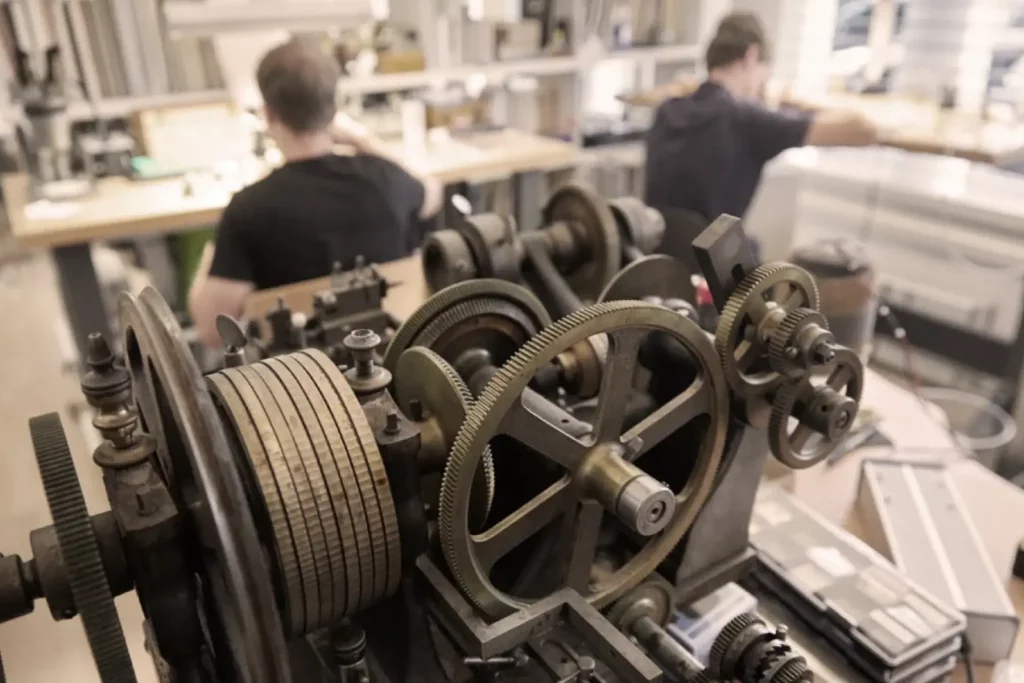
But over time, a kind of creative tension resurfaced. After years of watchmaking, engineering, digital tools, computer-aided design and complex development work, they felt the need to return to gesture, raw material and direct work. As Cyrano explains, they had become experts in computing and manufacturing software, capable of enlarging tolerances of a few microns into several centimetres with a few clicks. And yet, they gradually felt the need to become craftsmen again, to reconnect with raw material. This point is fundamental, because it helps explain that their approach has nothing to do with a simplistic rejection of modernity or a nostalgic anti-CNC position. They do not reject contemporary tools out of posture. They know perfectly well what those tools make possible, since they themselves used them at a very high level. But their project with Oscillon consists precisely in exploring something else: rediscovering what it truly means to make a watch when one chooses to return to manual tools, traditional machines and historical gestures.
It is within that logic that Oscillon was born. The name itself comes from the word oscillation, with, in the background, a broader reference to the physical phenomenon of the oscillon, studied from the nineteenth century onwards. But beyond the name, the idea became very clear from 2012 onward: to make wristwatches using only traditional machines, without CNC, and to produce in-house every component possible. For them, manufacture is not a marketing word. It is a requirement. Every metal component, from screws to wheels, pinions to case springs, hands to buckle, is made in their Buchs workshop using manually controlled machines. Only a few elements such as sapphire crystals, jewels and gaskets fall outside that logic. Development is done in CAD, of course, but once the plans are established, the computer disappears from the manufacturing process.
This approach takes time, a huge amount of time. It also requires multiple skills, extreme rigour, and an organisation that goes far beyond the founding duo. Today, the workshop also includes younger watchmakers such as David Friedli and Yan Hegelbach, within a transmission dynamic that is especially important. Because in the end, Oscillon is not only trying to make watches differently. The project is also about preserving and passing on a know-how that might otherwise disappear. And that is probably where one finds an interesting connection with Naissance d’une Montre 2, in which they took part: at Oscillon too, there is this desire to demonstrate that certain gestures, certain methods and certain standards are not only still possible today, but deeply relevant.
Their first model, L’Instant de Vérité, had already laid the foundations of this philosophy. But with Fundamentum, and more specifically with this Fundamentum Mosaic, the name of the model says almost everything. Fundamentum refers to the idea of foundation, of returning to basics, to what forms the very base of a certain kind of handmade watchmaking. At first glance, the watch could almost appear simple, discreet, highly classical. And that is precisely what makes it interesting. Behind this apparent sobriety lies a piece built according to a radical logic, in which almost everything has been made in the most manual way possible, with tools that belong more to the history of watchmaking than to its contemporary industry.
Ultimately, that is precisely what makes Oscillon so interesting today. We are not talking here about a project quickly built around a good story or a clever positioning idea. We are talking about two watchmakers who carried a dream for decades, accumulated machines, skills and experience, and then chose to give concrete form to a question they had already been asking themselves at school: can one still make a watch this way today? And judging by the Fundamentum Mosaic, the answer is clearly yes. Now, let us turn to the watch itself.
Table of Contents – Oscillon Fundamentum Mosaic
What are the key features of the Oscillon Fundamentum Mosaic?
Case
With this Oscillon Fundamentum Mosaic, what struck me first was really the quality of the case construction. At first glance, one could think it is something very simple, almost very direct, but as soon as you look at it more closely or see it come alive in the light, you realise there is in fact a great deal of mastery behind that apparent sobriety. It is a case that does not try to impress through stylistic effects or gratuitous complexity. Everything is very legible, very clean, very controlled. And that is precisely what I liked. There is something very square in the approach, in the good sense of the term, with a kind of rigour that almost made me think of a certain German watchmaking spirit, even if the execution itself remains fully Swiss.
What I liked immediately was the contrast between the different surfaces. The slightly concave bezel, almost like the curve of a watchmaker’s loupe, is entirely polished. The lugs, seen from the front, are also fully polished. And the rest of the case is satin finished. This interplay between polished and satin surfaces works extremely well. It gives the case relief, allows it to catch the light with great subtlety, and above all gives it real presence on the wrist without ever becoming flashy. It is a case that exists, that has poise, but never tries to attract attention in a forced way.
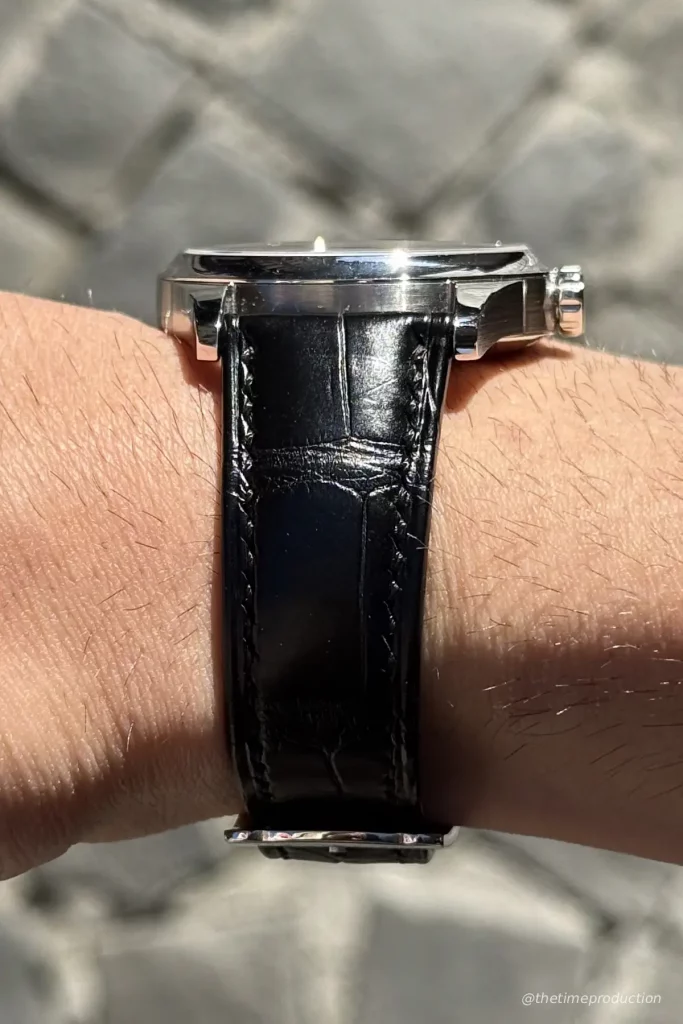
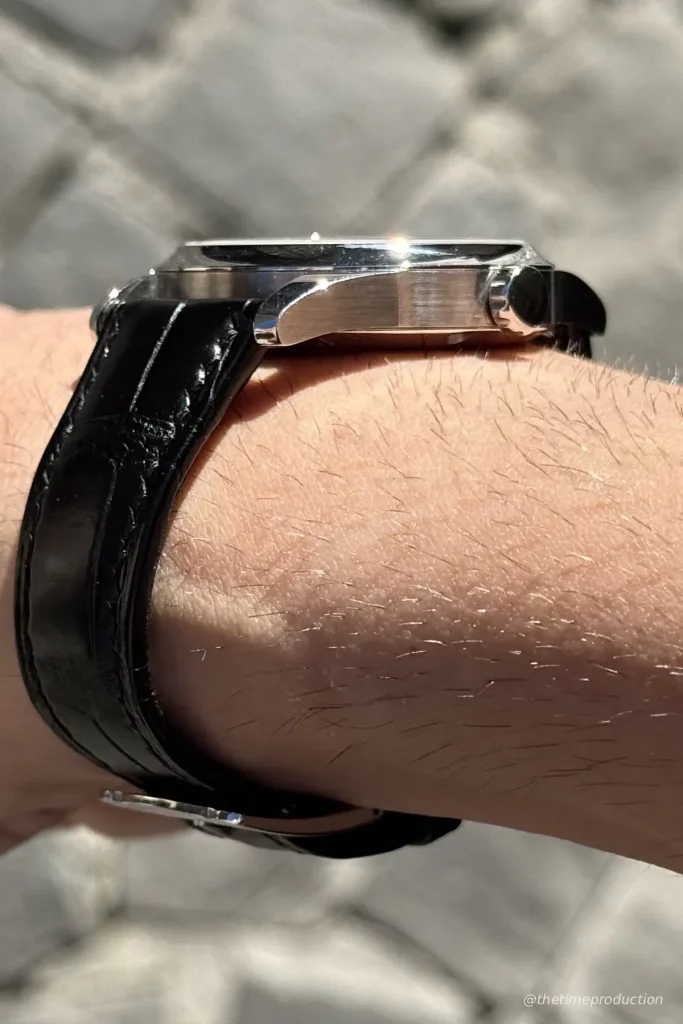
The proportions also felt particularly successful to me. At 38 mm in diameter and 10.45 mm thick, the watch wears very well. On my wrist, which is not especially large, I found the balance just right. One cannot really call the watch ultra-thin, that would be exaggerated, especially when one considers that it houses a proprietary calibre and an extremely high level of artisanal work. But overall, the relationship between diameter and thickness works very well. The watch remains elegant, wearable and natural on the wrist while still maintaining real presence. It never feels like a small watch, and I actually think it would also work very well on a larger wrist.
I also appreciated the lugs precisely because they remain very well judged. They are not overly pronounced, not overly demonstrative, and they support the overall design very well. The caseband also felt very right to me. It does not try to multiply details or create visual tension artificially. On the contrary, one feels they have gone straight to what truly works, to what can last over time. And that is, in my view, a real quality. This case does not respond to a trend. It does not try to tick the codes of the moment. It rather gives the impression of something that could always have existed, and could still feel perfectly relevant several decades from now. It is exactly the kind of design I would call timeless.
Another detail I liked was the crown. It is not standard at all, which is in fact coherent with the rest of the watch, since nothing is really standard here. It is not signed, but the area where one might have expected a logo is entirely polished, which gives it a very clean, very precise appearance. The small teeth of the crown are few, but their upper surfaces are also polished. And that changes a lot, both in perception and in use. You do not get that slightly aggressive feeling that some heavily cut crowns can sometimes have. Here, despite the shape, everything remains fairly soft to the touch, and it really makes you want to take the crown in hand, wind the watch and listen to the movement. It is a small detail, but it is exactly the kind of detail that contributes to the overall quality of an object.
In the end, I find this case totally coherent with the overall identity of the watch and the Oscillon project. It perfectly expresses their way of approaching watchmaking: doing things seriously, with traditional means, without chasing showmanship, but with a real concern for accuracy and longevity. There are no flourishes, no unnecessary details, no fashionable effects. Just a very well thought out, very well executed case, with a real sense of quality and a discreet yet assertive elegance. And in my eyes, that is precisely what makes it so successful.
Dial
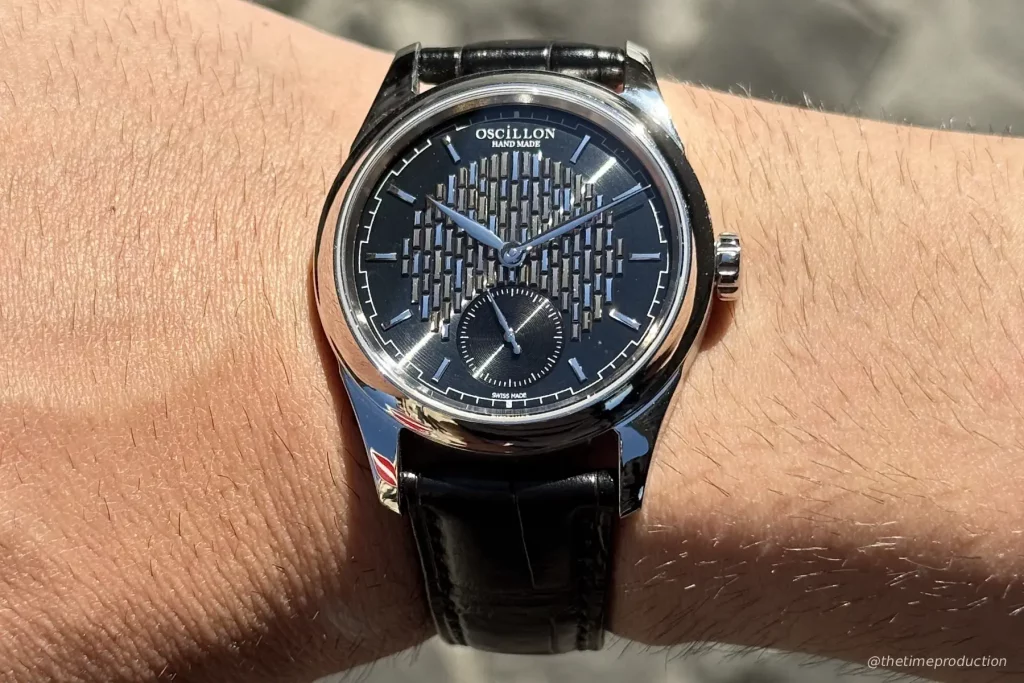
The dial of this Oscillon Fundamentum Mosaic does not try to impress in an immediate or demonstrative way. At first glance, one could almost take it for a relatively classical dial, very well executed, but rather restrained in its intention. And yet, as soon as you spend a little time with it, you realise that there is in fact an enormous amount of work, subtlety and intelligence behind this apparent simplicity. It is a dial that reveals itself gradually, and that is precisely what I found so compelling.
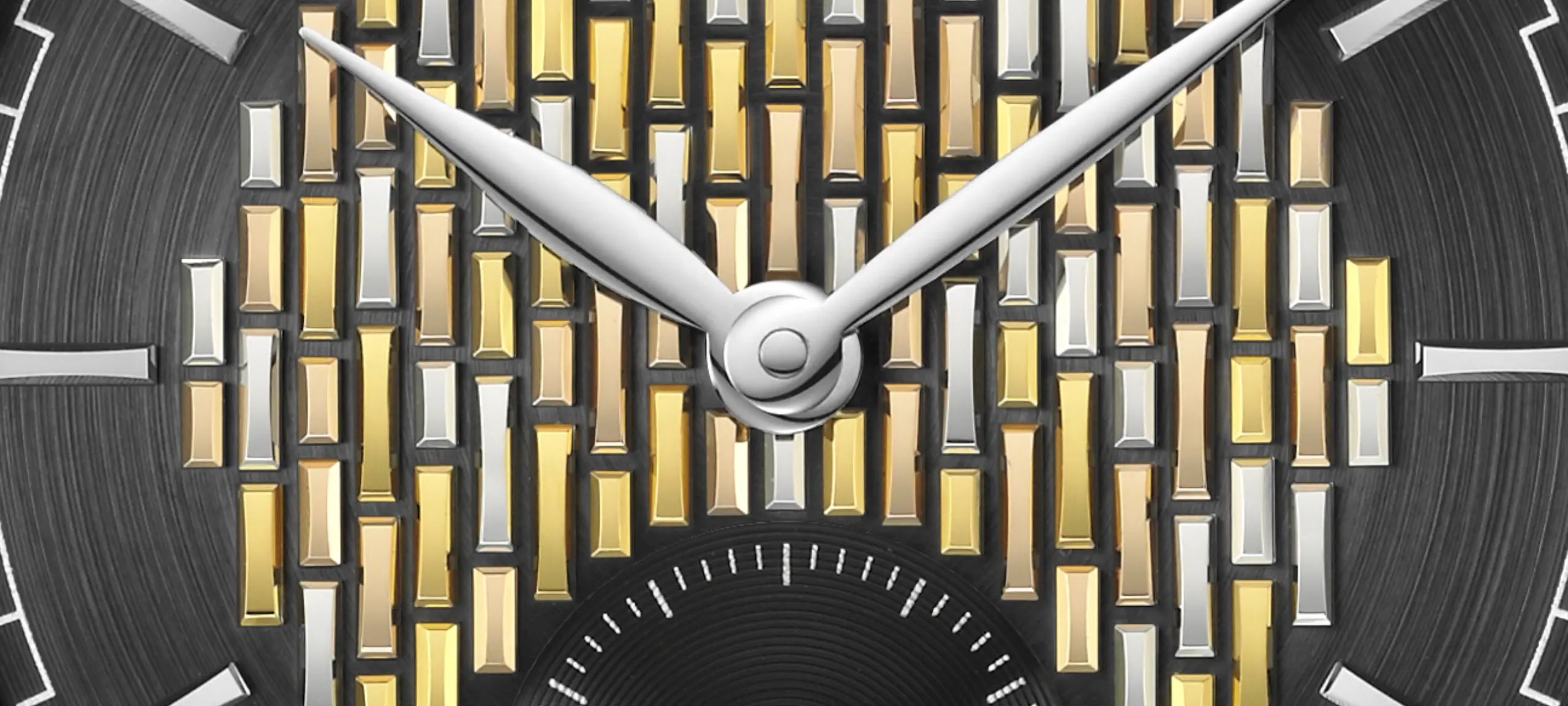
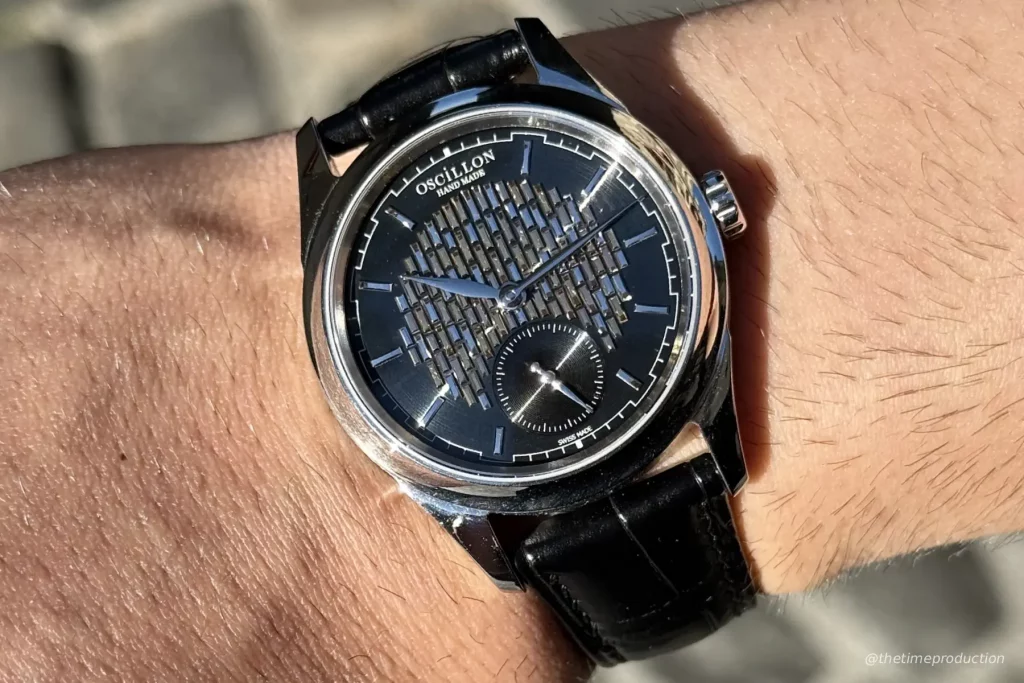
The most striking element, for me, is obviously this Mosaic decoration composed of 118 applied markers, in three different colours and four different sizes. That is really where the dial takes on its full dimension. What is impressive is that this work does not immediately jump out as a spectacular or flashy effect. But as soon as light touches the dial, everything changes. It literally comes to life. The different tones, the different sizes, the reflections, the way each marker catches the light, all of that creates a very rich, almost moving visual effect, while the whole remains perfectly controlled. And what I really like is that it never feels like an artificial decoration placed on top of the dial. Everything feels natural, integrated and coherent.
Visually, there is even something quite fascinating about the way the markers respond to light. Depending on the colours and the way they reflect, one almost gets the impression that they sit at different levels, as if they were creating additional depth. Whereas in reality, they are all placed on the same plane. It is simply the colour, the light and the geometry that create that illusion. And I find that really superb. It gives the dial a very particular, very lively presence, without ever slipping into something blingy or demonstrative. It is the exact opposite of a dial that tries to impress through accumulation. Here, everything rests on the intelligence of the execution.
What works particularly well, in my view, is precisely this ability to start from a very classical base and inject into it a very personal twist. We still have a traditional reading, with a small railway track, a very legible display, a nicely integrated small seconds, and yet this dial does not look like a classical dial. There is something much more playful, more subtle, more alive in the way it interacts with the light. And that never harms legibility. On the contrary, I find the time remains very easy to read. That is even one of the dial’s real successes: managing to bring so much visual richness without sacrificing the primary function.
I also really liked the shape of the markers themselves. They are applied, fully polished on their visible surface, with four bevels that almost make them look like little ingots. That contributes enormously to the perceived quality of the dial. And when you think about the amount of work involved, it becomes even more impressive. These markers are obviously not glued on like simple decoration. The dial must have been drilled with extreme precision in order to receive and secure them all. That operation alone gives some idea of how many hours must have gone into it. And that is also where one immediately senses that this is not a watch produced on a large scale. One is clearly dealing with an object made at an extremely slow rhythm, with real demands behind it.
The small seconds is also integrated very well into the whole. I found it interesting that it follows the formal logic of the other hands. That helps preserve a real unity of language across the dial. More broadly, it is a dial I find very coherent with Oscillon’s philosophy. They remain faithful to their traditional approach, to their manufacturing standards, to their taste for watches that do not try to sell themselves through gimmicks, while still managing here to offer something genuinely different. And that is, to my mind, a real success: being able to reinvent themselves without betraying their identity.
If I had to qualify one point, it would probably be the simultaneous presence of the words “HAND MADE” beneath Oscillon and “SWISS MADE” at 6 o’clock. To be honest, that is probably the only detail that leaves me slightly more doubtful. I understand the idea of reminding us that the watch is made in Switzerland, of course. But on a piece like this, with such a level of execution, such an approach and such a price, “HAND MADE” feels almost sufficient on its own to convey the essential point. “SWISS MADE”, so diluted today, feels here a little less necessary. It remains a detail, but it is probably the only real reservation I would express.
Movement
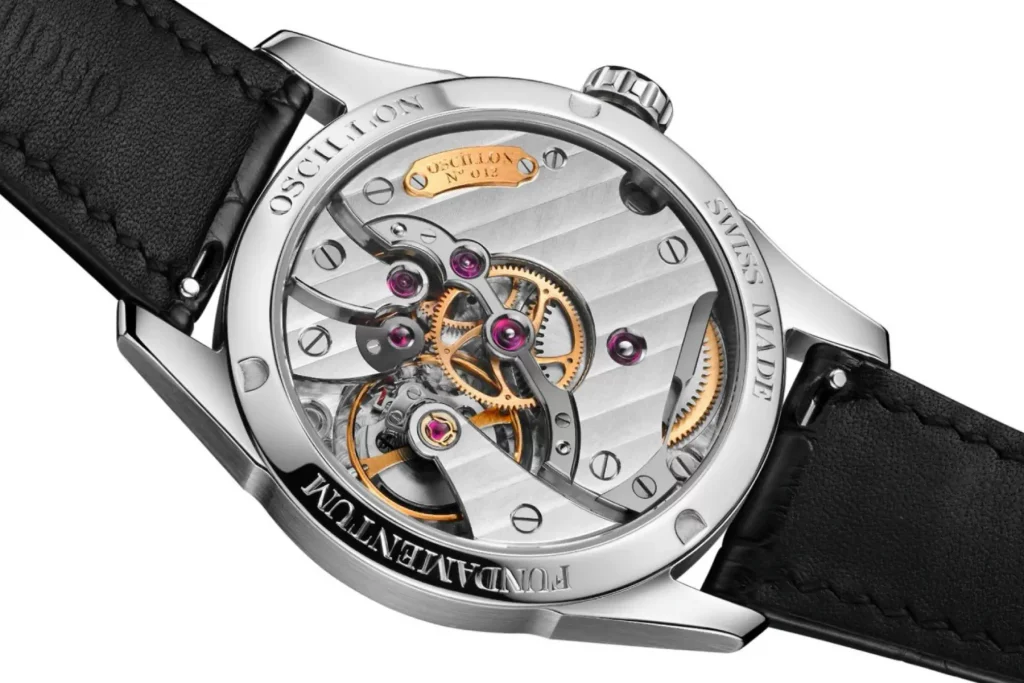
The movement of this Oscillon Fundamentum Mosaic is, in my view, one of the most important elements of the watch, not only because it brings real horological value to the whole, but also because it explains a large part of the project’s deeper logic. At first glance, one could almost think it is a relatively simple movement, fairly classical in architecture, without spectacular complication or excessive demonstration. And yet, that is precisely where its strength lies. Because the more one looks at it, the more one understands the finesse of its design, its level of execution, and above all the extraordinary amount of work required to achieve such a result with the means Oscillon has chosen to impose on itself.
What a serious collector should retain first and foremost is precisely this: this movement is not impressive because it tries to be visually impressive at all costs, but because it is the product of a completely singular method of manufacturing. Its value does not lie only in its appearance, but in the way it was conceived and made. We are talking here about a movement produced on old manually controlled machines, with a level of precision that forces one to rethink from the design stage how each part can actually be produced. And that is where this idea, fundamental in my view, of designing for manually controlled machines comes in. They do not draw a movement in abstraction and only then ask themselves how to make it. They design from the start by integrating the real constraints and possibilities of manual machines. And that changes everything.
That is in fact what I find especially strong in this movement. The real sophistication is not so much in the complication as in the making. This is not a watch about accumulating functions or effects. It is a kind of watchmaking where nobility comes from gesture, from fabrication, from an intimate understanding of material, machines and tolerances. The pivot staffs are shaped by hand on a pivoting lathe, the pinions are cut tooth by tooth, the wheels are crossed, the springs shaped on a pantograph, the plates and bridges made on manual lathes. And once you understand that, the movement becomes immediately much more impressive. It is no longer simply a beautiful calibre, but the result of an almost radical level of know-how in the way it is made.
On the aesthetic level, I found the movement very seductive. There is something very classical in its architecture, but classical in the best possible sense. One feels a connection with a great Swiss tradition of movement design, with separate bridges, a clear, legible and balanced construction that lets the components speak. Yes, the spirit of certain great references, especially the Philippe Dufour Simplicity, is not far away, and I think it is interesting to say so. Not in a frontal logic of comparison or imitation, but rather to situate an ambition. Using such a movement as a horizon or guide for thinking a handmade, superbly finished calibre seems to me an entirely legitimate and even very intelligent approach. It also shows very clearly the kind of watchmaking Oscillon is trying to defend.
And on that front, the level of finishing is truly impressive. We find German silver bridges, very refined anglage, polished sinks, polished steel parts, a large 11.70 mm balance, black polishing on certain especially sensitive areas, and a real care given to the variety of shapes and bridges. The escape wheel cock, the bridge holding certain wheels, the different inward angles, all of this testifies to a very high level of attention. This is not a movement decorated merely to flatter the eye quickly. It is a movement worked on in depth, where each detail seems to have been thought through and executed with great exactingness.
What I also appreciate is that this architecture, precisely because it remains relatively simple, allows the quality of the execution to stand out even more clearly. The movement no longer uses the constant-force remontoir spring or some of the more experimental choices of the first calibre, and I think that is actually a good thing in the context of Fundamentum. There is here a form of purity, a desire to return to something more fundamental, more legible, more rooted in the very idea of the project. It matches the spirit of the model perfectly. There is no need for additional complication to understand the level of mastery behind it.
The 45-hour power reserve and the 18,000 vibrations per hour frequency also contribute to this overall coherence. We remain in something very horological, very traditional, with no desire to overplay performance or modern technicality. And that is precisely what gives the whole so much meaning. The movement does not try to compensate for its apparent simplicity with spectacular numbers. It seeks above all to be right, well conceived, well made, and completely coherent with the philosophy of the watch.
In the end, I find that this movement brings a tremendous amount to the Fundamentum Mosaic. Of course, its method of manufacture makes it exceptional, but its value should not be reduced to that alone. It is also a very beautiful movement, very well thought out, very well built, very well finished, one that manages to convey the full seriousness of the Oscillon project. And in a watch like this, where substance, method and philosophy matter just as much as the visible result, that is obviously essential.
Strap
The strap of this Oscillon Fundamentum Mosaic remains in the same logic as the rest of the watch: understated, very well executed, and perfectly coherent with the whole. We are dealing here with a black alligator strap with black stitching and a fairly matte finish, which I found particularly well judged. It does not try to draw attention to itself and leaves the case, dial and movement fully free to breathe. On the wrist, I found it very comfortable, with a genuinely strong sense of quality. Honestly, it is entirely at the level of the watch itself.
What I particularly liked is the buckle, which is also handmade. And in the world of Oscillon, that is obviously a detail that matters. Its shape is not entirely classical: instead of a simple flat upper section, it draws a succession of refined curves, almost like three small arcs, which gives it a more original and more elegant silhouette. It is entirely polished, bears the Oscillon name in full, and really reinforces the personality of the watch without ever doing too much.
In the end, I find this strap does exactly what it should. It remains deliberately discreet in order to let the rest of the piece speak, but it is never banal for all that. It extends the overall philosophy of the watch with great accuracy, right down to this very important detail of the handmade buckle.
What is the price of the Oscillon Fundamentum Mosaic?
The Oscillon Fundamentum Mosaic is priced at CHF 157,500 excluding taxes, and that positioning seems entirely coherent to me with the overall proposition of the watch. At this level, one is obviously not paying only for a steel three-hand watch. One is paying for an approach, an extremely rare level of know-how, a method of manufacture that is almost impossible to find today, as well as the colossal human time required to produce such a piece. And within that context, the price seems fully justified to me.
What is interesting here is also that the rarity of the watch is not artificial. The Fundamentum is not limited in the marketing sense of the term. It is naturally limited by the reality of its own making. Oscillon produces around five pieces per year simply because it is impossible to go much faster with such a method, such a level of demands and this type of machinery. Each watch is also individually numbered, which further reinforces this very confidential dimension.
For me, this piece is aimed above all at a major collector of independents, or at someone highly sensitive to extreme artisanal work, much more than to the name of a brand alone. Because what one is buying here is not simply status or a recognised signature. It is something one will not find elsewhere. A way of making, a workshop culture, a human and technical rarity that gives the watch a very particular place in today’s horological landscape.
Oscillon Fundamentum Mosaic: discreet in appearance, significant in what it stands for
With this Fundamentum Mosaic, Oscillon offers, in my view, a particularly important watch for those who truly understand what lies behind it. At first glance, one could almost take it for a fairly classical watch, very well executed, certainly, but without any desire to do too much. And that is precisely where a large part of its strength lies. Because behind this apparent restraint there is in fact a level of know-how, rigour and commitment that places it at an extremely high level in the contemporary watchmaking landscape.
What I find strongest about Oscillon is that their approach has nothing of a nostalgic exercise. They are not trying to replay the past for the simple pleasure of making something look old. On the contrary, they demonstrate that a certain way of making watches, deeply rooted in the history of watchmaking, is not only still possible today, but still relevant. And that changes everything. The Fundamentum Mosaic does not impress through spectacular complication or through a visible demonstration at first glance. It impresses through its method, through its level of execution, through its coherence, and through everything it says to those who take the time to understand it.
It must also be said that Dominique Buser and Cyrano Devanthey form a truly unusual duo. They are two watchmakers with genuine technical culture, genuine freedom of tone, genuine independence of mind, and above all a trajectory that gives enormous credibility to what they are doing today. They did not arrive here by chance. They built this through decades of experience, reflection, learning, machine restoration, development and work. And that is immediately felt in the solidity of the project. To me, it is clear that they are not trying to generate attention at all costs. What they are really trying to do is make their work resonate with the right people, namely collectors who are capable of understanding what they actually have in their hands.
That is probably what defines Oscillon’s deepest singularity. It is not a brand trying to become mainstream, nor even to appeal to everyone within independent watchmaking. It remains confidential, demanding, almost discreet in the way it exists. And in the end, that makes perfect sense with the watches it produces. The Fundamentum Mosaic is exactly the kind of piece that will speak powerfully to certain collectors precisely because it is not trying to speak to everyone. It is not an accessible watch in the way it reads, in its price, or even in the understanding of what it stands for. But for those who are sensitive to it, it represents something very rare.
So yes, I absolutely believe in the future trajectory of the project. Because they are already making something today that almost no one else still knows how to make at this level. Because they are two highly complementary people with an extremely solid technical foundation. Because they also have the intelligence to pass that knowledge on to a younger generation, which seems fundamental to me for what comes next. And because their workshop, their method and their philosophy may become even more valuable over time, in a watchmaking world that is standardising its processes more and more, even in segments that are supposed to represent the very high end.
I also think their ability to remain human in scale is a real strength. Perhaps, in time, they will manage to increase production slightly through transmission and the integration of other watchmakers into the workshop. But what matters is that the spirit of the project remains intact. And from that perspective, I am rather confident. They seem to have found a rare balance between standards, identity and production reality. And that gives them, in my view, a very particular place in independent watchmaking today.
At the end of the day, what I like about Oscillon is that none of this ever feels overstated. They do not claim an extreme approach just to make people talk about them. They genuinely live it. And that is precisely why the Fundamentum Mosaic seems to me to be an important watch. Not because it seeks to impose itself as a manifesto, but because it shows, very concretely, that another way of making watches is still possible.
Oscillon Fundamentum Mosaic – Watch Specifications
- Brand: Oscillon
- Model: Fundamentum Mosaic
- Case Material: Stainless Steel
- Dial: Brass with rhodium and dark ruthenium coating
- Functions: Hours, Minutes, Small Seconds
- Movement: Su26.1L, Maually-Wound, 18’000vph frequency (2.5Hz), 21 jewels and 127 parts
- Power Reserve: up to 50 Hours
- Water Resistance: 3 ATM
- Crystal: Sapphire
- Case Back: Sapphire
- Case Dimension: 38mm (Diameter) × 10mm (Thickness)
- Strap: Black Alligator with Stainless Steel Pin Buckle
- Availability: Limited production of 5 pieces
- Retail Price: CHF 157,500 (excluding VAT)
What do you think of this Oscillon Fundamentum Mosaic and, more broadly, of this kind of highly confidential independent watchmaking, where true sophistication lies as much in the way something is made as in the final result itself?
If this article added value or sparked a discovery, you can support the project HERE. Your contribution helps me keep weekly articles and a biweekly newsletter free, accessible, and independent for everyone.
For more information about Oscillon, click here.