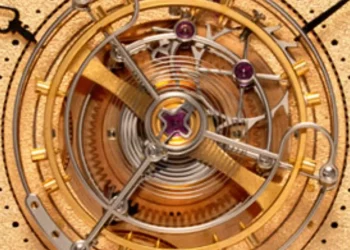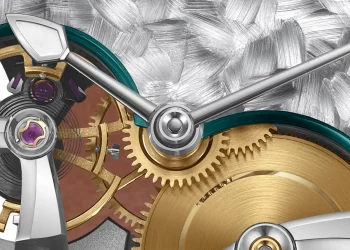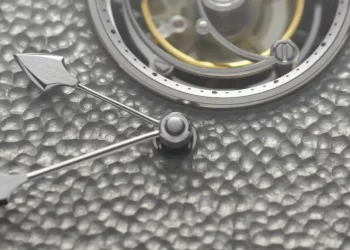
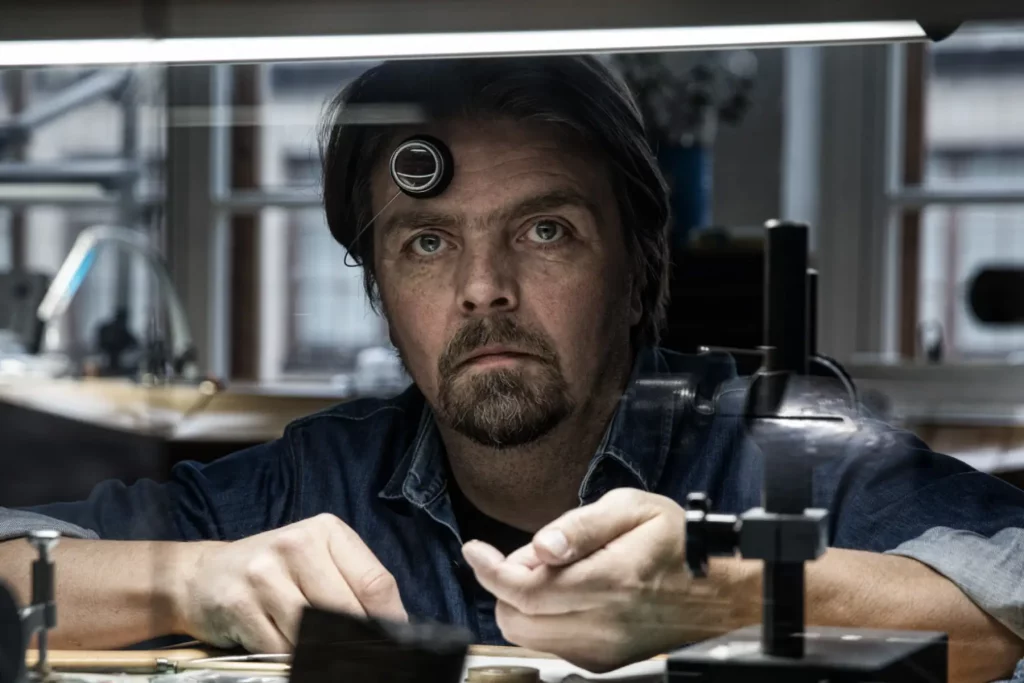
Today, I’d like to tell you about a Finnish brand that isn’t for everyone. To continue my series on Scandinavian watchmakers, I’m going to highlight the work of Sarpaneva. Before introducing one of its latest releases launched in 2025, I’d like to take a step back and revisit the very interesting journey of Stepan Sarpaneva.
Stepan Sarpaneva was born in Turku, Finland, in 1970. As a child, he moved often with his family, constantly changed schools, made new friends quickly, and discovered new activities. He loved building with Lego. Then, around the age of 12, Stepan Sarpaneva got his first motocross bike. Spending all his time repairing it sparked his interest in mechanics. Over the years, other mopeds followed, then road bikes and cars, all restored and modified. He also did a lot of restoration work because, at the time, his family imported old English and American cars, giving him the opportunity to work on them.
Stepan Sarpaneva also grew up in a family that carried a long artisanal tradition. His grandfather was a blacksmith, his father Pentti Sarpaneva was a jewelry designer, and his uncle Timo Sarpaneva was a Finnish product designer and professor. It was almost inevitable that Stepan Sarpaneva would become an artist, a craftsman. His interest in watchmaking began timidly when he was at school. His grandfather gave him his first mechanical watch. As time went by, it was purely by chance that he found himself at watchmaking school.
After a fairly typical path, he ended up in high school, but things were not going very well for him. He lacked interest, so his mother advised him to follow in his father’s footsteps and enter the jewelry world. In the end, that didn’t happen because he wasn’t accepted. Luckily, he had also applied for another program that same spring, this time in watchmaking. He told himself he would try it for a year, then try again for jewelry. Little by little, he realized that watchmaking suited him better than anything he had done before. In 1989, he began his studies at the Tapiola Watchmaking School near Helsinki, and stayed there until 1992.
At the time, there was no work for watchmakers in Finland. Fortunately, he applied to study at WOSTEP (the Swiss watchmaking training and education program) in Neuchâtel. He started in early 1994 with refresher courses. After five months at WOSTEP, he graduated with the best results. He then took his first position at Piaget in the small village of La Côte-aux-Fées, working in after-sales service, before returning to WOSTEP for advanced training in complicated watches and restoration.
After that training, he began working from 1994 at Parmigiani Fleurier with Kari Voutilainen, where he learned traditional working methods. They were responsible for special projects, unique pieces, and traditionally made complications. He then went to work for about a year with Vianney Halter in Sainte-Croix, who taught him that in watchmaking you can free yourself from the rules, step off the beaten path, and find technical solutions in unexpected ways. In 2000, he started working with Christophe Claret, making tourbillons and Westminster repeaters, and he stayed there until returning to Finland.
During those years in Switzerland, he was able to experiment with many watches. Naturally, he began wondering how he could create his own. Then, by chance, he made one in 2000 that he named Time Tramp (TT). It was built using the kickstarter pinion from his first Harley-Davidson motorcycle, into which Stepan Sarpaneva integrated an ultra-thin Piaget movement of great finesse. Someone saw it and wanted a similar watch. Then someone else saw it. In the end, it was customer demand that made the difference. His friends wanted the watch he was making, and that’s how everything began. In 2003, he structured his business plan and decided to open his workshop (which he financed by selling his vintage Harley-Davidson) in Helsinki, inside a former cable factory (Kaapelitehdas). With his brand, Stepan Sarpaneva set out to create innovative designs with a post-industrial, steampunk look, built around a central lunar theme, with impeccable finishing in the purest spirit of traditional watchmaking.
In 2004, he founded a second, more accessible watch brand: Sarpaneva Uhren Fabrik, or S.U.F Helsinki. This second brand was initially created primarily for the Finnish market, where he wanted to build something more alternative and pragmatic than Sarpaneva, as a way into the world of independent watchmaking. The brand embodies grit and determination, known locally as “sisu”, a trait associated with the Finnish people and rooted in long, harsh winters and Finland’s traditionally limited resources. S.U.F watches draw inspiration from Finnish icons, pioneers, and historical figures, such as the legendary Vetehinen submarine from World War II and the famous motorcyclist Jarno “Paroni” Saarinen. They are produced in greater numbers and offer a wider variety of models than the Sarpaneva brand, while remaining more affordable.
Stepan Sarpaneva has been a selenophile since childhood, a learned term for someone obsessed with the Moon. In the children’s shows and cartoons he watched, the Moon was everywhere. He has trouble sleeping on full-moon nights. The Moon is both his best friend and his worst enemy. Stepan Sarpaneva is also fascinated by working with steel, which allows him to express artistic freedom through his designs. His slogan, “These watches are not made for everyone,” is a reminder that these exceptional timepieces are meant for exceptional people. He wants to use the moonphase complication to slow the pace and take time in a world where everything moves too fast. The Moon is an essential natural element that influences many aspects of nature. Its gravitational pull affects ocean tides, and its light influences the behavior of many animals, especially nocturnal ones. The Moon is a symbol of natural balance and harmony.
Most often, his creations are bold, unconventional, uniquely conceived, infused with Nordic inspirations, and centered on our closest satellite, the Moon. In 2006, he introduced a model called Supernova. A supernova marks the end of an era, but also the birth of another. The Supernova, made in only ten pieces, is a truly fascinating watch with a worked dial that opens onto the upper plate of the movement, and a clever moonphase indication at noon. Nearly 20 years later, Stepan Sarpaneva decided to reinvent it by refining it and reducing its diameter, without losing any of its unique character. Inspired by the symbolism of the universe and, as its name suggests, exploding stars, this watch now offers a collection of new dials and a magnificent moonphase complication that I’m going to introduce to you now.
Table of Contents – Sarpaneva Supernova Moonphase
What are the features of the Sarpaneva Supernova Moonphase?
Case
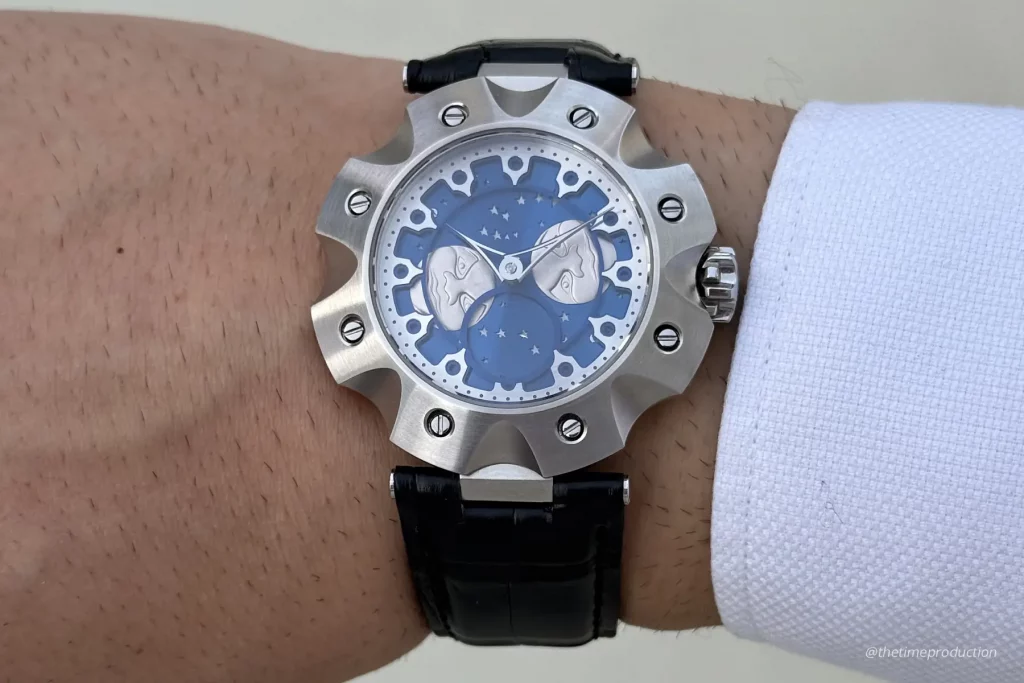
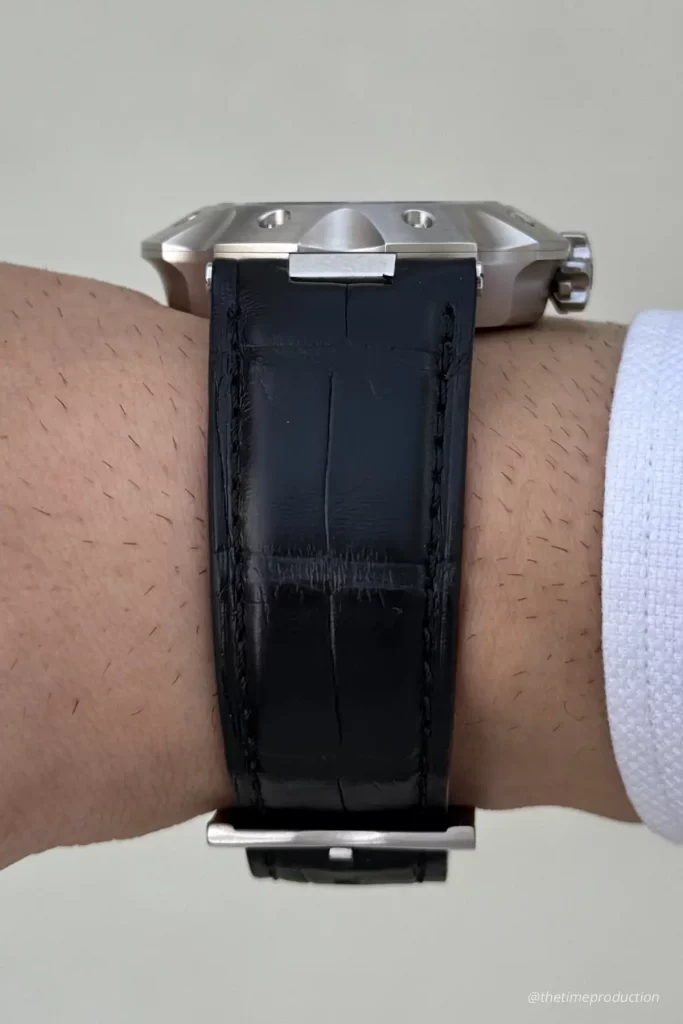
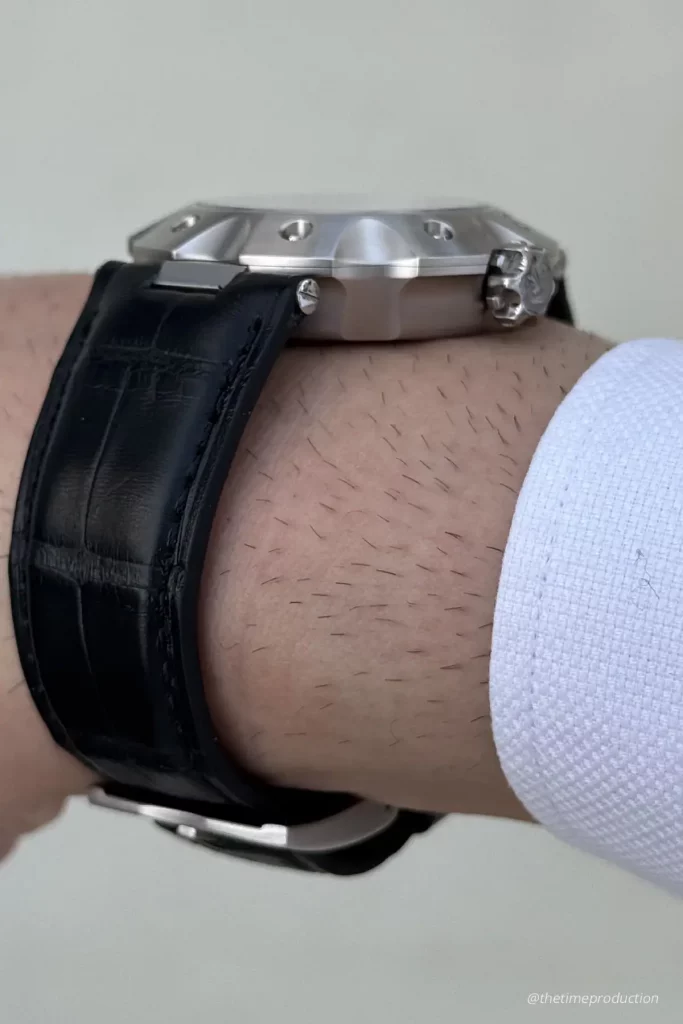
The Sarpaneva Supernova Moonphase features a highly futuristic and bold case made from high quality Finnish SUPRA 316L/4435 stainless steel, produced by the Outokumpu group. It contains less nickel and more chromium than standard 316L steel, giving it a tone that is less yellowish and more golden. The initial stamping also makes it harder. Working with this steel can be complex, but it was the exceptional look and feel of the material that convinced Stepan to choose it for this watch. Brushed and polished, its raw, angular, convex case, pushed to the extreme, carries Sarpaneva’s signature silhouette.
Thanks to a screw down crown, a sapphire crystal, and an exhibition caseback, the case is water resistant to 50 meters. Building on the design created in 2006, this new Sarpaneva Supernova retains that originality while offering surprisingly more compact proportions: 40 mm in diameter, 11.2 mm thick, and 42 mm lug to lug. Its only traditional element is its essentially circular shape. However, its gear like silhouette is a recurring motif in the brand’s history and played an important role in Stepan’s journey, notably when he made his pocket watch from Harley Davidson motorcycle gears in the late 1990s.
Thanks to its wide, sculpted bezel, its presence on the wrist feels far stronger than its dimensions might suggest. The bezel combines circular brushed surfaces, 8 screws, 8 concave cutouts, and a small opening for the dial. The flanks, equally complex, give birth to a horological UFO that leaves no one indifferent, triggering contrasting reactions, and ultimately proving remarkable creative boldness. Personally, I find this case superb and very comfortable on the wrist. A small detail I appreciated is the two part crown at 3 o’clock, a playful nod to the lunar muse that inspired this creation. It is a detail that invites touch, a tactile reminder of the watch’s connection to the sky.
Dial
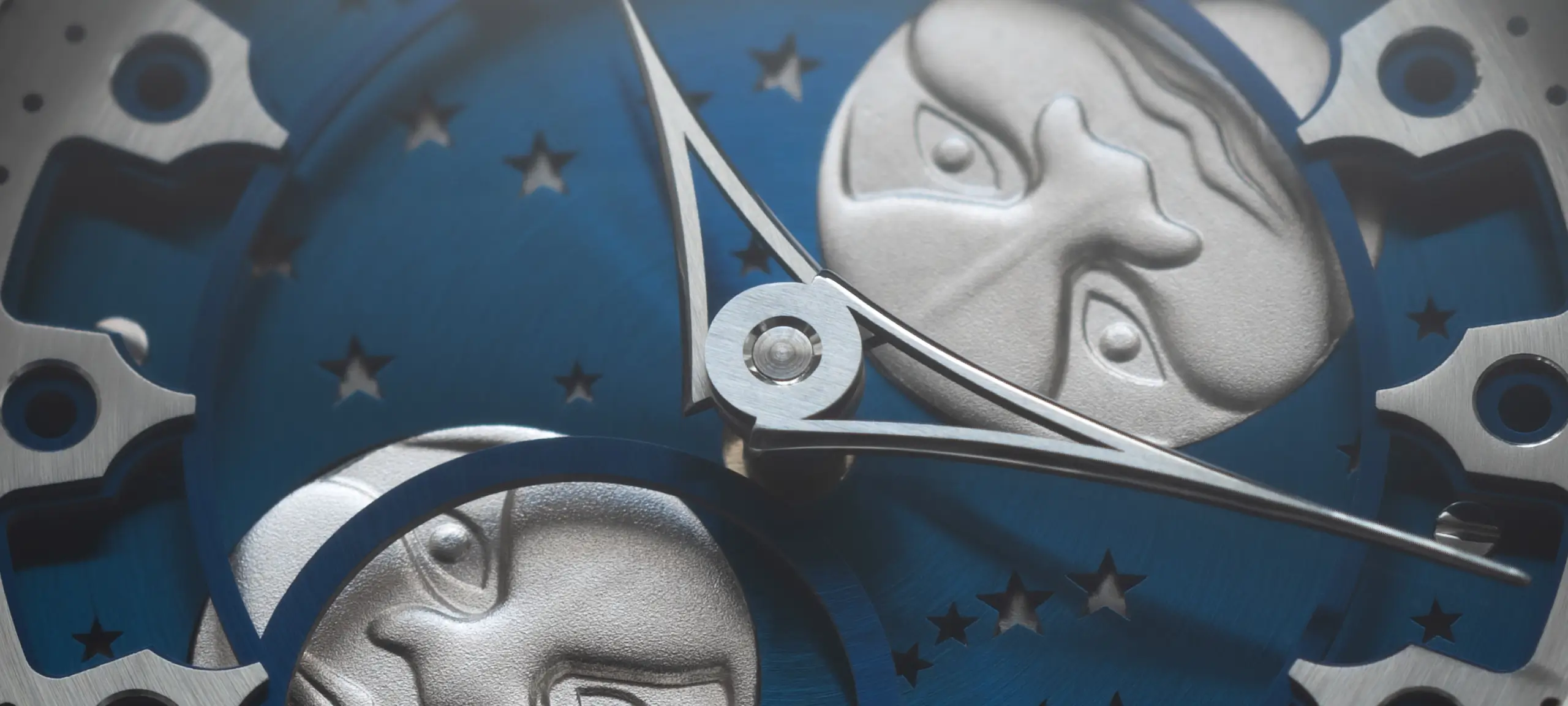
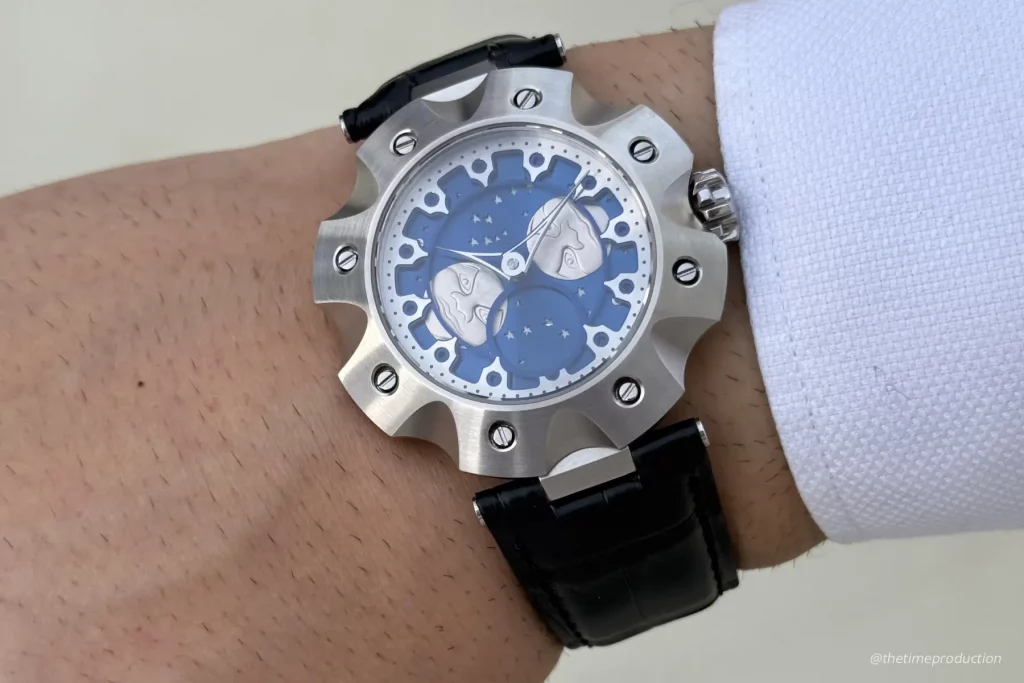
The Sarpaneva Supernova Moonphase is adorned with a very airy dial inspired by celestial forces. The complex Northern Stars motif evokes the calm that follows a cosmic explosion. It features Sarpaneva’s emblematic raised double moon display, half smiling, meticulously engraved and finished here by hand in white gold. It is also available, if you prefer, in red or yellow gold. To go a bit further, the raised motif is initially created from an oversized copper model, which is then carefully reproduced by milling onto the small precious metal dial of each moonphase display.
This moonphase display is paired with the brand’s distinctive five part stainless steel dial, layered to reveal a detailed chapter ring. For the hours and minutes, you get hand-made openworked stainless steel hands, which can optionally be filled with Swiss Super LumiNova for optimal legibility. Their finishing is impeccable, with polishing, chamfering, black polishing, and matte finishing. This dial, combining blue with more industrial tones, is very original and very well executed. The finishing is meticulous, and each element fits together naturally. I really like the work on the main dial, with stars created by removing material, adding character because they create small openings onto the movement’s mainplate.
Movement
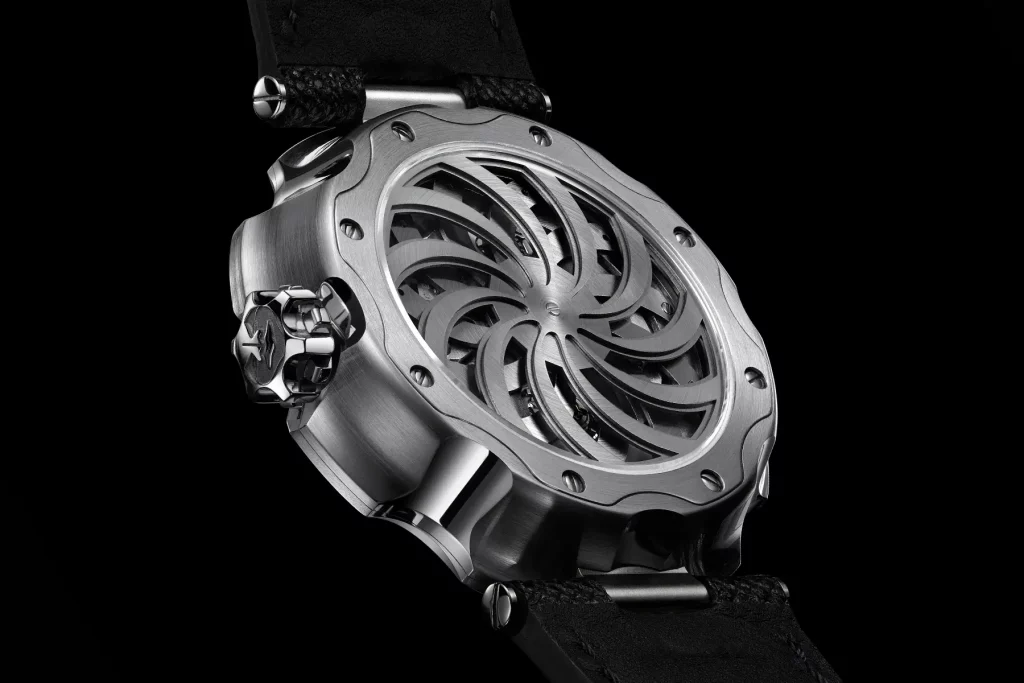
The Sarpaneva Supernova Moonphase houses a modified Swiss automatic Soprod A10 movement. It is fitted with a turbine style rotor called the “Magnetar Turbine.” It is said to be inspired by one of the most impressive phenomena in the universe: the rare and powerful explosion of a magnetar, a type of neutron star with an extremely intense magnetic field, also linked to the fascinating auroras we observe on Earth. In addition, this movement has the particularity of integrating a moonphase complication, beating at 28,800 vibrations per hour (4 Hz) and offering a 42 hour power reserve.
The Swiss Soprod A10 calibre, derived from the Seiko A10, offers a reliable alternative to the Sellita SW 200 and ETA 2824. This movement has received additional finishing, including rhodium plating and perlage, giving it an extra touch of refinement while remaining robust and reliable. Using an existing movement is a smart choice, because it ensures spare parts availability and the possibility of servicing the watch outside the workshop.
Strap
The Sarpaneva Supernova Moonphase is delivered here with a black alligator leather strap (22/18 mm), secured by a customized stainless steel pin buckle. Available in an infinite range of colors and finishes, the strap can be customized on request to match the client’s preferences.
What is the price of the Sarpaneva Supernova Moonphase?
The Sarpaneva Supernova Moonphase is priced at €24,500 (excluding VAT). It is available exclusively by order, with a €5,000 deposit required to secure the reservation. Only 12 to 15 watches were produced in 2025, versus 20 to 25 pieces in 2026.
Sarpaneva Supernova Moonphase: an unmistakable watchmaking universe
The Sarpaneva Supernova Moonphase is a remarkable watch, both in its construction and in the way it wears on the wrist. The Sarpaneva Supernova draws its inspiration from the raw and complex energy of the universe: its complexity, its power, its untamed beauty. Wearing the Supernova is like wearing a timeless fragment of the universe on your wrist, a constant reminder of the forces that shape time itself.
When a star runs out of fuel, it erupts in a dazzling burst. In the same way, this watch represents a transformation, a rebirth within the world of high watchmaking. Just as exploding stars are fundamental to the universe and to the creation of life, these watches are designed with precision and determination, built to stand the test of time. The very elements forged in stellar explosions can be felt in the robustness and refinement of each timepiece. These watches are far more than simple instruments: they are a link to the origins of life and to the inexorable flow of time. Wear a fragment of that story.
Owning a Sarpaneva watch means owning something truly unique, something you will not find in any other brand. The Sarpaneva Supernova is much more than a watch: it is an invitation to explore the universe, to lose yourself in the splendor of the stars, and to find your place among them. It is a celebration of infinity, a reminder that time is not only a measurement, but an experience, a journey, a dance. The Supernova embodies both simplicity and cosmic depth. Also, only around 70 pieces leave the workshop each year, which is a real guarantee of exclusivity.
Since 2022, he has moved the production of his two brands, Sarpaneva and Sarpaneva Uhrenfabrik (S.U.F.), into new, spacious premises on Tehtaankatu, fitted out with watchmakers’ benches and Finnish design. It is the top floor of a former chocolate factory, a brighter location that makes perfect sense given the watches he creates. The first Sarpaneva watchmaking workshop, set in a former cable factory, is still used today as a secondary workshop for metalwork, notably for producing the blued titanium dials of the Stardust and the cases.
I would like to thank Stepan Sarpaneva and Ville Arzoglou for allowing me to discover this watch during Dubai Watch Week 2025. This brand has been shining in the world of watchmaking for more than 20 years, and it still has many years ahead of it. A brand, a unique personality you do not find everywhere: that is the secret recipe to stand out and to build a polarizing universe, the complete opposite of the giants of watchmaking. I wish this brand all the best, and a great deal of success with its future projects.
Sarpaneva Supernova Moonphase – Watch Specifications
- Brand: Sarpaneva
- Model: Supernova Moonphase
- Case Material: Outokumpu stainless steel from Finland (SUPRA 316L/4435) Brushed and polished
- Dial: five part stainless steel “Northern Stars” dial, layered to reveal a detailed chapter ring
- Functions: Hours, Minutes, Phases of the Moon (29.5days)
- Movement: Modified Soprod A10 calibre, Hand-Winding, 28’800vph frequency (4Hz)
- Power Reserve: 42 Hours
- Water Resistance: 5 ATM
- Crystal: Sapphire
- Caseback: Sapphire
- Case Dimension: 40 mm (Diameter) × 11.2 mm (Thickness)
- Lug to lug: 42 mm
- Strap: Black Alligator with Stainless Steel
- Availability : Direct from Sarpaneva
- Retail Price: €24,500 (excluding VAT)
Did you know the Sarpaneva brand before reading this article? What do you think of this proposition within the world of watchmaking? Feel free to share your thoughts in the comments section.
If this article added value or sparked a discovery, you can support the project HERE. Your contribution helps me keep weekly articles and a biweekly newsletter free, accessible, and independent for everyone.
For more information about Sarpaneva, click here.