

Today, I would like to talk to you about a young independent American brand that made quite a stir when it arrived in 2024. If I say dress watch, total integration between case, dial and movement, Chronode, Jean-François Mojon, and a young American entrepreneur passionate about watchmaking, you have probably already guessed Fleming. Based in Carmel, California, this independent watch brand founded by Thomas Fleming quickly established itself as one of the most interesting propositions to emerge in the independent watchmaking landscape in recent years. Today, I would like to take a closer look at the Fleming Series 1 Mark II Pacific. But before presenting this new iteration in detail, it seems important to first go back to Thomas Fleming’s background, the birth of the brand, and the philosophy that still shapes each of its timepieces today.
Before founding his own watch brand, Thomas Fleming was not originally destined to evolve in this world. As he himself has explained, he did not develop a passion for watches particularly early on. As a child, his father had given him a plastic Timex Ironman, but an alarm that went off in the middle of class embarrassed him so much that he hardly wore a watch again until he was 18. That was when a close friend, on the occasion of his birthday, received a TAG Heuer Aquaracer from his parents and introduced him to the world of mechanical watches. That discovery proved to be a real turning point. Fascinated by mechanics, but also by the emotional permanence of objects capable of lasting for decades, Thomas Fleming immersed himself deeply in horology. Initially drawn to tool watches and the stories behind their creation, he gradually developed a broader sensitivity to high-end watchmaking, to this form of expression that no longer needs to be rational in order to exist, but instead lives through emotion, creativity and human craftsmanship.
A Stanford graduate, where he studied management and engineering, Thomas Fleming did not immediately move into watchmaking. After university, he worked on another entrepreneurial project built around a natural sparkling beverage called Atmos. But when the pandemic hit in 2020, that project slowed significantly and gave him the chance to step back and think more seriously about what he truly wanted to build. That was when he decided to fully invest himself in his passion for watches. Without any formal watchmaking background, but with a fierce determination to create his own brand, he began learning on his own, training himself, sketching, thinking through what he wanted to offer, and reaching out one by one to designers, movement developers and Swiss suppliers in order to understand what could realistically be achieved. This process, driven by unusual determination for a young American outsider far removed from the Swiss watchmaking ecosystem, gradually gave shape to a genuine vision.
The decisive turning point came when a message sent through the rather old-fashioned contact form on Chronode’s website did not disappear into the void. Thomas Fleming then came into contact with Jean-François Mojon, a major figure in contemporary watchmaking and the founder of Chronode, the manufacture and movement developer behind numerous creations for Czapek, Harry Winston, MB&F, HYT and Urban Jürgensen, among others. Mojon’s support would prove absolutely central to bringing the Fleming project to life. By listening to the ambitions of the young American entrepreneur and agreeing to become involved in the development of the project, he not only helped structure the watch around a credible and coherent mechanical foundation, but also enabled Fleming to connect with several top-tier Swiss partners. It is in large part thanks to this encounter that Fleming was able to transform a personal intuition into a genuine watchmaking project.
But Fleming is not defined solely by Thomas Fleming and his Swiss partners. As the brand developed, a small team gradually took shape in the United States to support its growth. Alongside Thomas Fleming are Grace Rood, who oversees finance, John Fleming, who handles operations, and James Kong, well known to enthusiasts under the Instagram handle @waitlisted. A former corporate lawyer in New York for eleven years, an acclaimed watch photographer, and a passionate collector, James Kong officially joined Fleming in early 2023 as Chief Operating Officer and Creative Director. His arrival gave the project an added layer of depth. As a collector, a sharp observer of watches, and a photographer used to capturing the way light interacts with surfaces, he brings a particularly relevant perspective to the aesthetic development of the brand’s future creations. While the core of the first Series 1 had already largely been established by the time he joined the adventure, his influence can be felt even more strongly on the Mark II and on what comes next.
From the very beginning, Fleming has been built around a very clear philosophy: total integration. For Thomas Fleming, a successful watch should not be conceived as a simple sum of components, but as a perfectly coherent whole in which the case, dial and movement speak to one another through proportions, volumes, finishes, and above all the way light interacts with each surface. The polished ring on the dial must echo the raised central band of the case, the forms of the movement must extend the shape of the case middle, and every detail must contribute to the same visual logic. In other words, the idea is not to design a watch around an existing movement, but to ensure that the movement serves a design language conceived as a whole. This level of demand lies at the very heart of the Fleming project and largely explains why the brand has managed to generate so much interest from the moment it launched.
That vision first took concrete form in 2024 with the Series 1 Launch Edition, the young American maison’s first official model. From this very first iteration, Fleming laid the foundations of its aesthetic universe and horological ambition: a dress watch, developed seriously, built with leading Swiss partners, yet driven by an independent and deeply contemporary American sensibility. Two years later, the brand returns with a new evolution of that proposition, the Fleming Series 1 Mark II Pacific, a piece that builds on the first version while reworking a number of elements. Now, let us turn to the watch itself.
Table of Contents – Fleming Series 1 Mark II Pacific
What are the key features of the Fleming Series 1 Mark II Pacific?
Case
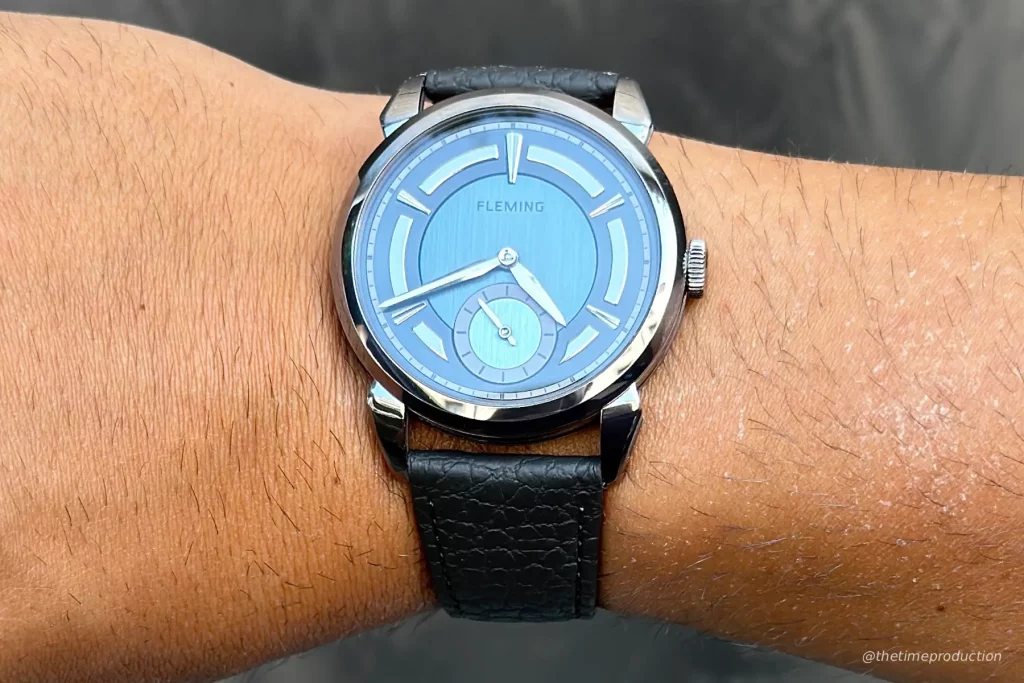
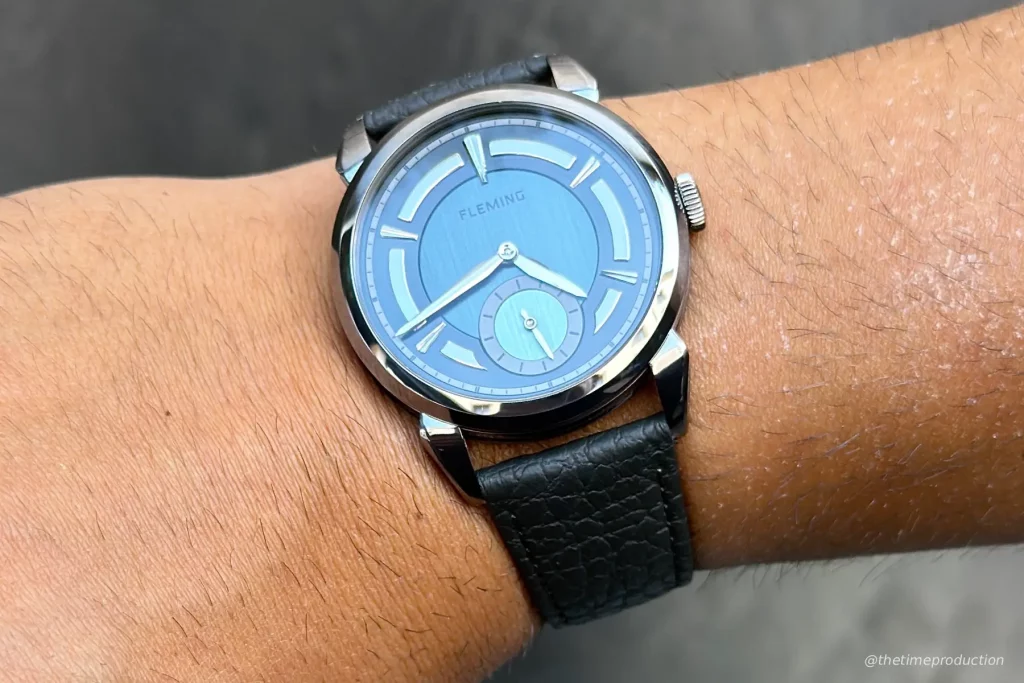
For this Series 1 Mark II Pacific, Fleming remains faithful to what already made its first creation so compelling, namely a case that is instantly recognizable and particularly refined in its construction. Here rendered in dark tantalum, it retains fairly classic dress watch proportions on paper, with a 38.5 mm diameter and a thickness of just 8 mm, yet its execution feels resolutely contemporary. At first glance, it is above all the lugs that catch the eye. They are extremely successful and immediately give the case a distinct identity. Hollowed out in profile, they visually lighten the whole while allowing more light to pass through, further reinforcing the sculptural dimension of the watch. I also really liked the small polished ring framing the dial, which echoes, in its curvature, certain elements found on the dial itself. This kind of detail may seem discreet at first, but it contributes precisely to that sense of overall coherence that appears to guide the entire Fleming project.
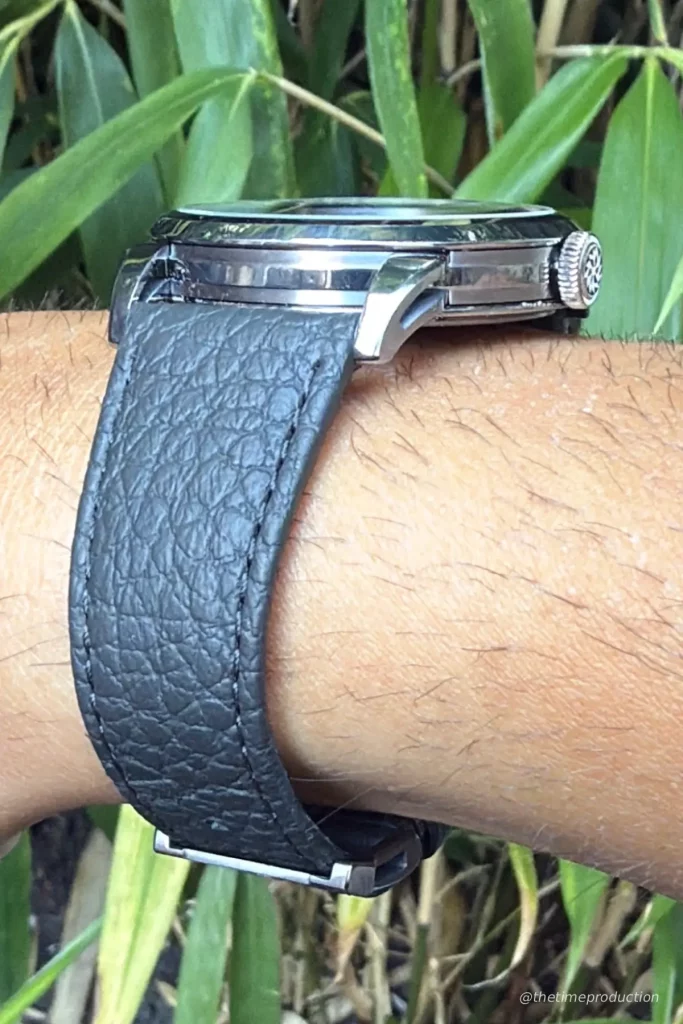
On the wrist, what struck me most was the comfort. The lugs are clearly very well thought out and allow the case to sit naturally against the skin. You can tell this was not left to chance, especially since the brand explains that it produced numerous 3D-printed prototypes in order to perfect the way the watch sits on the wrist. But beyond comfort, what I found particularly successful is the way the case reveals itself in profile. The construction of the case middle is, in my view, one of its most appealing aspects. Between the brushed surfaces and that polished central band running visually through the entire case, you really get the impression that material has been removed all around the case middle, almost naturally extending the work done on the hollowed lugs. The result is very fluid, very considered, and above all very lively under the light.
This ability to play with light is in fact one of the case’s greatest strengths. With its various angles, contrasting finishes, and sharper transitions on this Mark II, it genuinely changes character depending on the angle from which you observe it. Fleming explains that it refined and sharpened the geometry of the case compared with the first iteration, with more precise transitions between the surfaces, and that is something you can feel. This is not a revolution compared with the Launch Edition, but rather a further refinement, a measured evolution that gives the whole an even more accomplished presence. I also found the crown very pleasant to handle. Despite being small and relatively slim, it offers a very good grip while also bearing the brand’s logo.
Beyond the design itself, it is also worth highlighting the level of difficulty involved in working with tantalum. Known for being particularly demanding to machine, this metal required more than two and a half years of development, along with new tooling, new machining parameters, and new finishing techniques. What can be done with gold or platinum cannot necessarily be done with tantalum, whose malleable structure puts significant strain on tools and can even, if insufficiently lubricated, cause ignition during machining. For this, Fleming relied on Efteor, a Swiss specialist known for its expertise and also responsible for cases for brands such as Greubel Forsey. Once again, this says a great deal about the ambition behind the project. The case of this Mark II is not trying to impress through gratuitous complexity, but through genuine coherence between design, comfort, execution, and interaction with light. And in my view, that is precisely what makes it so fully consistent with Fleming’s identity.
Dial
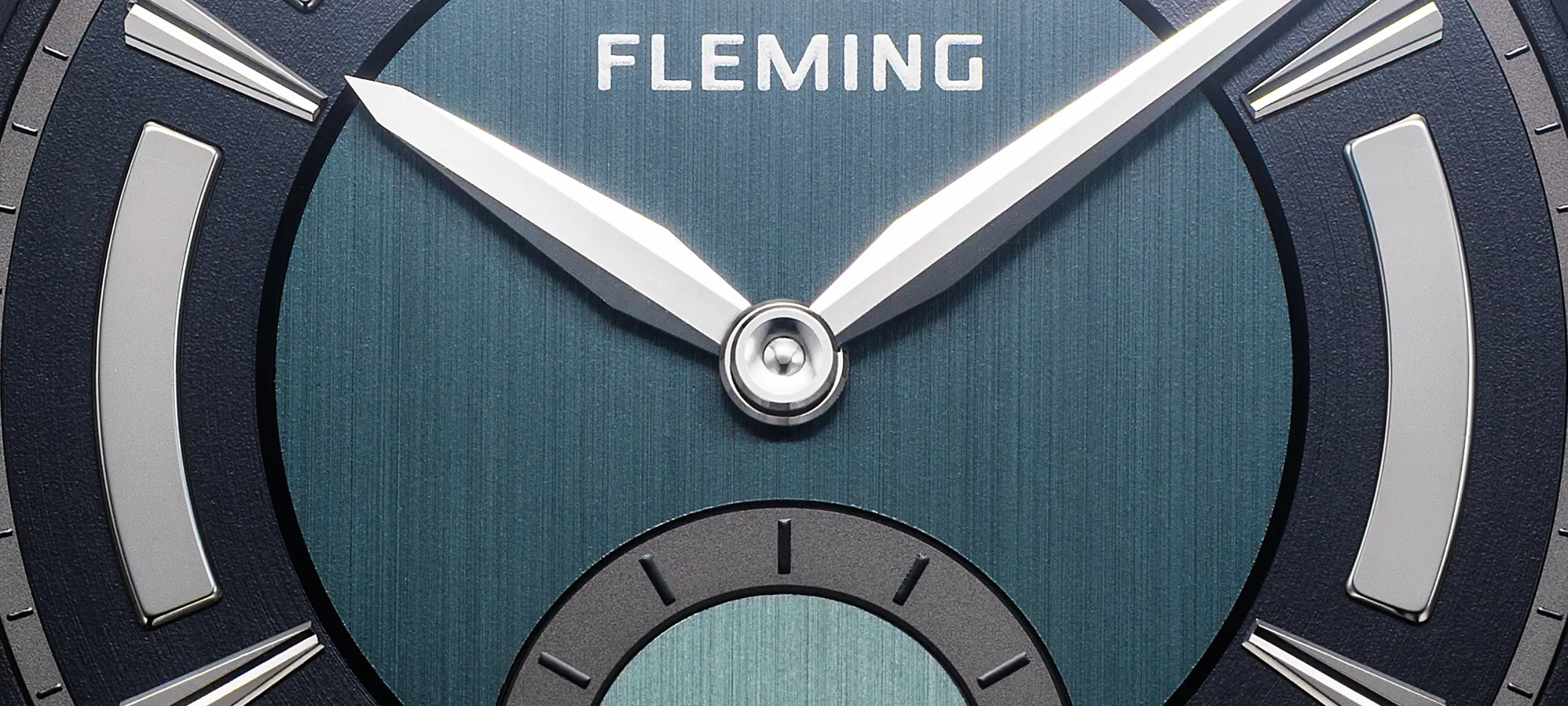
To my eyes, the dial of this Fleming Series 1 Mark II Pacific is one of the most successful elements of the watch. From the very first glance, what stands out most is its especially changeable character. More than just a surface, this dial seems to truly evolve with the light, revealing or concealing its architecture depending on the angle from which it is viewed. That is probably what makes it so memorable as well. Between the different shades of blue, the contrasts in finishing, and the polished elements punctuating the whole, you constantly feel as though you are looking at a living dial. Under softer light, it can take on darker tones, shifting from steel blue to deeper nuances, while in full light it becomes far more vibrant, almost moving, with reflections that genuinely evoke something aquatic. It is not a literal ocean-inspired dial, but rather an atmospheric interpretation, and that is precisely why it works.
That sense of depth comes in large part from the work done on the architecture of the dial itself. Fleming reprises the sector layout of the first Series 1 here, but pushes it noticeably further. The main dial and the small seconds subdial feature a vertical brushing, while the outer portion adopts a circular brushing, which already helps visually separate the different areas more clearly. Added to this is a polished black sector ring that brings even more relief to the whole. Depending on the light, this ring can almost disappear or, on the contrary, become highly present with a particularly attractive mirror effect. I also really like the way the dial’s different polished sections echo the case. There is a real visual continuity between the two, which further reinforces this idea of total integration that Fleming places at the heart of its project.
In terms of legibility, the dial works very well too. The faceted, polished, applied hour markers each catch the light in their own way, while the hands, reworked with new facets and black polish, stand out perfectly against the dial. The whole remains very legible despite the richness of its execution. If I had to nuance one point, I would say that on the outer minute track, the markers indicating certain hours could perhaps have been made slightly more visible. It is a fairly minor detail given the overall quality of the work done on the dial, but it is probably the only point on which I would have liked a little more visual presence.
What I also like about this dial is that it clearly carries over the DNA of the first Series 1 while making you feel you are looking at something new. The major codes of the first iteration are still there, notably in the organization of the different levels and the presence of the subdial, but the whole has been reworked intelligently enough to deeply transform the perception of the watch. Factually, this is very much a continuation of the first model, yet visually these evolutions are enough to give this Mark II a personality of its own. And that is probably where this dial is most convincing: it remains faithful to Fleming’s universe while bringing a more mature, more layered and, in my view, even more distinctive execution.
Movement
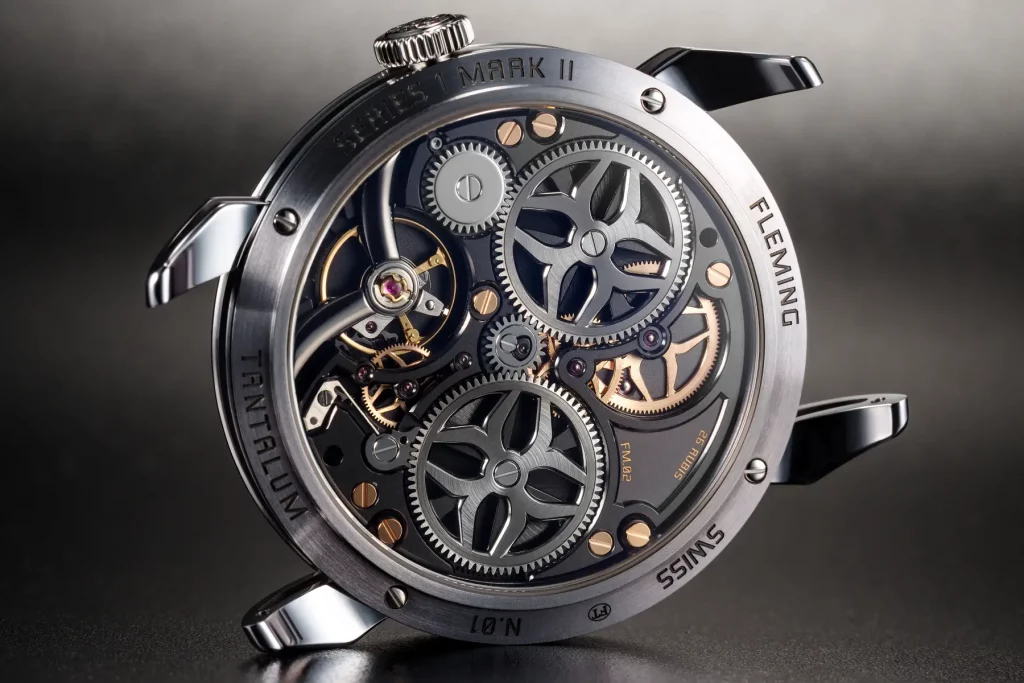
Turning the Series 1 Mark II Pacific over, Fleming has chosen to preserve what already gave solidity to its first proposition while pushing the execution noticeably further. We find a hand wound movement developed in close collaboration with Jean-François Mojon, whose underlying architecture is based on Chronode’s C101 caliber, a movement that is both slim and elegant, while also offering a generous power reserve. But the interest here does not lie simply in the use of a proven movement. What I find especially successful is the way this caliber has been reworked to integrate fully into the watch, rather than appearing as a simple engine fitted into the rest of the construction.
That is, to my eyes, exactly what gives this movement its real value. With the new FM.02 caliber, Fleming is not simply trying to offer a beautiful movement visible through an open caseback, but rather to extend the same design logic and sense of coherence that already structure the case and the dial. The bridges have been redesigned, the overall openness has been reconsidered, the forms have gained fluidity and sculptural presence, while certain wheels and the click have been entirely reworked in order to echo the curved silhouette of the hollowed lugs. This way of making the different elements speak to one another is, in my opinion, one of the most interesting aspects of the Fleming project. Here, the movement is not conceived as an autonomous element simply to be admired from the back of the watch, but as a third layer completing the whole.
What a serious collector should above all retain, then, is this dual reading of the FM.02. On the one hand, it rests on an architecture developed by Jean-François Mojon, which in itself already provides an extremely credible foundation. On the other, it has been extensively reworked to better match Fleming’s own identity. And that is immediately visible in the execution. I really liked the interplay of contrasts between the different tones, from anthracite grey to darker elements, with certain warmer accents subtly animating the whole. The finishes also contribute strongly to the visual interest of the movement, combining brushing, graining, frosting and polishing in a way that creates depth without ever falling into excessive demonstration.
That is in fact what I appreciate most here: Fleming never overdoes it. The movement is very well finished, very coherent and very detailed, but without trying to impress through overly emphatic decoration. The anglage, the work on the custom wheels, and the care given to components whether visible or not show that a real effort has been made, especially with the finishing work carried out with Manufactor SA. But all of this remains in service of a sober, legible whole that is perfectly aligned with the spirit of the watch. In that sense, the FM.02 strikes me as a real success, not only because it brings genuine horological value to this Mark II Pacific, but above all because it intelligently extends the philosophy of total integration that Fleming has defended since the beginning.
Strap
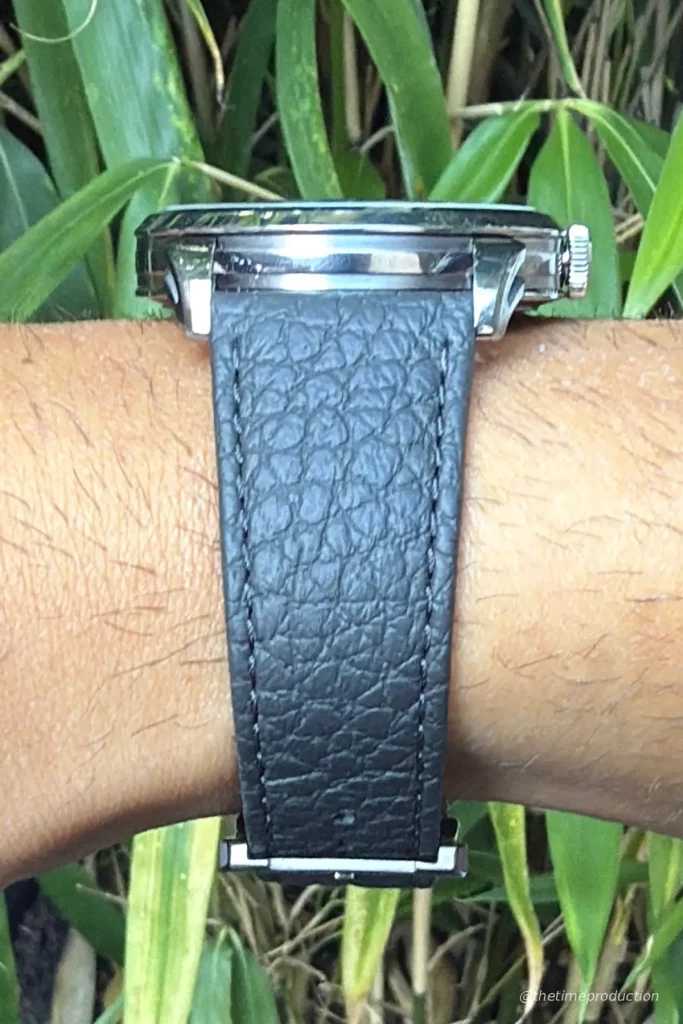
To accompany this Series 1 Mark II Pacific, Fleming has opted for a calfskin strap that feels particularly coherent with the overall spirit of the watch. Without trying to steal the spotlight from the case or the dial, it complements the whole with accuracy and plays a full part in the overall balance of the piece. On the wrist, I found it very comfortable, with a natural feel that further reinforces how well the watch sits overall. It may not be the most spectacular element of this Fleming, but it performs its role perfectly and clearly contributes to the watch’s overall comfort.
Where this strap becomes more interesting is precisely in the way Fleming has treated the details that accompany it. The pin buckle, made of tantalum, is in my view one of the most successful elements of this part of the watch. First because it subtly reprises the shape of the lugs, once again extending this idea of total integration that can be found throughout the watch. Then because it avoids the pitfall of the standard, personality-free buckle that is too often found on pieces with far greater ambitions. Here, Fleming has taken care to follow its approach all the way through by proposing an original, well-designed buckle signed with the brand’s logo.
That is exactly what I appreciated here: even on a more secondary element like the strap, the brand never gives the impression of treating any detail lightly. Everything remains coherent, comfortable and well thought out. There is not much for me to regret here, as the strap fulfils its role very well. It accompanies the watch discreetly while also bringing, thanks to its buckle, a real aesthetic continuity with the rest of the piece.
What is the price of the Fleming Series 1 Mark II Pacific?
The Fleming Series 1 Mark II Pacific is priced at CHF 55,500, in a limited run of 25 pieces. It is available now, with first deliveries scheduled to begin in April. Each watch is delivered in a redesigned presentation box, accompanied by a removable travel pouch, two calfskin straps, and a Fleming pin buckle.
At this price level, the competition is obviously significant, particularly in independent watchmaking where collectors now have access to a wide range of propositions, sometimes backed by names that are already well established. Even so, this positioning feels coherent with what Fleming is offering. Between the complexity of the tantalum case, the level of development invested across the entire watch, the collaboration with first-rate Swiss partners, and the visible care brought to the overall execution, this is clearly a piece whose price fits logically within a certain tier of contemporary independent watchmaking.
To my mind, this Series 1 Mark II Pacific is therefore not aimed at a first-time buyer or someone simply looking for a dress watch in this price bracket. It will speak more to collectors who already have a certain level of horological culture, who are sensitive to emerging projects, and above all who respond to the very particular design language developed by Fleming. Because that is probably where everything comes down to: either you connect with this vision of integrated design, with this very specific way of working with light, volumes and coherence between the different elements, or you will remain more at a distance.
Fleming Series 1 Mark II Pacific: a brand beginning to assert its identity
With this Series 1 Mark II Pacific, Fleming confirms, in my view, all the promise its first iteration had already shown at launch. I had really liked the Launch Edition, but this Mark II above all gives me the feeling of seeing a watchmaking project gradually evolve into a true brand, with a DNA that is beginning to take clearer shape. And that is probably one of the most interesting aspects here. Beyond the intrinsic quality of the watch itself, you can feel that Fleming is not simply trying to evolve a model, but to build a coherent, identifiable and lasting universe.
What I particularly appreciated about this Series 1 Mark II Pacific is, of course, its design, but also the way each element seems to have been conceived in relation to the others. The case, the dial and the movement never feel as though they were assembled to answer separate functional or aesthetic concerns. On the contrary, everything seems to have been designed as a coherent whole, where the choices of proportions, finishes, light and architecture all respond to the same intention. To me, that is precisely what gives Fleming’s proposition its real strength. The watch is visually rich, constantly changing, highly worked, yet it never falls into gratuitous effect.
If I really had to qualify one point, I would simply say that on the prototype I handled, the anti-reflective treatment did not seem entirely on par with the rest of the execution. That remains a fairly minor detail, especially since it is entirely possible that this point will be improved on the final versions. Aside from that, the watch struck me as particularly well resolved in its construction, its comfort and the overall coherence of its proposition.
Finally, it is difficult to close this article without mentioning what comes next. And on that front, I have to say I feel quite confident about Fleming. The brand seems to have a clear vision, a real consistency in the way it builds its products, and above all a desire to remain in a high-end artisanal segment where it can continue experimenting with the techniques that inspire it. The upcoming projects, such as the Series 1 “Ghost” developed with Casper Ruud, as well as the brand’s next developments, make me particularly curious. Fleming is also moving within an interesting dynamic today, notably through its growing proximity to other players I admire greatly, such as Ming and J.N. Shapiro within the AHA. If that logic of synergy continues in an intelligent way, I genuinely believe Fleming’s future creations could prove even more compelling than the ones we have seen so far.
Fleming Series 1 Mark II Pacific – Watch Specifications
- Brand: Fleming
- Model: Series 1 Mark II “Pacific”
- Case Material: Tantalum
- Dial: Silver: Blue-Green Modern Sector Dial with black-polished ring, applied hour markers, and mix of brushed, grained, and black- polished finishes.
- Functions: Hous, Minutes, Small Seconds
- Movement: FM.02, Hand-Wound, 21’600vph frequency (3Hz), 26 jewels and 394 parts
- Power Reserve: 168 Hours (7 days)
- Water Resistance: 3 ATM
- Crystal: Sapphire
- Case Back: Sapphire
- Case Dimension: 38.5mm (Diameter) × 8mm (Thickness) (9mm w/ domed crystal)
- Lug-to-Lug: 46.5mm
- Strap: Two calf with Tantalum Pin Buckle
- Availability: Limited edition of 25 pieces
- Retail Price: CHF 55,000 (excluding VAT)
What do you think of this Fleming Series 1 Mark II Pacific? Did this distinctive design and level of execution appeal to you as much as they did to me? Let me know your thoughts in the comments.
If this article added value or sparked a discovery, you can support the project HERE. Your contribution helps me keep weekly articles and a biweekly newsletter free, accessible, and independent for everyone.
For more information about Fleming, click here.