Today, I would like to talk about a young independent Chinese watchmaking house whose trajectory clearly deserves a closer look. If I say Beijing designers turned watchmakers, remontoir d’égalité with deadbeat seconds, and Louis Vuitton Watch Prize semi-finalist, the more informed among you may already have recognised Mineroci and its RD002. Before presenting this watch in more detail, let me first go back to the people behind the project, the way their passion took shape, the path that led them from industrial design to watchmaking, and the broader ambition that now seems to drive each of their creations.
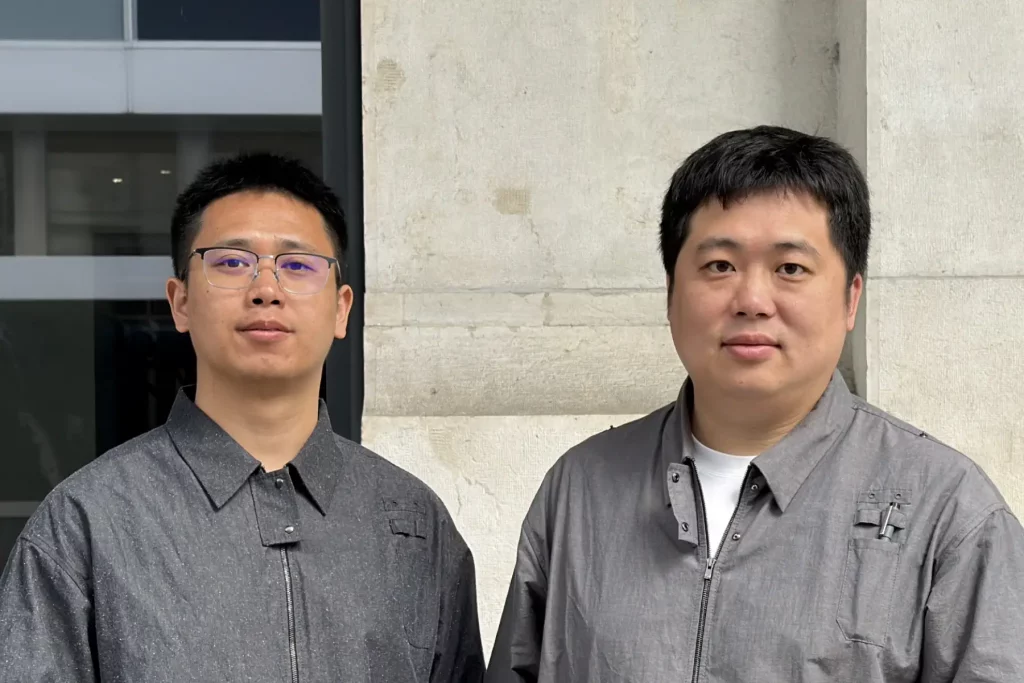
I also had the opportunity to meet Chang Qu for the first time at Dubai Watch Week, then to see Chang again and meet Pan Zhengyan during Watches and Wonders 2026 thanks to my friend Henri, which allowed me to better understand the logic of their project, the way they work, and the rather singular coherence of their approach. Because what strikes you immediately with Mineroci is precisely the fact that nothing in their original background really destined them for traditional watchmaking in the way we usually understand it. Both founders come from industrial design, product conception, and engineering applied to everyday objects, much more than from the classical watchmaking establishment.
Chang Qu’s profile is especially interesting in that regard. Born in 1988, he trained as a designer. After finishing his studies, he joined Intel’s R&D centre in China in 2010, before leaving the company a little over a year later to launch his own business specialising in virtual reality applications. That first entrepreneurial venture ended successfully when the start-up was sold roughly two years later. That first success matters, because it gave him both financial means, a certain credibility, and no doubt the confidence needed to consider a more ambitious and more personal project afterwards.
In 2014, Chang Qu joined forces with Zhengyang Pan, a designer five years younger than him, to found Roci Design in Beijing. At the beginning, this was not a watchmaking project, but an industrial design and product development studio specialising in product design, mechanical and structural design, interaction, prototyping, project management and industrialisation. The studio worked in particular for the Xiaomi ecosystem, designing numerous consumer products, connected devices, domestic accessories, lifestyle products and smart home related objects. Their structure also received several international distinctions, including Red Dot Design Awards and iF Design Awards. This industrial design background is essential to understanding Mineroci: their approach is not that of traditional Swiss watchmakers, but of creators used to thinking of objects as complete systems, with a strong focus on structure, formal clarity, engineering, and user experience.
But behind that professional background, there is also a more intimate and older passion, and this is where watchmaking truly enters the picture. Chang Qu and Zhengyang Pan had both long been passionate about pocket watches. These were not necessarily expensive pieces, but objects that were often fascinating because of their architecture, their size, and sometimes even their complications. Like many Chinese collectors, they were drawn to pocket watches because they offered access to more interesting, more visible, and sometimes more complex horological constructions at price levels that were still relatively accessible. And it was largely this passion that gradually led them toward watchmaking.
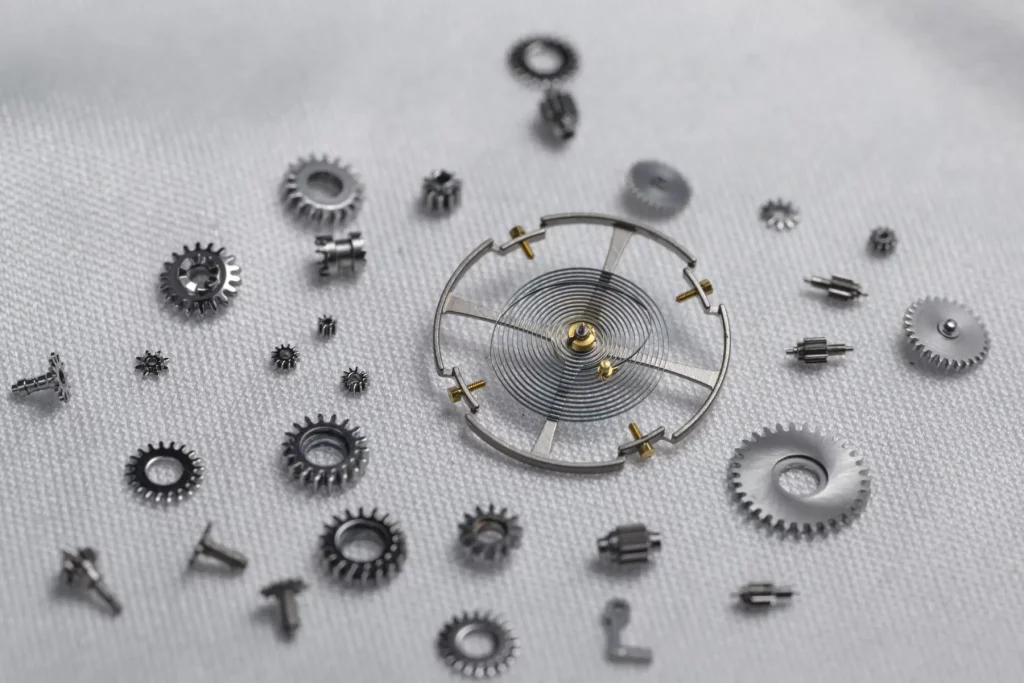
Around 2018, Chang Qu began exploring watchmaking much more seriously. Their point of entry is especially revealing of their method: they did not start by sketching a case or imagining a dial, but by developing a proprietary software for designing mechanical movements. Their first objective was therefore not purely aesthetic, but structural. They wanted to create a tool capable of helping them design their own mechanical architectures. The development of that software took around two years. And in order to demonstrate its capabilities, they then decided to create a real mechanical calibre.
From that point, the project changed scale. They took the architecture of the Unitas/ETA 6498 as a base, then redesigned almost everything else. They recruited two watchmakers, but remained directly involved themselves in the production, assembly, decoration and polishing of many components. At the same time, the team experimented extensively with dials, exploring stone, aventurine, meteorite, guilloché, cloisonné enamel, varied textures, and more openworked dial constructions. According to the available information, they developed more than 100 dial designs and over 50 physical prototypes. This phase says a lot about their personality: they were not simply trying to release a first watch, they wanted to learn, understand, test, and build a language.
These efforts led to the launch in 2023 of the brand’s first model, the RD001, under a new name: Mineroci, which can be understood as “Our Roci.” This first watch, produced in a limited edition of 99 pieces, is in many ways a school watch. It serves at once as a proof of concept, a learning field, and an experimental base. Equipped with a hand-wound manufacture movement, a small seconds display and around 52 hours of power reserve, it already offered a significant level of customisation, with numerous dial options and several movement finishes. The RD001 allowed them not only to validate their ability to design and produce a coherent watch, but also to meet Chinese watch enthusiasts and better understand their expectations.
But the real change of dimension comes with the RD002. This is where you feel that Mineroci enters another category. The project is no longer simply about proving that they can make a watch, but about proposing a far more ambitious piece of high watchmaking, combining a remontoir d’égalité, deadbeat seconds, a symmetrical architecture, and an openworked movement itself conceived within that same logic of symmetry. For a young Chinese structure, and one founded by self-taught creators coming from industrial design rather than traditional watchmaking, the approach is already impressive in itself. And that is precisely what makes this project so interesting: the RD002 marks their entry into a much more serious, more assertive, and also riskier form of independent watchmaking.
This watch also carries very legible horological influences. During a visit to the Patek Philippe Museum in Geneva in June 2024, Chang Qu was struck by a marine chronometer by Ferdinand Berthoud and Jean Martin dating from 1804, particularly by its two-tone guilloché, its finishes, and the very prominent central seconds hand, an element that was historically essential for precise navigation. One can also perceive echoes of George Daniels in the way they structure the movement and think about the object. In other words, the RD002 is not just a technical demonstration born from efficient software. It is also a watch nourished by a real horological culture, by the study of historical objects, and by a clear desire to elevate the standing of Chinese watchmaking.
Mineroci’s selection among the 20 semi-finalists of the Louis Vuitton Watch Prize for Independent Creatives with the RD002 also confirmed that their work was beginning to be viewed differently. And this is probably only the beginning. Because beyond the watch itself, what is taking shape here is the trajectory of a project born outside traditional codes, carried by two designers turned watchmakers, passionate about pocket watches, obsessed with structure, design and mechanics, and determined to propose another reading of what Chinese independent watchmaking can become. Now, let us turn to the presentation of this watch.
Table of Contents – Mineroci RD002
What are the key features of the Mineroci RD002?
Case
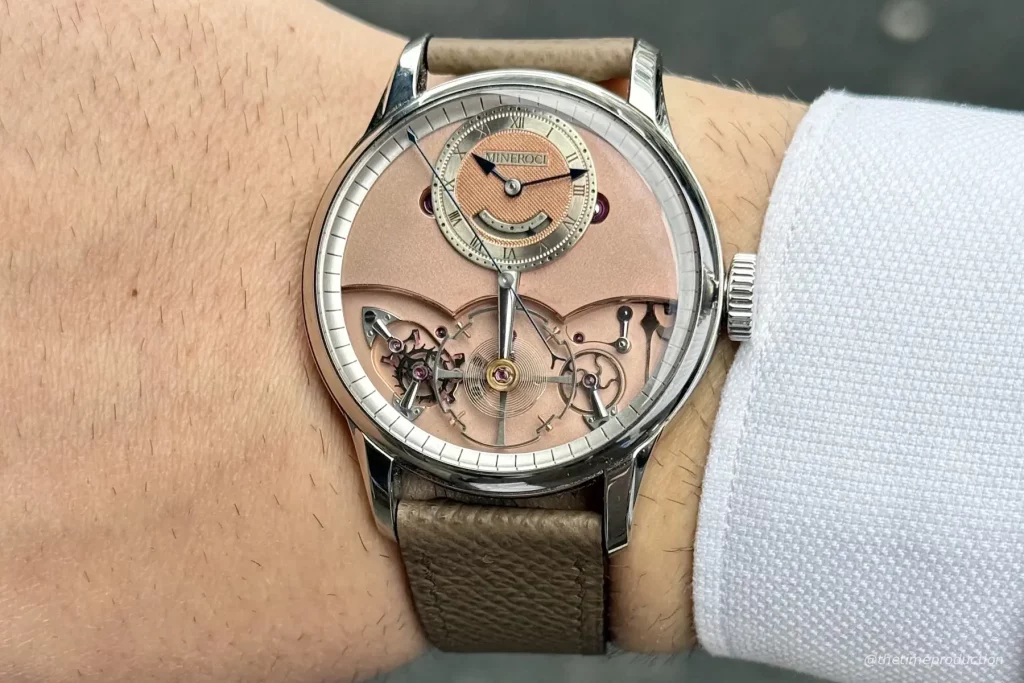
For this Mineroci RD002, Chang Qu and Pan Zhengyan chose a case with particularly well-balanced proportions, measuring 38.5 mm in diameter and 9.8 mm thick. And that is probably what struck me first on the wrist. This is a watch that sits very well, with a restrained format, almost classic on paper, yet it still retains real presence. That impression comes in large part from the lugs, which I found fairly long and which I had not necessarily perceived as such in the photos. The fact that they drop slightly below the caseback allows the watch to sit well on the wrist while giving the overall silhouette a little more character.
What I also appreciated was the overall coherence of the design. The prototype I was able to see was in steel, whereas the delivery version is planned in platinum, but even in this provisional execution, you can already feel that a great deal of work has gone into the shaping. The case is fully polished, with a very clean, very legible construction, almost very classical in its approach. There is something quite restrained and effective about it, with no desire to overplay stylistic effects. And in the end, that fits rather well with the way they seem to conceive objects: a clear, functional, well-proportioned form, with an aesthetic that remains discreet but structured.
I also found the work done on the lugs interesting. They are fairly long, but they do not throw the watch off balance. On the contrary, I think they bring real harmony to the whole. With shorter lugs, the 38.5 mm case might perhaps have looked a little too compact visually. Here, that extra length allows the design to breathe better and gives the watch a more natural presence on the wrist. There is also a slight effort to taper them, which keeps them from looking too massive despite their length.
If there is one point I would qualify, it would probably be the crown. I found it a little too large on this prototype, and I also regret that it was not signed. That said, Chang told me that the final version would have a slightly smaller crown, which seems to me to be a good decision. Because beyond that aesthetic reservation, the rest of the case felt very well thought out. I notably appreciated the large opening on the back, which allows the movement to be properly seen, something that obviously makes perfect sense on a piece of this kind.
This case therefore feels entirely coherent with the overall identity of the watch and the project. There is something very classic in its construction, almost a form of restraint, but it works precisely because it leaves all the space to the architecture of the dial and the movement. If one looks at the case in profile, and especially if one mentally removes the lugs, one can even see something that faintly recalls certain pocket watches. And in the end, that seems fairly logical for a house whose world has been nourished precisely by that culture. It may not be a demonstrative case, but it is an effective, well-thought-out and coherent one, which is ultimately what matters here.
Dial
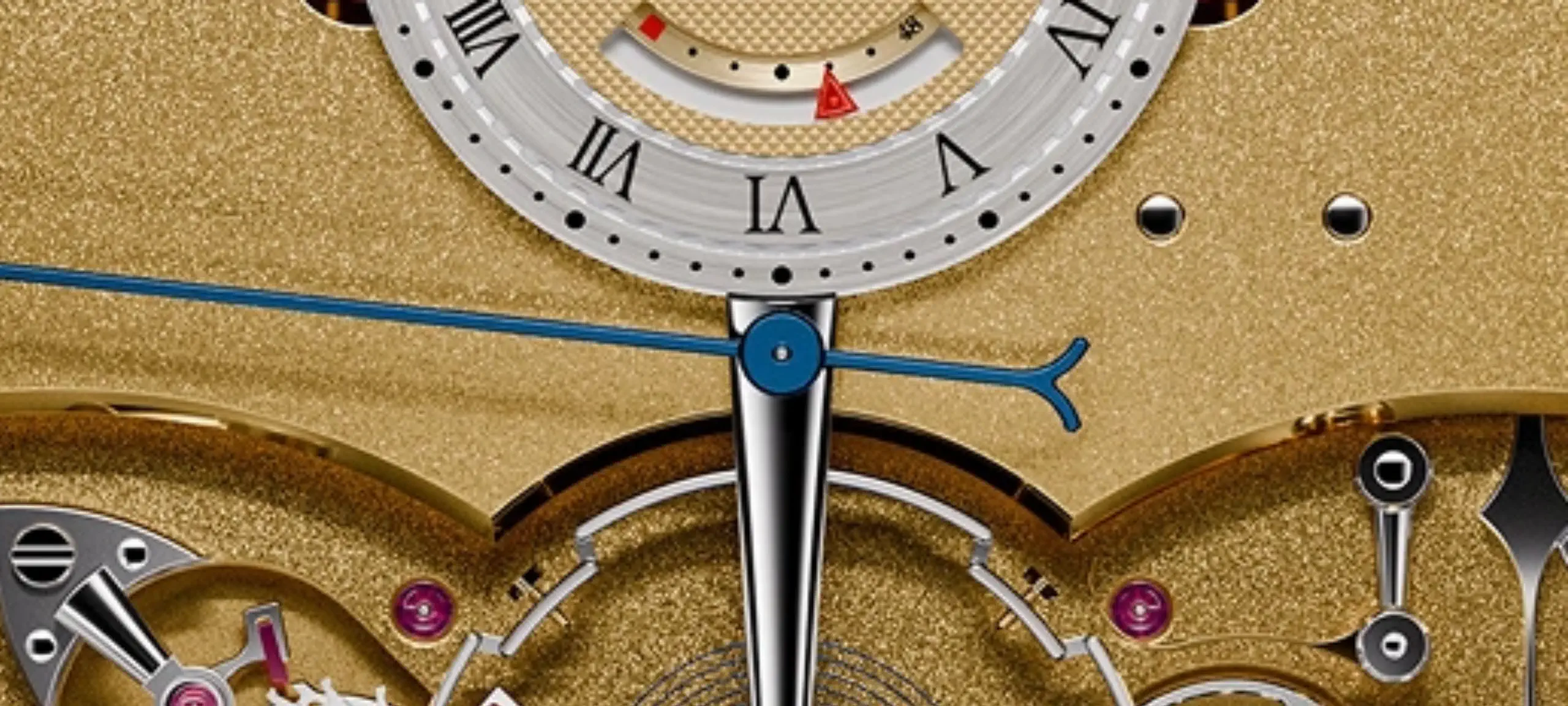
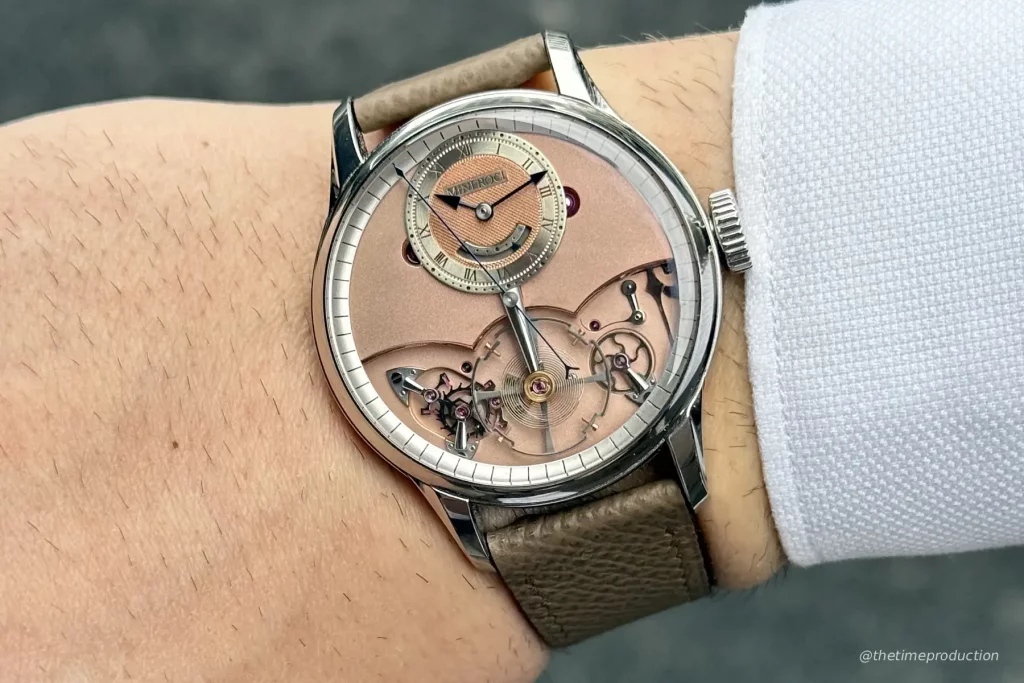
The dial of this Mineroci RD002 is, in my view, one of the most impressive elements of the watch. And what strikes me most here is the way it manages to bring together several registers that seem very different at first sight within a composition that remains extremely coherent. On one side, there is a genuinely classical small dial at 12 o’clock, with the display of hours and minutes, its arrow-shaped hands, its guilloché centre, its more satin-finished outer ring, and its Roman numerals, all of which immediately reinforce the chronometric and traditional anchoring of the piece. On the other side, the entire lower section opens onto the mechanics, with that large openworked area that reveals the regulating organ, the escapement and part of the movement’s kinematics. And it is precisely this meeting point between classicism and technicality that, in my opinion, makes this dial so strong.
What I particularly liked is the overall symmetry of the composition. Visually, everything feels very right. The small upper dial immediately structures the reading, while the lower part brings depth, motion and life. You can feel that there has been real work on balance in the way the volumes have been distributed. The main plate plays an essential role here. On its upper section, it remains relatively solid, with only two openings revealing jewels on either side of the dial. Then, halfway down, it is interrupted by an extremely elegant separation, composed not of a straight line but of several curves that create a far more organic visual transition between the closed and open sections. I found that very beautiful, and above all very intelligent. It avoids any harshness in the reading of the dial and instead allows the whole composition to breathe.
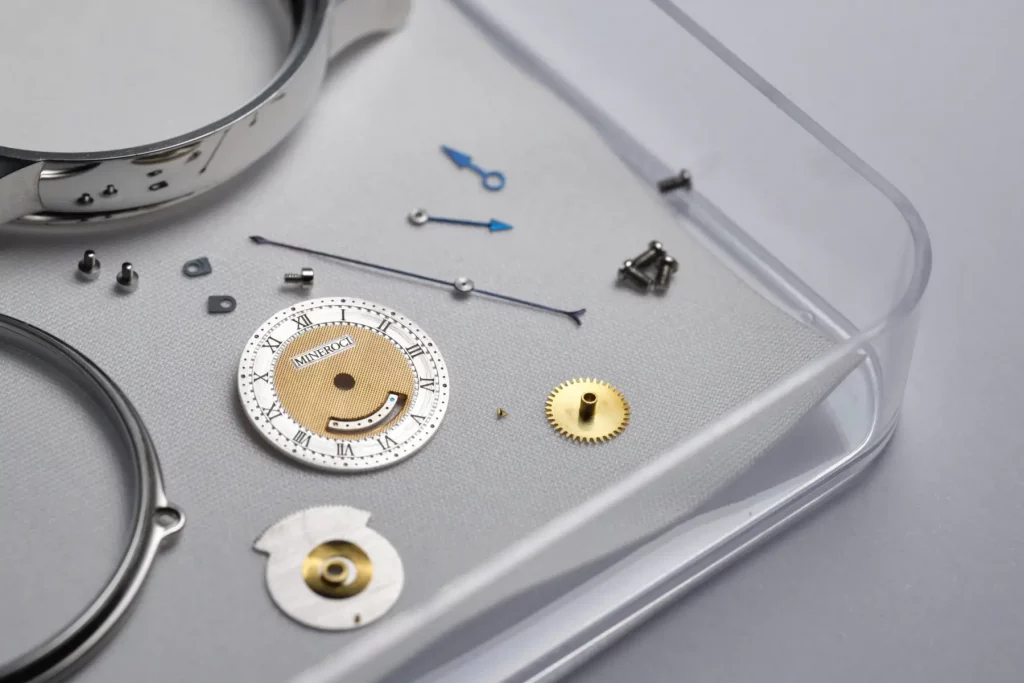
From that break onward, the lower part opens up and reveals the mechanics with great clarity. And that is where the dial becomes truly fascinating. One gets the impression that the movement has been displayed in an almost didactic way, leaving the essential elements visible without unnecessary overload. Nothing feels gratuitous. Every highlighted component seems to be there to tell something about the watch, its precision, its construction and its technical logic. The central balance, the visible wheels, the escapement, the large central deadbeat seconds hand: all of this creates a permanent animation that gives the watch real presence on the wrist. This is not simply an open dial for the sake of spectacle. It is a dial that stages the mechanics with a great deal of control.
The other major strength, to my mind, lies in the work done on the levels. Nothing is flat here. The small hours and minutes dial seems to sit above the plate, the various rings that compose it each have their own treatment, the hands stand out clearly thanks to their small central cap, itself very well integrated, and the peripheral white chapter ring dedicated to the seconds creates a very subtle transition between the dial and the case. I particularly liked the fact that this chapter ring is not completely flat, but slightly raised. It is a detail, but it contributes a great deal to the visual softness of the whole and to the junction with the polished case. You can feel that nothing has been left to chance.
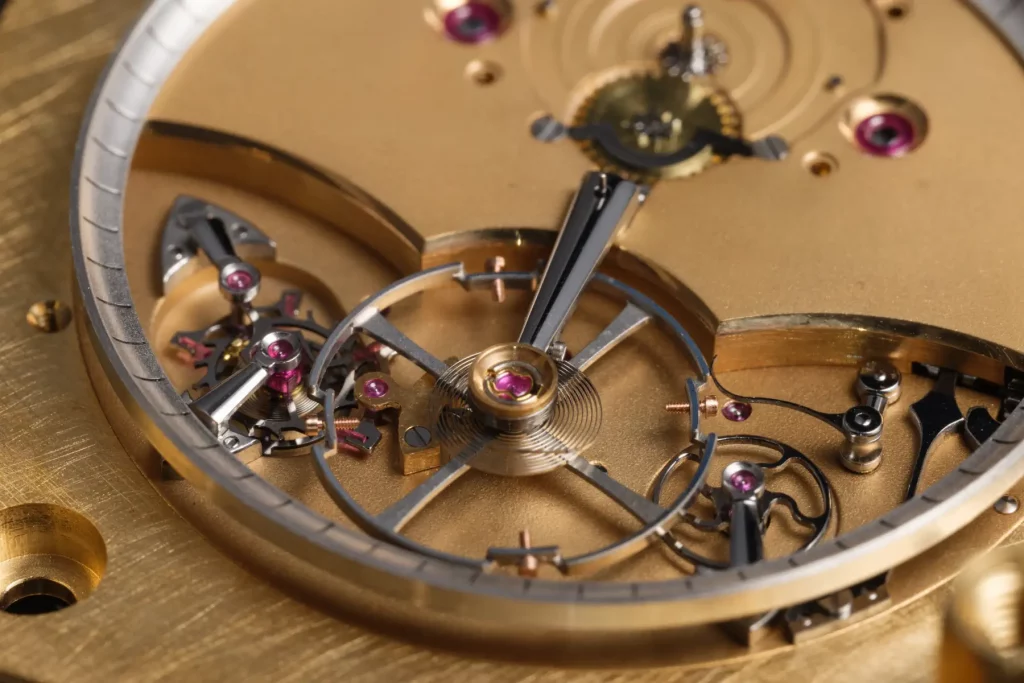
In terms of finishing, I found the whole extremely attractive. The blend between the guilloché on the small dial, the circular brushing of certain elements, the grained finish of the plate and the more polished surfaces works very well indeed. There is also a beautiful harmony of colours. The guilloché section and the centre of the dial have that slightly warm, almost coppery tone that I found particularly successful. Around that, one finds cooler, more silver-toned shades, while the purple jewels punctuate the composition very elegantly. This palette gives the dial genuine visual richness without ever drifting into excess.
Another thing that works very well, in my opinion, is the legibility. Despite the apparent complexity of the watch, reading the time remains clear thanks to the small upper dial, which immediately draws the eye. That is a real strength, because it allows the RD002 to be both spectacular and readable. You can admire it as a complex horological object, but you can also read the time without any particular effort. And that duality is not so easy to achieve.
In the end, I think this dial brings something truly distinctive within its category. It does not merely aim to be beautiful or demonstrative. It tells on its own a large part of the Mineroci project: the dialogue between tradition and innovation, the taste for marine chronometers, the search for symmetry, the sense of construction, and that very clear desire to reveal the mechanics without ever sacrificing elegance. And to my eyes, that is precisely what makes it so memorable.
Movement
The movement of this Mineroci RD002 is, in my view, one of the great strengths of the watch. More than that, it almost forms the intellectual and visual core of the piece. Here, one is not simply looking at a beautiful calibre or at a somewhat gratuitous technical demonstration. This movement brings real value to the watch because it structures both its identity, its architecture and its power of fascination. At first glance, you immediately understand that something is happening. Symmetry is omnipresent, the reading is very constructed, and the whole gives that rare impression of a movement conceived as much as a mechanism as a true visual composition.
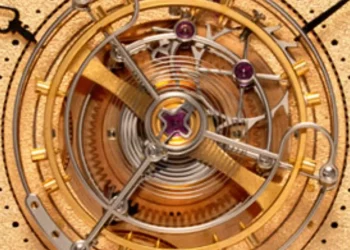
What a serious collector should retain first and foremost is precisely this architecture. From the beginning, Mineroci wanted to develop a perfectly symmetrical movement, visible both from the front and from the back, while integrating a constant-force remontoir d’égalité and deadbeat seconds. And it is precisely this combination that gives the RD002 such a distinctive dimension. One finds here a large 13 mm central balance wheel, positioned on the dial side, accompanied by a visible escapement, a remontoir d’égalité and a following wheel. All of it is part of a very strong composition, evoking at once certain historical references from Western watchmaking and a much more personal reading nourished by Chinese cultural elements.
That is also what I found particularly successful in this piece. Yes, one can clearly perceive the inspirations of George Daniels, Ferdinand Berthoud, and indeed great marine chronometers. You see it in the central role of the large seconds hand, in the movement’s construction, in the way so much visual weight is given to chronometric precision. But this is not a servile quotation. And that is where Mineroci becomes much more interesting to me than with its first model. On the RD001, one could still have had the impression of a project leaning heavily toward a certain kind of Swiss watchmaking language. Here, with the RD002, they go further. They are truly trying to integrate a part of Chinese culture into the architecture of the movement itself, notably through this dragon-head idea, which structures the visual reading of the calibre. And honestly, it works very well.
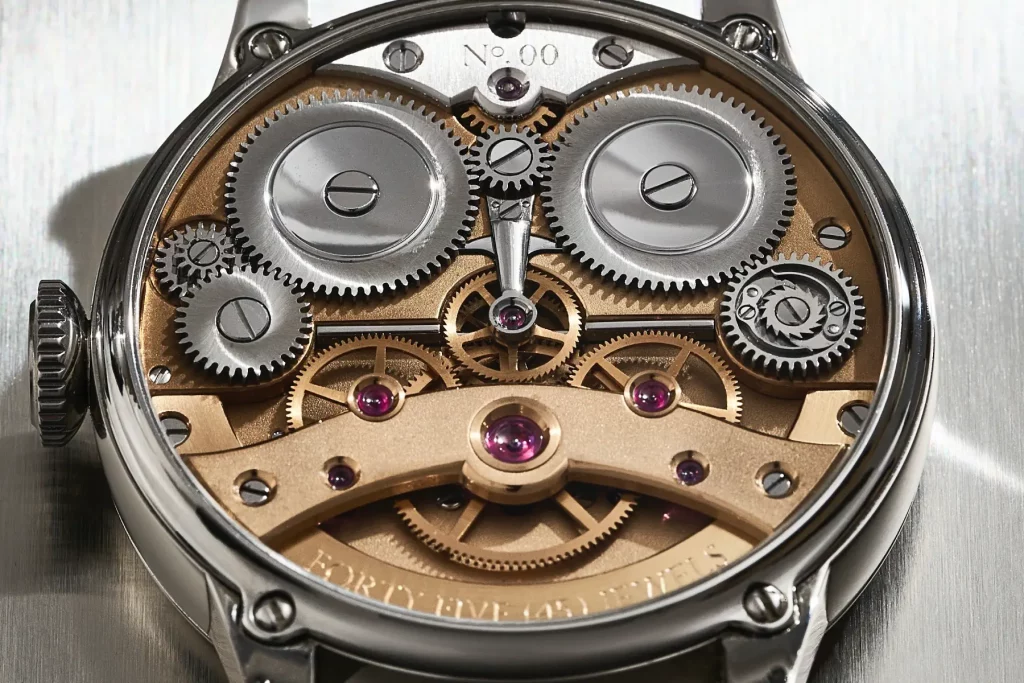
When one looks at the movement, one immediately notices this play between the different levels, the different colours and the different textures. The two barrels form something like two eyes, with this very specific treatment, almost like water droplets, which really made me think, in spirit, of certain finishes one can find with Simon Brette. Then there is that sort of large central bridge drawing a moustache or upper lip, while the more yellow wheels, almost brass-coloured, stand out differently from the rest. All of that truly brings the movement to life. There is a very strong visual reading, almost expressive, and I find that especially impressive for a piece that is still at the prototype stage.
On the technical side, the remontoir d’égalité is obviously one of the major elements. Positioned near the escape wheel, it isolates the balance from variations in mainspring torque in order to ensure a more constant flow of energy. Here it is associated with a Reuleaux triangle, a specific locking wheel, and an entire kinematic system that also makes it possible to achieve the central deadbeat seconds. It is a difficult, demanding complication, and the fact that they have managed to align each jump of the seconds hand perfectly with the markers truly deserves to be highlighted. It is in fact the kind of detail that can easily go unnoticed, even though it says a great deal about the technical seriousness of the project.
The movement also uses two barrels with Maltese crosses in a logic of improved torque management. The power reserve remains relatively modest, however, at around 38 hours, which is not a great deal today. That is probably the point I would qualify the most. But honestly, it does not worry me too much at this stage, because one can clearly feel that they are still in an optimisation phase and are already working to improve that aspect. And above all, what this movement offers in return, in terms of architecture, complication, visual coherence and personality, remains to my mind far more striking than that somewhat short power reserve.
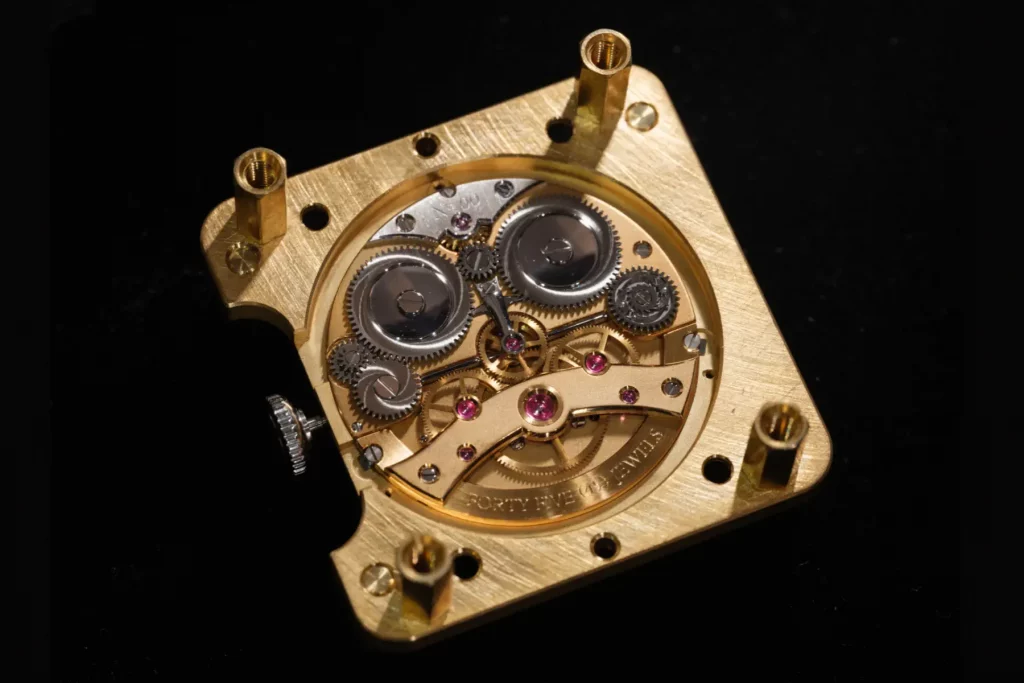
In terms of finishing, I found the level already very impressive for a second prototype, and even noticeably superior to what I had seen on the prototype presented in Dubai. Of course, everything will be even better on the final version, but one can already sense real mastery. The 18k gold bridges feature different textures, the sandblasted and satin surfaces dialogue very well with one another, the bevels are present, the screws are very well treated, and the whole already gives off a very strong feeling of seriousness. What I especially like is that the finishes are not there to disguise the movement. They are there to serve it, to highlight it, to accompany an architecture that is already extremely strong.
In the end, I find this movement absolutely central to the appeal of the RD002. It is what gives the watch its deep identity, what truly sets it apart, and what shows that Mineroci is moving into another dimension. Beyond a simple technical exercise, this calibre already tells a story: a desire to learn quickly, to move upmarket, to embrace very ambitious references, while trying to build a language of its own. And frankly, for a young Chinese structure still in an advanced prototyping phase, I find that extremely impressive.
Strap
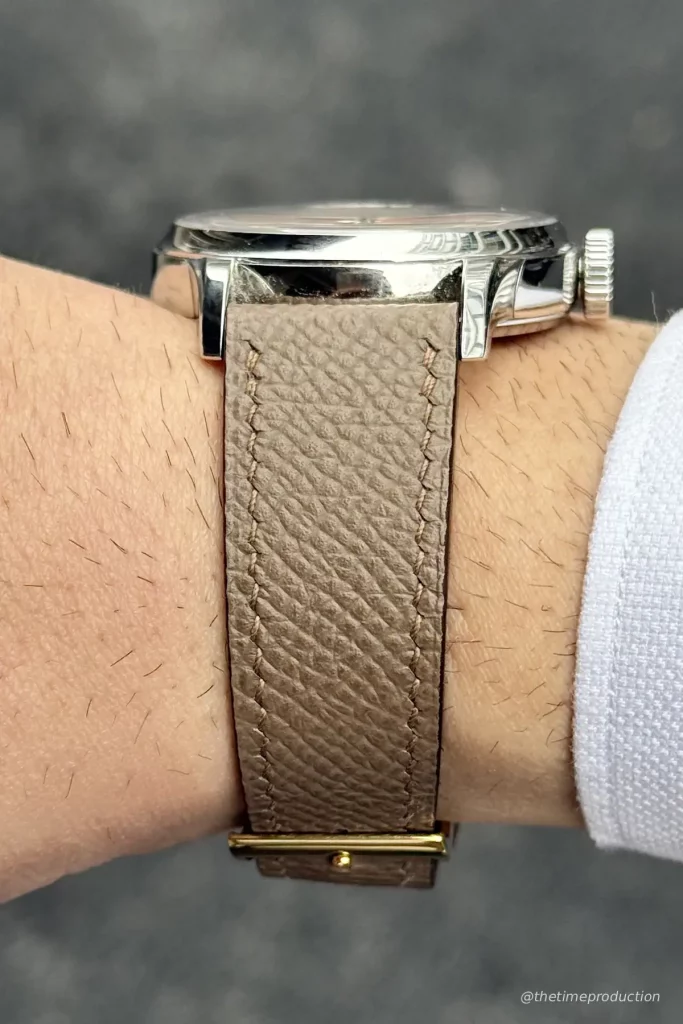
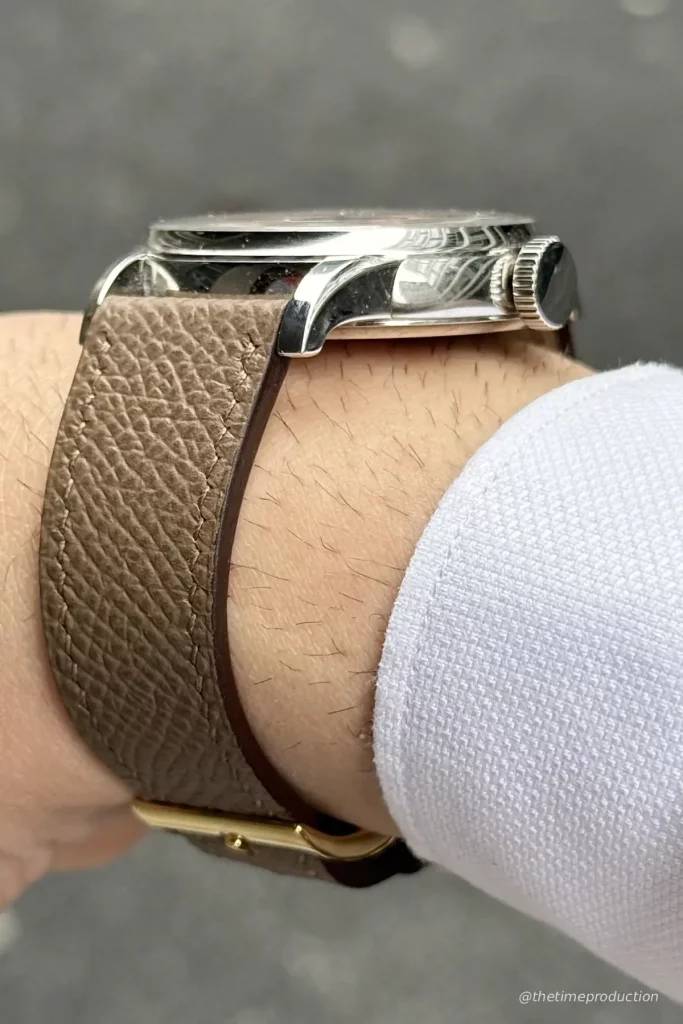
When it comes to the strap of this Mineroci RD002, one has to be honest: the example I was able to see did not really allow any proper judgement of the final result. It was clearly a prototype strap, fitted to accompany the watch at this stage of development, but not at all intended as a definitive execution nor as a representative element of the level the final piece is supposed to reach. In that context, I think it would be rather unfair to dwell too long on what I had in hand.
The strap fitted to the prototype was a simple, fairly standard leather strap, with no particular interest, and with a perceived quality that did not correspond at all to the overall ambition of the watch. Very frankly, it felt much more like something one could find on a far more accessible piece than on a strap truly coherent with a watch at this level. The buckle itself was not definitive either, and was not even in the right tone relative to the case. In other words, this was not a fully resolved stylistic choice, but simply a provisional solution.
Under these circumstances, the strap obviously did not reinforce the personality of the watch. It remained entirely secondary within the proposition, almost anecdotal, since it was very clear that it had no intention of reflecting the final product. And in the end, that is not really a problem at this stage. On a prototype, the essential thing lies elsewhere: in the fine-tuning of the movement, the dial, the overall ergonomics and the structural details. The strap will come later.
What should really be retained, then, is rather the announced intention for the final version. The RD002 is expected to be delivered with a brown embossed leather strap, paired with an 18k white gold pin buckle featuring alternating brushed and polished surfaces. On paper, that configuration already feels much more coherent with the spirit of the watch. And so it is really on that final execution that the true relevance of the strap should be judged, far more than on the provisional element fitted to the prototype I was able to see.
What is the price of the Mineroci RD002?
The Mineroci RD002 is priced at CHF 78,000 and will be produced in a limited edition of 21 pieces, numbered from 1 to 22 with the exclusion of number 14 for cultural reasons specific to China. The first deliveries are, at this stage, scheduled for 2027.
To my mind, this price positioning is coherent with the overall proposition of the watch, even if it will no doubt surprise part of the public at first glance. Not because of the piece itself, but because I think there is still a real educational effort to be made around Chinese watchmaking when it seeks to position itself at this level. Many people still instinctively associate a Chinese watch with a very different market segment, whereas here we are clearly talking about an object of independent high watchmaking, technically ambitious, visually very accomplished, and still in an advanced stage of refinement.
What one has to understand above all is that the RD002 is not conceived as just another watch in a catalogue. For Mineroci, it marks an entry into another category altogether, in terms of price, complexity, legitimacy and perception. It is the kind of piece that allows a young house to show that it is capable of playing in a different arena, one that is more demanding and also more closed, that of very high-end independents. And at this level, it is not only the price that matters, but also what the watch says, what it embodies, and the way it contributes to changing the way people look at a watchmaking scene that is still too often underestimated.
To me, this watch is aimed above all at an already seasoned collector, someone familiar with niche independent pieces, who is not simply looking for beautiful execution but for a strong, singular project carrying a genuine vision. This is not an entry point into independent watchmaking, nor a piece that will automatically seduce on the strength of its name alone. It is a watch that demands to be understood, placed back into its context, and appreciated for what it represents both in the journey of its founders and in the broader evolution of contemporary Chinese watchmaking.
The fact that production is limited to 21 pieces obviously reinforces the exclusive nature of the proposition, but even here, I see less of a marketing argument than a natural extension of the project’s current state. Mineroci is still at a stage where each piece represents an important step, almost a milestone in the construction of its legitimacy. And in that context, the RD002 appears less as a definitive culmination than as the first true piece in a line that could, in the future, continue to push the duo’s mechanical and horological ambitions even further.
Mineroci RD002: a striking entry into another dimension of independent watchmaking
With this RD002, Mineroci is, in my view, offering a genuinely striking watch, and I was sincerely impressed by what I saw. What impressed me the most was obviously the mechanical side, the architecture of the movement, the overall construction of the piece, and the level already reached by a project led by two people who, originally, did not come from the traditional watchmaking establishment. The fact that they managed to learn so much, so quickly, through books, YouTube, experimentation, prototyping and workshop practice is truly remarkable to me. And beyond the technical achievement itself, what feels important here is that we are not talking about a simple stylistic exercise. We are talking about a project that is genuinely beginning to assert an identity of its own.
That is probably their greatest quality today. With this RD002, I feel they are going further than they did with the RD001. Their first model was already interesting, of course, but it could still give the impression of a watch strongly influenced by a certain classical Swiss language, both in its architecture and in the spirit of its finishing. Here, they are truly beginning to build their own world. You can feel a signature, a desire to integrate something else, to propose a more personal balance between Western watchmaking tradition, Chinese culture, contemporary design and sophisticated mechanics. And for me, that is essential. Because this is not just a beautiful watch: it is a watch in which one begins to recognise a language that could become distinctly theirs in the future.
What I also find very strong about Mineroci is the quality of their structure. They are not simply operating within a passion project centred around a single watch meant to prove they can make one. They already have a workshop, a real development logic, proprietary software for movement design, a brand vision, projects already lined up, an ability to prototype, correct, learn quickly and evolve their work in a very concrete way. That inspires confidence for what comes next. You can feel that they want to build something over time, with method, rather than simply attract attention with a spectacular first piece.
So my main question today is not so much about the potential of the project as it is about their ability to deliver on time and at the level expected, given the complexity of the watch. That is obviously the real challenge. Between the prototype seen at Dubai Watch Week 2025 and the one presented during Watches and Wonders 2026, there is already a very clear gap, and that is highly encouraging. But there is still work to be done before the first deliveries planned for 2027. And that is perfectly normal. At this level of complexity, with this level of ambition, and for a young structure that is still gaining momentum, the question is not whether there are still things to improve, but whether they will continue to progress with the same level of rigor. And very honestly, what I have seen so far makes me rather confident.
So yes, I do believe in the trajectory of the project. Because the RD002 is solid at its core. Because they have already shown their ability to progress quickly. Because they seem to have a real entrepreneurial vision, with this desire to keep doing better, to question their own work, and not to rest on a first success. And because they do not give the impression of simply wanting to produce a copy of Swiss watchmaking. They are genuinely trying to bring their own vision of watchmaking, drawing on their culture, their background, their tools, their working method and their sensibility. And I find that very commendable.
In the end, that is also what makes Mineroci particularly interesting today. Their project brings another vision of independent watchmaking, shaped by people who do not come from the traditional environment, yet who manage precisely because of that to create something you do not see every day. They think at once as product designers, engineers, developers and system designers, while immersing themselves more and more seriously in horological culture. This hybrid approach is rare. And in time, it could become a truly distinctive strength.
More broadly, I find that projects like this also help place Chinese watchmaking even more firmly on the map. There is a real potential today, both in terms of the Chinese market and in terms of know-how, industrial capability, upward positioning and creative ambition. What Mineroci shows with the RD002 is that there is not just one way of making high-end independent watchmaking. And that it is possible to draw inspiration from the past, from Ferdinand Berthoud, George Daniels or marine chronometers, without falling into servile imitation. They are trying to propose their own reading, their own synthesis, their own path. And that is precisely why this project deserves to be followed closely.
If this momentum continues, if the gap between each prototype remains as significant as the one between Dubai and Geneva, and if this level of rigor carries through into their future models and future complications, then yes, Mineroci could clearly become an important name to watch in the independent scene over the coming years. And that is also why I wanted to talk about them today.
Mineroci RD002 – Watch Specifications
- Brand: Mineroci
- Model: RD002
- Case Material: 18K White Gold
- Dial: White silver subdial at 12 o’clock with a guilloché center and circular satin-brushed finish. Flame-blued hour and minute hands indicate the time, while a red gemstone marks the power reserve at 6 o’clock.
- Functions: Hours, Minutes, Dead-beat Seconds, and Power Reserve Indicator.
- Movement: In-House, Maually-Wound, 21,600vph frequency (3Hz) 45 jewels
- Power Reserve: 38 Hours
- Water Resistance: 3 ATM
- Crystal: Sapphire
- Case Back: Sapphire
- Case Dimension: 39mm (Diameter) x 9.8mm
- Strap: Brown Calf with 18K White GoldPin Buckle
- Availability : Limited production of 21 pieces
- Retail Price: CHF 78,000 (excluding VAT)
What do you think of this Mineroci RD002 and, more broadly, of this new generation of creators coming from different backgrounds to propose another reading of independent watchmaking?
If this article added value or sparked a discovery, you can support the project HERE. Your contribution helps me keep weekly articles and a biweekly newsletter free, accessible, and independent for everyone.
For more information about Mineroci, click here.