Today, I’d like to talk about a watch project you will not come across every day. If I say philosopher’s watch, sobriety taken down to the essential, and a project imagined by a collector for collectors, the more attentive among you may already have recognised Mermont and its model La Parfaite. Before presenting this watch in more detail, let me go back to the person behind the project, the philosophy driving it, the way this watch proposes a different relationship with time, and how Mermont now fits into a singular vision of independent watchmaking.
What makes this project interesting from the outset is that it was born neither from a watchmaker wanting to sign his own piece nor from a designer trying to impose a style, but from a collector. And that is a fundamental point. Sébastien Bey-Haut presents himself as neither a watchmaker nor a designer. He defines himself first and foremost as a watch lover, a passionate collector for more than twenty years, whose perspective has been shaped both by experience on the wrist, by writing, and by extensive exposure to the watch world. French by origin, now based in Zurich after having lived in Paris, trained at business school and active in management consulting, he long evolved in a professional universe far removed from watchmaking in the strict sense. Yet alongside that path, he developed a remarkably deep horological culture.
For around seven years, Sébastien was one of the standout contributors to The Watch Observer, a publication known for the quality and depth of its reviews. He saw, tried and analysed a considerable number of watches there, from Tissot to extremely high end pieces, including creations priced in the several hundred thousand euro range. He estimates that he has worn well over a hundred very different watches, which naturally gives him a rather rare degree of perspective. Added to that is an already serious personal collection, including a Starwheel, and a sensibility shaped not only by a taste for the object itself, but also by repeated direct experience. This is therefore not a project born from a recent fascination. It comes from a viewpoint that was already highly mature.
That viewpoint gradually led him towards a very particular category of watches: single hand watches, also known as philosopher’s watches. This preference does not come from a simple aesthetic whim. Sébastien likes them for two very specific reasons. First, because they propose a different relationship with time. A single hand watch is almost motionless. It does not constantly remind you that time is running out. It invites you to inhabit the present moment rather than chase after it. Second, because by removing the technical constraints linked to the traditional stacking of hands, it opens the door to a different formal approach, especially with the hour hand, which can then gain in curves, volume and singularity.
That is where La Parfaite fully comes into its own. The Mermont project is built around a simple but especially demanding idea: removing everything that is not essential. Going against an industry that for years has kept pushing toward more performance, more precision, more efficiency, more visible sophistication. Where many brands try to prove that they go faster, further and stronger, Mermont proposes the exact opposite: slowing down. Returning to a more contemplative relationship with time. Offering a watch that remains perfectly functional, yet refuses to turn every minute into an injunction. That is also the full strength of the philosopher’s watch concept, which refers back to an older tradition in which indicating the hour was more than enough to organise the day, without the need to measure everything obsessively.
The quotation chosen by the brand to accompany the project also perfectly sums up this philosophy. “Perfection is achieved not when there is nothing more to add, but when there is nothing left to take away.” Attributed to Antoine de Saint-Exupéry, it acts here as a true manifesto. Remove the superfluous, refine down to the essential, give time back its purest form: that is exactly what Mermont is trying to do with La Parfaite. And it is not just a discourse. It is a logic that runs through the entire watch.
Even the name of the brand fits into this approach. Mermont is a contraction of “MERveilleuse MONTre”, and that wording could almost raise a smile if it did not say so clearly what it means. There is something quite sincere in it, almost naïve in the best sense of the word, like a direct declaration of love to watchmaking. Passion, authenticity, respect: these are the three values the brand puts forward, and they correspond quite well to the overall impression the project gives. You can feel that this watch was not conceived as an opportunistic product, but as a personal, precise, almost intimate answer to what its founders love about horology.
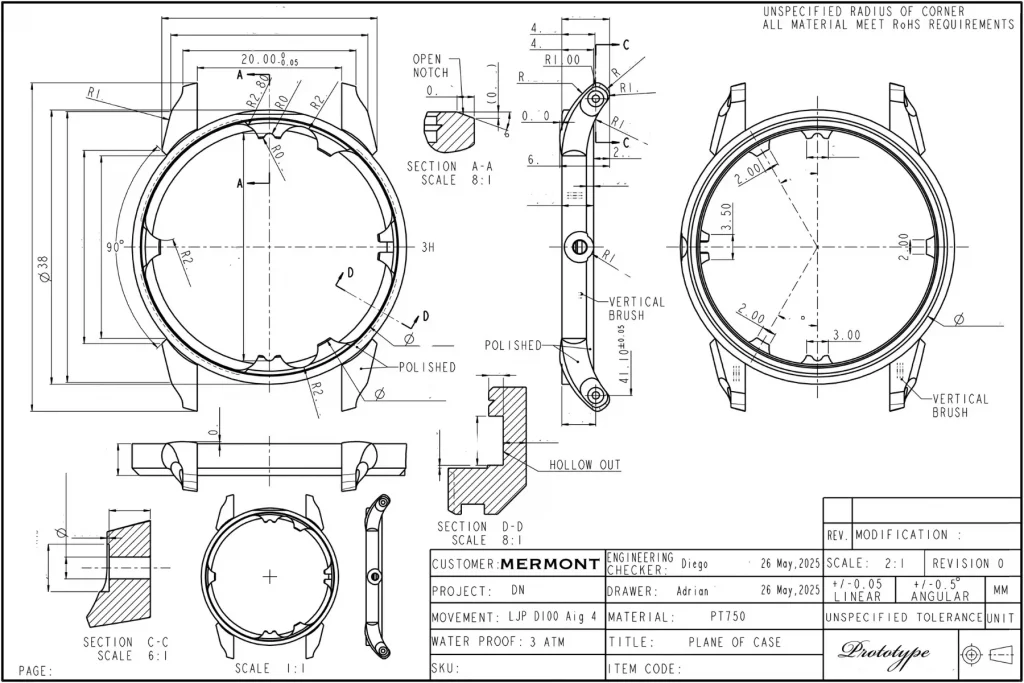
Because Mermont is not solely Sébastien Bey-Haut’s project. It is also a collective project, carried by several complementary sensibilities. There is first Marie, with whom he forms the project’s founding core. Then there is Diego Böttger on design, and finally Nicolas Delaloye, a respected Geneva watchmaker and AHCI member, who brings valuable horological credibility to the whole. Nicolas Delaloye is not just a name added there to reassure people. His role is real. He personally polishes the hour hand, performs the final regulation, and cases up the watches in his Geneva workshop. That allows the project to offer a true taste of independent watchmaking, but through a different recipe. Here, artisanal work is not focused on the demonstration of a spectacular movement, but on the quality of the object as a whole, on its execution, on its finishing, and on that famous hand which becomes the heart of the project.
This way of distributing the effort is particularly interesting. It allows the price to remain in a range that is relatively unusual for a watch that can claim a certain independent spirit. And that is a point that should not be underestimated. Today, many new independent watch projects arrive straight away at very high price levels, sometimes almost out of reach for a collector simply wanting to enter that world. Mermont takes an interesting counter approach here. The idea is not to mimic the most visible codes of independence, but to offer another point of entry. A collector’s watch, thought through seriously, executed with care, endowed with real personality, and able to appeal to someone looking for a sincere piece more than a name to display.
There is also within the project a real desire for local coherence. The brand is seeking to make a watch that is as Swiss as possible in spirit, with as many components as possible made in Geneva or in its immediate surroundings. This concern for local production is not a slightly easy marketing argument here. It fits into a broader desire to do things properly, with clearly identified people, with acknowledged know how, and with a certain proximity in the chain of creation. Once again, that reinforces the impression of a project that is very well thought out and very clear in its intentions.
But what seems perhaps most interesting to me at heart is that La Parfaite is not merely trying to exist as a beautiful minimalist object. It is trying to propose another way of living time. A calmer, slower, more conscious way, without ever abandoning the primary function of a watch. Because despite its intentionally more approximate display, reading the time remains simple: each marker on the minute track corresponds to ten minutes. So the point is not to renounce time, but to stop turning it into permanent pressure.
It is in this context that La Parfaite appears. A contemporary single hand watch, imagined by a very experienced collector, carried by a credible collective project, nourished by a genuine horological culture, and built around an idea that is ultimately rather rare today: that a watch can still teach us to slow down. Now it is time to take a closer look at the watch itself.
Table of Contents – Mermont La Parfaite
What are the key features of the Mermont La Parfaite?
Case
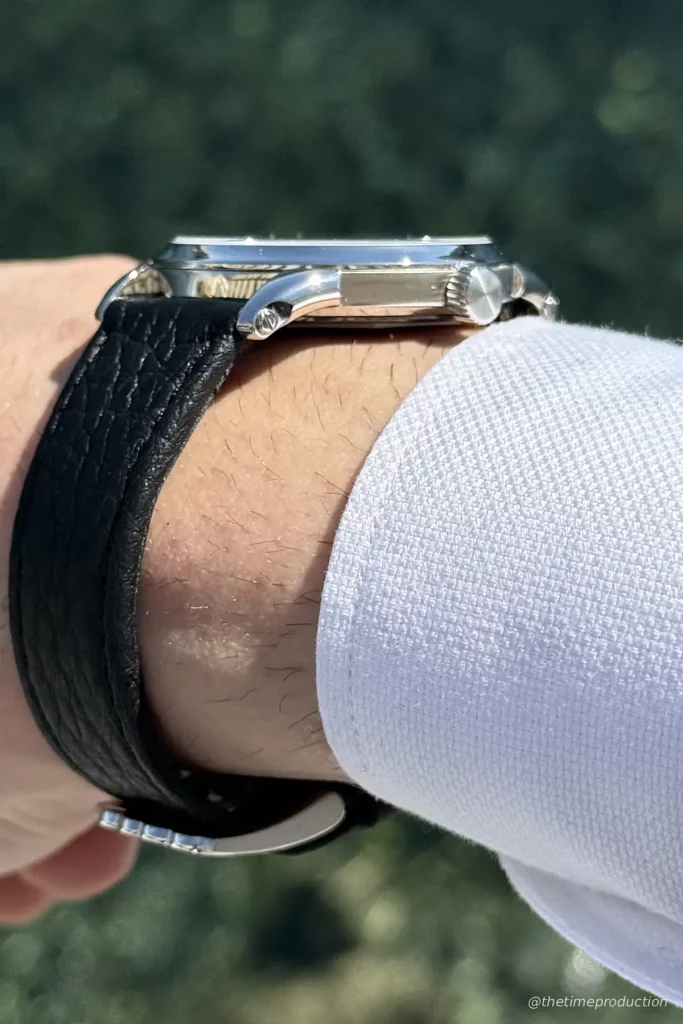
With this Mermont La Parfaite, what struck me first was really the accuracy of the proportions. At 38 mm in diameter and just 9.2 mm thick, this is a watch that wears remarkably well. It has that immediate slimness you notice within the first few seconds, but without ever becoming too discreet or too understated. On the contrary, it keeps a real presence on the wrist precisely because it is so well proportioned. What I also liked is that it can work equally well on a male or female wrist, which is not always so obvious with a watch in this register.
Visually, I really liked the construction of the case when looking at the watch head-on. The concave bezel is fully polished, just like the lugs, which gives the watch a real first-glance elegance. Then the rest of the caseband develops a contrast with brushed surfaces, bringing just enough variety to avoid any sense of monotony. And above all, this mix works very well because it remains in service of the overall design without trying to overplay sophistication.
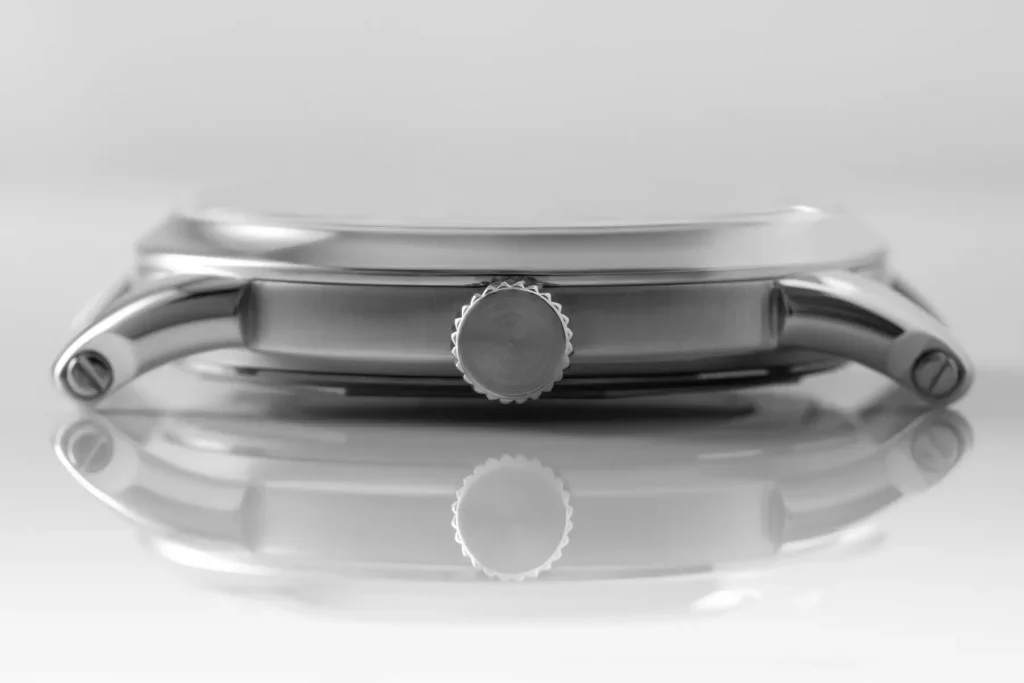
The lugs are in fact among the elements I liked most. This revisited interpretation of bullhorn lugs is very successful. They give the watch a lot of personality while remaining perfectly integrated into the whole. This is not an overly emphatic vintage reference or a demonstrative retro exercise. It is simply a very well controlled classical nod, with real coherence in the way they support the silhouette of the case. Their inward curve also plays an important role in the overall comfort.
Another detail I found particularly interesting is the crown. More precisely, what I liked were the grooves on the crown. They are not straight, but slightly slanted, creating a discreet echo with the lines of the dial and the railway track. This is exactly the kind of detail one does not necessarily notice straight away, but which shows how carefully the design was thought through as a whole. In the same spirit, I found the PT950 marking on the caseband a very nice touch, a discreet detail that contributes to the perceived quality of the piece.
I also found the contrast between the platinum case and the tantalum caseback interesting. Of course, that choice brings an original visual and material nuance, but I mainly get the impression that it was chosen for reasons of comfort and use, with something softer against the wrist. The fully brushed closed caseback remains coherent with the overall philosophy of the watch, even if I will come back to that in a moment.
Another appreciable detail is that the strap is fixed with screw bars, in a spirit that recalls certain historical watches. Here, those screws remain decorative, but they still contribute to the visual identity of the case and to the care given to this kind of detail. It is subtle, but on a watch like this, these are precisely the little elements that reinforce the overall coherence.
If I had to qualify one point nonetheless, it would probably be the fact that the caseback remains closed. I completely understand the logic behind that choice, and I also understand that this is not a watch primarily designed to showcase its movement. But at this price level, and even if the calibre was not conceived as a demonstrative movement in the decorative sense of the term, I would have found it interesting to at least leave open the possibility for certain clients to choose an open caseback. Not because the movement absolutely had to be shown, but because many enthusiasts today remain attached to that dialogue with the mechanics. That said, it remains the main reservation I would express, because overall the choice of a closed back still fits the spirit of the project.
In the end, this case feels completely coherent to me with the overall identity of La Parfaite and with the Mermont project as a whole. More than through pure classicism, it works above all through its discreet refinement. There are many small details here that are not necessarily perceived at first glance, but which gradually emerge when one takes the time to look closely at the watch. And that is exactly what I like about this case: it expresses a very restrained, very measured, never demonstrative luxury, but one that is genuinely worked through.
Dial
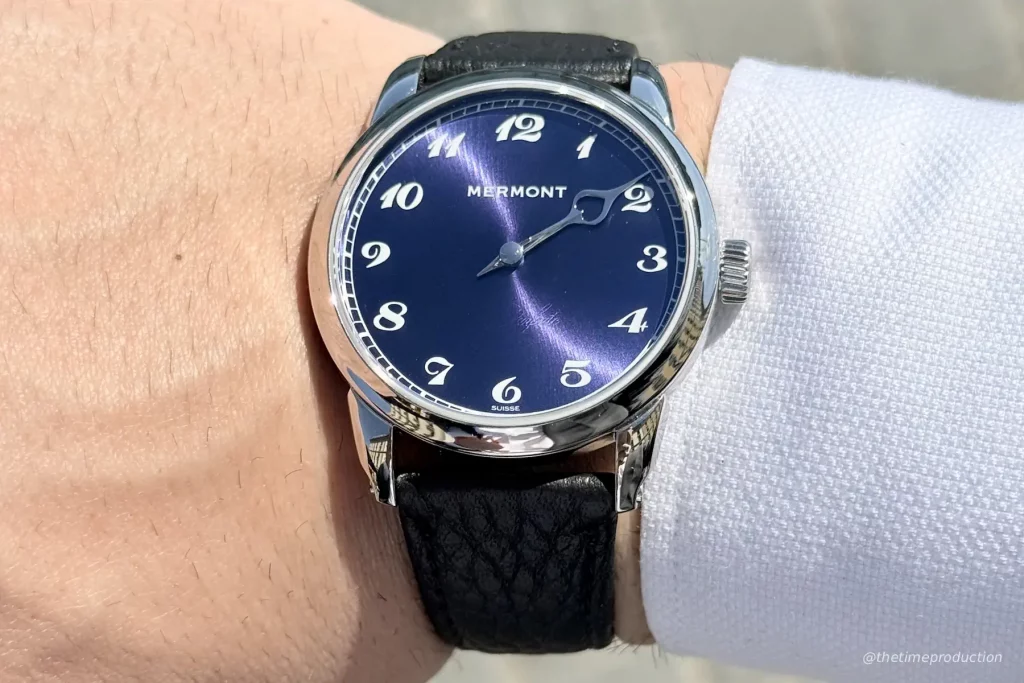
To my eyes, the dial of La Parfaite is one of the most successful elements of the watch, precisely because it plays on a contrast that I find particularly appealing: in appearance, everything seems very simple, very legible, almost very calm. And yet, as soon as one spends a little time with it, it becomes clear that this is in fact an extremely elaborate dial, both in its conception, in its production, and in its interaction with light.
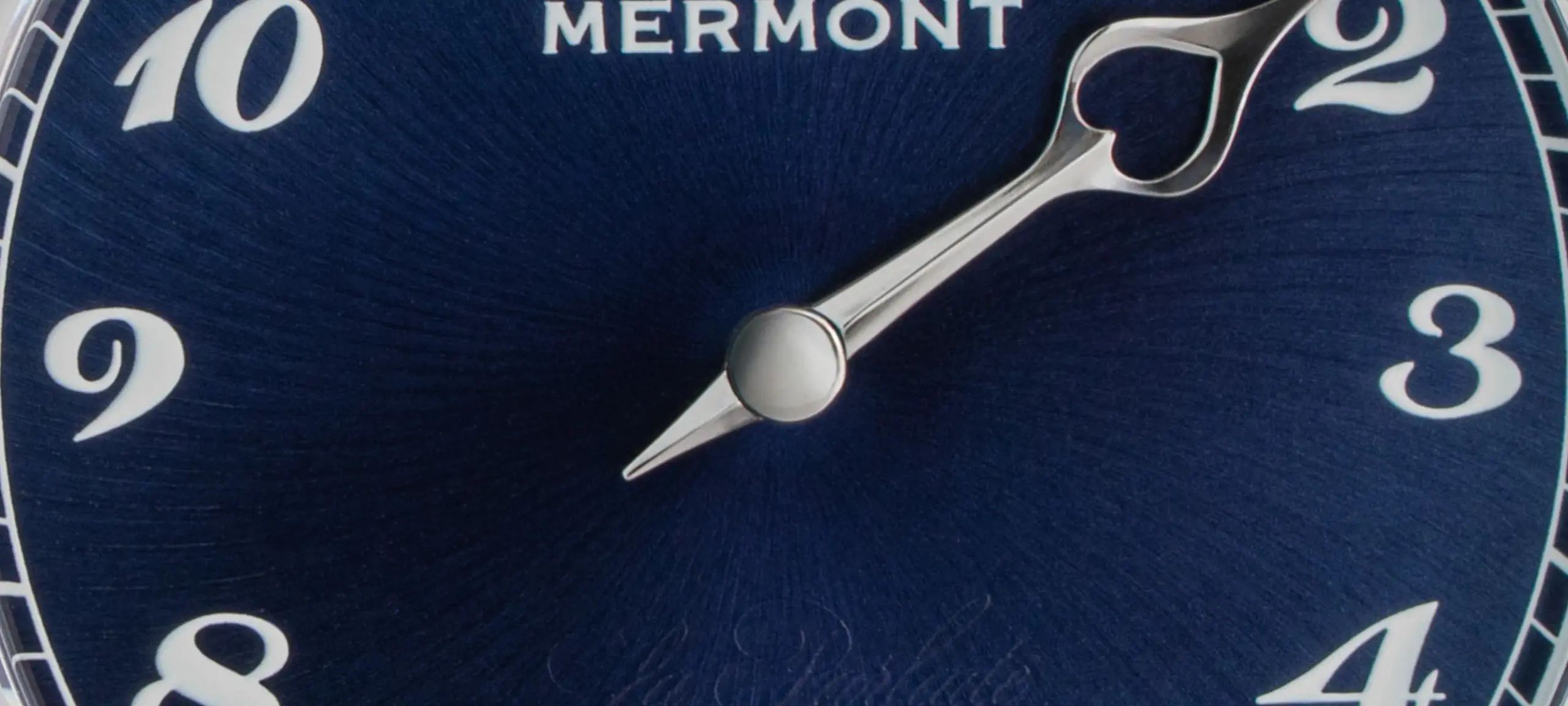
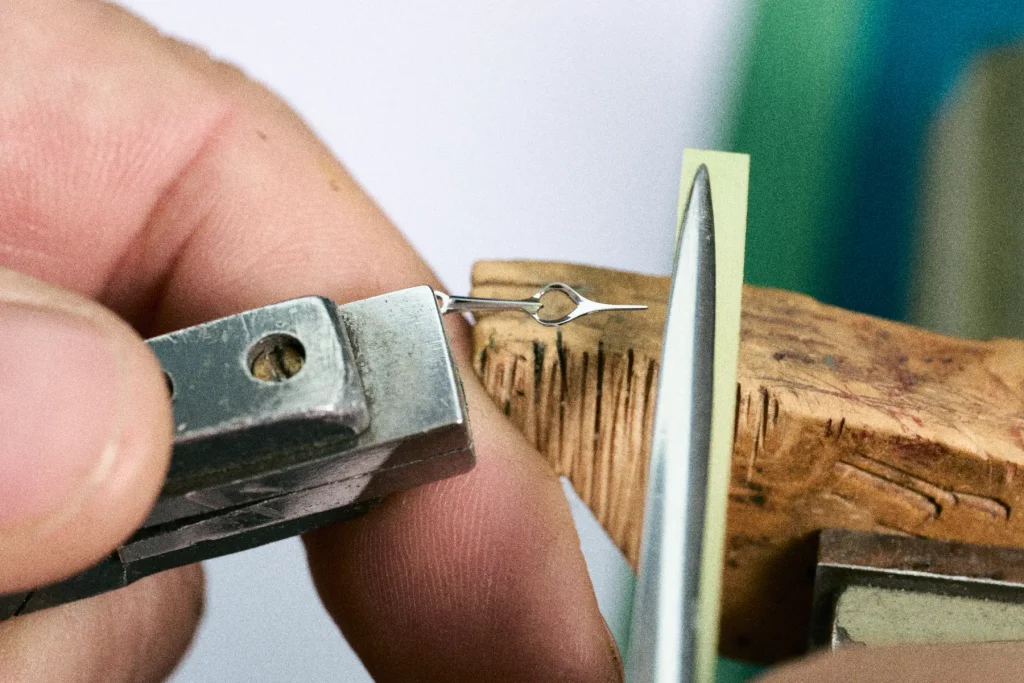
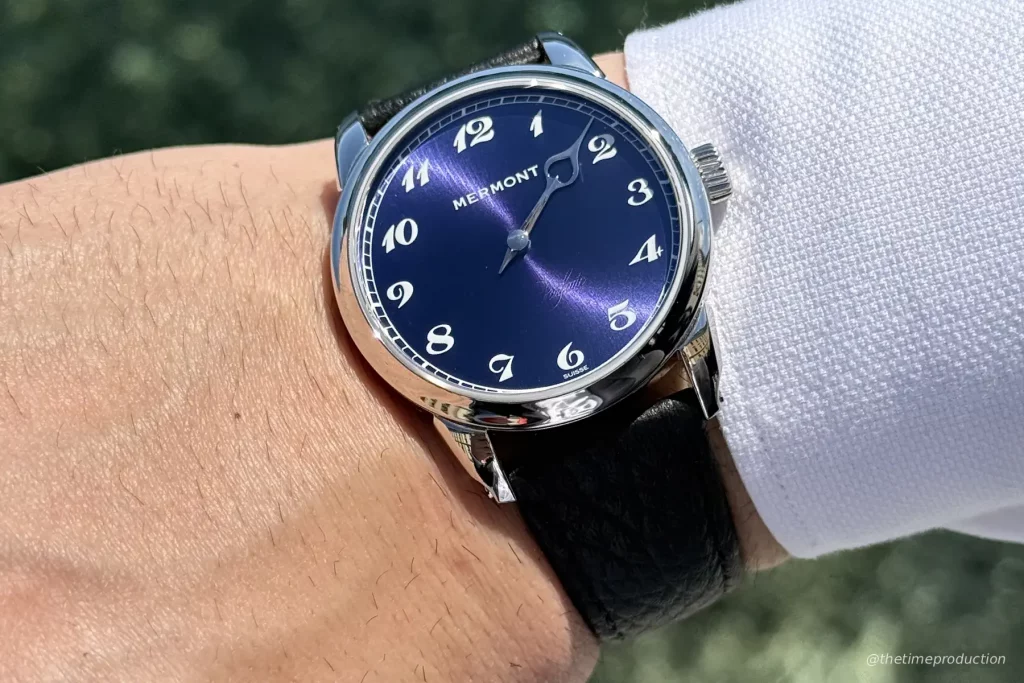
What struck me first was of course the “Solo” hand. It is clearly the aesthetic, technical and poetic centre of the watch. On a single-hand watch, everything rests on it, and here it does not merely fulfil a function. It literally structures the identity of the piece. This is not a standard hand, nor even a hand that is simply well finished. It is an almost sculptural piece, made of steel, machined on both sides, flame heat treated, then black polished by hand by Nicolas Delaloye using traditional techniques in his Geneva workshop. This work alone requires around four hours per hand, with polishing carried out using diamond paste, including on the flanks and inside the opening. And that is immediately visible. The hand has volume, presence, and real visual nobility. It becomes far more than a simple pointer: it is the living heart of the watch.
The other particularly strong element is of course the dial itself. Made by GVA Cadrans, it features a sunburst spiral finish that fully reveals its character once the watch is placed in the light. And that is really when the dial changes dimension completely. It moves from a rather deep blue to more violet tones, at times almost purplish, with something very fluid, almost alive. One almost has the impression that the dial breathes with the light. This is not a simple decorative effect, but truly a surface that transforms depending on the angle and the intensity of the light. And that perfectly reinforces the idea of time being less fixed, more fluid, more contemplative.
The way this colour is obtained is also very interesting. The dial is made using coloured pigments mixed into Zapon lacquer, according to an old-fashioned method. And although there is no need to overload the text with an overly technical explanation of what Zapon precisely is, I do think it is important to say that this is a traditional process, one that gives the surface real depth without making it artificially glossy or overly demonstrative. Once again, one finds that idea of hidden refinement, discreet sophistication, of quality that does not present itself immediately, but gradually reveals itself.
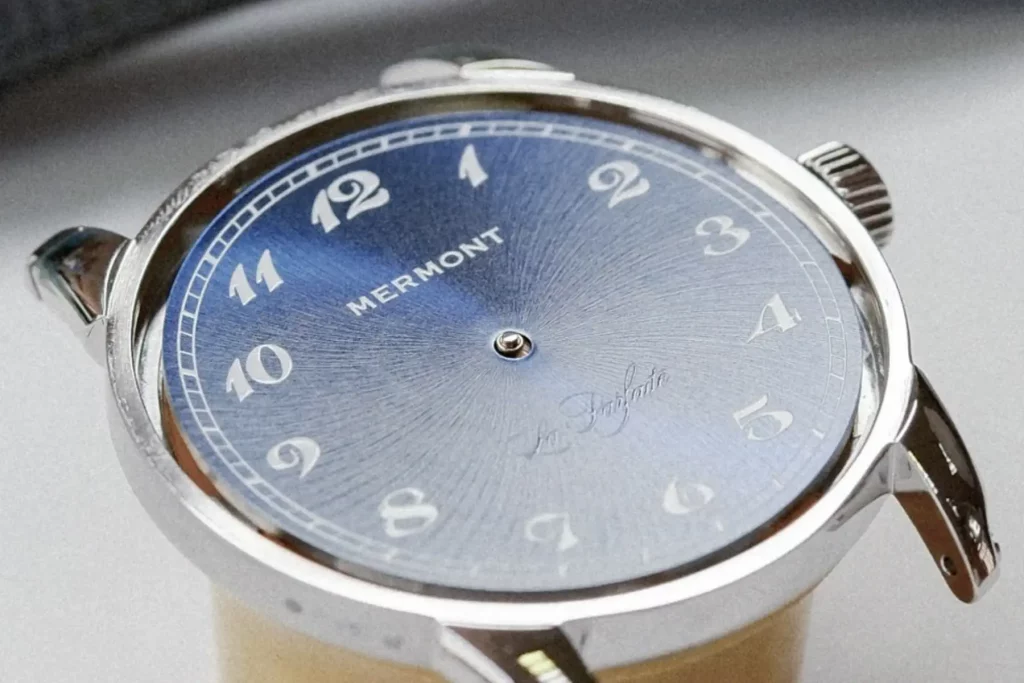
I also found the legibility very good, which matters on a watch of this kind. Yes, the display is read in ten-minute segments, which is entirely coherent with the philosophy of the philosopher’s watch. But that does not mean reading the time becomes vague or frustrating. On the contrary, the watch remains perfectly understandable in its intention. It visually slows down time without ever renouncing its primary function. And that is precisely what I find successful here: the coherence between the philosophy of the project and the actual experience of the dial.
The Breguet numerals, the slanted railway track, the logo at twelve o’clock, and above all the discreet “La Parfaite” signature at six, visible only under certain angles, also contribute to this overall intelligence. It is the kind of detail one may not notice immediately, but which gives even more depth to the piece once discovered. Once again, nothing is forced, nothing is overplayed. Everything remains within a form of restraint.
If I had to qualify one point, it might be the absence of applied indexes. Not because the dial lacks personality, quite the opposite, but because I would have found it interesting to have a very slight additional separation between the spiral background and the display, perhaps with floating indexes further enriching the visual depth. That said, this is a real nuance more than a criticism, because in its current state the dial already works very well as it is.
In the end, I find this dial completely coherent with the identity of La Parfaite and with the Mermont project. Its strength comes precisely from that blend of apparent sobriety and hidden refinement. It needs to be seen in the metal, and above all seen in the light, to understand just how carefully it was conceived. Between the Solo hand, the artisanal complexity of its production, the visual richness of the blue spiral finish, and the dial’s ability to move from blue to violet with a real life of its own, this is a dial that says far more than it shows at first glance. And that is exactly what I like here.
Movement
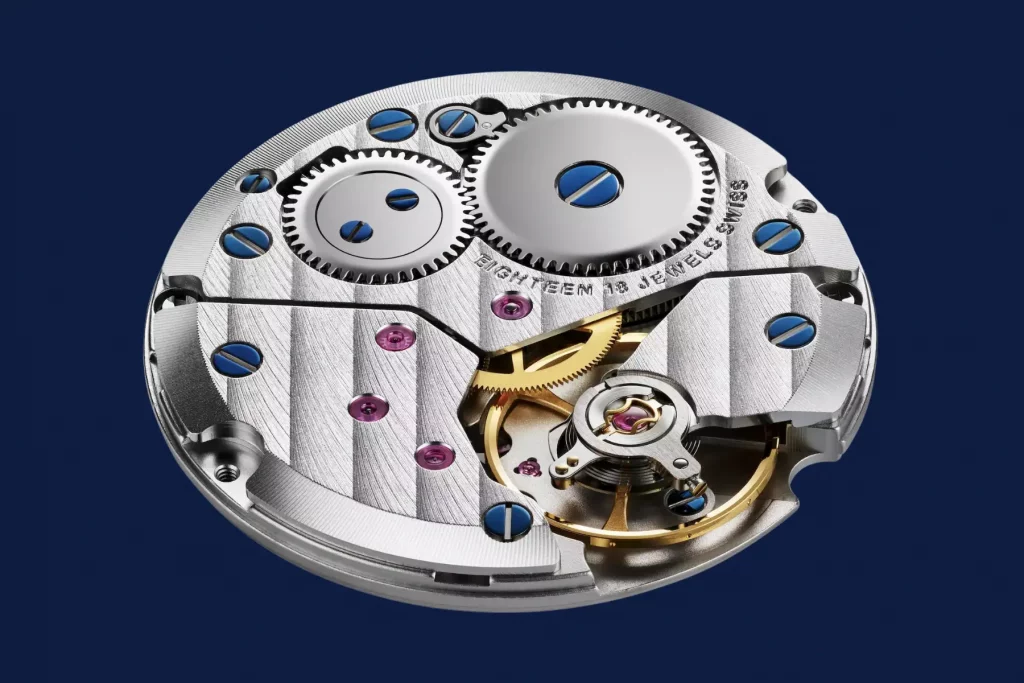
To my eyes, the movement of La Parfaite is not the most emotional or the most spectacular element of the project. And precisely for that reason, I think it is important to say so clearly. Here, most of the poetic, aesthetic and conceptual weight lies elsewhere: in the idea of the single-hand watch, in the dial, in the Solo hand, and in the different relationship to time that the piece proposes. The movement fulfils another role. It provides a serious, coherent and credible technical foundation, perfectly aligned with the philosophy of the project.
Mermont chose a La Joux-Perret D101 in Soignée finish, a well-known manual movement based on the proven architecture of the Peseux 7001. And to me, that is a very intelligent choice. First because it is a reliable, slim, proven and easily repairable calibre. Then because it allows costs to be kept under control without degrading the horological level of the watch. And that is precisely where this choice makes complete sense. The idea behind La Parfaite was never to offer the most demonstrative or the most complex movement on the market. This is not a watch designed to break performance records or justify its existence through visible mechanical sophistication at all costs. It is a watch built according to a different hierarchy of priorities.
What a serious collector should retain, then, is less the intrinsic exceptionality of the calibre than the relevance of its integration into the project. We are dealing here with a handsome manual movement, slim, coherent with the thickness of the watch, credible in its origin, and above all perfectly adapted to a piece of this kind. The D101 offers 50 hours of power reserve, beats at 21,600 vibrations per hour, and is based on an architecture known for its slimness and robustness. In other words, Mermont did not try to reinvent what already works very well. And in the context of this watch, I find that entirely relevant.
The other important point is of course the involvement of Nicolas Delaloye. Even if the movement is not developed by him, his role brings real quality of execution and finishing to the whole. Each example is assembled, finished, regulated and checked in Geneva by Nicolas Delaloye himself, which gives the piece real horological depth. This is particularly interesting because it allows Mermont to offer a watch that still has a true flavour of independent watchmaking, not by claiming an in-house movement at all costs, but by relying on a coherent calibre that is then treated with the seriousness and standards of a very high-level watchmaker.
The regulation is also a good example of this approach. La Joux-Perret already announces respectable rate tolerances for this movement, but Nicolas Delaloye pushes each calibre beyond that, with a stated regulation around three seconds per day on average. Obviously, on a single-hand watch, one could almost smile at such a level of precision, since the object itself invites a more flexible relationship with time. But that is precisely where the paradox becomes interesting. Even when it offers a deliberately less tense reading of time, La Parfaite does not give up real horological standards.
The movement has also been intelligently adapted to the single-hand logic. Mermont removed the minute hand and covered the corresponding pinion with a cap in order to suit the desired display. Once again, this is not a spectacular transformation, but a sober, functional and coherent adaptation. It is not the kind of detail that jumps out immediately, but it is precisely this type of choice that shows the project has been thought through seriously.
At heart, that is perhaps what needs to be emphasised most here: the movement of La Parfaite never tries to be more than what it needs to be. It does not try to cannibalise the rest of the watch. It does not try to artificially become the centre of the discourse. It does exactly what it should do in this project: offer a reliable, slim, repairable, well-finished and intelligently chosen technical base, allowing the watch to exist in a price range that remains accessible for what it offers elsewhere.
And that is precisely why I find this choice successful. In many other projects, one sometimes has the impression that a movement is there to be sold as an argument in itself, even when it is not truly coherent with the watch. Here, it is the opposite. The D101 is not spectacular, but it is right. And in a watch like La Parfaite, that sense of rightness probably matters more than any unnecessary mechanical demonstration.
Strap
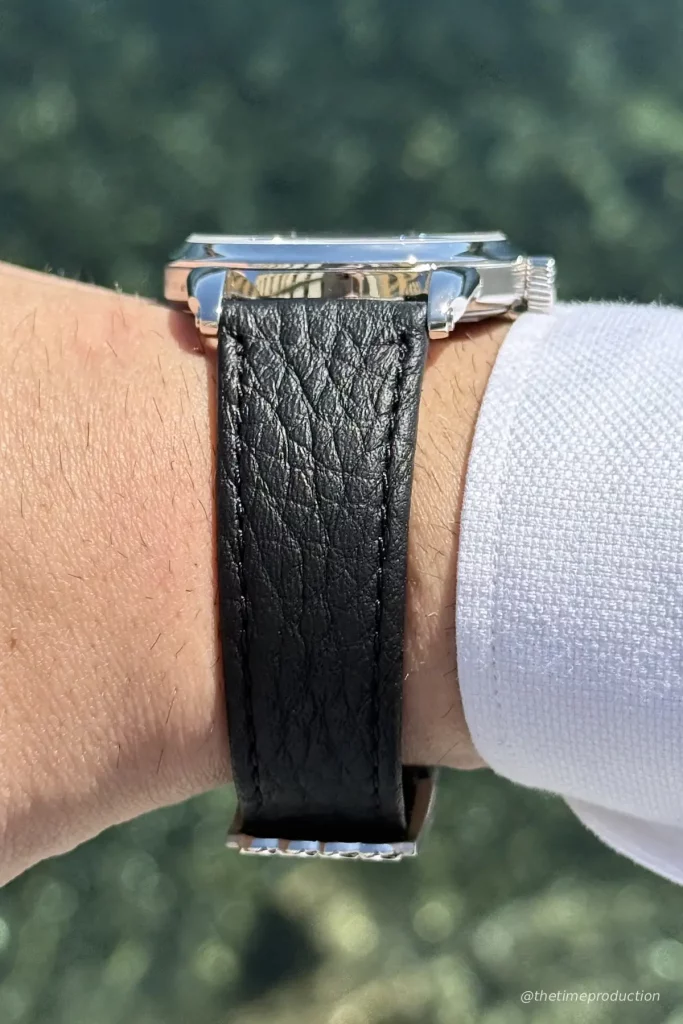
La Parfaite comes with two straps, and I find that a real strength in the way Mermont has thought about the use of the watch. On one side, there is a taurillon calf strap lined with rubber, produced by Camille Fournet, which brings something more dressed-up. On the other, a technical textile strap lined with calf leather, which should work very well in a more everyday reading of the piece. I find that duality very well judged, because it prevents the watch from being locked into a single register.
In terms of comfort and perceived quality, it is very good. The strap suits the watch well, the choice of materials feels considered, and the whole remains entirely coherent with the spirit of the project. One can feel that this is not a standard strap added at the end, but an element thought through to extend the personality of the piece. The taper from 20 to 16 mm also contributes to that impression of elegance and finesse on the wrist.
I also really liked the platinum buckle, which is not at all standard in its form. It is fully polished, very well worked, and brings a real additional touch of personality to the whole. Without being demonstrative, it once again shows that the project has been thought through in detail. And the fact that Camille Fournet is involved also reinforces the credibility of this part of the project.
In the end, I find that these two straps allow La Parfaite to remain elegant without becoming too ceremonial. And that is precisely what was needed here: a refined watch, but one that is genuinely wearable on a daily basis.
What is the price of the Mermont La Parfaite?
The Mermont La Parfaite is priced at CHF 10,998 before tax, with production limited to 28 pieces for this blue dial version. At that level, I find the price really makes sense when one looks at the project as a whole, rather than simply at the movement. Of course, if one isolated the calibre alone, some might find the positioning ambitious. But that would be missing what really gives this watch its value: the platinum case, the tantalum back, the very substantial work on the hand, the dial that is difficult to produce, the assembly and regulation by Nicolas Delaloye, and more broadly the overall coherence of the proposal.
In that context, I find La Parfaite becomes a particularly interesting offer. First for someone wanting to acquire a first true independent watch, with strong personality but real everyday wearability. Then for an enthusiast of major brands who would like to enter the world of independents through a sincere, well thought out piece that is not yet out of reach. And finally, of course, for an already seasoned collector who has simply been won over by the spirit of the project.
The watch is delivered in a Chronosphere presentation box designed by AIS Collective, which coherently extends the attention given to the object as a whole. As for the salmon dial, it is already sold out as part of a friends and family edition, which also shows that the project has already found a first echo among an audience sensitive to this type of proposition.
Mermont also mentions a medium-term objective of remaining below 50 watches produced per year. But for La Parfaite in its blue dial version, we are indeed talking about a limited series of 28 pieces, sold directly to collectors.
Mermont La Parfaite: a poetic and coherent watch that slows down time without freezing it
With La Parfaite, Mermont offers, in my view, a particularly coherent watch, and that is probably its greatest strength. It is not merely a well-designed piece or an original concept wrapped up elegantly. It is a watch that pushes a simple yet demanding idea all the way through: removing everything that is not essential in order to keep only what truly makes sense. And in today’s watch landscape, often saturated with demonstrations, displayed performance and spectacular propositions, I find this approach possesses a rare, almost soothing elegance.
What feels especially successful to me here is that La Parfaite never falls into the trap of the empty concept. Yes, it is a philosopher’s watch. Yes, it is a contemplative watch. Yes, it proposes another relationship with time. But it never remains at the level of discourse alone. Everything in the watch gives substance to that idea. The case expresses discreet refinement, the Solo hand becomes the aesthetic and poetic centre of the whole, the dial comes alive in the light with real depth, and even the movement, without trying to steal the spotlight, fits intelligently into that hierarchy of priorities. One can feel that nothing was conceived at random.
I also think Mermont has achieved something rather rare: proposing a watch that genuinely brings something different to the market without becoming so conceptual that it loses its desirability. La Parfaite remains a real watch, wearable, elegant, legible and pleasant on the wrist, rather than a mere idea turned into an object. And that is precisely why it seems interesting to me. It is not trying to compete with other propositions on the ground of pure performance or horological demonstration. It is seeking something else. A form of presence. A slower, more sensitive, more conscious way of inhabiting time.
Personally, this is not necessarily the type of watch I am instinctively drawn to. I often like to keep a precise eye on time, set myself a rhythm, move fast and fill my days. And perhaps that is precisely why I found this watch so interesting. Because it introduces another possibility. Today, if you want the exact time, you read it on your phone in a second. A watch like La Parfaite is not there to compete with that. It is there to offer something else: an object of contemplation, a presence on the wrist that reminds us that time is not only there to be divided, optimised and exploited, but also to be lived.
The greatest quality of this watch, in my eyes, therefore lies in its ability to be poetic without losing credibility. It succeeds in visually slowing down time without freezing it, in proposing a different experience without sliding into abstraction, and in bringing out genuine emotion without giving up horological coherence. It is a watch with substance. And that matters enormously.
If I still had to qualify one point, I would say that, personally, I would have liked the option of an open caseback from the outset, even though I fully understand the logic behind the closed back within the framework of the project. But that remains a minor reservation in light of the whole, especially since the project already seems to have been thought through intelligently enough to evolve later without losing its DNA.
And that is precisely what makes me rather confident about Mermont’s trajectory. One can feel a very solid foundation here already. The project has taken time, has been matured, refined and built with patience. And that slowness is more a quality than a weakness. It gives real depth to what is being proposed today. Above all, one understands that La Parfaite is probably only a starting point. The case has already been designed to accommodate thicker dials, potentially craft-driven executions, other colours seem possible, and the idea of keeping the single-hand concept while exploring future complications opens up a very interesting creative field. In other words, there is still a great deal that can be done around this concept without betraying the DNA of the first model, which is already strongly defined.
At heart, that is perhaps what I retain most from Mermont. A collector’s project, conceived with sincerity, carried by genuine horological culture, real sensibility, and a real desire to propose something else. Not an artificial break. Not a marketing move. But a watch that seems born from a deep reflection on what a watch can still bring today, beyond simply telling the time.
And within that framework, La Parfaite wears its name particularly well. Not because it claims to reach some absolute ideal, but because it gives the feeling of having been thought through all the way with real logic, real coherence and real delicacy.
Mermont La Parfaite – Watch Specifications
- Brand: Mermont
- Model: La Parfaite
- Case Material: Platinum
- Dial: Colimaçon sunburst blue dial with Zapon varnish
- Functions: Hours ; Minutes
- Movement: La Joux-Perret D101, finition soignée (top-grade), Manual-Winding, 21’600vph frequency (3Hz), 18 jewels
- Power Reserve: 50 Hours
- Water Resistance: 3 ATM
- Crystal: Sapphire
- Caseback: Tantalum
- Case Dimension: 38mm × 9.2mm
- Strap: Black Leather from Camille Fournet with Platinum Pin Buckle
- Availability : Limited to 28 pieces in blue – produced over two batches per year
- Retail Price: CHF 10,998 (excluding VAT)
What do you think of this Mermont La Parfaite and, more broadly, of this type of watch that seeks less to measure time precisely than to help us live it differently?
If this article added value or sparked a discovery, you can support the project HERE. Your contribution helps me keep weekly articles and a biweekly newsletter free, accessible, and independent for everyone.
For more information about Mermont, click here.