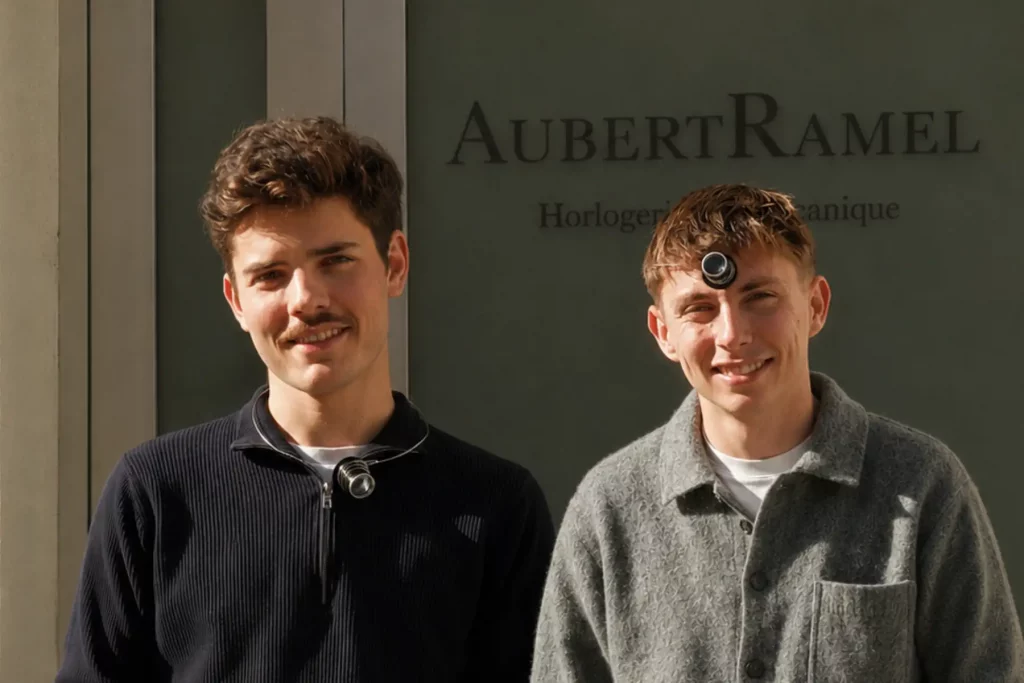
Today, I have the pleasure of introducing a young independent watch brand that, in my opinion, deserves the full attention of anyone passionate about independent watchmaking. If I told you about two young Franco-Swiss watchmakers educated at the Edgar Faure School of Watchmaking in Morteau, trained in Luc Monnet’s workshop, collaborators of Simon Brette, one of them being the winner of the prestigious F.P. Journe Young Talent Competition 2024, capable of manufacturing a large proportion of their watch components themselves using traditional machinery while embracing a deeply architectural vision of watchmaking, you would probably recognize Thomas Aubert and Alexis Ramel-Sartori, the two founders of Aubert & Ramel. Behind the watch I am presenting today, the Ouréa Titanium, lies a story that is far richer than it first appears. It is a story built on passion, learning, meaningful encounters and friendship, but above all on the determination to create a solid foundation long before thinking about launching a first watch.
The reason I wanted to dedicate an article to Aubert & Ramel goes far beyond the fact that the Ouréa Titanium immediately caught my attention with its architecture and the remarkable craftsmanship displayed on its dial. Over the past several months, I have had the opportunity to exchange numerous conversations with Alexis before finally meeting both founders during Watches & Wonders 2025. Through these discussions, as well as the podcasts, interviews and documents they have shared, I gradually discovered a project whose consistency genuinely impressed me. The more I learned about their journey, the more one idea kept coming back to me: Aubert & Ramel is not a brand that was created in a rush. Quite the opposite. It is the result of a carefully planned path where every step seems to have prepared the next. At a time when countless new watch brands appear every year, this thoughtful approach immediately stood out to me.
To fully understand this philosophy, it is worth looking back at the backgrounds of both founders. Although they now work side by side, Thomas Aubert and Alexis Ramel-Sartori discovered watchmaking through very different paths. Thomas was born in La Chaux-de-Fonds before growing up between Switzerland and France in a modest family. His passion began at a very young age thanks to his grandfather, an independent watchmaker and restorer, with whom he spent much of his childhood. While many children were building LEGO sets, Thomas preferred taking watches apart, even if he could not always put them back together. He often jokes that he kept the quartz movements he had completely dismantled inside glass jars, which eventually became decorative objects displayed in his bedroom. Behind this amusing story lies something much deeper. From an early age, Thomas fell in love with the almost meditative concentration that watchmaking requires, with the satisfaction of understanding a mechanical system and working on an object of extraordinary precision. At that stage, creating his own brand was never part of the plan. What fascinated him was simply the profession of a watchmaker and restorer, just like his grandfather. Following his grandfather’s passing, he pursued his studies with even greater determination, seeing it as a way of honoring the person who had first introduced him to this world.
Alexis followed an almost opposite path. Born near Toulouse to a Swiss father and a French mother, he grew up in a family of landscape gardeners with no connection whatsoever to the watch industry. Nothing suggested that he would one day become a watchmaker. It was only around the age of fourteen, while choosing his educational direction, that he discovered watchmaking almost by chance. Drawn to metalworking while naturally possessing a highly analytical mindset, he was looking for a profession capable of combining technical thinking with manual craftsmanship. This discovery became a turning point. Unlike Thomas, whose passion was born during childhood, Alexis developed his interest progressively through his studies, internships and professional encounters. The deeper he immersed himself in watchmaking, the more he realized that it extended far beyond repairing watches. It offered an almost limitless field where engineering, craftsmanship, creativity and mechanical architecture all came together.
Their paths eventually crossed at the Edgar Faure School of Watchmaking in Morteau, one of France’s most respected institutions for training young watchmakers. Thomas completed his entire education there, while Alexis joined the school after earning both his CAP and BMA diplomas in Bordeaux before pursuing his DN MADE degree. Even at that stage, both were already working on remarkably ambitious graduation projects. Alexis designed L’Immuable, an automaton in the shape of a cube whose multiple faces came alive simultaneously through a sophisticated mechanical system, already revealing his fascination with original technical constructions. Thomas, meanwhile, created Séléné, a watch inspired by shooting stars and astronomy. Built around a Unitas 6497 movement, he almost completely redesigned its architecture while developing an ingenious system capable of recovering energy normally lost through the winding click in order to animate the back of the watch. Behind this project was a reflection on human curiosity, inspired by an ancient belief attributed to Ptolemy that shooting stars bring mankind closer to the gods when making a wish. This creation earned Thomas first place at the prestigious 2024 F.P. Journe and The Hour Glass Young Talent Competition, an international distinction recognizing several years of dedication while confirming the immense potential of this young watchmaker.
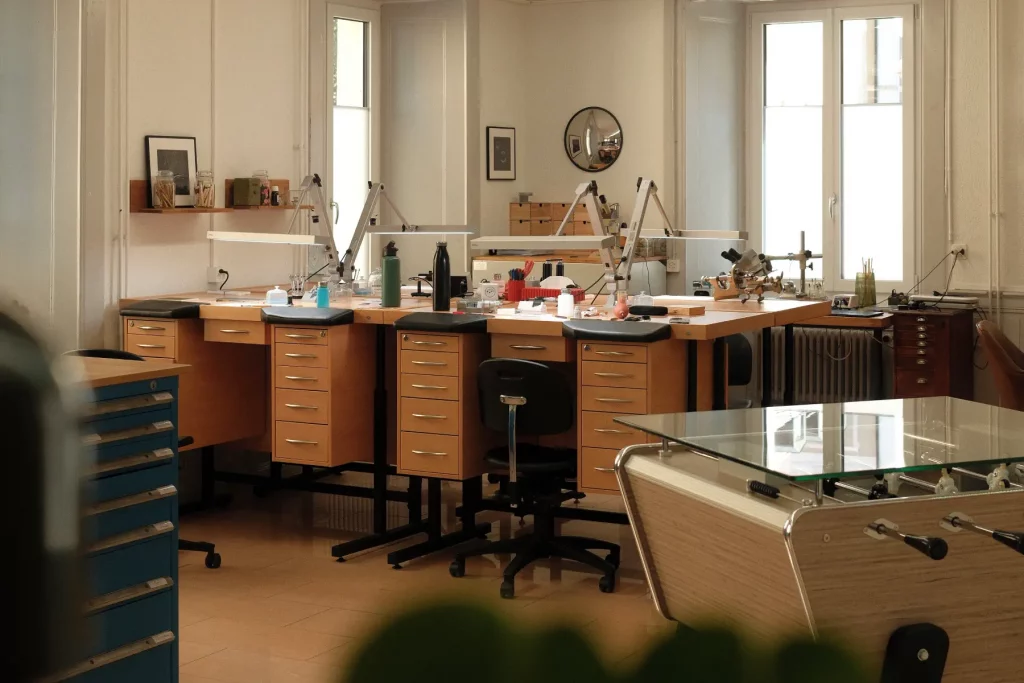
Yet Aubert & Ramel was not truly born at school, nor through this competition. The real turning point came during an internship at Luc Monnet’s workshop. At that time, Thomas and Alexis already knew each other but were not particularly close. Working together every day over several weeks, they quickly realized how naturally complementary they were. More than a friendship, they developed an exceptional working relationship. Each brought his own strengths to the partnership. Alexis naturally gravitated toward the more technical aspects, while Thomas found his greatest fulfillment in design and creative thinking. That division never meant either of them remained confined to a single role. On the contrary, both fully understood the other’s work and constantly challenged one another’s ideas. Even today, this collaborative approach remains one of the greatest strengths behind Aubert & Ramel. Luc Monnet soon became a true mentor, and during this period they also had the opportunity to work alongside Simon Brette, manufacturing and hand-finishing various components for his watches. This experience exposed them to an exceptionally demanding level of craftsmanship that would permanently shape their own standards.
After graduating, Thomas and Alexis made a decision that perfectly reflects their mindset. Instead of immediately launching a brand under their own names, they founded Les Petits Ateliers. Their objective was simple: continue learning by manufacturing for others. For nearly a year, they produced components, carried out decorative finishing, developed prototypes and collaborated with several independent watchmakers. This period proved essential to their development. Not only did it allow them to refine their skills, but it also enabled them to gradually build their own workshop, equipped with traditional machinery that already gave them an impressive degree of independence. They learned to manufacture, decorate, adjust and prototype a large proportion of the components required to build a watch entirely in-house. In my opinion, this is perhaps what most clearly distinguishes Aubert & Ramel from many other young independent brands. What impresses is not their age, but the remarkable level of maturity they had already achieved. Long before unveiling their first watch, they had built a genuine manufacturing workshop and developed an exceptionally comprehensive understanding of their craft. Today, this subcontracting activity has largely been put on hold so they can dedicate virtually all of their energy to developing their own brand.
This gradual progression explains why their project immediately inspires confidence. Nothing feels improvised. Every stage appears to have been carefully designed to prepare for the next. Their motto, “Watchmaking in Motion,” perfectly captures this philosophy. At Aubert & Ramel, craftsmanship exists to serve a vision where engineering, architecture and design evolve together. The founders are not simply trying to produce beautiful watches. They want to develop a genuine visual language that is uniquely their own. This shared vision, enriched by their complementary personalities and skills, has become the very identity of the brand.
Before introducing the Ouréa Titanium itself, it is important to look back at the very first chapter of this journey. The story of Aubert & Ramel began with the Ouréa Subscription, a limited edition of just six platinum watches. Conceived from the outset as a true subscription watch, it was made possible through the support of the first six collectors who chose to accompany Thomas and Alexis as they launched their brand. More than simply being their first watch, this platinum edition became the founding statement of Aubert & Ramel. Designed with a deliberately more traditional approach, particularly through its polished steel bridges, it established the principles that continue to define the brand today: producing very small numbers, manufacturing as much as possible in-house, working with traditional machinery and building direct relationships with collectors who share the same vision.
Eighteen months later came the Ouréa Titanium, the watch at the heart of this review. Rather than breaking away from the original Subscription edition, it builds upon exactly the same architecture while interpreting it through a far more contemporary lens. Titanium, dramatic light reflections, multiple dial levels and an even stronger visual identity all contribute to its character. More than the evolution of a first watch, it represents the natural continuation of a project that has been patiently built over several years. It is precisely this consistency, both on a human level and from a watchmaking perspective, that made me want to introduce it to you. Now, let’s take a closer look at the Ouréa Titanium.
Table of Contents – Aubert & Ramel Ouréa Titane
What Are the Specifications of the Aubert & Ramel Ouréa Titanium?
Case
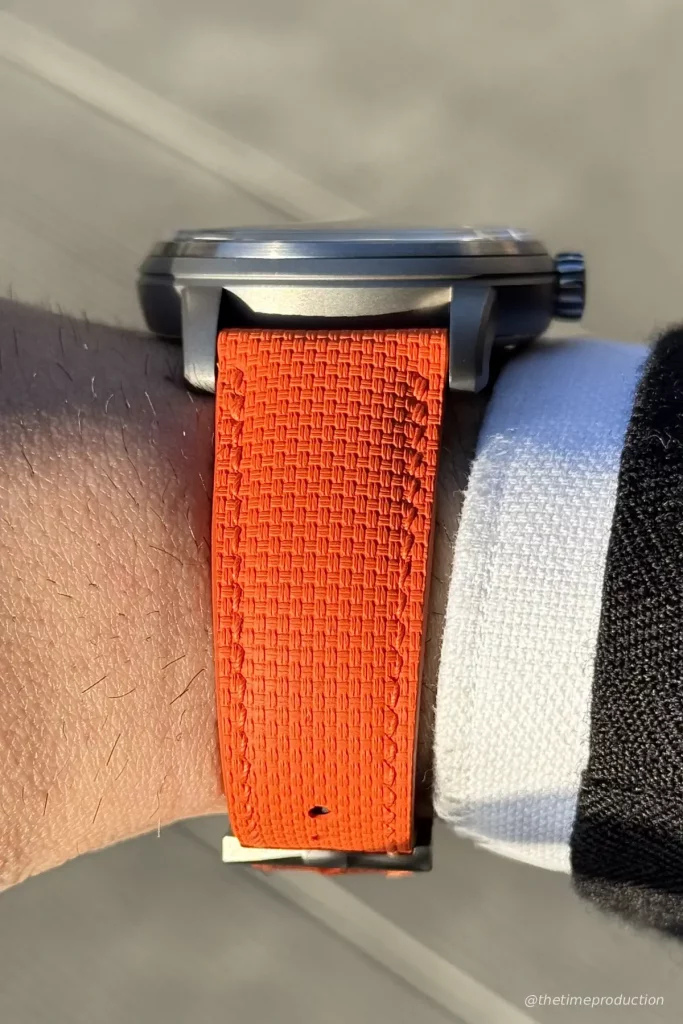
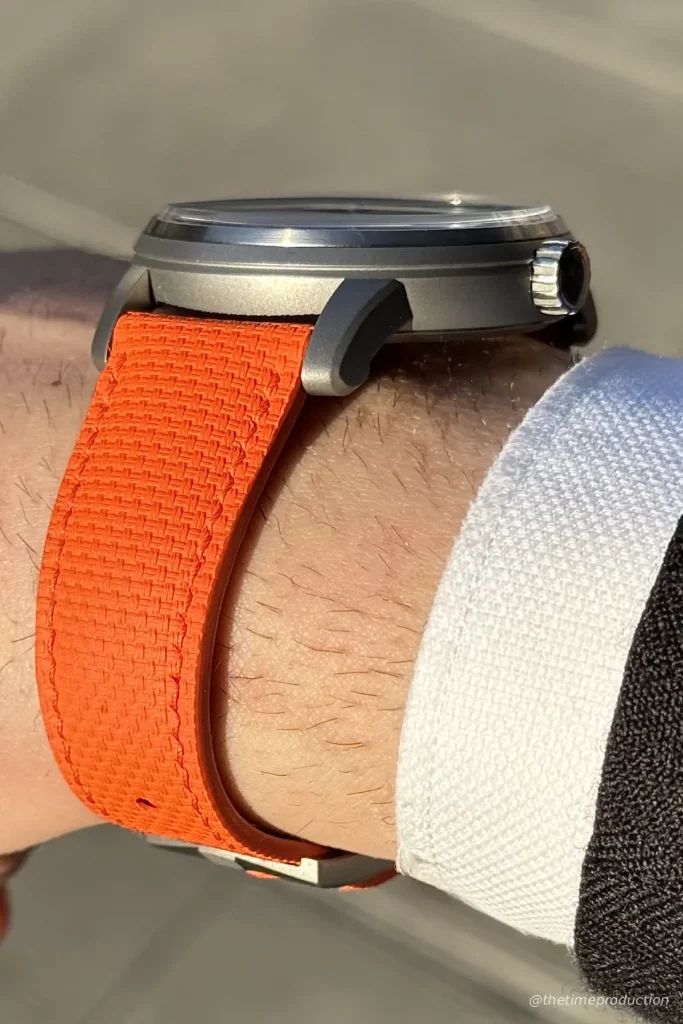
The case of the Aubert & Ramel Ouréa Titanium is made from Grade 5 titanium and measures 40.40 mm in diameter and 11.50 mm in thickness, or 9.30 mm if the crystals are excluded. Its total length of 48 mm and 20 mm lug width might suggest a relatively imposing watch on paper. Yet once it is on the wrist, the impression is quite different. What first caught my attention was precisely the shape of the lugs. They are long, but also strongly curved, allowing them to follow the natural contour of the wrist. I expected the watch to feel more substantial, but this construction allows the case to sit with remarkable balance, even on a small or medium-sized wrist like mine. The lugs remain visually prominent and may appear slightly long depending on personal taste, but they contribute greatly to the identity of the watch and, more importantly, to the quality of the wearing experience.
Unlike the vast majority of the Ouréa’s components, which are manufactured and decorated in the founders’ own workshop, the case is not produced in-house. Thomas Aubert and Alexis Ramel-Sartori chose to entrust its production to Stila, a specialist partner capable of bringing such an unusual construction to life with the required level of precision. This is therefore by no means a standard case onto which the brand has simply added its dial and movement. Its architecture was conceived as a coherent whole, with a structured caseband, lugs fully integrated into the design and considerable attention paid to the layering of the different volumes.
The caseband features a sandblasted finish that enhances the matte appearance of the titanium and keeps the case relatively discreet despite the complexity of its construction. This choice seems particularly appropriate to me, as it prevents the exterior of the watch from competing with the most spectacular elements of the Ouréa, namely its dial and movement. The case therefore acts more as a frame. It gives the watch presence and balance while naturally directing the eye towards its mechanical heart. This sandblasted finish does not prevent the case from interacting with the light. A slim bezel with a more satin-brushed finish creates an initial contrast around the dial. It catches the light more readily and subtly echoes the polished and reflective components visible inside the watch.
The construction becomes even more interesting when the Ouréa is viewed from the side. A form of raised line or reinforcement runs around the caseband and almost marks its centre when considering the complete structure formed by the case, bezel and sapphire crystal. This line visually separates the lower section, where the four lugs are anchored, and reinforces the architectural character of the case. The sapphire crystal does not appear to have been simply placed on top of the watch. It follows the shape of the bezel while seeming slightly narrower, creating a particularly attractive succession of levels when viewed in profile. The 2.20 mm difference between the total thickness and the measurement excluding the crystals is therefore far from insignificant. It reflects the care devoted to the vertical architecture and to the way in which each element extends naturally from the one beneath it.
The crown also deserves closer attention. Rather than adopting conventional fluting, it is composed of a succession of flat surfaces. The outer sections are polished, while the recessed areas retain a sandblasted finish. The contrast is subtle, but once again reveals the attention paid to even the smallest details. It gives the crown greater depth, makes its design easier to appreciate and, above all, provides a secure grip when manually winding the watch. The action feels pleasant and perfectly consistent with the handcrafted character of a watch whose movement naturally invites its owner to interact with and observe it.
With a stated water resistance of 50 metres, the case of the Ouréa Titanium is obviously not intended to transform this piece of high watchmaking into a sports watch. It simply provides the level of everyday protection expected from a watch of this kind. Its real appeal lies elsewhere, in the balance between the lightness of titanium, the quality of the fit, the precision of the finishing and the strength of its architecture. This is not a case designed to attract attention through excess. Instead, it gradually reveals the richness of its construction when observed from different angles.
Dial
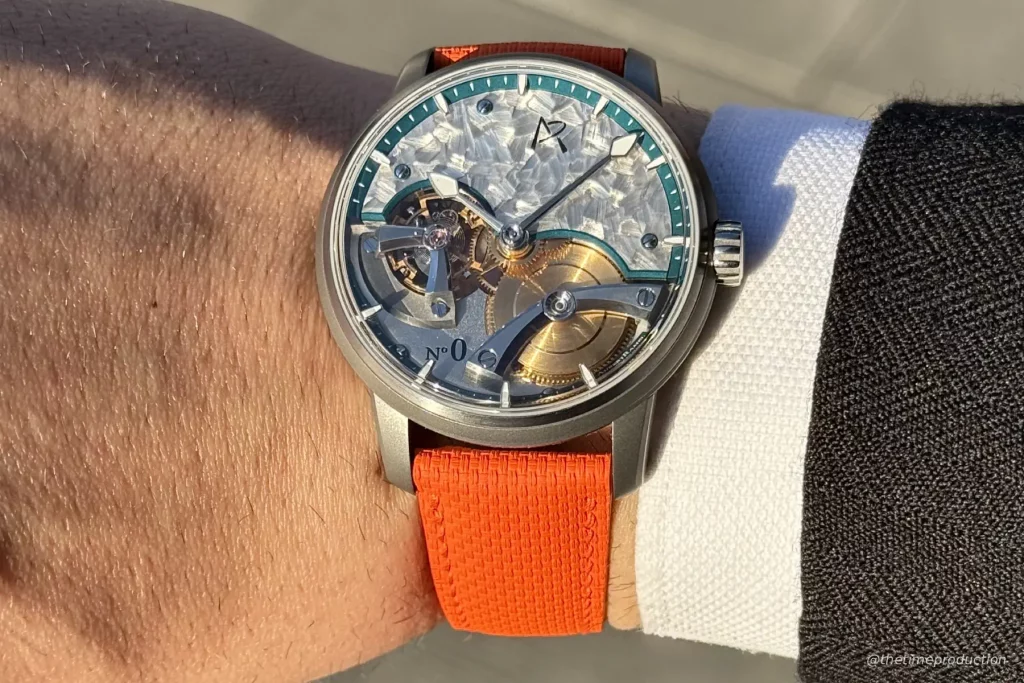
The dial of the Aubert & Ramel Ouréa Titanium is undoubtedly one of the most distinctive elements of the watch. Made from silver in the founders’ workshop, it receives an exclusive finish known as Silver Frost, created entirely by hand, scratch after scratch. At first glance, it could simply be described as a brushed or scratched surface, but the final result goes much further. The material appears almost sculpted, as though the dial had been worked deeply enough to create a genuine texture. This deliberate irregularity immediately gives the watch an artisanal dimension and ensures that every example is slightly different. Under the light, the numerous scratches catch reflections unpredictably, constantly changing the appearance of the dial. Depending on the angle, lighting conditions or surrounding environment, the surface can appear brighter, more contrasted or almost mineral. This living, constantly evolving character was precisely what struck me first when I discovered the Ouréa Titanium.
The finish is inspired by natural glacial formations. The reference is not necessarily obvious at first sight and becomes clearer once Thomas and Alexis explain their intention. Yet this is not a narrative artificially added after the watch was designed. The irregular lines, changing reflections and almost crystalline appearance of the silver genuinely evoke the fractures, relief and light effects seen across the surface of a glacier. The inspiration remains sufficiently open to allow each person to interpret it differently. The texture may also recall a rocky surface, a frozen landscape or marks left by a tool on raw material. The pattern is never perfectly uniform, and that is precisely what gives it its personality.
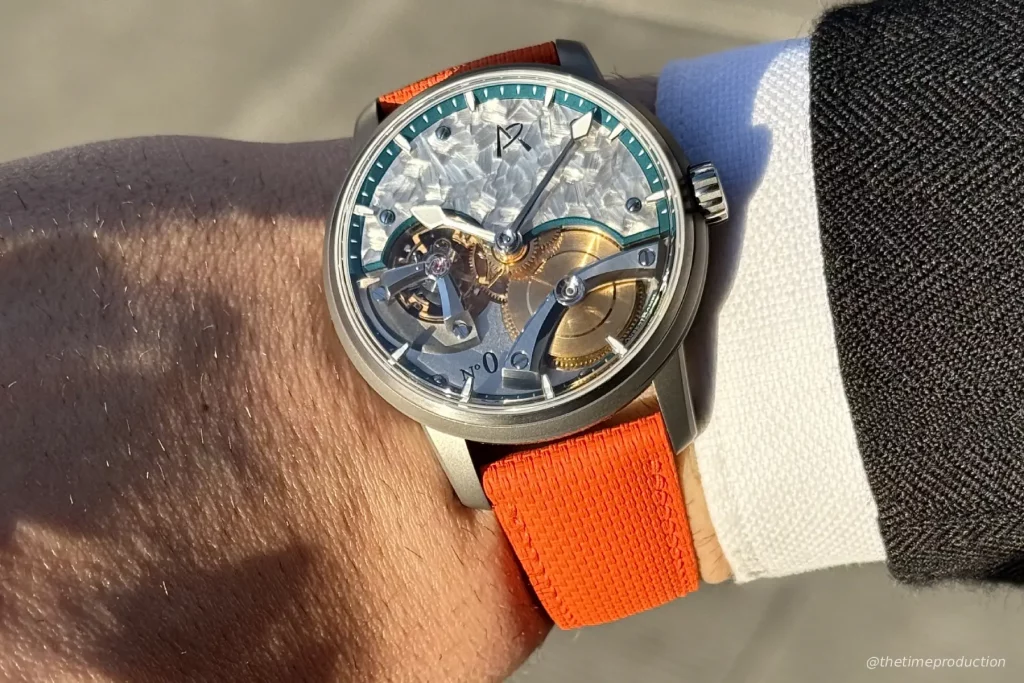
The architecture of the dial is just as important as its finish. The Ouréa Titanium does not feature a flat surface that simply covers the movement. Instead, it is built across several levels, revealing part of the mechanics beneath. The silver section occupies most of the upper half of the watch, while the lower part opens more extensively onto the movement. The result is a form of imperfect symmetry, or more accurately, a balance between two areas that do not attempt to mirror one another exactly. The construction takes into account the components the two watchmakers wanted to reveal and those they preferred to keep more discreet. The eye is gradually drawn into the watch, where certain bridges and movement components become visible without the dial losing its primary purpose. This opening never makes the watch feel artificially skeletonised. It supports the overall architecture and helps the wearer understand how the different elements relate to one another.
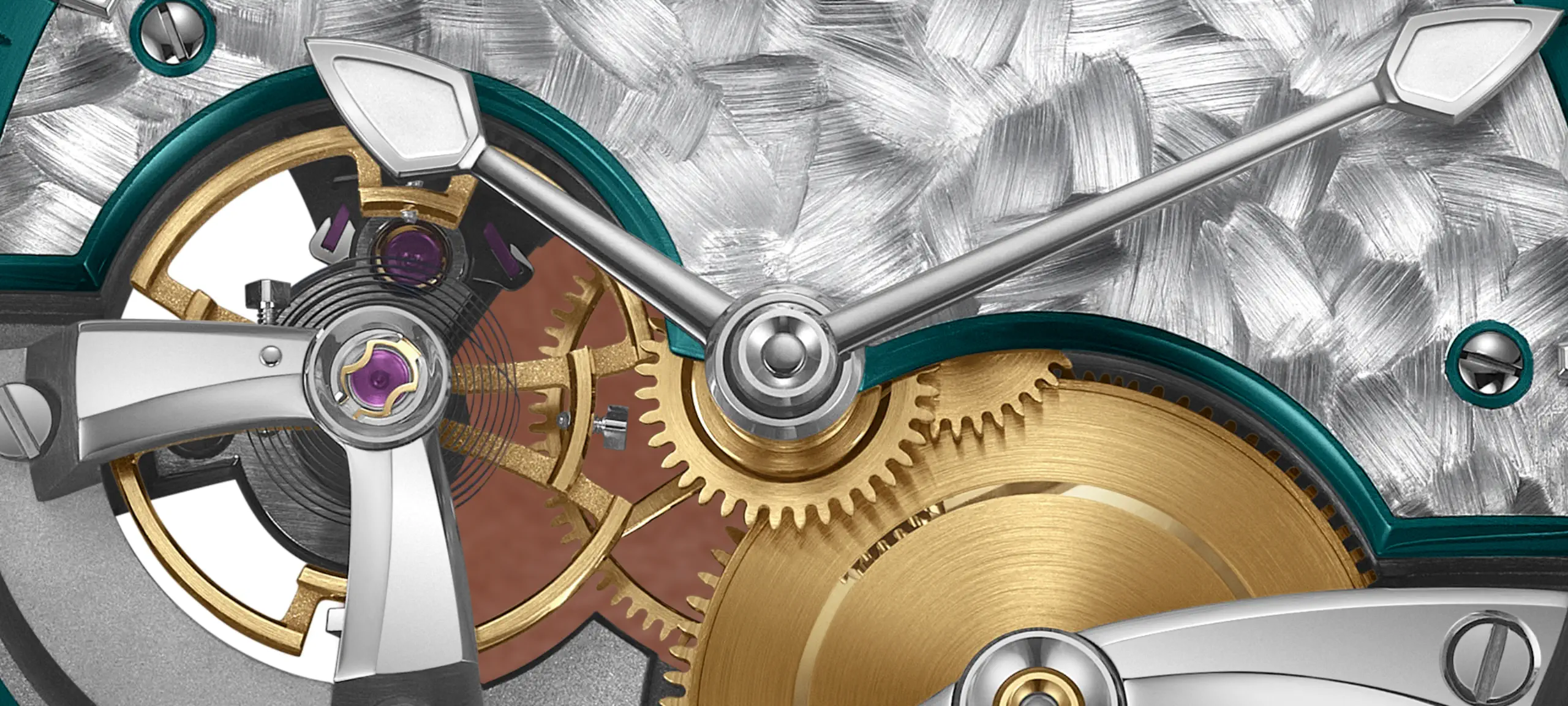
Several rings surround the Silver Frost surface, structuring the display and introducing the main touch of colour found on the Ouréa Titanium. Manufactured and decorated in-house, they receive an ALD coating, short for Atomic Layer Deposition, which gives them a shade that is particularly difficult to define precisely. Depending on the light, it shifts from blue to green, with numerous turquoise reflections in between. The colour is never entirely fixed and also contributes to the constantly changing appearance of the dial. Under certain conditions, it may recall the depth of a mountain lake, the dark tones of a fir forest or the colder shades of a glacier. These associations are not literal, of course, but they integrate naturally into the mineral and alpine character that seems to emerge from the watch.
The ALD treatment is not used solely to colour the rings. It also appears around certain screws, a choice I find particularly interesting. Rather than attempting to conceal these technical components, Thomas Aubert and Alexis Ramel-Sartori fully embrace them and incorporate them into the design. The screws therefore become genuine points of articulation within the composition. Their coloured surrounds catch the eye and emphasise the dial’s construction while also creating a visual link between its different sections. This approach perfectly reflects the way the founders work. A component is never hidden simply because it serves a functional purpose. When it contributes to the architecture, it can instead be highlighted and become an integral part of the design.
The hour markers help preserve excellent legibility. Their white sections are created using hand-applied lacquer, and four of them are mounted on pillars. This detail further enhances the depth of the dial, as the markers do not all appear to occupy the same plane. The white also creates a clear break from the silver, blue and green tones found throughout the watch. The choice of lacquer seems particularly appropriate to me. Thomas and Alexis could have used Super-LumiNova, but that would probably have given the Ouréa Titanium a sportier character that would not have suited its identity. The white lacquer retains a certain softness, almost comparable to porcelain or enamel, creating a link between the highly contemporary architecture and a more traditional approach to watchmaking.
The same white lacquer is also used at the tips of the hands. Entirely manufactured and decorated in-house, they are made from Grade 5 titanium and adopt an original shape, sometimes described as resembling a shovel or a spear. Their bevels are polished by hand, creating subtle contrasts with the rest of their surfaces. The design is distinctive enough to contribute to the identity of the dial without becoming excessive. More importantly, the white sections at the tips make the hours and minutes immediately readable despite the complexity of the construction. Without this contrast, the titanium hands would probably have blended into the silver dial and the mechanical components visible beneath it. Once again, colour is not used purely for decoration. It serves a precise function and ensures the watch remains perfectly usable.
The logo positioned at twelve o’clock is also integrated with considerable discretion. It appears to have been created by removing material from the dial before adding a darker tone that improves its visibility without disturbing the overall balance. The true signature of the watch is even more difficult to notice. The Aubert & Ramel name is engraved at the lower right of the coloured hour ring. I personally did not notice it until the detail was pointed out to me. This was entirely intentional. The two founders wanted to sign their creation without placing their name too prominently in the centre of the dial. The engraving therefore becomes something discovered gradually, almost like a secret reserved for those who take the time to observe the watch closely. It forms part of the architecture rather than being simply added on top of it.
Despite the abundance of details, the Ouréa Titanium remains extremely legible. The white markers and hand tips stand out immediately, while the different rings provide structure to the display. The dial is complex, but never confusing. The sapphire crystal also contributes to this impression. Its shape and slight magnifying effect visually enlarge certain details and make it easier to appreciate the work carried out inside the watch. The Silver Frost finish appears even deeper, the hands gain greater presence and the different levels of the dial become easier to distinguish.
The greatest achievement of this dial is ultimately its ability to bring together several expressions of watchmaking without ever feeling forced. The hand-finished silver and white lacquer evoke traditional craftsmanship, while the titanium, ALD treatment and open architecture give the watch a distinctly contemporary dimension. It also reveals part of the movement without compromising legibility or turning the watch into a technical demonstration. Aubert & Ramel has not simply reused the visual codes already common in contemporary independent watchmaking. Thomas and Alexis have developed their own approach to dial construction, with a recognisable identity, coherent choices and genuine attention paid to every detail. The result is alive, deeply architectural and original enough never to feel as though it has been seen before.
Movement
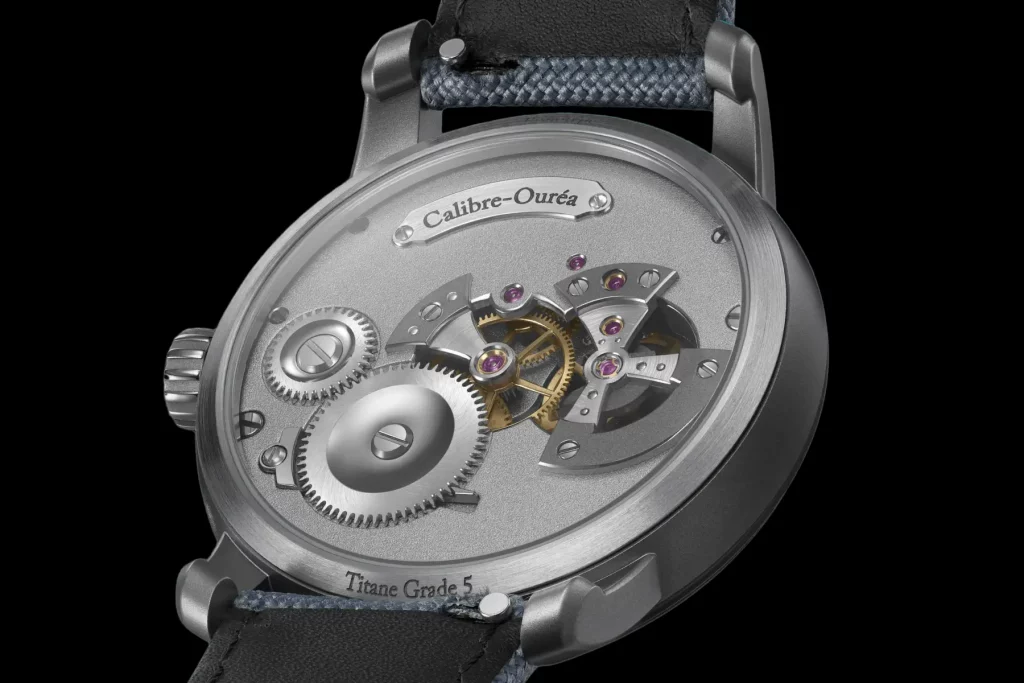
When first discovering the Ouréa Titanium, the dial naturally draws the eye. Yet the more time one spends observing the watch, the more it becomes clear that the true heart of the project lies in its movement. Unlike many independent creations based on an existing calibre that has been extensively modified, Thomas Aubert and Alexis Ramel-Sartori chose to develop their own movement. This was an especially ambitious decision for a first watch. The result of more than 800 hours of design and development, this manually wound calibre was not conceived as a simple engine responsible for displaying the hours and minutes. It forms the true backbone of the Ouréa Titanium and perfectly expresses the philosophy of its creators: offering a contemporary vision of high watchmaking without ever abandoning traditional craftsmanship.
Composed of 174 components, including 17 jewels, this entirely in-house developed calibre offers a comfortable 72-hour power reserve while operating at a relatively traditional frequency of 18,000 vibrations per hour, or 2.5 Hz. This choice is far from insignificant. While many modern movements favour higher frequencies, Aubert & Ramel embraces a slower rhythm that makes the oscillations of the balance wheel easier to appreciate and reinforces the sense of living mechanics that emerges from the watch. The movement measures 34.80 mm in diameter and 6.80 mm in thickness, dimensions that also contribute to its highly open architecture and allow the different mechanical organs to breathe visually.
What is truly impressive, however, is not simply the technical specification but the level of integration achieved by the two founders. Very few young independent brands can claim to manufacture so many of their own movement components. The bridges, wheel train, balance wheel, escape wheel and many other parts are manufactured, adjusted and decorated directly in their workshop. Only a small number of highly specialised components, such as the mainspring, jewels, certain pins and screws, are sourced from external suppliers. This decision is not driven by a desire to promote a theoretical claim of being completely in-house. It reflects a pragmatic approach based on manufacturing internally everything that genuinely falls within their own expertise.
One of the most remarkable aspects is the balance wheel. In contemporary watchmaking, this component is very often entrusted to specialised suppliers such as Precision Engineering, Atokalpa or Feller Pivotages. Thomas Aubert and Alexis Ramel-Sartori chose a far more demanding path by producing their own variable-inertia balance wheel and even counting and shaping the hairspring themselves with a Breguet overcoil. This approach immediately recalls the work of some of the most respected names in independent watchmaking, including Kari Voutilainen and Greubel Forsey. For a first creation, such a level of mastery naturally commands respect and reflects the ambition that has guided the project from the beginning.
The architecture of the movement also plays a major role in the character of the Ouréa Titanium. Built across several levels, it never seeks to multiply openings or decorative effects without reason. Every bridge, wheel and component appears to have been positioned to create genuine visual depth. The eye moves naturally between the different planes, guided by the volumes and changing reflections. The balance wheel, prominently displayed through the opening in the lower section of the watch, quickly becomes one of the main focal points. Its slower motion, combined with the frequency of 18,000 vibrations per hour, provides a constant animation that is particularly enjoyable to observe.
The choice of materials also contributes to the movement’s highly contemporary identity. While the mainplate is made from brass, Thomas Aubert and Alexis Ramel-Sartori chose to machine the principal bridges from titanium. Although considerably more difficult to work than traditional brass, titanium offers several advantages. It is exceptionally light, highly resistant to corrosion, unaffected by ageing and possesses excellent antimagnetic properties. This choice once again demonstrates their intention not simply to reproduce the historical codes of watchmaking, but to evolve them by incorporating modern materials whenever these provide a genuine technical benefit.
The use of titanium also highlights a particularly accomplished level of hand finishing. The upper surfaces of the bridges receive a straight-grained finish that almost recalls the fine ripples found on the surface of a perfectly still lake. The broad bevels, polished by hand to a mirror finish, create striking contrasts against the more matte surfaces. Their asymmetrical geometry is another especially interesting detail. The bevels are deliberately made wider on the side most visible to the wearer, further enhancing the interaction with light when the watch is viewed from different angles. The numerous internal angles, which are especially complex to execute, also reveal the standard of finishing achieved by the two watchmakers.
This attention to detail is present throughout the movement. Polished gold chatons contrast with the titanium bridges, the steel components receive a remarkable black polish, the wheels are grained before being reworked after treatment and the barrel combines several different finishes depending on the surface being viewed. Even the titanium pallet bridge receives its own gold chaton. No component appears to have been left unfinished, whether visible or hidden once the watch is assembled. Thomas Aubert and Alexis Ramel-Sartori openly embrace this approach. Every component receives the same level of attention, not as a technical demonstration, but out of respect for the watchmaker’s craft and the time required to execute it properly.
A closer look at the movement reveals several further details that reinforce this sense of coherence. The movement uses a blade-style click with a relatively uncommon configuration in which the ratchet wheel is positioned above the click. The screws mounted on the rim of the balance wheel appear to use the same square head as the one securing its pivot, a detail that contributes to the visual harmony of the movement while probably allowing the watchmaker to use the same tool during assembly. Individually, these elements may appear insignificant. Together, they reveal a broader philosophy in which engineering, aesthetics and functionality consistently move in the same direction.
Ultimately, this movement perfectly summarises the Aubert & Ramel approach. It does not seek to impress solely through its number of components, the complexity of its architecture or the accumulation of spectacular finishes. Above all, it expresses the vision of two watchmakers who chose to build their project one stage at a time, developing the skills required to manufacture, decorate and assemble a very large proportion of their watch themselves. In an industry where subcontracting has become the norm, seeing a young brand go as far as producing its own balance wheel, shaping its own hairspring and hand-finishing every component, whether visible or hidden, is rare enough to deserve attention. It is probably this constant level of commitment that gives the movement of the Ouréa Titanium such a strong personality and, in my opinion, makes it one of the most compelling aspects of this first creation.
Strap
The Aubert & Ramel Ouréa Titanium is paired with a strap that fits perfectly within the overall philosophy of the watch. During my hands-on experience, I had the opportunity to try it on an orange strap which, to my surprise, worked remarkably well with the blue and green accents created by the ALD treatment on the dial. The contrast adds a warmer note to the watch without compromising its identity. The official photographs, however, show a grey strap with stitching in the same distinctive turquoise tone. This combination is probably closer to the original vision imagined by Thomas Aubert and Alexis Ramel-Sartori.
The strap itself combines a textile-like outer surface with an almost mesh appearance and a black calfskin lining. It is a simple and effective construction that provides a good level of comfort on the wrist. There is nothing ostentatious here. Its purpose is above all to complement the watch without drawing attention away from it, a choice that remains perfectly consistent with the rest of the design.
The titanium pin buckle also deserves a few words. Without attempting to reinvent this component, Aubert & Ramel did not simply rely on a standard buckle. Its shape has been subtly reworked, particularly around the area surrounding the pin, where the volumes give it greater character. Like the case, it combines several finishes, including sandblasted and satin-brushed surfaces, allowing it to integrate naturally with the rest of the watch. It is obviously not the most spectacular element of the Ouréa Titanium, but it once again demonstrates the attention paid to detail, even in the most discreet components.
How Much Does the Aubert & Ramel Ouréa Titanium Cost?
The Aubert & Ramel Ouréa Titanium was produced in a limited edition of just 14 pieces over a period of two years. This extremely confidential production is perfectly aligned with the philosophy of the brand, which prioritises the time devoted to each individual watch rather than pursuing higher volumes. Unsurprisingly, the entire series is now sold out.
Priced at 72,000 Swiss francs, the Ouréa Titanium occupies a particularly demanding segment of the independent watch market. It is a significant sum that may naturally raise questions at first, but the positioning becomes easier to understand once the extent of the work carried out by Thomas Aubert and Alexis Ramel-Sartori is considered. The complete development of the movement, the in-house manufacturing and decoration of a very large proportion of its components, entirely hand-executed finishing and an extremely limited production all help explain the price of this first creation. At this level, the Ouréa Titanium competes directly with watches from independent makers who have already been established for several years, reflecting the ambition openly embraced by the two founders.
This pricing strategy also reflects a longer-term vision. Building an independent watch brand is not simply about creating a beautiful watch. It also requires the means to continue developing, invest in the workshop, further improve manufacturing processes and eventually expand the team. For collectors who are already drawn to independent watchmaking, or for those wishing to enter this world with a particularly accomplished creation, the Ouréa Titanium therefore represents a coherent proposition, supported by a project whose ambitions extend far beyond this initial series of fourteen watches.
Aubert & Ramel Ouréa Titanium: A First Creation That Sets the Tone
Discovering a new independent watch brand is always a unique experience. The first images can be captivating, the technical specifications impressive and the finishing convincing on paper. Yet it is only after handling the watch, speaking with its creators and understanding the thinking behind every decision that you can truly appreciate the coherence of the project. That is exactly the impression the Aubert & Ramel Ouréa Titanium left on me.
Before seeing it in person, I already considered it a watch with a strong design identity. After spending time observing it, wearing it and, above all, talking with Thomas Aubert and Alexis Ramel-Sartori, I realized it was much more than that. Behind its contemporary architecture, its constantly evolving dial and its entirely in-house developed movement lies an exceptionally mature vision of watchmaking. It is a vision that neither seeks to recreate the past nor provoke for the sake of originality. Instead, it strives to find a genuine balance between tradition and modernity.
That is probably what impressed me the most throughout my research. Nothing at Aubert & Ramel feels as though it was added simply to make an impression. Every colour has a purpose. The movement architecture is driven by technical decisions. The dial openings reveal the mechanics in a meaningful way. Even the brand signature has been deliberately kept discreet, integrated into the construction rather than simply printed on the dial. This consistency can be found throughout every aspect of the watch and reflects a genuine depth of thought.
I was equally impressed by the complementarity between Thomas and Alexis. Each clearly brings his own strengths to the project, yet those differences strengthen one another rather than compete. One naturally gravitates towards design and architecture, the other towards engineering and technical development, but both ultimately speak the same language. This way of working together probably explains why the Ouréa Titanium feels so cohesive. Nothing appears to have been designed independently of the whole.
Beyond this first watch, what I find particularly compelling is the long-term vision behind the project. The founders are not trying to grow Aubert & Ramel as quickly as possible. Their ambitions lie elsewhere. They want to expand their workshop progressively, recruit the right people, pass on their working methods and build a team capable of maintaining the level of excellence that defines their watches today. For the next several years, they are deliberately choosing to produce only very small quantities, with a target of around ten watches per year, prioritising quality over volume. It is a philosophy that has become increasingly rare in an industry where growth is often seen as the ultimate objective.
This willingness to move forward patiently is also reflected in their plans for future creations. Rather than producing endless variations by simply changing a dial colour or case material, Thomas Aubert and Alexis Ramel-Sartori want to evolve their identity without ever losing it. They have already spoken about introducing a complication, exploring new touches of colour and developing fresh architectural concepts, all while preserving the instantly recognisable DNA that defines the Ouréa today. This is probably the greatest challenge facing any young independent watch brand: evolving without disappointing the collectors who believed in the project from the very beginning.
Above all, what I will remember most from meeting them is the deeply human side of their project. Throughout our conversations, I never had the feeling that I was speaking with two entrepreneurs focused solely on building a business. Instead, I met two passionate watchmakers who genuinely love their craft, who still speak about watchmaking with enthusiasm, who would rather collaborate with partners sharing their values than pursue growth at any cost, and who simply want to continue making a living doing what they love. Their humility, sincerity and uncompromising standards are reflected as much in the way they work as in the watch they have created.
The Ouréa Titanium is undoubtedly not a watch intended for every collector. Its positioning, design language and price place it firmly within the world of serious independent watchmaking. What it offers in return, however, is something many more conventional creations still struggle to achieve: a truly distinctive identity. When a brand’s very first watch already displays such a strong personality while resting on technical and human foundations of this calibre, it is difficult not to look towards Aubert & Ramel’s future with genuine excitement.
As for me, I will be following their journey very closely. If Thomas Aubert and Alexis Ramel-Sartori continue to move forward with the same patience, dedication and humility that gave birth to the Ouréa Titanium, I am convinced we have only seen the opening chapter of what promises to be a remarkable story in independent watchmaking.
Aubert & Ramel Ouréa Titane – Watch Specifications
- Brand: Aubert Ramel
- Model: Ouréa
- Case Material: Grade 5 Titanium
- Dial: Solid silver dial with griffé hand-made finishing
- Functions: Hours, Minutes
- Movement: Ourea, Manual-Winding, 18’000vph frequency (2.5Hz), 17 jewels and 174 parts
- Power Reserve: 72 Hours
- Water Resistance: 5 ATM
- Crystal: Sapphire
- Case Back: Sapphire
- Case Dimension: 40.4mm (Diameter) × 9.3mm (Thickness)
- Lug-to-Lug: 48mm
- Strap: Calfskin with Titanium Pin Buckle
- Availability : Limited edition of 14 pieces (SOLD OUT)
- Retail Price: CHF 72,000 (excluding VAT)
What do you think of the Aubert & Ramel Ouréa Titanium? Does its contemporary architecture and vision of independent haute horlogerie appeal to you, or would you have imagined a different approach for a first creation? Feel free to share your thoughts in the comments. I would be delighted to continue the conversation.
If this article added value or sparked a discovery, you can support the project HERE. Your contribution helps me keep weekly articles and a biweekly newsletter free, accessible, and independent for everyone.
For more information about Aubert & Ramel, click here.