

Today, I have the pleasure of introducing a young independent Swiss watch brand that, despite its recent launch, brings together more than fifty years of combined experience in some of the most demanding areas of watchmaking. If I mention a Dutchman fascinated since childhood by the workings of a record player, an Australian woman who left university to learn a practical craft, complications developed for brands such as Breguet and Omega, fifteen years at the head of WOSTEP and an adventure that would take them all the way to Cambodia to help establish a watchmaking school and create tourbillon watches intended for international leaders, those of you familiar with the watchmaking world may already have recognised Maarten and Jessica Pieters. These two watchmakers, as different as they are complementary, officially unveiled their own brand, Atelier Pieters, on 23 July 2026, with a first creation named the Atelier 1 Founders’ Series. A watch with a richer story than its classical appearance might suggest and one that, in my view, deserves as much attention for the people who conceived it as for the mechanisms inside it.
I wanted to devote an article to Atelier Pieters not only because of the tourbillon movement in this first creation or its founders’ experience in the watch industry. I also wanted to take the time to understand their approach before sharing it with you. As you will know if you regularly follow The Time Production, I place great importance on meeting watchmakers and discovering their watches for myself. Each article is an opportunity for me to share an experience, understand the decisions behind the development of a watch and offer you information that goes beyond a press release. I was already in touch with Jessica before the brand’s launch and had been following the progress of their project with interest. We had the opportunity to meet at Geneva Watch Days 2026 in Geneva, where I spoke with her and Maarten about their first watch, examined it more closely and took my own photographs and videos. That meeting helped me better understand their philosophy and what distinguishes this project among the many independent watch brands that have emerged in recent years.
This is the first thing that sets Atelier Pieters apart: although the brand is new, its founders have devoted much of their lives to watchmaking. And unlike projects whose identity rests primarily on the vision of a single creator, Atelier Pieters grew out of two professional paths that gradually came together. Maarten has extensive experience in the design, prototyping and development of mechanical complications, while Jessica has built her approach around after-sales service, decoration, finishing and passing on skills. But reducing their partnership to a simple division of technical expertise would, in my view, miss the point. Their philosophy of the craft is that making a watch cannot be entirely separated from the knowledge required to produce it, its future maintenance and the people who help bring it to life.
To understand this approach, we first need to return to Maarten’s early years. Born in the Netherlands in 1971, he grew up in a middle-class family in the countryside, not far from the German border. He is the elder of two boys and does not come from a watchmaking family. His younger brother, Ruben, would later follow the same path, making them the first two members of their family to enter the profession. One anecdote from his childhood stayed with me: when his father bought a record player, Maarten became fascinated by how it worked. In particular, he wanted to understand how a simple stylus could produce music as it followed the grooves of a vinyl record. This curiosity about mechanisms soon extended to other activities. He spent a great deal of time taking apart and reassembling bicycles, record players and whatever mechanical objects he could get his hands on. I like this anecdote, which shows that his interest in watchmaking began with a broader fascination with micromechanics and understanding how things work.
Around the age of twelve or thirteen, Maarten began moving towards a technical education. After secondary school, he enrolled at a watchmaking school in the Netherlands, where he met Tim Grönefeld. Their friendship would continue well beyond their years of training. At a time when the Swiss watch industry was beginning to regain momentum after the difficulties of the preceding decades, the two friends decided to continue their training in Switzerland. They moved to Neuchâtel to study at WOSTEP, an institution that would later play a central role in Maarten’s career and in the story of Atelier Pieters. Before eventually becoming its director, however, he would first discover a world in which mechanical creativity played an essential role.
After completing his training at WOSTEP, Maarten entered the world of prototyping and mechanical complications, notably at Janvier SA and THA in Sainte-Croix. There, he encountered several figures who would leave their mark on contemporary independent watchmaking, including Vianney Halter, Denis Flageollet and Nicolas Court. This period introduced him to an approach in which designing a mechanism and manufacturing it were closely connected. It involved not simply understanding how a complication worked, but also developing the components needed to make it and resolving the difficulties that arose during prototyping. Maarten contributed to work on the famous Breguet Sympathique clocks, complex creations pairing a clock and a watch with interacting mechanisms. This experience exposed him to that degree of mechanical sophistication and helped him develop an appreciation for traditional techniques and artisanal skills.
In the late 1990s, Maarten joined Omega, where he helped establish the department dedicated to complications and restoration. He took charge of a team and worked on the restoration of historic timepieces as well as demanding mechanical development projects. It was during this period that he deepened his knowledge of the tourbillon, notably working alongside Maurice Grimm on developments for the Omega Central Tourbillon that led to COSC chronometer certification for certain calibres. At Omega, he also returned to the Breguet Sympathique clocks, this time to service and restore them. Having helped manufacture them in Sainte-Croix, he now encountered another aspect of their existence: their preservation and continued operation over time. These same clocks would continue to accompany him throughout his subsequent career. These experiences allowed him to approach watchmaking from several angles, from design to restoration, while retaining a conviction that seems to have guided him from the beginning: despite the considerable advances of industrialisation, much of the richness of this craft lies in skilled handwork and the human ability to give physical form to an idea.
Jessica came to watchmaking by a different route. Originally from a small coastal town in the Australian state of Victoria, she grew up in a family with no watchmaking tradition and was raised mainly by her mother. Her mother is Anglo-Australian, while her father comes from India, specifically the Manali area at the foot of the Himalayas. From childhood, Jessica developed an interest in activities that required patience and precision. She particularly enjoyed drawing, engraving, embroidery and making jewellery. As a teenager, she also became fascinated by car mechanics and considered following her uncle into that field. Those around her, however, were more inclined to picture her pursuing a legal career. After two years at university, she eventually decided to change direction and train as a watchmaker. That choice reveals a need she shares with Maarten: to understand mechanisms and work with her hands, although her interests also encompass the finesse of manual work and the almost artistic nature of certain techniques.
Jessica began her watchmaking career in Australia in 2002, discovering the profession through after-sales service. That first experience had a lasting influence on how she viewed a watch. While Maarten was primarily interested in designing and manufacturing mechanisms, Jessica developed a particular sensitivity to a timepiece’s life after production. For her, a watch’s value does not depend solely on its price, its complexity or the name on its dial. It also lies in the relationship its owner has with it. When someone entrusts a watchmaker with a watch for a repair or a service, they may be handing over an object of considerable sentimental value. Jessica therefore sees technical proficiency as a responsibility towards the person placing their trust in the craftsperson. I appreciate this approach, which reminds us that a watch has a life beyond the workshop. It will continue to be worn, serviced, repaired and perhaps passed down through several generations.
Jessica then turned towards teaching, which would become an essential part of her career. In 2010, she received a prestigious Churchill Fellowship, an award that allowed her to travel to Switzerland to further her technical knowledge at WOSTEP in Neuchâtel. This experience gave her a more direct understanding of training methods rooted in the Swiss watchmaking tradition. Above all, it confirmed her desire to pass on the skills she had acquired. In 2011, after around nine years in after-sales service, she joined a watchmaking school in Dallas, in the United States, through a partnership between WOSTEP and Richemont. There, she worked alongside Stanley McMahan, whose rigour and teaching methods would have an important influence on her own approach to education. Her interests extended beyond demonstrating practical techniques. She also wanted to understand how to structure a course, develop teaching materials, define assessment criteria and help students make lasting progress in mastering the craft.
Maarten’s and Jessica’s paths came together at an institution whose philosophy they shared: WOSTEP, which stands for Watchmakers of Switzerland Training and Educational Program. Maarten had returned there as deputy director in 2002 before becoming director in 2003, a position he would hold for fifteen years, until 2018. Jessica joined the teaching and management team in 2013, following her international experience. She worked on training programmes, assessments, certifications and partnerships with watchmaking schools around the world, while developing her expertise in component decoration and finishing. For both of them, WOSTEP represented much more than a workplace. It became a place for exchanging ideas, meeting people and sharing expertise, where watchmakers from different countries shared their knowledge and experience. It was also in this environment that their paths gradually drew closer, until they became a couple united by a shared passion, while each retained a sensibility of their own. That duality would find its way into Atelier Pieters several years later.
During his years as director of WOSTEP, Maarten championed a comprehensive approach to watchmaking education. In his view, training should not simply serve the immediate needs of watch manufacturers or be limited to the most common servicing operations. A watchmaker should also understand movement construction, component manufacturing, regulation techniques and restoration methods. A mechanical watch is generally intended to last for several decades, or even several generations. If tomorrow’s watchmakers no longer learn certain traditional techniques, who will be able to service and restore the creations we admire today? And who will develop tomorrow’s complications? These questions connect the passing on of skills directly to the future of independent watchmaking. For Maarten and Jessica, training a watchmaker is therefore about more than teaching someone to repeat a series of actions. It means giving them enough knowledge and independence to understand, manufacture and potentially develop their own mechanical solutions.
This philosophy found expression in the development of the WOSTEP W-01 training watch, an important project in Maarten’s career. By making a watch, students put the skills acquired during their training into practice. The idea is to look beyond examinations as an end in themselves, with the W-01 preserving a record of the work, time and effort devoted to learning. Each student can give tangible form to part of that experience through a timepiece they have helped make. In 2017, WOSTEP W-01 number 100 was presented at the Only Watch charity auction through a collaboration bringing together former students, teachers and independent watchmakers. This remains the only official occasion on which a W-01 has been offered to the public. I appreciate how an educational project can also become an expression of watchmaking expertise.
Building on this experience, Maarten then conceived a new training watch for the most advanced students: the WOSTEP W-02. This time, the aim was to let them tackle a demanding complication, the tourbillon. The intention was not simply to explain how it worked or show the different parts, but to allow students to explore precision timekeeping and the construction, assembly and adjustment of a complex regulating assembly in greater depth. A prototype featuring a tourbillon that completed one rotation every two minutes, running at a frequency of 18,000 vibrations per hour, was presented in 2016 to mark WOSTEP’s fiftieth anniversary. Unfortunately, the project was never fully realised, but the ambition to develop a tourbillon as a teaching tool survived Maarten’s and Jessica’s departure from WOSTEP in 2018. It would become one of the foundations of their next adventure.
In 2019, Maarten and Jessica officially founded their own company, time2, to continue their work in watchmaking and education. Based in Les Hauts-Geneveys in the canton of Neuchâtel, the new company offered consulting, prototyping, specialist training and the development of educational programmes for the watch industry. Their first clients were mainly Swiss watch brands looking to strengthen their training programmes, particularly internationally. But time2 also became a place where the couple could develop their own mechanical projects. It was during this period that the T2 family of calibres emerged, its name referring directly to their company. Several developments were undertaken, including a manually wound movement named the T2-01, a project for a large-format tourbillon with a detent escapement and, above all, the T2-03 calibre, a tourbillon movement designed as a teaching tool. The T2-03 was therefore not originally conceived to power a luxury watch for commercial sale. Its primary purpose was to allow students to study, handle, manufacture and understand the mechanisms of this complication. A few years later, this architecture would evolve in an unexpected way.
While Maarten and Jessica were developing their business in Switzerland, an unexpected proposal came their way in late 2019: to help establish a school teaching traditional Swiss watchmaking in Cambodia. It might seem a surprising idea, given the historical concentration of watchmaking skills in certain European regions. Nevertheless, the couple accepted the challenge and embarked on an adventure that would occupy a considerable part of their professional lives over the following years. The project led to the Prince Horology Vocational Training Center in Phnom Penh, which opened in 2020. Maarten and Jessica helped set up the school, took part in recruitment and contributed to developing the curriculum and teaching materials. The aim was ambitious: to provide Cambodian students on full scholarships with watchmaking training based on the same standards as specialist institutions in Switzerland. The school was equipped with machines and tools from Switzerland, giving students access to a technical environment rarely available in a country without an industrial watchmaking tradition comparable to that of the Jura Arc.
The content of the training deserves a closer look. Maarten and Jessica did not simply want to teach students to assemble movements or carry out servicing work. They believed that a complete education should also include an understanding of how a mechanism’s components are manufactured. Students therefore learned to make balance staffs, winding stems, pinions and wheels, as well as perform various regulation, decoration and finishing operations. Some even went on to design their own bridges, machine them from raw material, cut their gears, polish their pivots and make their hands or dials. This approach continued the philosophy they had championed at WOSTEP. While the W-01 training watch was a relatively standardised project, the Cambodian students had additional freedom to develop their own components and understand the constraints involved in making them. It was also about giving them enough independence to practise their profession in an environment where watchmaking infrastructure remains limited.
This experience also had a human dimension. For many students, it meant discovering a profession they would probably never have imagined entering a few years earlier. The school soon attracted the attention of several international institutions and public figures, but it was above all the students’ progress that gave the project its purpose. Some became teaching assistants, helping train new intakes and ensuring that skills continued to be passed on. For around five years, Maarten and Jessica divided their time between Switzerland and Phnom Penh, despite the difficulties caused, in particular, by the global pandemic. What I like about this story is that teaching was more than a way of passing on skills they had already mastered. It also allowed a new generation of watchmakers to build their professional futures. This ambition would reach another stage when the couple decided to introduce their T2-03 tourbillon movement into the training programme.
Initially, Maarten and Jessica envisaged a project comprising thirty pieces in total. Fifteen movements were to be used for training, while fifteen watches with more elaborate finishing could be sold to help fund the school. The idea was to use a complication usually associated with the most prestigious creations in fine watchmaking as a teaching tool, while allowing some of the watches to help fund that educational work. For students, working directly on a tourbillon offered an exceptional opportunity to deepen their knowledge of precision timekeeping and mechanical construction. But the project would take an unexpected turn. In mid-2021, Maarten and Jessica received a special request from Cambodia’s then Prime Minister, who wanted to use their movement to create a series of watches intended as gifts for international leaders at the ASEAN summit held in Cambodia in 2022.
This led to the ASEAN Lotus Tourbillon, produced in an edition of twenty-five watches using an adaptation of the T2-03 calibre, with the movements bearing the reference T2-03S. Maarten and Jessica accepted the commission for reasons that went beyond the prestige of its intended recipients. Their aim was to highlight the skills being developed in Cambodia and introduce the school to an international audience. The watches thus became ambassadors for the educational project and for the students who had devoted several years to learning the craft. The significance of the ASEAN Lotus Tourbillon lies not only in its mechanical complexity or in the fact that certain international leaders may have received an example. Above all, it lies in turning a training project into a tangible watchmaking achievement capable of representing the ambitions of a new generation of watchmakers. An unusual path for the T2-03, originally conceived in Switzerland as a teaching tool.
The origin and manufacture of these watches call for some clarification, as the subject has raised questions among collectors I have spoken with since Atelier Pieters was unveiled. On seeing the first images of the Atelier 1 and learning about the ASEAN Lotus Tourbillon project, some drew a connection between the two creations. But the link with Cambodia sometimes led to a mistaken interpretation, suggesting that Maarten and Jessica had taken a movement of Asian origin and adapted and decorated it for a Swiss watch. The opposite is true. Maarten and Jessica developed the T2-03 calibre within their Swiss company, time2, before incorporating it into their Cambodian educational venture. The ASEAN Lotus Tourbillon was therefore based on a movement architecture they had developed themselves, rather than an Asian movement purchased from an outside manufacturer. I see this clarification as fundamental, because it changes how we understand the development of their first independent watch.
For the twenty-five ASEAN Lotus Tourbillon watches, the components were manufactured and finished in Switzerland, apart from the straps supplied by Delugs in Singapore. The movements were assembled piece by piece in Les Hauts-Geneveys, in the workshop that is now home to Atelier Pieters. The cases, dials and hands were also made in Switzerland. The final casing-up and final checks, however, were carried out at the school in Cambodia by Maarten Pieters and Stéphane Monard, who was then an instructor. These were therefore not watches made entirely in Cambodia, but a Swiss watchmaking project closely connected to a Cambodian educational initiative. This division of work clarifies each person’s role and the movement’s particular place in Maarten’s and Jessica’s careers. The T2-03 brings together their experience in developing complications, their commitment to education and several years of work devoted to passing on skills.
That story brings us back to the Atelier 1 Founders’ Series today. The T2-03RM calibre powering this first creation belongs to the line of movements developed by Maarten and Jessica at time2. The current movement is not identical to the one used in the watches made for ASEAN. Its architecture has evolved, its design has been adapted and various mechanical solutions have been developed to meet the requirements of this new creation. We will examine the movement in more detail. I like the fact that this watch for collectors has its roots in a calibre conceived for learning. That continuity sums up the founders’ philosophy. After devoting much of their careers to training watchmakers, they have chosen to give their expertise a more personal expression, without abandoning the principles that have guided them along the way.
On 23 July 2026, Maarten and Jessica reached another milestone by officially unveiling Atelier Pieters on their wedding anniversary. Their choice of date says a great deal about how they see the brand. It was more than a commercial launch: this is a project closely tied to their shared history. Coming from two different hemispheres, with distinct sensibilities and professional backgrounds, they gradually learned to combine their skills around a shared vision of watchmaking. This idea of complementarity even appears in the brand’s logo, whose design evokes a tulip in reference to Maarten’s Dutch origins, with a central “M” accompanied by two mirrored “J”s. It also runs through their approach to creating a watch. For them, a timepiece’s value depends not only on the finished result, but also on the time devoted to making it, the mastery of manual techniques and the connections it can create between people. That philosophy is consistent with their desire to work on a very small scale, prioritising quality of execution and preserving their skills over a significant increase in production volumes.
This approach is reflected in their working environment. Atelier Pieters is based in Les Hauts-Geneveys, in the Chalet des Gollières, a building near a forest in the Neuchâtel region of the Jura. Historically associated with preserving the traditions and identity of the canton of Neuchâtel, the chalet now houses both their workshop and their family home. The first two levels are devoted to watchmaking, including a machining area equipped with conventional, manually operated machines, a decoration and assembly workshop, and their offices. The upper floors are their living space. Maarten and Jessica joke that they are not always sure whether their workshop is in their home or their home is in their workshop. I like this detail, which reveals how central watchmaking is to their daily lives. They can take the time to manufacture, develop and refine their creations in a setting that brings together their work and family life. This relationship between their personal lives and their craft reflects the identity they want to give their brand.
To launch Atelier Pieters, Maarten and Jessica chose to introduce a first collection named the Atelier 1 Founders’ Series, offered in two distinct aesthetic interpretations. The first, named Minuit, adopts a monochrome palette, with an anthracite dial accompanied by dove grey and silvery details. The second, named Jour, offers a warmer combination, with tones reminiscent of rose gold, almost salmon in colour, lifted by blue accents. Two interpretations of the same creation that express the idea of duality and balance at the heart of the founders’ approach. Each version is limited to eight examples. For this article, I chose to focus on the Atelier 1 Founders’ Series Minuit, whose understated appearance had intrigued me. It gives little away about the rich mechanical detail and craftsmanship we are about to discover.
The way their backgrounds, their experience and their desire to pass on their skills fit together is what made me want to devote an article to Atelier Pieters. The Atelier 1 Founders’ Series represents more than the first creation of a new independent watch brand. It is the culmination of a long journey, from Maarten’s and Jessica’s early experiences to the development of their own movements, taking in their teaching at WOSTEP and their Cambodian adventure along the way. I wanted to bring this human, historical and mechanical dimension into focus before examining the watch itself. Behind its apparent simplicity, the Atelier 1 already has a story that few first creations can claim. Now, let’s take a closer look at the Atelier Pieters Atelier 1 Founders’ Series Minuit.
Table of Contents – Atelier Pieters Atelier 1 Founders’ Series Minuit
What are the key features of the Atelier Pieters Atelier 1 Founders’ Series Minuit?
Case
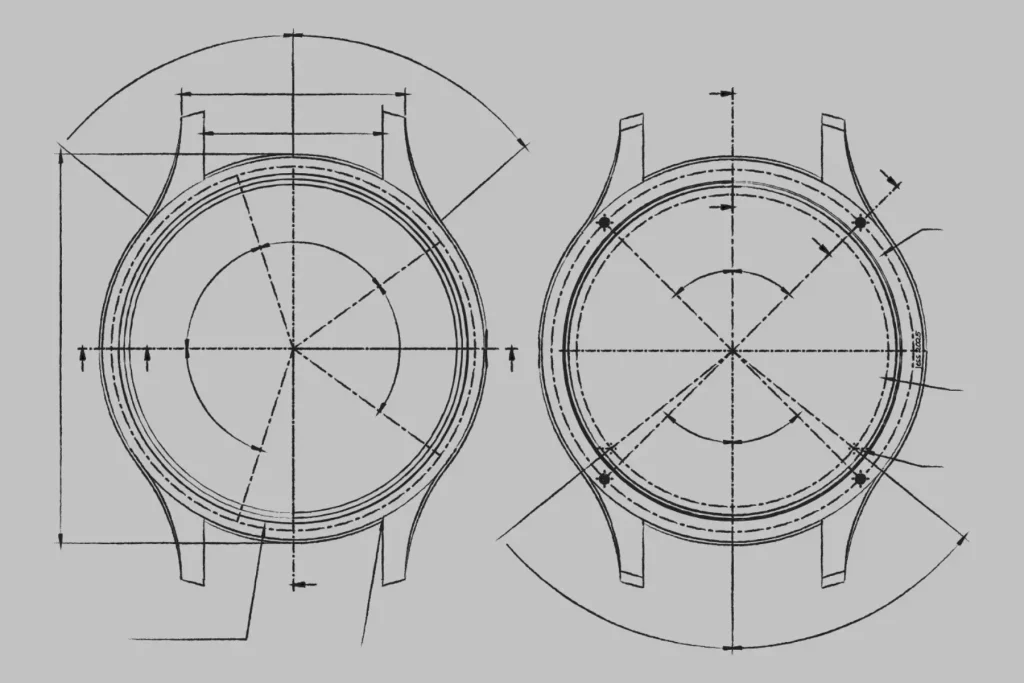
The case of the Atelier Pieters Atelier 1 Founders’ Series Minuit combines classical lines with a fully polished platinum construction. I appreciated the shaping of its curves and the way the lugs seem to extend naturally from the case middle. The design looks understated at first, revealing several details when you take the time to examine it.
The Atelier 1 Founders’ Series Minuit measures 43.5 mm in diameter and 13 mm in thickness. Its case is made from 950 platinum, with a three-part construction and a fully polished finish. This precious metal makes sense to me given the positioning of this first creation and the standard of execution its founders are aiming for. Considerably denser than 18-carat gold, platinum gives the watch a distinctive sense of weight. The documentation mentions around 86 grams of platinum for the case, a figure that does not represent the total weight of the watch.
These proportions are partly explained by the need to accommodate the T2-03RM calibre. Its architecture imposes construction constraints that become easier to understand when we examine the movement.
The case is manufactured by Voutilainen & Cattin SA, a Swiss specialist. It would hardly be reasonable to expect every independent watchmaker to master all the crafts needed to make a watch. Working with a specialist manufacturer therefore seems appropriate to me for a brand of this size. The result is carefully executed, particularly in the way the different surfaces meet. Despite its three-part construction, the continuity between the case middle and the integrated lugs gives the impression that the whole has been sculpted from a single piece of metal. I appreciated this when I first saw the watch, as the mirror polish extends naturally along the sides and into the curves of the lugs.
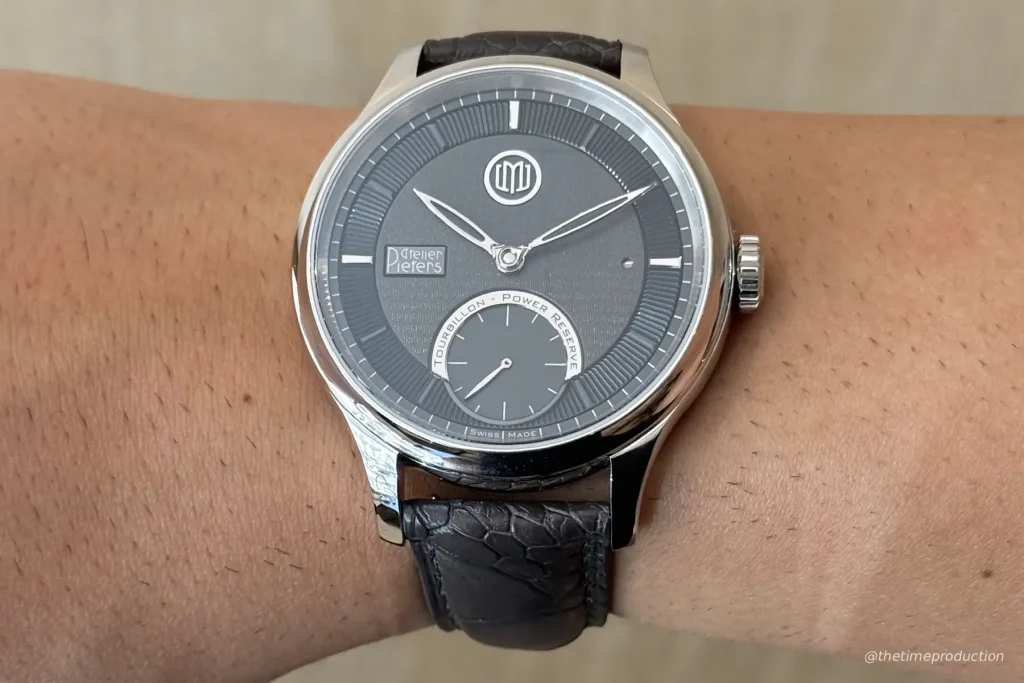
The rounded contours give the case a certain softness, while the bezel has a subtly concave shape. It draws the eye towards the centre of the watch, where a slightly domed sapphire crystal sits. I like this treatment of the surfaces, whose continuous reflections emphasise the curves without adding a succession of decorative finishes.
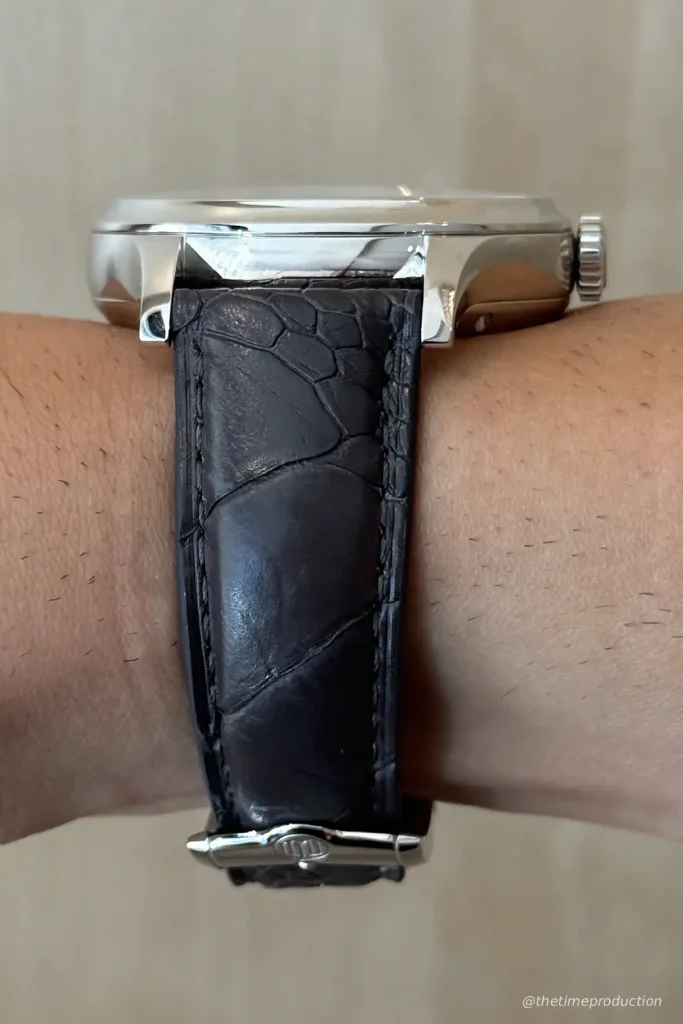
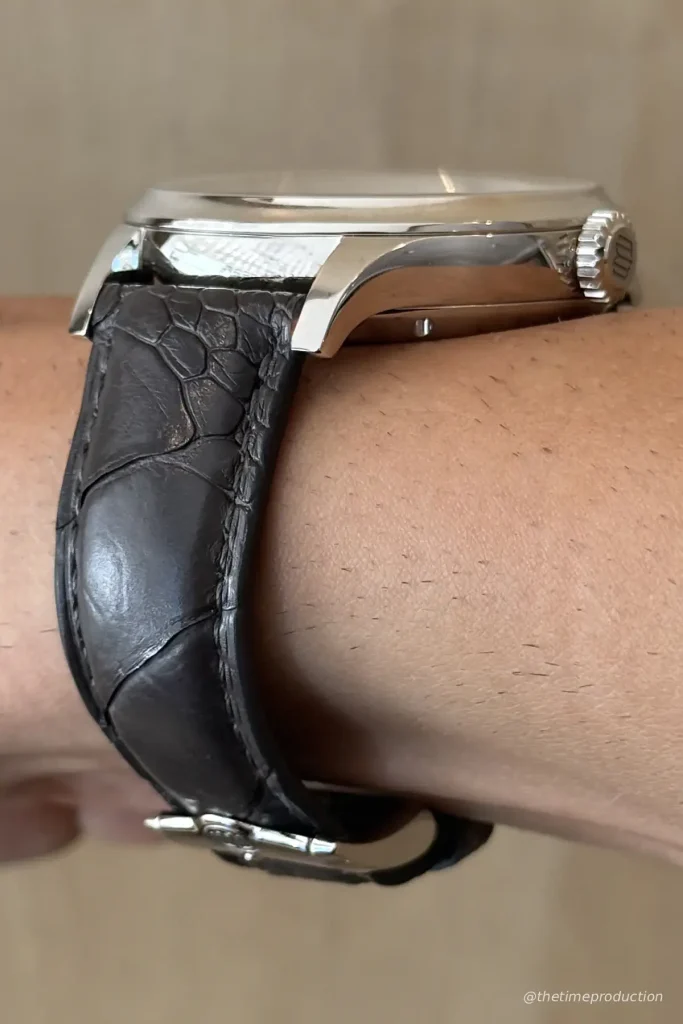
Relatively short and slender, the lugs curve downwards quite sharply to follow the wrist naturally. When I tried the watch on, they did not noticeably overhang my wrist, and their angle allowed the watch to sit properly. The weight of the platinum was immediately apparent: you can really feel the watch on your wrist, something certain collectors will appreciate. Personally, I would have preferred a diameter of around 38 to 40 mm, which would also have made the watch suitable for a wider range of wrists. I am well aware that such a reduction would mean revisiting some of the construction constraints. On my wrist, the diameter remained visually prominent despite the comfort provided by the lugs. I think it will be better suited to collectors with larger wrists than mine, or those who enjoy watches with generous proportions.
I did, however, find the relationship between diameter and thickness well judged, particularly considering the complexity of the movement and the architecture of the dial. The slender, downward-curving lugs help reduce the visual impression of thickness, preventing the case from looking as though it is simply sitting on top of the wrist. The overall design remains balanced.
The crown conceals a detail I had not noticed before discussing it with the founders. Positioned at 3 o’clock, it is made from platinum and is large enough to offer a good grip. When I tried the watch on, I enjoyed handling it and the mechanical feel of winding it manually. Its 21 facets, arranged around its circumference, make a symbolic reference to the movement’s frequency of 21,600 vibrations per hour. This anecdote illustrates the attention Maarten and Jessica give to details that could easily go unnoticed. The crown also bears the Atelier Pieters logo.
The Atelier 1 Founders’ Series Minuit has two sapphire crystals. On the dial side, the slightly domed crystal follows the lines of the bezel, while a flat sapphire crystal at the back provides a view of the movement and its finishing. Both crystals have an anti-reflective coating on their inner surfaces. When I examined the watch, I found the dial very legible, despite some reflections caused in particular by the curve of the crystal. These occasionally made photography more difficult without really interfering with reading the indications. The stated water resistance is 30 metres, or 3 ATM, a fairly typical rating for a watch of this kind.
Dial
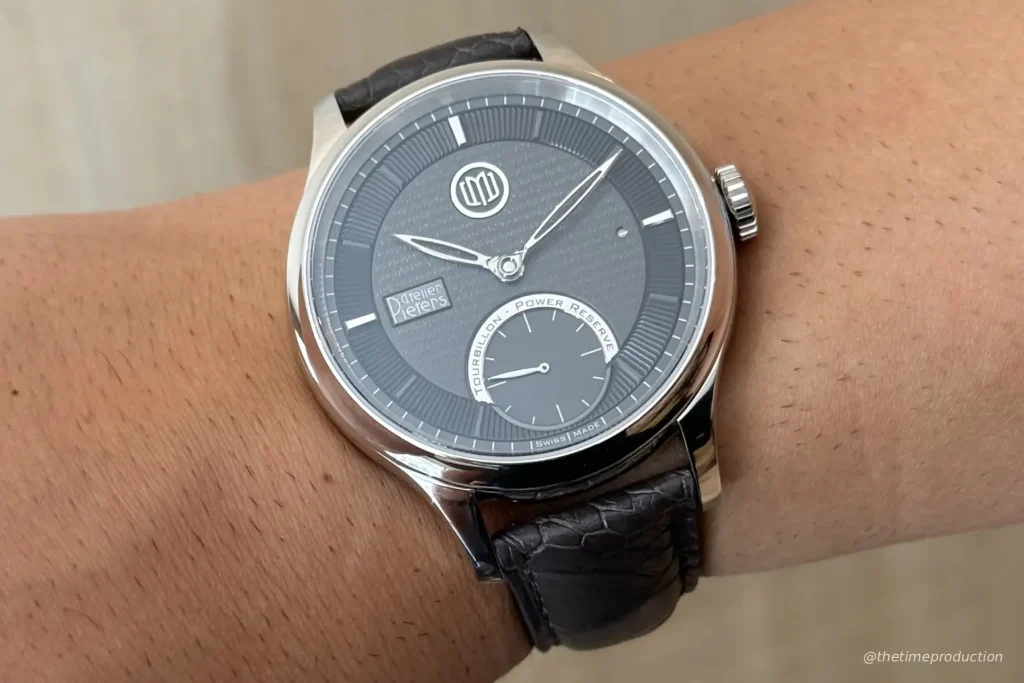
At first glance, the dial of the Atelier Pieters Atelier 1 Founders’ Series Minuit might suggest a fairly simple construction, with its classical appearance and monochrome tones. Yet, when I examined it at, I discovered how its levels, textures and different indications give it greater depth. Maarten and Jessica Pieters wanted to preserve a certain restraint while incorporating several decorative and mechanical details. The dark palette of this version helps bring out the different finishes.
The Minuit version combines an anthracite base with various shades of dove grey and elements with silvery reflections. The appeal of this understated combination lies in the contrasts between the surfaces. Depending on the viewing angle, the raised areas of the dial catch the light differently, gradually revealing its construction.
The dial architecture consists of several elements arranged at different levels. Around the periphery, a very fine minute track frames an hour ring with a fluted surface. The latter is constructed much like an inner flange, creating a transition between the outer minute track and the central part of the dial. There are also applied, faceted hour markers at the cardinal positions, their facets catching the light and helping guide the eye when reading the time. This layering adds depth without introducing too many visual elements. I found the arrangement coherent, as it preserves a traditional way of reading the time, enriched by the shaping of the different levels and their finishing.
At the centre, the surface has a three-dimensional geometric pattern formed by repeating the Atelier Pieters emblem. Beyond its role as a signature, the logo becomes a decorative element that helps create an impression of depth. This immediately reminded me of another independent creation I had the pleasure of featuring on The Time Production: the Dunselman Black Tulip, conceived by Dutch watchmaker Annelinde Dunselman. On that watch, the brand’s logo is also repeated as a decorative pattern, creating texture across several levels of the dial. Although the two watches have different identities, I appreciate this way of incorporating a brand’s own graphic element into a watch’s design. On the Atelier 1, the result brings the central surface to life without making the decoration feel excessive.
The dial is made by Schätzle & Cie, a specialist company based in Lörrach, Germany. As with the case manufactured by Voutilainen & Cattin, identifying these specialists helps explain how Atelier Pieters’ work complements the expertise of its partners. Maarten and Jessica also work directly on certain elements, notably applying Swiss Super-LumiNova to some of the numerals.
The hour and minute hands have a slender shape that slightly recalls traditional leaf-shaped hands, with a more contemporary interpretation through a partially openworked profile. They are machined from solid material, then receive several finishes: rhodium plating, surfaces with a frosted appearance and diamond-cut facets. This combination produces crisp edges whose reflections change as the hands move across the dial. I really liked their design, which complements the geometric treatment of the centre without dominating the composition. Despite their slenderness and the richness of the surrounding textures, I found reading the hours and minutes easy and pleasant. The hands’ different surfaces provide enough contrast against the anthracite background to maintain very good legibility.
There is one detail I am less sure about, however. At 12 o’clock, we find the Atelier Pieters logo, while the brand’s name also appears at 9 o’clock on a small plaque integrated into the composition. I understand the founders’ desire to establish their identity on this first creation, but I am not entirely convinced by this second inscription. I would have preferred to keep only the logo at 12 o’clock, whose design already has meaning, and leave more space in the composition. This remains an aesthetic preference: in my view, the plaque adds information the dial did not need, especially as the emblem already appears in several places within its decoration.
At 6 o’clock is the small seconds display, accompanied by an arched plaque with inscriptions referring to the tourbillon and power reserve. One point needs clarifying: the Atelier 1’s tourbillon is not visible from the dial side. You have to turn the watch over to discover it through the sapphire caseback. I appreciate this choice, which preserves a classical appearance while reserving the view of the most spectacular mechanical element for the wearer. It reminds me of certain Laurent Ferrier creations, where the presence of a tourbillon is not immediately apparent on the dial. I like this discretion: such a complication does not need to be permanently on display to justify its presence.
A discreet circular aperture at 3 o’clock provides the power reserve indication. The T2-03RM calibre has a dual display, visible on both sides of the watch. On the dial side, the aperture gives a quick reading of the remaining running time without requiring a large display. At the back, a second, more detailed indication uses a hand to show the movement’s state of wind. Its integration remains discreet on the dial side; we will return to how the system works when we look at the movement.
I have more questions about the presence of luminous material. I had not noticed the Super-LumiNova when I first saw the watch, and I had not expected to find it on a watch of this kind. I understand its practical purpose, as it can make certain indications easier to read in the dark, but its inclusion feels less obvious to me in a creation whose identity rests on a classical, restrained aesthetic. Having had no opportunity to observe the watch in low light, however, I cannot comment on its actual effectiveness. My hesitation is about the choice itself, rather than the execution of the dial.
Movement
Turning the Atelier Pieters Atelier 1 Founders’ Series Minuit over reveals what I consider the most impressive part of the watch: the T2-03RM calibre and its finishing. This manually wound movement brings together the two areas in which its creators specialise. Maarten Pieters contributes his knowledge of construction, prototyping and mechanical manufacturing, while Jessica Pieters draws on her expertise in component decoration and finishing. The movement is the heart of their work together, with a three-dimensional architecture and a standard of execution that express their respective skills. What I like is that both approaches seem to be involved from the outset of the calibre’s design, rather than following one another as two separate stages.
In technical terms, the T2-03RM calibre measures 36.60 mm in diameter and 6.75 mm in thickness. Equipped with 35 jewels, this manually wound movement operates at 21,600 vibrations per hour, or 3 Hz, and has a power reserve of 50 hours. It displays central hours and minutes, small seconds at 6 o’clock and a dual power reserve indication visible on both the dial and movement sides. Its main complication remains the tourbillon, which completes a full rotation every 60 seconds and is visible only through the sapphire caseback.
The T2-03RM derives from the T2-03, developed in Switzerland at time2 as a teaching tool for learning about the tourbillon. This architecture accompanied the founders’ Cambodian adventure through the ASEAN Lotus Tourbillon before evolving into the movement of the Atelier 1. The T2-03RM now has its own identity in its architecture, finishing and technical solutions. A mechanism originally conceived to pass on skills has thus become the central element of a watch for collectors, without being identical to the one used in the watches made for ASEAN.
Arranged across several levels, the movement architecture reveals the substantial planetary power reserve mechanism in its upper section, while the tourbillon occupies the lower part of the composition. Between these two elements, the bridges and components are positioned to create visual depth. This shaping of the different levels is not dictated solely by mechanical constraints. Maarten and Jessica also sought to bring their respective aesthetic sensibilities together, with Maarten drawn to the geometric forms of Art Deco and Jessica more attracted to the organic curves of Art Nouveau. This complementarity appears in the components’ design, their shapes meeting technical requirements while retaining a certain fluidity. I like this construction, which remains easy to read despite its complexity, in keeping with their experience in teaching.
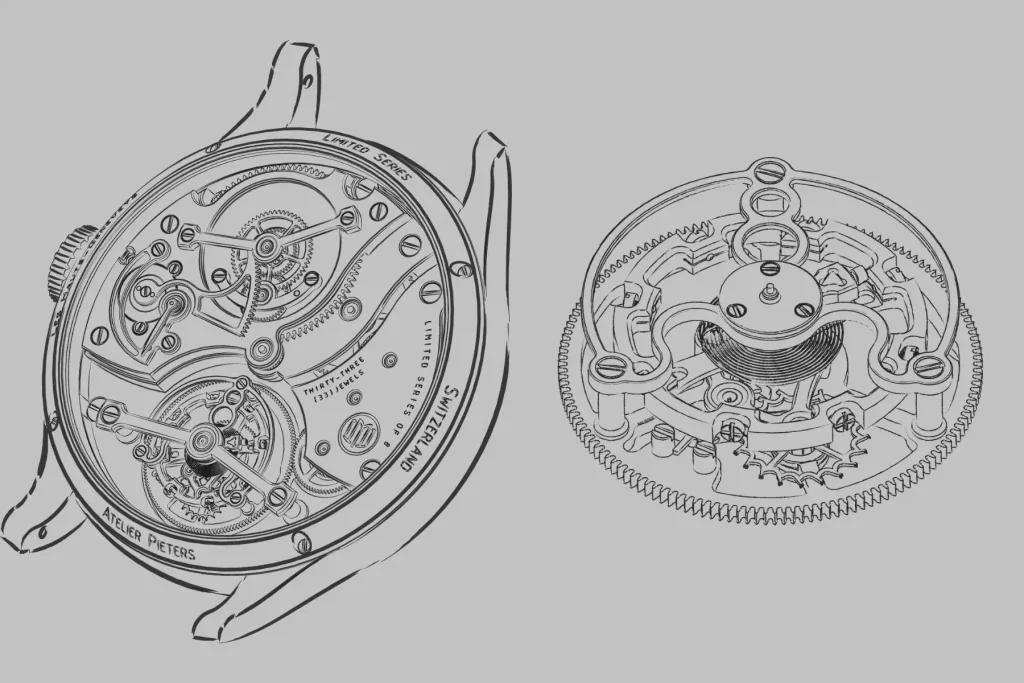
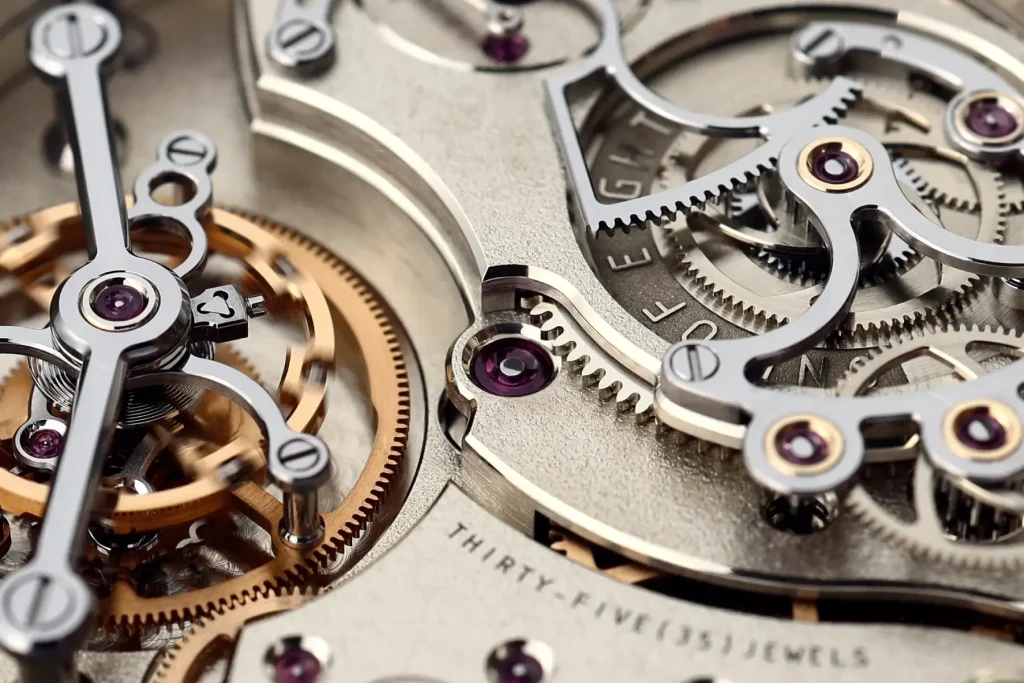
The tourbillon is distinguished by its upper bridge with two arms, shaped and finished by hand, whose black-polished surfaces contrast with the warmer tones of the surrounding components. Its cage incorporates a numeral “8”, also shaped and finished by hand, which rotates with the mechanism. This reference recalls the eight examples produced for each of the two Founders’ Series versions. The tourbillon has a variable-inertia balance with eight adjustment screws, paired with a balance spring with a Breguet overcoil and no index regulator. The rate is therefore adjusted by altering the balance’s inertia.
The escapement combines traditional watchmaking principles with contemporary manufacturing processes. The pallet fork and escape wheel are made from a nickel-phosphorus alloy, chosen in part for its non-magnetic properties. These components are made by a specialist Swiss supplier using the LIGA process, which allows micromechanical parts to be produced with precise geometries. The balance also comes from this supplier. This combination with a Breguet overcoil balance spring and a variable-inertia balance illustrates an approach in which the watchmakers select solutions that meet their requirements without limiting themselves to older methods. I find this consistent with Maarten’s career, which has involved work on demanding complications and precision timekeeping.
The planetary power reserve system is based on an epicyclic gear train consisting of eleven components, each shaped and finished individually by hand. It translates the movement’s state of wind into two separate indications. The circular aperture on the dial is complemented at the back by a hand travelling across an arc-shaped scale. This display occupies a prominent position in the upper part of the movement, where the components of the planetary system contribute directly to its visual architecture. I appreciate this solution, which allows the remaining running time to be checked on the wrist, then reveals the mechanism and its more detailed display when the watch is turned over.
The manufacturing and decoration of the components are what give this calibre its strength. Maarten and Jessica make and finish the majority of the T2-03RM’s components themselves in their workshop in Les Hauts-Geneveys, working from raw materials on conventional, manually operated machines. This method involves considerable human input at every stage and contrasts with automated industrial processes. The founders describe manufacturing tolerances of just a few microns, achieved through precise machine settings and their command of machining operations. According to them, making the upper bridge of the tourbillon cage alone requires more than 65 manual machining operations before finishing even begins. That figure is a reminder of how much work can lie behind a small component.
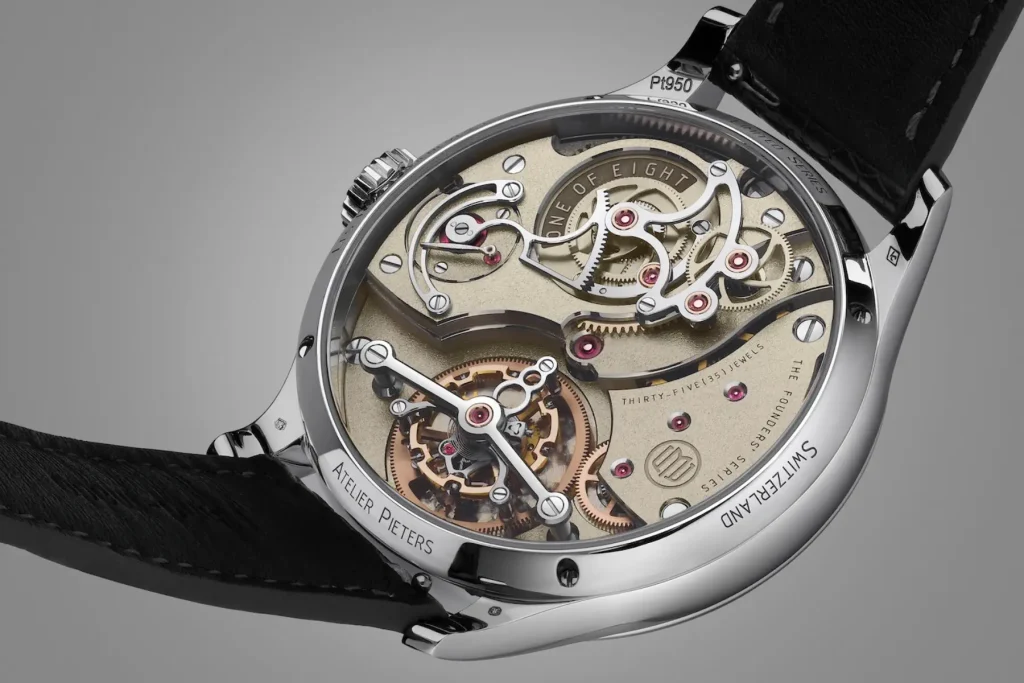
For the mainplates and bridges, the founders chose German silver, or maillechort, an alloy composed primarily of copper, nickel and zinc that, despite its English name, contains no silver. Used in watchmaking since the 19th century, this material is appreciated for its mechanical properties, corrosion resistance and naturally warm colour. At Atelier Pieters, the components are machined from lead-free German silver plates that have first been annealed and ground. The components are then left unplated. This preserves the metal’s natural appearance, allowing its surface to evolve over time. I appreciate its tones, which differ from those of rhodium-plated bridges and are highlighted here by the reflections of the polished steel components and the five gold chatons.
The surfaces receive a relatively rare finish: hand graining. At first glance, it might recall bead blasting, but both the process and the result are different. Graining involves the repeated action of small hardened steel tools, which strike the surface to create a multitude of tiny impressions in the metal. Thousands of these actions are needed to achieve a regular texture, whose microscopic relief changes the way light is reflected. The result looks almost alive, with subtle reflections that shift with the viewing angle and contrast with the movement’s polished surfaces. This finish requires great consistency of execution, a skill that falls within Jessica’s area of expertise. On the T2-03RM, I found that the graining gave the mainplates and bridges a character that goes beyond their colour: the texture also helps define their forms.
The components also feature edges bevelled and polished by hand, straight-grained surfaces, satin finishing, perlage and snailing, while certain steel parts are black polished. Black polishing relies on achieving a perfectly flat surface that reflects light differently depending on its orientation. These contrasts emphasise the lines of the bridges and the depth of the architecture. I also appreciate the care given to parts that are normally invisible once the movement is assembled. Maarten and Jessica have shown the snailing on a ratchet wheel whose decoration cannot be admired in the completed watch. This detail reflects a standard applied to every component, whether directly visible or not.
Each mainplate is individually engraved with the movement reference and its serial number, while the bridges feature the Atelier Pieters logo in relief. These inscriptions contribute to the calibre’s identity without adding decoration unrelated to its architecture.
Strap
The Atelier Pieters Atelier 1 Founders’ Series Minuit comes with a 20 mm strap made from ostrich-leg leather and stitched by hand, paired with a platinum pin buckle whose design and polished finish match the case. I appreciated the choice of this leather, which brings a distinctive texture and a degree of structure. A thinner calfskin strap would probably have created a visual imbalance. In my view, ostrich leather therefore offers an interesting alternative to traditional alligator, with enough character to accompany this creation. I found the combination comfortable when I tried it on.
How much does the Atelier Pieters Atelier 1 Founders’ Series Minuit cost?
The Atelier Pieters Atelier 1 Founders’ Series Minuit is priced at CHF 148,500 excluding taxes, in a limited edition of eight examples. The Jour version is also limited to eight watches, bringing the total for this first collection to sixteen. Both versions are available directly from Atelier Pieters at their workshop in Les Hauts-Geneveys, Switzerland. The stated production capacity is around four watches per year. The first example is expected to be completed in late 2026, with an estimated production rate of one watch every three months. These lead times reflect the individual machining, assembly and finishing operations carried out in their workshop.
CHF 148,500 represents a considerable investment, particularly for a brand that has only just introduced its first creation. Nevertheless, the price does not strike me as unreasonable given the work involved. Beyond the platinum case and the tourbillon, what stands out for me is the execution of the T2-03RM calibre, the artisanal manufacturing of the majority of its components and the time devoted to their decoration. The stated figure is around 1,400 hours of work for each watch. That figure alone is not enough to justify a price: quality of execution, sound technical choices, reliability and aesthetic identity also need to meet expectations. Each collector will assess it according to their own criteria, but I find the Atelier 1’s pricing consistent with its founders’ expertise and the time required to make it.
Atelier Pieters Atelier 1 Founders’ Series Minuit: a watch shaped by time
Looking back on this experience, what stays with me most is the relationship with time that runs through Maarten and Jessica Pieters’ project. The time they have devoted to learning their craft, perfecting their handwork and sharing their knowledge now finds expression in a personal creation. In my view, that experience comes through most strongly in the T2-03RM calibre and its finishing. The Atelier 1 shows that a watchmaking identity can also take shape through the execution of established principles, without introducing an entirely new complication.
Working with specialists for the case, dial and certain movement components is part of this approach. Independent watchmaking also relies on collaboration. What matters to me here is their control over technical choices and their responsibility for the final result, rather than any ambition to make everything themselves.
I also pay attention to a watch’s life after its purchase. The founders’ experience in after-sales service, restoration and education adds another dimension to their project, although the long-term future of a brand this young still needs to be established over time. Artisanal production also comes with constraints relating to lead times, sourcing and coordination. Their experience does not make those constraints disappear, and we will have to see how the stated standard of execution is maintained from one watch to the next.
The founders do not want to limit Atelier Pieters to producing watches. They speak of offering specialised one-to-one training, alongside a knowledge base and a collaborative platform for sharing their craft. These initiatives have yet to be realised, but they build on their careers in teaching. This is also what I look for in an independent watchmaker: the opportunity to meet the creators, understand their choices and discover their methods. Maarten and Jessica’s teaching experience could make those conversations particularly rewarding.
This sharing of skills could take on a family dimension, with their son Attis, himself a watchmaker, expected to join the workshop in 2027. The founders plan to reveal more information about their next calibre once he has joined, although they have not yet specified what this development involves. They have not announced any significant increase in production and want to keep the scale of their work compatible with the time devoted to each watch. I will follow this next stage with interest, without making assumptions about the role Attis will play or the features of their future creations.
I am very grateful to Maarten and Jessica for the time they devoted to me and for being open about their backgrounds. Our conversations at Geneva Watch Days gave real meaning to this experience. Behind the classical appearance of the Atelier 1, I found a story and a standard of craftsmanship that deserved to be shared. That is why, for me, it remains a watch shaped by time.
Atelier Pieters Atelier 1 Founders’ Series Minuit – Watch Specifications
- Brand: Atelier Pieters
- Model: Atelier 1 Founders’ Series Minuit
- Case Material: Solid Platinum, Three-Piece Polished Case with Swiss Hallmark
- Dial: Minuit (Anthracite with Turtle Dove Accents) or Jour (Rose Gold Hue with Blue Accents), Featuring Layered Textures and Geometric Details
- Functions: Central Hours and Minutes, Small Seconds at 6 o’clock, Dual Power Reserve Indicators (Dial Side at 3 o’clock and Movement Side) and 60-Second Tourbillon
- Movement: In-House Calibre T2-03RM, Hand-Wound, 21,600vph Frequency (3Hz), 35 Jewels, Variable-Inertia Balance with Eight Regulating Screws, Free-Sprung Breguet Overcoil Hairspring and Nickel-Phosphorus Escapement Components
- Finishing: German Silver Mainplates and Bridges with Hand-Applied Dynamic Grainage, Traditional Hand Finishing and Internal Angles
- Power Reserve: 50 Hours
- Water Resistance: 30m (3 ATM)
- Crystal: Domed Sapphire Crystal and Sapphire Exhibition Caseback, Both with Internal Anti-Reflective Coating
- Case Dimensions: 43.5mm (Diameter) x 13mm (Thickness)
- Strap: Bespoke Hand-Stitched Ostrich Foot Leather with Solid Platinum Pin Buckle
- Limited Edition: 8 Pieces per Colourway (16 Pieces Total)
- Availability: Directly from Atelier Pieters, with First Deliveries Expected by the End of 2026
- Retail Price: CHF 148,500 (excluding VAT)
And what do you think of this first creation from Atelier Pieters? Are you drawn to this artisanal approach and the emphasis on its creators’ backgrounds? Feel free to share your thoughts in the comments. I would be happy to discuss them with you.
If this article added value or sparked a discovery, you can support the project HERE. Your contribution helps me keep weekly articles and a biweekly newsletter free, accessible, and independent for everyone.
For more information about Atelier Pieters, click here.