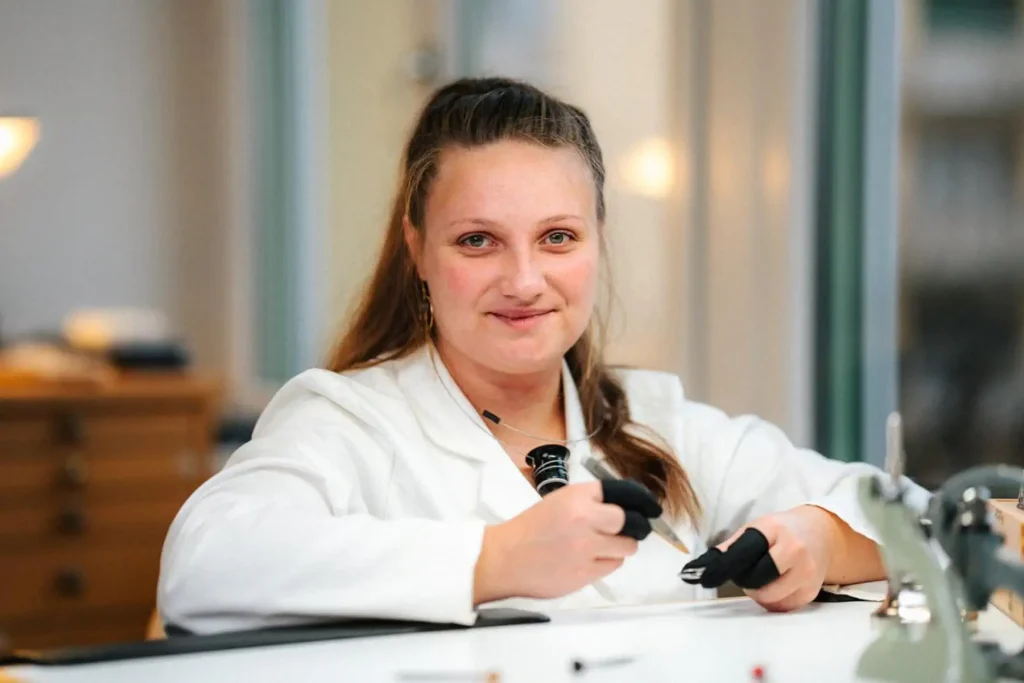
Today, I have the pleasure of introducing a young French independent watchmaker whose work I have been following for several years and whose journey, in my opinion, deserves the attention of anyone interested in independent watchmaking. If I mention a passion sparked at just ten years old by Prague’s astronomical clock, six years of watchmaking training in Morteau alongside studies in literature and philosophy, several distinctions earned at a remarkably young age, and admission at just 27 to the prestigious Académie Horlogère des Créateurs Indépendants (AHCI), the more knowledgeable among you will probably have recognised Shona Taine, who now develops her watchmaking house under her own name. Yet behind her first creation, the Shona Taine Khemea, lies a far richer story than one might initially imagine. A story of curiosity, learning, encounters and perseverance, but above all, a desire to bring together several worlds that, at first glance, might seem very different: mechanics, literature, philosophy, music and the artistic crafts.
If I wanted to dedicate an article to Shona Taine, it was not simply because her Khemea features a particularly interesting architecture or brings together several complications that I personally appreciate. It was primarily because we have been in contact since the earliest presentations of her project to the AHCI, and I have had the opportunity to follow its evolution over the years. We have met on several occasions, but it was recently, during Geneva Watch Days 2026, that we took the time to have a much longer conversation around a prototype of the Khemea that is now very close to its final version. This meeting allowed me to better understand the decisions that shaped its development, but also to appreciate just how far she has come since those first presentations. Beyond the watch itself, I discovered someone particularly curious, deeply passionate about her craft and driven by an almost constant desire to learn. The more I discovered about her journey, the more I realised that her approach could not simply be considered a business venture launched by a talented young watchmaker. Above all, it is the expression of a personality and a vision of watchmaking that have gradually taken shape through experiences and encounters.
To understand this approach, we must first go back to Shona’s origins. Born in Pontarlier in 1998, she grew up in La Chaux-de-Gilley, a small French village near Morteau, in a region with deep historical ties to watchmaking. Yet, contrary to what one might imagine, she does not come from a family of watchmakers. Her mother works in retail, while her father, originally from northern France, has a personality more inclined towards artistic and literary pursuits. Throughout his life, he has worked in several different professions, travelled and written books. There was therefore nothing in her immediate family background that naturally destined Shona for a career in watchmaking. However, it is worth remembering that the region where she grew up has a longstanding tradition of manufacturing precision mechanical components. As early as the 18th century, many farmers in the Doubs region spent the long winter months producing small watchmaking components for neighbouring Swiss manufacturers. This activity, historically known as travail à la fenêtre, or working by the window, allowed them to make the most of natural daylight while carrying out operations requiring considerable precision. A tradition that gradually shaped the identity of an entire region, although it does not, on its own, explain Shona’s passion.
The real turning point came during a family trip to Prague when she was just ten years old. While visiting the Old Town, she discovered the famous astronomical clock on the Old Town Hall. Its dimensions, colours, moving automata and the various astronomical indications displayed on its dial immediately fascinated her. In fact, she recalls that the clock is practically the only memory she has retained from that trip, such was the impression it made on her. I particularly like this anecdote because it helps us understand that her interest in watchmaking did not begin with a luxury watch or through the history of a prestigious brand. What fascinated her above all was the ability of a mechanism to bring an object to life, to set different elements in motion and to create something that goes beyond its purely technical function. Looking back, this first encounter with horology takes on a rather special significance when we discover the complications and artistic sensitivity that characterise her creations today.
Yet Shona did not immediately set out to become a watchmaker. An avid reader since childhood, with a passion for literature, poetry and philosophy, she initially considered pursuing university studies in these fields. At the same time, however, she felt an equally strong need to work with her hands. This dual interest would gradually shape her future. On one side, a genuine intellectual curiosity and an interest in ideas, literature and the great philosophical questions. On the other, an attraction to traditional crafts, understanding mechanisms and transforming materials. Her father, who also appreciates watches, encouraged her to consider Lycée Edgar Faure in Morteau, located close to their home. The decision, however, was not as straightforward as it might seem. At the time, Shona was studying in an environment where vocational training and manual trades did not necessarily enjoy the same recognition as more academic subjects. She therefore had to defend her desire to pursue watchmaking, convinced that working with her hands could offer a form of expression and personal fulfilment just as rich as intellectual disciplines.
She eventually enrolled at Lycée Edgar Faure in Morteau in 2013, embarking on a six year watchmaking education consisting of three successive qualifications. She began with a Certificat d’Aptitude Professionnelle (CAP), which she completed in 2015, learning the fundamentals of the profession, machining techniques and the workings of simple watch movements, particularly quartz calibres. Her early experiences did not entirely match the image she had formed of watchmaking. It was only during her second year, when she began working properly on mechanical movements, that she rediscovered what had fascinated her in front of Prague’s astronomical clock. Understanding the operation of an escapement, observing the interaction between different gear trains and discovering how a succession of components could bring a mechanism to life ultimately confirmed that she had made the right choice. That same year, she received the title of Meilleure Apprentie de France in 2015, a prestigious distinction recognising France’s most accomplished young apprentices. She was notably the only girl among the award winners in her category, marking an important first recognition of her abilities.
Shona then continued with a Brevet des Métiers d’Art between 2015 and 2017, allowing her to deepen her theoretical and technical knowledge, particularly in complicated movements, chronographs and calendar mechanisms. Finally, from 2017 to 2019, she pursued a Diplôme des Métiers d’Art, with a greater focus on design, movement development and traditional restoration techniques. This final qualification introduced her to the methods required to restore collectible timepieces, some of which were destined for museums, while also encouraging her to approach the creation of a watch as a complete design project. In 2018, she also achieved first place in a student watch regulation competition, demonstrating her ability in another particularly demanding aspect of the profession: chronometric precision. These distinctions are obviously important, but what I find even more interesting is the diversity of skills they recognise. Between creation, restoration, manufacturing and regulation, Shona was already showing that she had no intention of specialising in just one area. Instead, she wanted to become what she calls a complete watchmaker, capable of understanding and mastering the different stages involved in creating a watch.
What makes her journey even more distinctive is that she never abandoned her original passions. Alongside her watchmaking education and throughout her subsequent career, she also pursued distance learning studies in philosophy at Paris Nanterre University, followed by modern literature at the Sorbonne. A rather unusual undertaking, especially when one considers the level of commitment already required by a comprehensive watchmaking education. But for Shona, these disciplines are by no means incompatible. Literature and philosophy nourish her thinking, while watchmaking allows her to give tangible form to her ideas. This complementarity seems essential to understanding her work today. While some watchmakers approach their profession primarily from a technical perspective, Shona naturally seems to seek a dialogue between the mechanical function of an object and what it can express on an artistic or emotional level. For her, working with materials is not simply about transforming a component. It is also an intellectual, physical and almost spiritual undertaking.
Her final years of study were also marked by two projects that perfectly illustrate her curiosity and ambition. The first originated from another passion that had accompanied her since childhood: music. Ever since discovering Prague’s astronomical clock, Shona had developed a particular interest in mechanisms capable of producing sound. The idea of combining gears, springs, hammers and gongs to create a mechanical melody fascinated her. When she was required to present a restoration project as part of her training, she therefore decided to tackle an old minute repeater movement equipped with a Le Phare calibre. Obtained through one of her teachers, who had himself found it at a second hand dealer, the mechanism was incomplete. Numerous components were missing, and restoring it to working order represented a considerable challenge for a student.
Rather than limiting herself to a partial restoration, Shona decided to recreate the missing components. She began researching archives, studying the available historical photographs, redrawing the parts and eventually manufacturing them herself. Fortunately, all the original pivot points were still present on the mainplate. These provided essential reference points for determining the positions of the missing components, manufacturing replacements and reconstructing the mechanical interactions between them. This work would occupy nearly two years, alongside the construction of her school watch and her other responsibilities. She recalls that, at the time, getting her striking watch to function had almost become more important to her than obtaining her diploma. This anecdote probably says a great deal about her personality. She does not necessarily choose the easiest path, but rather the one that allows her to learn and satisfy her curiosity. She eventually managed to complete her projects, gaining valuable experience in understanding, restoring and manufacturing complex mechanisms along the way. Looking back, it is difficult not to see this adventure as one of the earliest expressions of the interest she still has today in grand complications, particularly striking watches.
Her second project was equally interesting, although this time it was focused on creation rather than restoration. As her studies also required her to design and manufacture a watch, Shona chose to develop a pocket watch named La Route du Thé. Far from opting for a conventional construction, she imagined a particularly original mechanism combining a triple retrograde minute display with a semi instantaneous hour indication. An ambitious choice, especially considering that she was simultaneously continuing her restoration of the minute repeater. Despite the reservations that such a complex project might naturally raise within an educational setting, she decided to pursue her idea and devote a considerable amount of time to bringing it to life. In 2017, this creation earned her second place nationally in the Prix Avenir Métiers d’Art, when she was just nineteen years old. I find it particularly interesting to consider these two projects together. On one side, a historic watch movement that she sought to understand and reconstruct while respecting its original operation. On the other, a personal creation in which she imagined an original display and developed her own solutions. This complementarity between restoration and invention already provides a good indication of how she would later approach independent watchmaking.
Shona also realised fairly early on that the knowledge acquired at school, however solid, would not be sufficient to master every aspect of independent watchmaking. She therefore sought opportunities to gain experience alongside artisans whose work she admired. During her training, she completed an internship at Christophe Claret, an experience that introduced her to a particularly demanding world, renowned for its mechanical complications and striking watches. It was also on this occasion that she met Yosuke Sekiguchi, whose work I have already had the pleasure of presenting in a previous article. Eager to deepen her knowledge, she subsequently visited him regularly, particularly in the evenings and at weekends, to observe his working methods and continue improving outside the classroom. This approach perfectly reflects her mindset: she has never considered learning to be a stage that ends once a diploma has been obtained, but rather a continuous process.
This curiosity also led her to explore the artistic crafts involved in creating a watch. In particular, she trained in the techniques of anglage, the delicate art of bevelling and polishing component edges, under the guidance of Nathalie Jean-Louis, gradually developing her understanding of decorative finishing. These encounters played an important role in her development, allowing her to approach watchmaking from different perspectives. Restoration, mechanical construction, complications, decoration and traditional manufacturing techniques gradually became interconnected disciplines that she sought to bring together. This is probably one of the aspects I appreciate most about her approach. Shona does not simply seek to accumulate skills so that she can claim to do everything herself. She wants to understand the techniques, constraints and individual sensitivities associated with each craft, enabling her to gradually develop her own way of working.
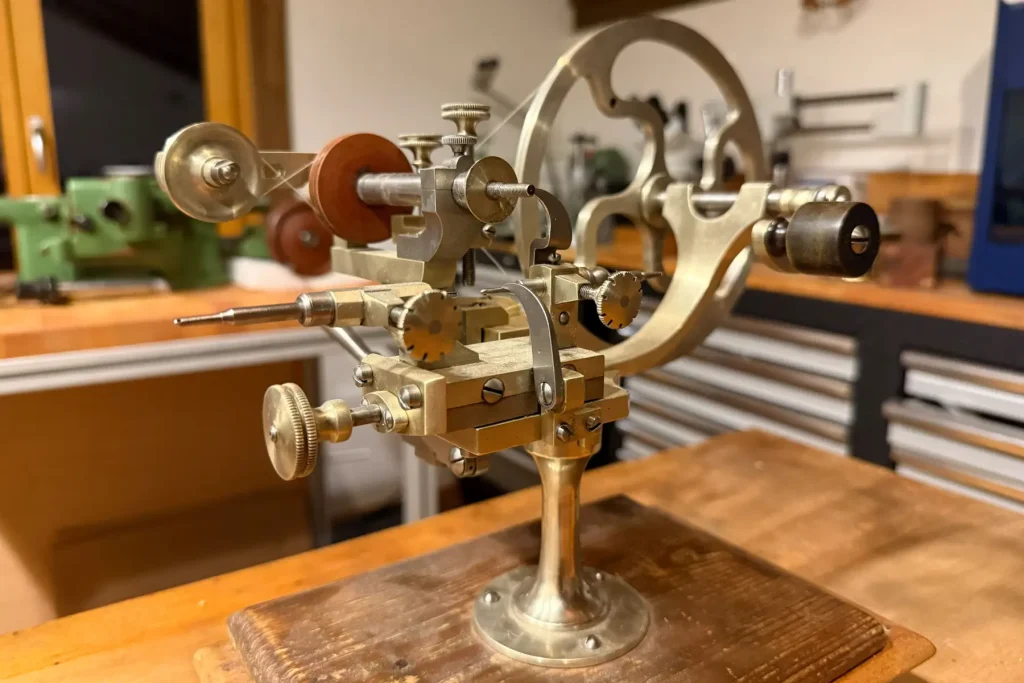
After completing her studies in 2019, she joined an independent watchmaker based in Les Brenets, Switzerland, close to the French border. She worked there part time, mainly carrying out watch servicing and repair operations, while continuing her other activities. This experience allowed her to discover the daily workings of a professional workshop, but she soon realised that she wanted to pursue a more creative approach to watchmaking. After approximately six months, she therefore decided to leave her position. A particularly ambitious decision for a young watchmaker who had only just completed her training, but one that was entirely consistent with the direction her journey had taken. Rather than waiting several years before developing her own ideas, she preferred to take the plunge, even if it meant acquiring new skills along the way. And so, in 2020, at just 22 years old, she established her own independent watchmaking workshop, initially under the name Khemea. Her watchmaking house now bears her own name, Shona Taine, while Khemea designates her first watch.
The choice of the name Khemea, now associated with her first watch, was far from accidental. Inspired by the ancient Greek term khemeia, from which the word alchemy originates, it perfectly reflects Shona’s understanding of what a timepiece represents. In her eyes, a watch is above all the result of bringing together elements that, individually, remain inert. Wheels, springs, bridges, screws and numerous other components which, once assembled and precisely adjusted, give birth to an object capable of coming to life. But this alchemy extends far beyond mechanics. It also encompasses the people, knowledge and expertise involved in the creative process. Each artisan brings their own experience, sensitivity and approach to their work, helping to transform an initial idea into a tangible creation. I find this definition particularly interesting because it explains why Shona places such importance on the encounters that have shaped her journey. Her independence is not based on a desire to do everything alone, but rather on the ability to bring together the right skills around a vision that remains entirely her own.
The early years of her workshop, however, were far from straightforward. Like many young independent watchmakers, Shona had to find a balance between the work that allowed her to earn a living and the development of her own creations. She accepted various servicing, restoration and repair assignments, working for both private clients and professionals, while continuing to learn from other artisans. Her work included the restoration of historic complications, prototype development and the manufacture of components that had become difficult to source. This period was essential, allowing her to gradually establish her professional independence while discovering the practical challenges involved in running a workshop.
It was precisely in this context that she met Olivier Mory, who would play a decisive role in the next stage of her journey. Known particularly for his work in the development of watch movements and tourbillons, Olivier Mory possessed extensive experience in horological design and manufacturing that complemented the traditional craftsmanship Shona had acquired during her education. He offered her the opportunity to work within his workshop environment in La Chaux-de-Fonds, where she could use certain machines, deepen her understanding of movement construction, discuss the technical difficulties she encountered and continue carrying out various assignments for other clients. This collaboration represented much more than simply access to equipment. Above all, it allowed her to approach watchmaking from a broader perspective, discovering the constraints that connect the design of a mechanism with its actual manufacture. This combination of traditional craftsmanship and a more industrial approach gradually gave her the tools needed to envisage a project of an entirely different scale: developing her own watch.
Olivier Mory notably encouraged her to build this first creation around a tourbillon that he developed and manufactured. However, Shona did not simply want to incorporate an existing mechanical component into a watch for which she had designed the case and dial. Instead, she began reworking the components and surrounding architecture to adapt them to her own interpretation of the movement, the complications she wanted to incorporate and the aesthetic identity she was beginning to establish. This collaboration therefore provided her with a solid technical foundation while leaving considerable room for experimentation as she gradually developed her own vision.
It was also around this time that Shona truly began shaping what would eventually become the Khemea. From the outset, her ambition was not simply to select an existing movement and surround it with a case and dial. She wanted to create a watch that reflected her tastes, her background and her personal interpretation of horology. At the same time, she did not pretend to possess all the knowledge required from the very beginning. Developing this first watch therefore became another stage in her education. She sketched, experimented, carried out tests, encountered difficulties and regularly reconsidered her initial decisions. I find this approach particularly interesting because it demonstrates how an independent watchmaking project can develop alongside the technical progression of its creator. For Shona, every problem she encountered represented an opportunity to deepen her understanding of the profession and become increasingly independent.
The development of the Khemea would consequently extend over several years, requiring numerous changes between the earliest sketches and the version we know today. Throughout the successive prototypes, different elements were reconsidered, both in the mechanical architecture and in the overall proportions and aesthetics of the watch. Shona gradually learnt to reconcile technical constraints, component manufacturing, decorative finishing and the coordination of the various artisans involved in the project. Her initial ideas took shape on paper before being translated into technical drawings and ultimately confronted with the realities of manufacturing. In her work, she continues to use traditional machines, some of which are several decades old, alongside manual operations requiring patience and precision. This approach allows her to maintain a very direct relationship with the materials she works with and to understand how each decision influences the final construction.
This period also allowed her to produce several unique pieces in response to the specific requests of collectors. Four creations gradually emerged during the development process, each possessing its own personality and allowing Shona to experiment with different combinations of materials, colours and finishes. Some notably featured blue guilloché elements or white mother of pearl discs for the moon phase and date indications. Beyond their aesthetic appeal, these creations provided further opportunities to refine her work, deepen her understanding of manufacturing constraints and gradually build relationships with her first clients. They also demonstrated her ability to respond to individual requests without compromising the consistency of her own watchmaking vision.
As this development progressed, another important milestone came to recognise the quality of her work. Invited to join the Académie Horlogère des Créateurs Indépendants as a candidate in 2023, Shona continued her journey towards official admission in April 2025. She notably benefited from the support of two respected watchmakers, John-Mikaël Flaux and David Candaux, who acted as her sponsors within the Academy. She thus joined an institution bringing together some of the most respected figures in independent watchmaking, including Philippe Dufour, Kari Voutilainen and F.P. Journe. This recognition carried particular significance for a watchmaker who, only a few years earlier, had considered such an achievement almost beyond her reach. At just 27, she became one of the youngest personalities to join the Academy, while also entering the still very small circle of women recognised within this institution. But beyond her age or the question of female representation, what seems most important to me is the recognition of her abilities by her peers. In a field where technical mastery, experience and quality of execution are fundamental, this admission confirmed just how far she had come since her earliest years of training.
Despite this recognition, Shona retains the curiosity and desire to learn that seem to have accompanied her since the beginning of her education. She also remains committed to passing on traditional skills, occasionally teaching at Lycée Edgar Faure in Morteau, where she completed her own watchmaking studies. I find this approach particularly consistent with her journey: having benefited from the experience of numerous artisans herself, she is now helping to pass on some of her knowledge to a new generation of watchmakers.
Today, Shona continues to develop her watchmaking house from her workshop in La Chaux-de-Fonds, where she has been based since 2025, after spending some time working in Biel/Bienne. After several years of design, prototyping and refinement, January 2026 marked another important milestone with the official presentation of the Khemea Souscription Edition, the first limited series of her creation. Produced in just twelve individually numbered examples, with manufacturing spread over several months due to its highly artisanal nature, this edition represents an important step for the young watchmaker. It is no longer simply the culmination of a personal endeavour, but also the beginning of a production series intended for a group of collectors who have chosen to place their trust in her.
This first watch therefore marks the starting point of an aesthetic and mechanical language that Shona intends to develop in the years ahead. With its architecture arranged across several levels, its various complications and its combination of traditional decorative techniques, the Khemea already brings together many of the influences that define its creator. We naturally find her interest in mechanics, but also her search for balance, her artistic sensitivity and her desire to create a watch that goes beyond its primary function. Creating it thus becomes a genuine exercise in composition, in which every element finds its place within a carefully considered and coherent whole. It is also through this first timepiece that the Shona Taine watchmaking house begins to establish an identity of its own.
Ultimately, it is probably this consistency between her personal journey, her different passions and her approach to watchmaking that made me want to dedicate an article to Shona Taine. The Khemea is not simply the culmination of several years of technical development. It is also the first tangible expression of a watchmaking identity that Shona has gradually built through her experiences and encounters. And it is precisely this combination of human, artistic and mechanical dimensions that makes her work so interesting to me. Now, let us take a closer look at the Shona Taine Khemea.
Table of Contents – Shona Taine Khemea
What are the technical specifications of the Shona Taine Khemea?
Case
The case of the Shona Taine Khemea is probably one of the elements that interested me most when I first discovered the watch. Even before examining the various complications that animate its dial, I was particularly drawn to the work carried out on its proportions, curves and the integration of its different components. At first glance, it has a rather unusual silhouette, with pronounced shoulders, substantial lugs and an architecture that almost seems to have been sculpted around the movement. Yet, despite its distinctive character, it never tries to be extravagant. That is precisely what I appreciate about this creation. Shona Taine has managed to design a case that is immediately recognisable without sacrificing elegance, comfort or the overall coherence of the watch. And when you begin to examine its construction more closely, you discover that several particularly interesting solutions lie behind this aesthetic.
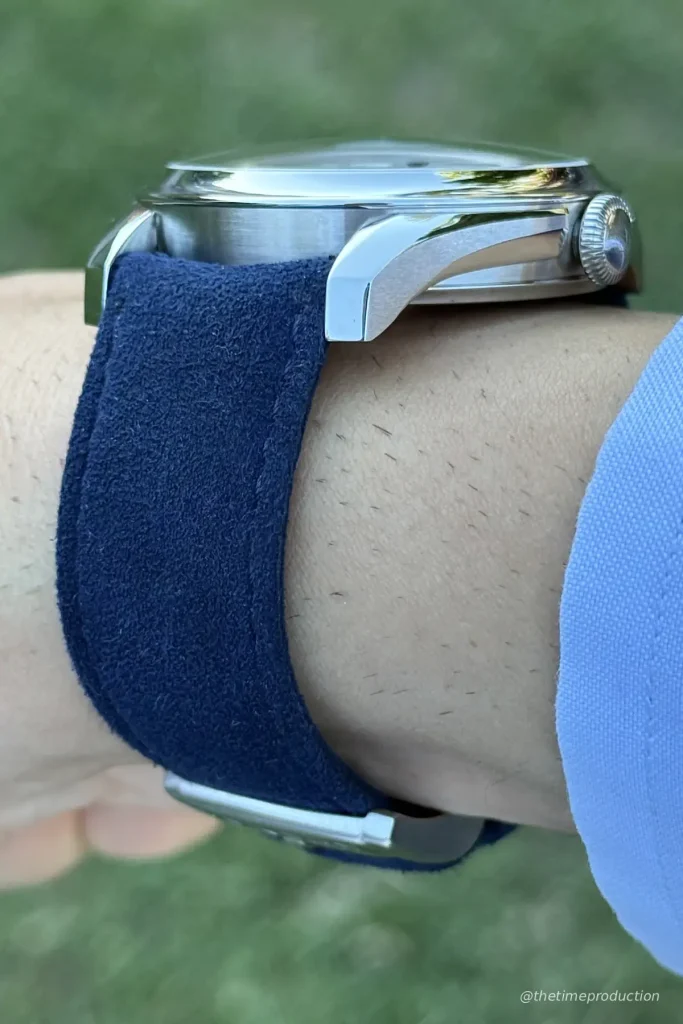
The Shona Taine Khemea measures 40 mm in diameter, with a case thickness of approximately 10.10 mm excluding the sapphire crystal. Including its domed sapphire crystal, the overall thickness reaches 13.89 mm. These dimensions help us better understand how Shona has organised the different volumes of her creation. The caseband remains relatively restrained, while a significant portion of the overall height comes from the crystal, which complements the three dimensional architecture of the dial. The watch I had the opportunity to handle was a prototype made from 316L stainless steel, whereas the Souscription Edition, limited to twelve pieces, is offered in grade 5 titanium. An important distinction, particularly in terms of how the watch feels on the wrist, as titanium should naturally provide a lighter wearing experience than the steel prototype I tried on.
What immediately catches the eye is the way the different surfaces of the case seem to flow into one another. Its architecture is based on seven distinct facets, with an alternation of polished and satin finishes that emphasises the volumes without introducing unnecessary decorative elements. The polished bezel gradually tapers towards its outer edge, while the flanks of the caseband feature softer curves highlighted by a satin finish. Depending on the viewing angle, light reflects differently across the shoulders, lugs and caseband, giving the entire construction a rather distinctive sense of depth. This interplay of finishes reveals the complexity of the design without making the case appear excessively elaborate. Its relatively broad shoulders give it a certain robustness, almost a sporting character, immediately balanced by the rounded contours of its different surfaces. The result has a strong presence, yet retains considerable softness and an elegance that never tries too hard to attract attention.
While speaking with Shona, I also discovered an anecdote that says a great deal about the way she developed this case. Certain shapes she wanted to achieve proved difficult to reproduce directly on a computer. Despite adjusting the various parameters available in her design software, she could not always recreate the exact volumes she had imagined. Rather than limiting herself to what digital modelling could offer, she would return to a much more tangible approach, producing new sketches, making small physical models and studying the resulting shapes before going back to the computer to refine the construction. This process illustrates the complementarity between traditional methods and modern tools. Shona does not believe that a computer should necessarily provide every answer. When a particular solution does not work, she returns to the material itself and experiments to understand the problem from a different perspective. And when you look at the various curves of the Khemea today, you begin to appreciate that their apparent fluidity is the result of a far more extensive development process than one might initially imagine.
One of the most distinctive features of the case, however, undoubtedly lies in the construction of its lugs. At first glance, they appear simply to extend the lines of the caseband, with a fairly pronounced curvature that allows them to slope naturally towards the wrist. Their architecture, however, is considerably more unusual. On the left side, at 9 o’clock, the two lugs are joined together as a single component, forming both the upper and lower lug. On the right side, at 3 o’clock, the construction is different, with two independent lugs forming separate components. This asymmetry makes it possible to integrate the crown between the two lugs on the right, while the opposite side accommodates only the moon phase correction pusher. I find the result particularly successful, as the watch maintains remarkable visual harmony despite the technically different construction on either side of the caseband. Here, asymmetry is not simply an attempt to create something unusual. It follows directly from the constraints involved in integrating the various components.
Another aspect I particularly appreciated is the fact that these lugs are removable. Unlike many watches whose lugs are machined as part of the case or permanently attached to it, Shona has developed a system that allows them to be removed independently of the rest of the case. To access their attachment points, the screwed caseback must first be removed, followed by two screws positioned inside. The solution remains completely discreet, with no visible fastening elements disrupting the exterior design. More importantly, however, it offers considerable advantages for servicing and restoration. As a watch passes through several decades, impacts and successive polishing operations can gradually alter the original proportions of its case. With removable lugs, it theoretically becomes possible to work on a damaged section in a much more targeted manner, or even replace it if necessary. I find this particularly relevant for a piece of independent haute horlogerie intended to be preserved and potentially passed down through generations. Designing a watch is not simply about finding a way to assemble it today. It also means considering how it might be maintained and restored decades into the future.
This consideration for future maintenance extends beyond the construction of the lugs. Shona has also designed the Khemea so that the movement can be accessed from the front of the case, particularly to carry out certain adjustments to the tourbillon after casing up. She explained that securing the movement inside the case can exert a very slight pressure on the mainplate, potentially influencing its regulation. Being able to access the mechanism once it has been installed in the case therefore represents a particularly useful advantage. I appreciate this approach because it demonstrates that Shona has considered her watch not only as an aesthetic object, but also as a mechanism that she will personally need to assemble, regulate, service and potentially restore several decades from now.
The lugs also play an essential role in ensuring comfort on the wrist. Their relatively pronounced curvature allows them to follow the natural shape of the wrist and keep the watch in a particularly comfortable position. This is something I was able to appreciate during my own experience wearing it. Despite its 40 mm diameter, pronounced shoulders and substantial domed sapphire crystal, the Khemea wears remarkably well. It has a genuine visual presence, yet the lugs curve down sufficiently to avoid the impression of a case simply sitting on top of the wrist. This attention to ergonomics can also be found in another detail that I find particularly interesting: the shape of the sapphire crystal on the back of the watch. It is slightly domed, both to improve comfort around the wrist bone and to accommodate the space required by a distinctive ratchet mechanism within the movement. We will return to this component when examining the K10 calibre, but I already appreciate the way Shona has considered the mechanical architecture and the experience of the person wearing the watch simultaneously.
The crown also deserves a closer look. Positioned at 3 o’clock, it is particularly well integrated into the caseband and the construction of the lugs. Unlike some watches where the crown noticeably interrupts the silhouette of the case, that of the Khemea remains almost entirely within its overall profile. The two independent lugs on the right contribute to this integration while leaving sufficient space for comfortable operation. During my time with the watch, I found the crown particularly pleasant to handle, offering excellent grip despite its discreet positioning. The Khemea logo engraved on the crown provides another small signature detail that I appreciate. On the opposite side, at 9 o’clock, a discreet pusher allows the moon phase indication to be adjusted without disrupting the lines of the caseband.
The domed sapphire crystal on the dial side is another important element of the Khemea’s personality. Its curvature complements the three dimensional architecture of the display, with the various indications arranged across several levels. This construction naturally contributes to the overall thickness of 13.89 mm, but above all, it creates a genuine impression of depth when looking at the watch. I would nevertheless like to mention one reservation concerning the prototype I had the opportunity to try on. Despite what appeared to be the presence of an antireflective coating, I noticed fairly significant reflections on the crystal, which could occasionally make it difficult to appreciate the dial properly. This was particularly noticeable in direct sunlight, when it became harder to distinguish the finer details and finishes of the watch. I cannot say whether this was due to the crystal’s coating or simply the stage of development reached by the prototype, but I think it is important to mention it transparently. This does not necessarily mean that the final production pieces will exhibit the same characteristics, as I have not yet had the opportunity to examine them. Nevertheless, it is one aspect that I hope Shona will be able to improve, because a dial displaying this level of craftsmanship deserves to be admired under the best possible lighting conditions.
With a stated water resistance of 50 metres and a screwed caseback, the Khemea also offers a reassuring level of protection for such an elaborate piece of haute horlogerie. Combined with the comfort provided by the lugs, the successful integration of the crown and the work carried out on the sapphire caseback, this reinforces the impression of a watch whose ergonomics have been considered just as carefully as its aesthetics. One final point also deserves mentioning regarding the future evolution of the case. During our conversations, Shona explained that she was considering a future interpretation in rose gold. Rather than offering an entirely polished version, she would like to retain the same alternation of polished and satin finishes found on the current model. A decision that seems particularly coherent to me, as much of the case’s identity comes precisely from this interplay of textures and the way they emphasise its volumes.
Overall, I find the case of the Shona Taine Khemea particularly accomplished for a first creation. Its originality does not simply come from an unusual design, but from a carefully considered approach combining aesthetics, ergonomics and mechanical construction. I particularly appreciate the way Shona has managed to give its proportions so much character without sacrificing comfort on the wrist. And when you learn about the sketches, physical models and successive adjustments involved in its development, you begin to understand that this apparent fluidity is the result of considerable work. That is precisely what I like about this architecture: every decision seems to have been made to serve the watch as a whole, rather than simply to make it different.
Dial
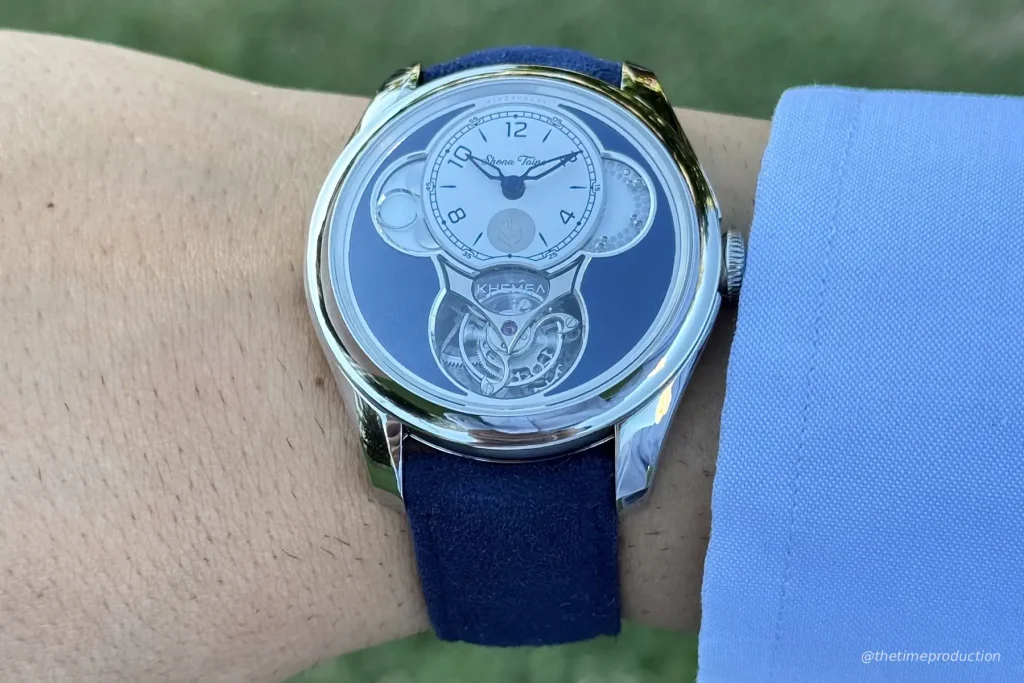
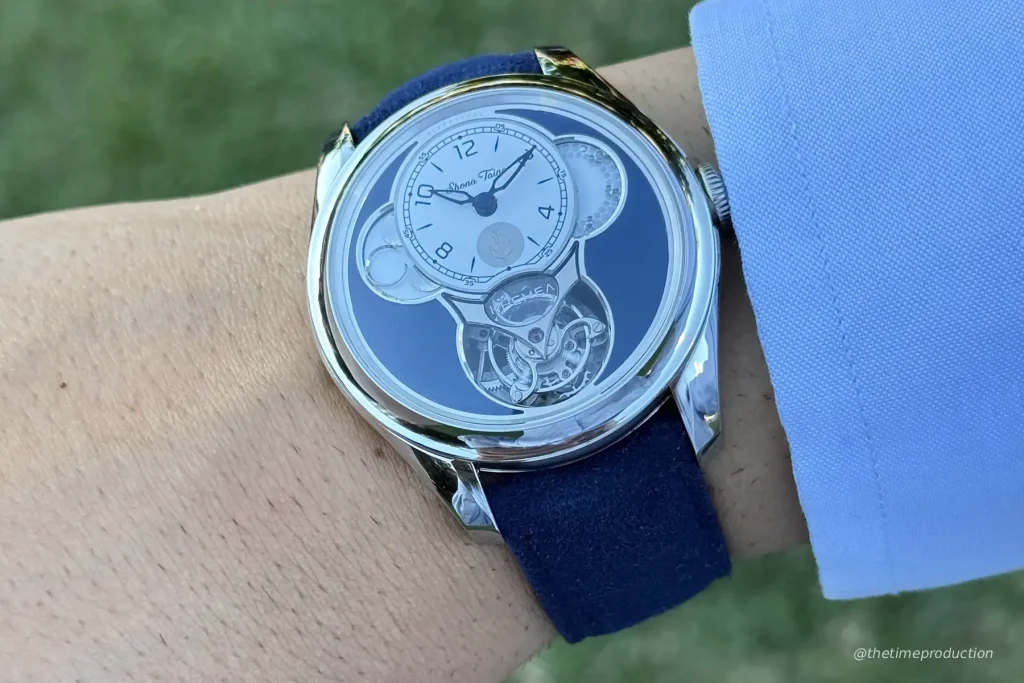
The dial of the Shona Taine Khemea is probably the element that best illustrates the watchmaker’s philosophy. When I first discovered the watch, I was immediately struck by its three dimensional architecture and the way the different indications seemed to overlap without ever disturbing the overall balance of the composition. Yet, on closer inspection, it quickly becomes apparent that this first creation brings together an impressive range of techniques and expertise: Grand Feu enamelling, traditional guilloché, work involving silver, gold and mother of pearl, not to mention the mechanical complications that bring the entire composition to life. Combining so many elements in a first watch already represents a considerable challenge, but making them coexist within such a coherent design strikes me as even more remarkable. That is precisely what I appreciate about this Khemea. Despite the complexity of its construction, the dial retains a genuine softness and a certain lightness, with rounded lines that naturally complement the various displays.
This impression is largely the result of a particularly interesting arrangement across three distinct levels. In the upper section, at 12 o’clock, sits the off centre hours and minutes dial, forming the first level of the display. Just below it, the moon phase and date indications occupy positions on either side of the central axis, creating a second plane. Finally, at 6 o’clock, the tourbillon appears in the lower section of the composition, forming the third level and its mechanical focal point. This arrangement is not simply an aesthetic exercise. It establishes a hierarchy between the indications, allowing each complication its own space while maintaining a certain symmetry. I was also particularly interested to learn that Shona had sought to reproduce this organisation on both sides of the watch. We will therefore discover a similarly layered construction when examining the movement, creating a genuine continuity between the dial and the K10 calibre.
One of the first elements to attract attention is naturally the guilloché. Entirely engraved by hand on a silver base, it features a remarkably delicate pattern, with curves that seem to follow the different indications rather than simply fill the available surfaces. Its design immediately reminded me of certain historic dials, particularly those found on vintage Breguet watches, where guilloché plays an essential role in defining the aesthetic identity of a timepiece. What I find particularly interesting about the Khemea, however, is precisely the contrast between an ancestral decorative technique and a thoroughly contemporary architecture. The pattern remains relatively organic, almost sculptural, highlighting the different depths of the dial before opening up in its lower section to reveal the tourbillon. The result is exceptionally refined, without giving the impression of decoration added merely to demonstrate craftsmanship.
For the Souscription Edition, this silver base receives an anthracite ruthenium finish, while delicate rose gold borders emphasise certain divisions and follow the contours of the design. This combination creates an interesting interplay between the darker surfaces, metallic reflections and various indications. Beyond the aesthetic result, however, I find the decision to use traditional guilloché particularly interesting. The decoration is produced using historic engine turning machines that require the direct involvement of the artisan. This type of work demands not only excellent control of the tools, but also remarkable consistency throughout the execution. Every movement of the cutting tool contributes to the development of the pattern, and even the slightest irregularity can alter the way light reflects across the surface. On the piece I examined, I found this decoration particularly successful, with a level of delicacy and precision that contributes enormously to the watch’s personality.
To create this part of the dial, Shona called upon Nico Cox, an artisan specialising in traditional guilloché who is based in Seattle, United States. This collaboration perfectly illustrates the diversity of expertise brought together for the Khemea and the international dimension that such a deeply artisanal project can acquire. Nico Cox also signs the reverse of the component she produces, a detail that becomes invisible once the watch has been assembled, but one that clearly reflects Shona’s determination to recognise the work of the artisans who contribute to her creation.
This philosophy can also be found in the production of the hours and minutes dial, for which Shona collaborated with an enamel artist based in the Vallée de Joux. Positioned at 12 o’clock, this off centre display is crafted in white Grand Feu enamel on a white gold base. This traditional technique involves the successive application of layers of enamel, which are then fired at very high temperatures to obtain a durable, luminous and exceptionally pure surface. The result creates a striking contrast with the darker textures surrounding the dial. I particularly appreciate this combination, as enamel possesses a depth and visual softness that is difficult to reproduce with a simple lacquered finish. It also ensures excellent legibility despite the richness of the different elements that make up the Khemea.
What I appreciate even more is that the enamel artist also signs her work on the reverse of the dial. Shona would like to extend this practice to the other artisans involved in her creations, preserving a record of their contributions through inscriptions placed on components that are normally hidden from view. She explained to me that she would find it dishonest to give the impression that she had personally produced an entire watch when its manufacture relies on the collaboration of several people. I find this perspective particularly fair. In independent watchmaking, we naturally tend to associate a creation with the name of the watchmaker who conceived it, even though its production may require the involvement of numerous specialists. Within her watchmaking house, Shona wants to acknowledge this collective dimension without calling into question the consistency of her own vision. And I find it particularly touching to imagine that some of these signatures may only be discovered several decades from now, when a watchmaker opens the watch for servicing. The idea of alchemy that inspired the name Khemea takes on a very tangible meaning here, as it concerns the people involved just as much as the mechanical components.
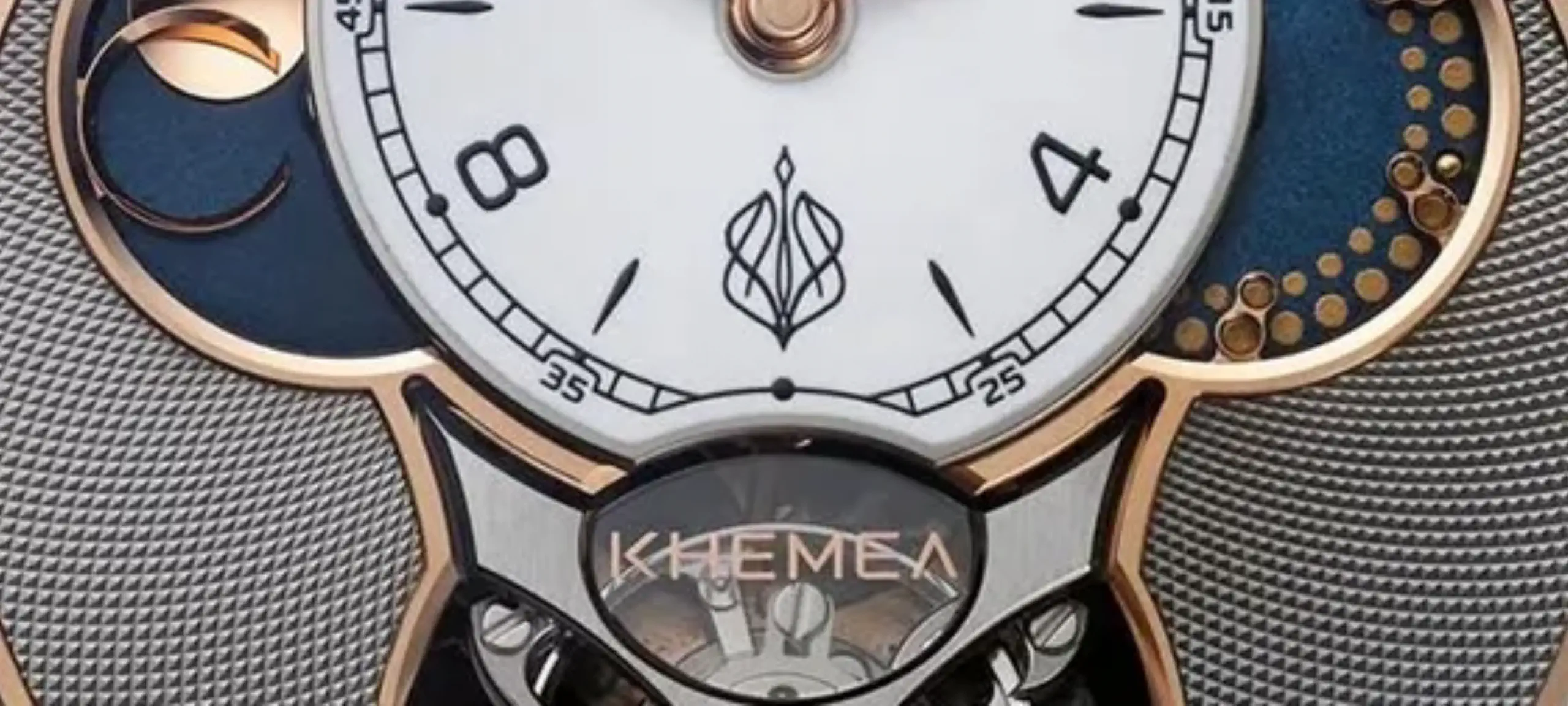
The hour and minute hands also deserve our attention. Their particularly slender design, with subtly skeletonised sections and tapered tips, bears little resemblance to a conventional pair of watch hands. They have a genuine personality and appear to have been designed to complement the other graphic elements of the watch, particularly certain curves found in the Khemea logo. On the prototype I examined, they featured a blue finish that contrasted particularly well with the white enamel dial. I found them extremely easy to read, despite their delicate proportions and the overall complexity of the composition. The technical specifications of the Souscription Edition, meanwhile, indicate polished brass hands plated in rose gold. Another detail I particularly appreciated appears just below the time display, where the Khemea name is presented on a small section of slightly smoked sapphire. This allows the inscription to stand out discreetly while retaining a degree of transparency, revealing the mechanical elements positioned behind it. In the upper section of the dial, we also find a discreet inscription in ancient Greek, « αἰσθάνομαι » (aisthanomai), referring to the ability to perceive and feel, a notion that Shona associates with aesthesis, or sensory perception. This reference takes on particular significance when one considers her background and her attachment to philosophy. For her, a watch can also become an object capable of stirring emotions.
Shona also shared a detail with me that I find particularly touching. Beneath the dial lies a wheel connecting the moon phase and date indications. A line of poetry is inscribed on it, although its content is deliberately kept secret. Only a few times each year does this line align with the inscription evoking aesthesis, engraved in the upper section of the dial. I particularly like the idea that such a discreet connection can exist between literature and the watch’s mechanisms, without collectors necessarily discovering all its secrets at first glance.
To the left of the time display sits one of the Khemea’s most interesting complications: its moon phase indication. Unlike a traditional display, in which the representation of the Moon gradually appears and disappears behind an aperture, Shona wanted to offer a more personal interpretation of the lunar cycle. The Moon is positioned on a disc that completes one revolution in approximately 29.5 days, corresponding to the duration of a lunar month. During this movement, it travels partly beneath the hours and minutes dial, while a C shaped index allows its position within the cycle to be identified. The interest of this construction lies in retaining a complete representation of the Moon rather than progressively concealing it to reproduce its different phases. It is therefore the Moon’s position in relation to the marker that allows the progression of the lunar cycle to be understood. A particularly poetic way of presenting this complication, transforming the reading of the moon phase into an almost astronomical observation.
The moon phase and date indications are displayed on discs whose material has evolved throughout the development process. Shona initially considered aventurine, but eventually opted for mother of pearl, particularly because of its greater resistance to impacts. On the prototype I personally tried on, these subdials are therefore made from white mother of pearl. For the Souscription Edition, they will feature mother of pearl with a blue varnish finish, giving both displays a richer colour. I particularly appreciate this decision because it demonstrates how closely the pursuit of aesthetic refinement remains connected to the practical constraints of manufacturing and everyday use. The soft reflections of the mother of pearl create an interesting transition between the purity of the enamel and the more technical character of the guilloché. What I appreciate most, however, is Shona’s approach. Rather than simply incorporating traditional complications into her movement, she has sought to rethink the way collectors can read and observe them, giving them a more personal dimension directly connected to her interest in astronomy and the representation of time.
To the right of the hours and minutes dial, we discover another particularly original interpretation: the calendar that Shona herself describes as “poetic”. Its display is based on 31 small fixed apertures, corresponding to the different days of the month. Beneath them, a rotating disc gradually moves a small dot, which becomes visible through one of the apertures to indicate the position of the current day. Rather than using a traditional date window that displays a number directly, Shona has imagined a representation in which the date occupies a position along a circular path. Six markers notably take the form of an “8” and correspond to multiples of five, namely the 5th, 10th, 15th, 20th, 25th and 30th days of the month. These indications help the wearer find their position within the cycle, while the visible dot moves as the days pass. To follow its progression, the eye first travels along the outer semicircle, then the inner semicircle, always from top to bottom. The result is a representation of the month in which the passing days are expressed through a gradual movement across the display rather than a succession of numbers.
It is precisely this interpretation that I find particularly interesting. Shona’s objective is not necessarily to allow collectors to identify the exact date instantly, as they would with a watch equipped with a conventional date display. Instead, she wants to provide a reference point within the course of the month, a way of visualising its progression and positioning the present moment in relation to the days that have passed and those still to come. Ultimately, this approach naturally recalls the moon phase indication on the opposite side of the dial. In both cases, an indication traditionally intended to communicate precise information also becomes a way of observing a position within a cycle. I particularly appreciate this coherence, as it demonstrates that Shona has not simply tried to develop two original complications independently of one another. She has imagined two representations of time based on the same sensibility, where the movement and position of the different elements are just as important as the information they communicate. The result is particularly refined and lends an almost contemplative dimension to indications that are otherwise very familiar in mechanical watchmaking.
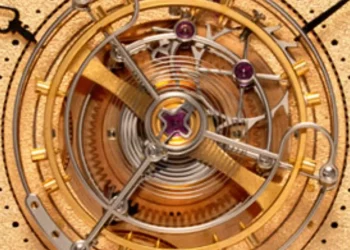
Finally, at 6 o’clock, the tourbillon naturally occupies the last level of this three dimensional architecture. The guilloché gradually opens up to reveal the rotating cage, while its bridge features a particularly distinctive geometry, with a shape reminiscent of a double arrow or a “V”. Its curves echo certain elements of the Khemea logo, creating a visual connection between the brand’s identity and the most spectacular mechanical component of the watch. I also appreciate the work carried out on its finishing, particularly the black polishing, which creates striking contrasts between luminous surfaces and darker sections of the bridge. The result has a genuine personality, without giving the impression that the tourbillon has been added simply to impress. We will naturally return to its construction and Olivier Mory’s involvement when examining the movement, but its aesthetic integration already deserves recognition. It forms the focal point of the entire composition, visually extending the two complications positioned above it. Overall, I find the dial of the Shona Taine Khemea particularly successful, especially considering that this is Shona Taine’s first creation. What impresses me most is not simply the richness of the techniques employed, but the way they come together to form such a coherent whole. The arrangement across three levels creates a genuine sense of depth, while the curves, textures and different materials maintain a relatively understated aesthetic despite the complexity of the composition. I also appreciate this desire to give recognition to the artisans involved in its creation, right down to the details that would normally remain invisible to collectors. Ultimately, this is what best sums up Shona’s philosophy in my eyes: a creation in which mechanics and the artistic crafts come together to produce something profoundly personal.
Movement
After discovering the richness of the dial, turning the Shona Taine Khemea over allows us to appreciate the mechanical ambition behind this first creation. During our meeting, I was immediately drawn to the depth of the K10 calibre’s architecture, particularly its imposing floating ratchet wheel, its two clicks and the attention devoted to the decoration of its various components. What I appreciate most, however, is the coherence between the two sides of the watch. As on the dial, Shona has sought to organise the different elements across three levels, creating a particularly successful aesthetic and architectural continuity. The movement therefore does more than simply power the indications visible on the dial. It becomes a form of expression in its own right, where every component seems to have found its place.
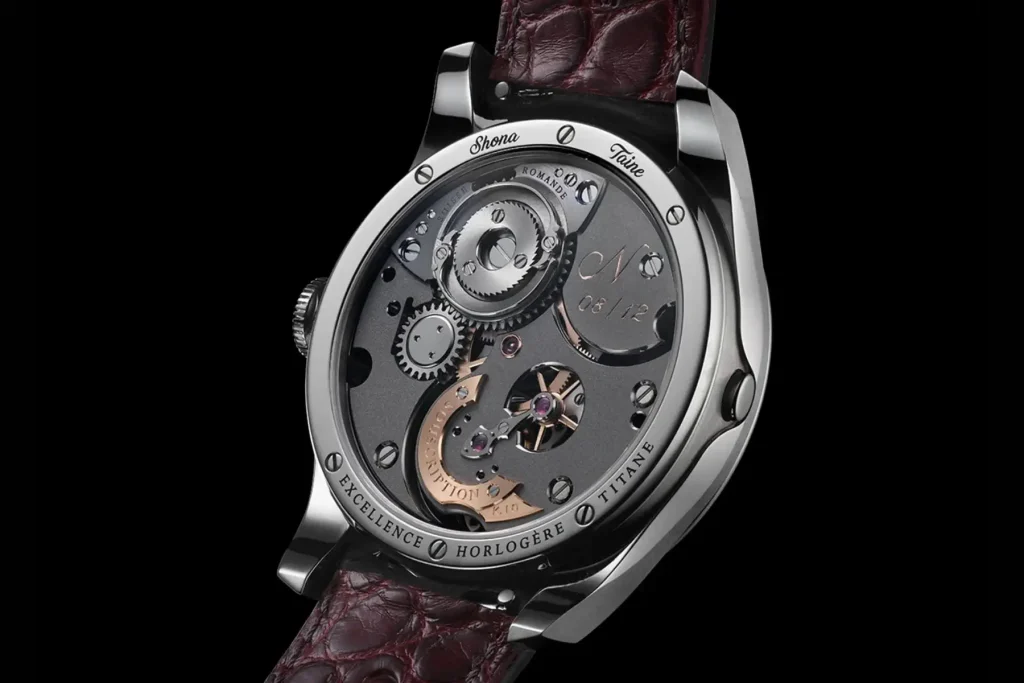
This three dimensional construction gradually reveals itself when looking through the sapphire caseback. In the foreground, in the upper section, the floating ratchet wheel and its two clicks immediately attract attention. Just below, the bridges treated with anthracite ruthenium display a grained finish that contrasts with the various polished surfaces of the movement. Deeper within the construction, openings in these bridges reveal the wheels of the gear train and certain elements of the transmission. I particularly like this arrangement because it makes the mechanics genuinely readable. We can distinguish the different components, their positions and some of the interactions between them, without feeling that we are looking at a movement deliberately opened up simply to expose as many parts as possible. Shona seems to have pursued the same balance as on the dial: creating depth, highlighting the essential elements and maintaining a certain harmony despite the complexity of the entire construction.
Before examining the technical details more closely, I think it is important to return to the origins of the K10 calibre. As we discussed in the introduction, meeting Olivier Mory played a decisive role in the development of this first watch. Shona chose to build upon an existing and proven mechanical architecture, particularly for the tourbillon and certain parts of the gear train, before extensively reworking its construction to incorporate her own complications and specifications. She is particularly keen to remain transparent about this collaboration, without presenting the movement as something she developed entirely on her own. Yet it would be equally reductive to consider the K10 simply an existing calibre to which a few additional functions have been added. Adapting it required considerable work in design, manufacturing and fine tuning, allowing Shona to gradually develop her own solutions while retaining a reliable mechanical foundation.
From a technical perspective, the K10 calibre is a manually wound movement comprising approximately 330 components and operating at a frequency of 21,600 vibrations per hour, or 3 Hz. It incorporates a tourbillon completing one full revolution every 60 seconds, alongside the mechanisms required to display the hours, minutes, moon phases and poetic date indication we discovered on the dial. The movement also offers a particularly generous power reserve of 100 hours, provided by a single barrel. This last point is worth emphasising, as achieving such autonomy without multiplying the number of barrels represents an interesting construction choice for a watch featuring so many complications. The power reserve therefore remains a major characteristic of the movement, even though Shona ultimately decided not to retain the mechanical power reserve display she had considered during its development.
This decision deserves a closer look, as it illustrates how Shona has learnt to reconcile her ambitions with the realities of production. The power reserve indicator originally planned would have required more than fifty additional components, while the K10 already contains approximately 330 in its final configuration. Rather than further increasing the number of parts to manufacture, decorate and assemble, Shona preferred to abandon this display to avoid extending the delivery times of the first series even further. I found this decision particularly interesting. It is not about making the watch artificially simpler, but rather deciding where complexity should be concentrated and preserving what matters most to the project. The Khemea therefore retains its stated 100 hours of autonomy without adding a power reserve display as another complication.
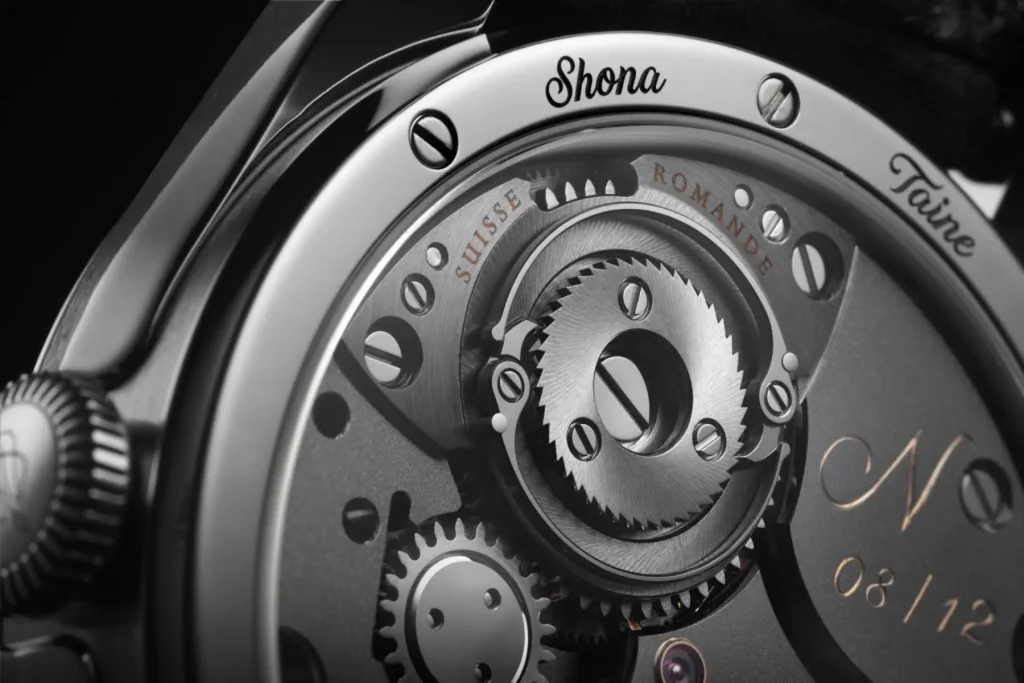
The other element that immediately attracts attention is naturally the floating ratchet wheel, whose construction is one of the most distinctive features of the K10 calibre. Traditionally, the ratchet wheel of a manually wound movement is a relatively discreet component, sometimes partially hidden beneath a bridge or incorporated into an architecture that does not necessarily seek to highlight it. Here, Shona has done precisely the opposite. By removing the upper bridge traditionally associated with its construction, she gives the ratchet wheel an almost suspended appearance above the other components. It consequently becomes the first element we notice when looking at the movement, but also one of the most interesting to watch in operation. I particularly appreciate this decision, as it transforms an essentially functional component into a genuine element of the watch’s aesthetic identity without changing its fundamental purpose.
This ratchet wheel is accompanied by two clicks whose construction draws inspiration from mechanisms found in certain historic watches, particularly those equipped with striking complications. This choice seems especially consistent with Shona’s background and her longstanding interest in minute repeaters. She wanted to recapture some of the character of these traditional mechanisms, with clicks sufficiently elaborate to become decorative elements in their own right. Their appeal, however, extends beyond aesthetics. During manual winding, they interact with the teeth of the ratchet wheel, creating a mechanical animation that collectors can observe directly through the sapphire caseback. This construction also produces a distinctive sound that I personally enjoyed during my time with the watch. Winding therefore becomes a special opportunity to observe and listen to the mechanics, a sensory dimension that perfectly reflects Shona’s philosophy.
The tourbillon naturally represents the other major element of the K10 calibre. Positioned at 6 o’clock, it completes one full revolution every 60 seconds and forms the starting point around which Shona gradually developed her first creation. Its architecture originates from the work of Olivier Mory, but integrating it into the Khemea required numerous adaptations. Shona particularly wanted to design a movement capable of accommodating the different complications on the dial while maintaining balanced proportions and a construction sufficiently reliable for everyday wear. The titanium tourbillon bridge, entirely finished and bevelled by hand, also illustrates the importance placed on the decoration of this mechanical component. What I find most interesting, however, is the work involved in integrating this complication into such a personal calibre. The tourbillon is not simply a spectacular presence at 6 o’clock. It also represents one of the mechanical foundations upon which Shona has developed her entire project.
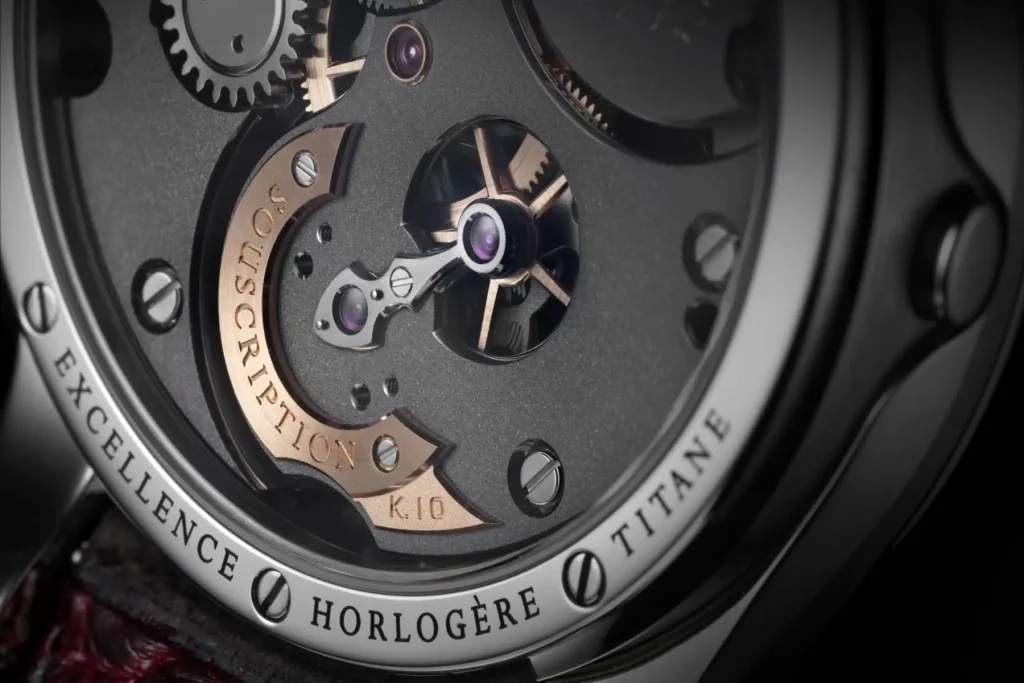
What probably impressed me most when examining the K10, however, was the amount of work devoted to its finishing. The brass bridges, treated with anthracite ruthenium, feature hand applied graining, whose dark texture contrasts particularly well with the polished surfaces and the various components of the gear train. The mainplate receives a microblasted finish, while the flanks are brushed and certain undersides feature perlage. The jewel settings found on certain elements of the movement, particularly around the centre wheel, add further details to this relatively contemporary architecture. Meanwhile, the carefully polished bevels and contrasts between the different textures create points of light that help reveal the full depth of the movement. I particularly appreciate this combination of deeply traditional finishing techniques and a more modern aesthetic, in which the dark bridges occupy an important position without concealing the richness of the craftsmanship.
The bevelling deserves particular attention. Shona trained in this discipline under Nathalie Jean-Louis, whose experience allowed her to deepen her understanding of a particularly demanding skill. On the K10, the components display a very high level of finishing, with edges polished by hand and numerous operations carried out using traditional methods. The technical documentation notably mentions work involving up to forty inward angles per wheel on certain elements of the gear train, a particularly impressive figure when one considers the difficulty involved in producing them. Unlike an outward angle, an inward angle requires exceptionally precise manual work to achieve a sharp intersection between two polished surfaces. This is the kind of detail that demands enormous patience and can easily go unnoticed by a less attentive observer. Yet it represents one of the most demanding expressions of traditional watchmaking craftsmanship. And when we consider that Shona still works with traditional machines, including lathes and equipment that are several decades old, it becomes easier to appreciate the time and skill required to achieve such a level of execution.
This attention to detail can also be found in the different inscriptions and engravings present on the movement. Some refer directly to the identity of the watch, including the markings “K10” and “Souscription”, while others evoke its roots in the Swiss watchmaking tradition, such as the engraving “Suisse Romande”. The individual numbering of each piece also involves engraved detailing. I appreciate this way of incorporating references to the watch’s identity directly into its architecture, without resorting to excessive decoration.
Overall, I find the K10 calibre particularly accomplished for a first creation, both in its construction and its execution. What impresses me most is the way Shona has managed to combine demanding mechanical solutions with a deeply personal aesthetic, without ever losing sight of manufacturing constraints and reliability. The arrangement of the components naturally reflects that of the dial, while the various artisanal finishes give the movement a genuine sense of depth. I also appreciate this desire to make certain mechanisms visible without attempting to create a completely skeletonised movement, where an excessive number of openings could ultimately compromise the legibility of the entire construction. The result possesses a clearly defined identity and perfectly extends the aesthetic language of Shona Taine. For a first watch, I find this coherence particularly convincing.
Strap
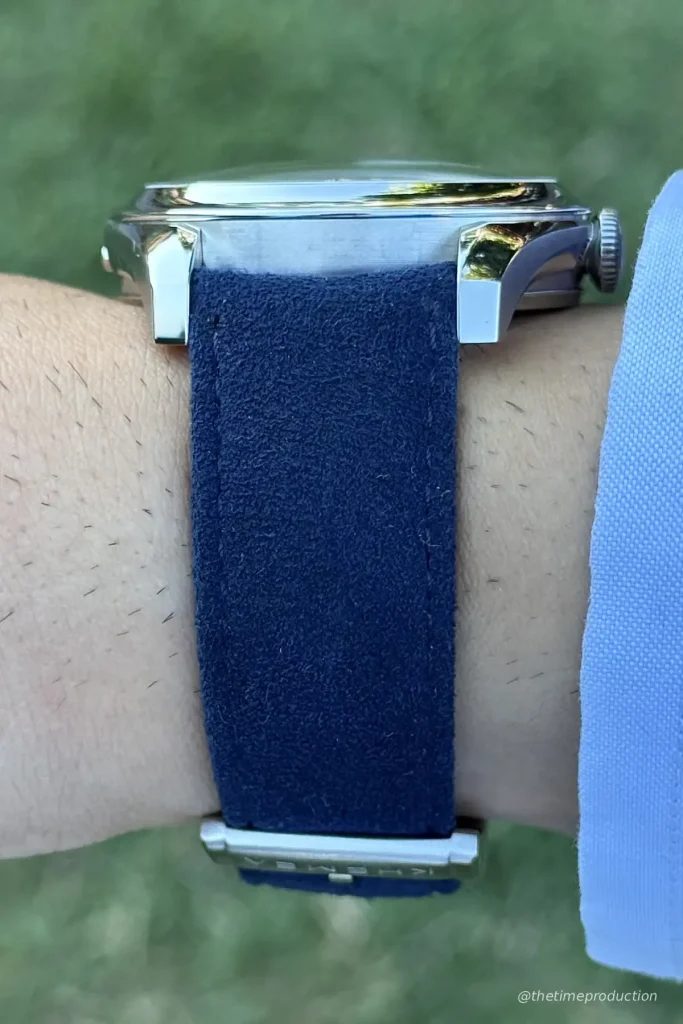
The Shona Taine Khemea I had the opportunity to examine was fitted with a high quality suede leather strap, a choice that I find particularly consistent with the overall aesthetic of the watch. Its soft texture naturally complements the different finishes of the case without attempting to draw too much attention to itself. On the wrist, it proves particularly comfortable and contributes to the excellent balance of the entire watch. The pin buckle, made from steel and engraved with the Khemea logo, also features an interesting construction, with a design that integrates harmoniously into the identity of the watch. Nothing particularly extravagant here, but a carefully considered combination that is pleasant to wear and perfectly suited to the contemporary and artisanal character of the Khemea.
What is the price of the Shona Taine Khemea?
The Shona Taine Khemea was introduced in an initial Souscription Edition strictly limited to twelve individually numbered pieces, housed in a 40 mm grade 5 titanium case. Priced at CHF 86,000 excluding taxes, this first series quickly found its collectors and is now entirely reserved. Such an extremely limited production perfectly reflects Shona Taine’s artisanal approach. After several years devoted to developing her first model, the manufacture of the twelve pieces is progressing gradually, according to the different stages of craftsmanship required to produce such a complex watch. Between machining the components, the numerous manual finishing operations and the involvement of various specialists, each piece requires considerable attention. Shona also explained to me that certain stages, particularly those involving decoration, remain difficult to schedule precisely, as they depend on the work of several different people.
For collectors who did not have the opportunity to acquire a piece from this first series, Shona is already planning two new interpretations of the Khemea. The first is expected to take the form of a steel edition limited to eight pieces, with a predominantly blue colour scheme. This configuration is particularly interesting because it was not originally intended for commercial production, but the interest expressed by several collectors during the presentation of the prototypes eventually encouraged her to consider a small series. A second edition, also limited to eight pieces, is expected to be produced in rose gold with a dial featuring lighter tones. A particularly personal combination, as Shona explained to me that it corresponds to the configuration she would most like to wear herself. These two interpretations are expected to follow the Souscription Edition, although no definitive delivery schedule has been announced at this stage.
Beyond these limited editions, Shona is also continuing to develop unique pieces while maintaining an extremely restricted production capacity. Each creation requires numerous operations carried out individually, alongside the coordination of the different artisans involved in the project. This organisation largely explains the manufacturing timescales, but it also allows her to preserve the level of craftsmanship and personalisation to which she seems particularly attached. An approach that is entirely consistent with her desire to develop her watchmaking house gradually, without sacrificing the artisanal dimension that has become one of the defining characteristics of her work.
Shona Taine Khemea: The Alchemy of a First Creation
Having taken the time to explore all the characteristics of the Shona Taine Khemea, what strikes me most is probably the maturity of the approach behind this first creation. With such an ambitious watch, it would be easy to imagine a young watchmaker eager to demonstrate the full extent of her abilities through an accumulation of complications and spectacular finishing techniques. Yet that is not the impression I had when discovering the watch. Instead, I met a watchmaker who seems to have developed every element with a clear intention, constantly seeking to find a balance between her technical ambitions, personal tastes and manufacturing constraints. And I believe it is precisely this coherence that represents one of the Khemea’s greatest strengths today.
This coherence can also be found in the three main aspects of the watch. The case possesses an immediately recognisable identity, but its originality comes above all from careful consideration of its construction and ergonomics. The dial combines traditional decorative techniques with indications that offer a more personal interpretation of time. As for the movement, it naturally continues this approach through an architecture designed as much for its mechanical function as for the pleasure of observing it. What I particularly appreciate is that these three elements seem to have been developed together, with the same constant search for balance. The Khemea never gives the impression of being a collection of interesting ideas brought together within a single watch. It possesses a genuine sense of unity.
Beyond the technical characteristics, I also take away the deeply human dimension of this project. What I particularly appreciate about Shona’s approach is her ability to establish a personal identity while fully acknowledging the contribution of the artisans who work alongside her. Ultimately, she demonstrates that an independent watchmaking creation can possess a very strong signature without necessarily being the result of one person’s work alone. This collective understanding of craftsmanship perfectly reflects the name Khemea and the idea of alchemy that runs throughout her journey.
This philosophy seems all the more remarkable to me because Shona already possesses considerable technical expertise, while remaining fully aware of everything she still has to learn. The Khemea was never conceived as a creation intended to immediately revolutionise every principle of mechanical watchmaking. Above all, it represents a particularly ambitious first step that has allowed her to confront the full range of challenges involved in developing a watch, from design and manufacturing to organising her own workshop. I find this approach particularly intelligent, as it has enabled her to gradually establish solid foundations, both technically and as an entrepreneur, while developing an aesthetic language that is entirely her own.
What makes her journey even more interesting is that she certainly does not consider the Khemea to be a final achievement. Shona already has several projects in mind, although she naturally prefers to remain discreet about them for the time being. She wants to continue developing her aesthetic language, deepen her knowledge and explore new mechanical possibilities, potentially through creations offering different levels of complexity. Her passion for striking watches also remains very much alive. Ever since restoring her Le Phare movement during her studies, this field has occupied a special place in her journey, and she continues to work regularly on these mechanisms as part of her restoration and after sales servicing activities. It would therefore be particularly interesting to see her introduce a creation of her own in this field one day. Nothing allows us to say what form such a project might take, but I find it rather fascinating to imagine that a future watch could establish a direct connection with the astronomical clock she discovered in Prague when she was just ten years old.
Personally, I came away from this experience with a great deal of respect for the work accomplished by Shona and the people who have accompanied her. Of course, the Khemea remains a first creation, and certain details may still evolve as the final pieces are completed. But that does not diminish what it already represents. I particularly appreciated the opportunity to speak with a watchmaker who knows her creation inside out, takes the time to explain her decisions and does not attempt to conceal the difficulties encountered throughout its development. Beyond its mechanical and aesthetic qualities, the Khemea reflects a rare determination to bring traditional craftsmanship, mechanics and personal sensitivity into dialogue. I will be particularly pleased to discover the next stages of this adventure and to see how Shona continues to develop the identity of her watchmaking house.
I would also like to warmly thank Shona Taine for the time she spent with me, for the quality of our conversations and for her openness about the different stages involved in developing the Khemea. Encounters like this remind me why I appreciate independent watchmaking so much. Behind the complications, precious materials and exceptional finishing, there are above all people, stories, convictions and a desire to create something that truly reflects who they are. And I believe the Khemea perfectly illustrates this human dimension of our shared passion.
Shona Taine Khemea – Watch Specifications
- Brand: Shona Taine
- Model: Khemea
- Case Material: Polished and Satin-Brushed Stainless Steel
- Dial: Grand Feu Enamel on a White Gold Base, Hand-Guilloché Silver Base, Solid Rose Gold Dial Rings
- Functions: Hours, Minutes, 60-Second Tourbillon, Moon Phase, Poetic Date
- Movement: Manual-Winding, 21,600 vph Frequency (3 Hz)
- Power Reserve: 100 Hours
- Water Resistance: 5 ATM / 50 m
- Crystal: Sapphire
- Caseback: Sapphire
- Case Dimension: 40 mm (Diameter) x 10.10 mm (Height, Excluding Sapphire Crystal)
- Strap: Blue Alcantara Leather with Stainless Steel Pin Buckle
- Availability: Limited Edition of 12 Numbered Pieces – SOLD OUT
- Retail Price: 86’000 CHF (excluding VAT)
What do you think of Shona Taine’s first creation? Does this approach, combining mechanical complications, traditional craftsmanship and an almost poetic interpretation of time, appeal to you? And above all, what are your thoughts on this new generation of independent watchmakers seeking to develop their own distinctive language while remaining deeply attached to traditional watchmaking techniques? Feel free to share your thoughts in the comments. I would be delighted to hear your opinions and discuss them with you.
If this article added value or sparked a discovery, you can support the project HERE. Your contribution helps me keep weekly articles and a biweekly newsletter free, accessible, and independent for everyone.