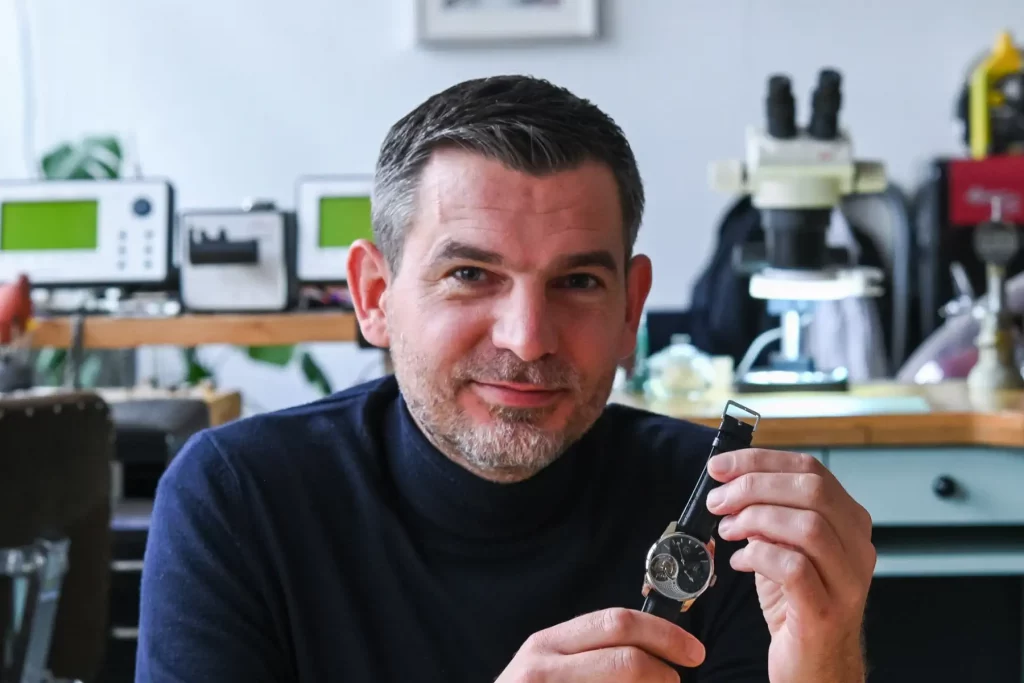
Today, I would like to talk about an independent watchmaker whose journey alone deserves close attention. If I say a self-taught Dutch watchmaker, a former consultant who left the corporate world for independent high watchmaking, and a tourbillon with jumping hours and retrograde minutes born as a unique piece and now turned into a very limited series, the more attentive among you may already have recognised Hulsman and his Tourbillon Solstitium. Before presenting this watch in greater detail, let me first go back to the man behind the project, the way he came to watchmaking, this very personal need to finally turn his ideas into reality, and what gives the Tourbillon Solstitium such a singular place in the independent landscape today.
What strikes you first about Machiel Hulsman is that his path has nothing conventional about it. He did not come out of a watchmaking school, nor from an environment traditionally linked to this industry. He grew up in a small village in the north of the Netherlands, with his parents, his older brother and his younger sister, in a world where the desire to create was already very present. As a child, he loved Lego, drawing, imagining objects, inventing solutions, and designing things on paper. His father helped him a great deal during that phase, teaching him how to work with wood, metal and other materials. Very early on, he developed a highly instinctive relationship with making, with materials, with construction. He also loved reading, especially encyclopaedias, and spending time imagining concepts that he never actually made. That is an important point, because it would return much later as a kind of foundational regret.
Machiel has in fact said that as a child he had many ideas that he never turned into reality, only to see them appear years later in real life. He mentions, for example, a third brake light he had imagined long before it became common on cars, or a multi-step method for reducing CO2 emissions that he had put on paper and later saw presented on television, years afterwards, on Discovery Channel. His parents would sometimes call him and tell him to watch a certain programme or look at a certain article because something he had imagined much earlier now existed in the real world. And that is precisely what ended up affecting him deeply: for a long time, he had ideas, but never did anything with them. That realisation, almost quiet at first, became over time something he regretted. He no longer wanted merely to invent in his mind or draw. He wanted to finally execute his ideas. And watchmaking gave him that possibility.
Long before that, however, a first intimate link with watches had already appeared. At the age of seven, his grandfather gave him an LCD watch. He was immensely proud of it. One day, wanting to show a friend how scratch-resistant it was, he gently tapped it with a small toy car and broke the plexiglass. He felt like crying. It is a very simple anecdote, but it already says something. That watch did not make him a watchmaker at the time, of course, but it quietly triggered a lasting interest in watches.
For many years, however, his life took a completely different direction. Machiel Hulsman built a successful career in IT and consulting, notably for major groups and financial institutions. He worked in IT quality, in a highly structured professional setting, very far removed from the image one has of an independent watchmaker at his bench. He lived well, very well in fact. So well that when he later decided to leave everything behind, many people around him thought he was crazy. He himself has said that he sold his Porsche to buy a milling machine, sold his boat, stopped flying as a pilot, and gave up a certain level of material comfort to start again from scratch. But that radical choice did not come out of nowhere. It corresponded to a personal reset, as he calls it himself, when he felt the need to change his life and identify what had truly made him feel alive from childhood through adulthood.
At that point, he drew up a kind of intimate map of what really mattered to him. He identified five fundamental elements, among them this central idea: executing his ideas, inventing, creating. And the turning point took a very concrete form. Looking at the watch on his wrist, and then another expensive watch bought in a family context, he thought that for that level of price, certain components looked surprisingly uninspired. He began asking himself whether he could make his own hands, perhaps his own dial, then very quickly his own bridges, his own mainplate, and eventually much more than that. The idea grew immediately. At first, he almost considered starting from an existing movement and transforming it. Then he abandoned that stage altogether and decided he would make every possible component himself, including the escapement and the jewels. At that moment, all his boxes were ticked. Three weeks after that thought, he began his first watchmaking course.
The beginning of the project still took place alongside his main job. He set up his activity in a tiny workshop, almost like a shed, in which he tried to fit as many machines, tools, books and raw materials as possible. For two years, he progressed like that, in parallel. Then came the moment when he realised he could no longer do things halfway. He told his wife that he had to stop working and devote himself entirely to watchmaking. She fully accepted that decision. That was when the project became concrete, total and irreversible. He invested everything he could in tools and machines, modernised his workshop, learned 3D design, and spent his days, nights and weekends refining his practice.
After around five and a half years of work, he completed his first watch, the Marie-Elise, named after his daughter. This first timepiece is foundational in more than one sense. He designed it, calculated it and made it almost entirely by hand, from scratch, including elements that very few creators produce themselves at that level. That watch immediately laid the foundations of his legitimacy. It showed that Machiel Hulsman was not just a converted enthusiast, but a creator capable of turning an almost crazy ambition into a real, coherent and accomplished horological object. This first creation already attracted attention, notably because it seemed to open an extremely rare path for a Dutch independent outside the great historical centres of watchmaking.
Once that first watch was finished, he wanted to go further. He decided to create a tourbillon. He worked on several designs, but one gradually imposed itself: the Solstitium. The story of that watch is quite unexpected. Following a presentation of his work to a philanthropic club in the Netherlands, one of the members approached him. A relationship began, and then the idea of a commission took shape. The collector wanted to be his first client on this project. Machiel then replied that if he wanted to be the first client, he would have to want a tourbillon. The other agreed, even before fully knowing what a tourbillon actually was. He loved the design, the spirit, the proposal. From there, Machiel personalised the project for him. He integrated jumping hours and retrograde minutes, and created a unique piece that would become one of his most emblematic creations.
The Tourbillon Solstitium then played an important role in his rise in visibility. It helped build his reputation among collectors of independent watchmaking, and also accompanied his entry into the AHCI from 2022 onwards. And yet, as is often the case with him, the story did not follow a conventional industrial or commercial logic. He did not start producing the watch in series. He continued to work on other commissions, other complications, and very ambitious projects ranging from multi-time-zone timepieces to far more complex pieces still. Solstitium therefore remained for a long time this pivotal piece, a one-off, almost mythical within his trajectory.
And that is precisely what makes the current stage so interesting. Today, with the agreement of the original owner, the Tourbillon Solstitium is becoming a very limited series. This is an important turning point for Machiel Hulsman, because until now his work had rested almost exclusively on unique pieces and commissions. From here on, he is offering an identifiable, more structured model, without giving up his artisanal DNA or a high degree of personalisation. In other words, this is not a move into serial production in the industrial sense. It is more an evolution of his language, a way of making one of his most important pieces slightly more accessible to a few collectors, while preserving the very human, very direct and highly involved spirit that characterises his work.
Ultimately, that is exactly what makes Machiel Hulsman’s approach so interesting today. We are not talking about a watchmaker who arrived through the conventional route, nor about a brand built from the outset on a perfectly rationalised plan. We are talking about a man who left a very comfortable life in order to finally execute his ideas, a creator who built his legitimacy through work, risk-taking and sheer determination, and an independent who, outside Switzerland, has managed to build a coherent universe by combining tradition, invention and extreme personalisation. And at a moment when the Tourbillon Solstitium is taking on a new dimension by becoming a limited series, it seemed particularly interesting to me to go back over that journey before entering into the details of the watch itself. Now, let us move on to the watch.
Table of Contents – Hulsman Tourbillon Solstitium
What are the key features of the Hulsman Tourbillon Solstitium?
Case
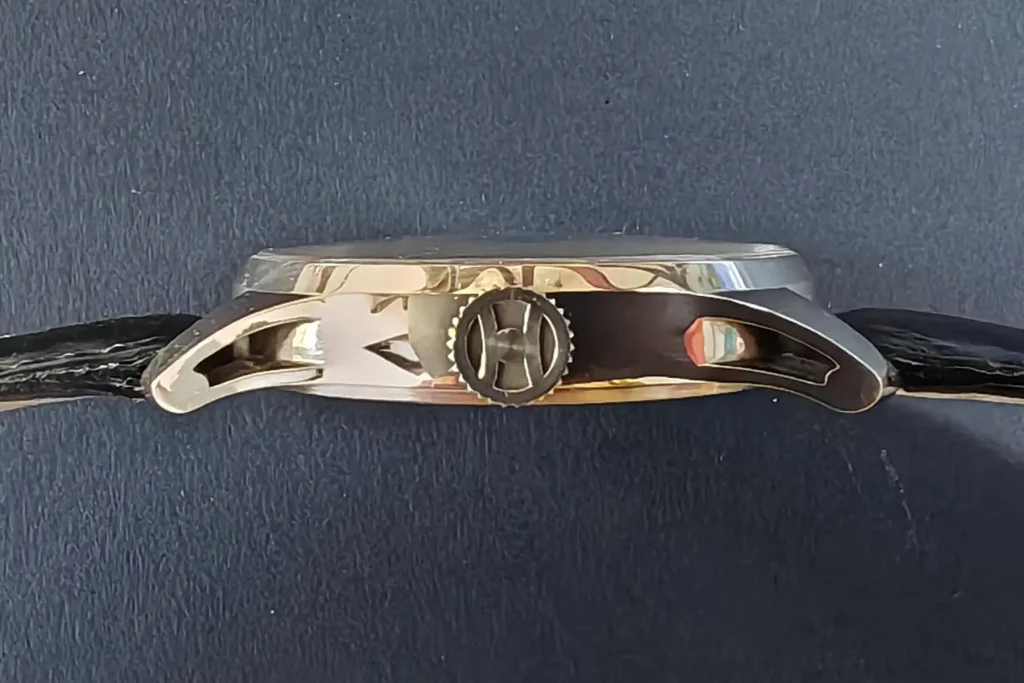
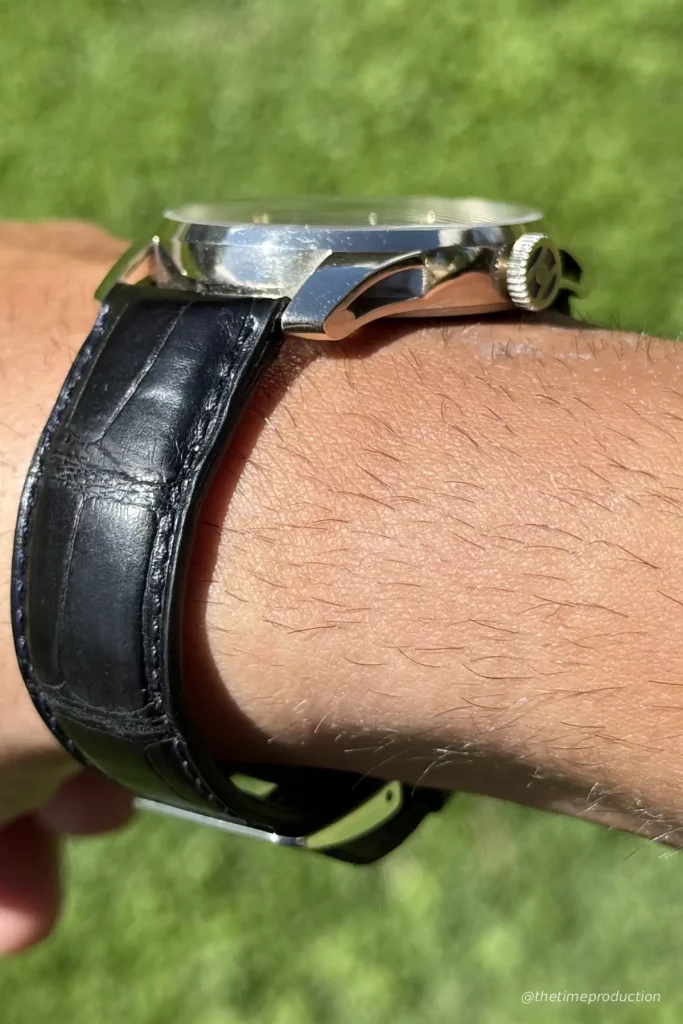
What struck me first about this Tourbillon Solstitium was clearly the work on the open lugs. They are the visual element that immediately gives the watch its personality. They bring something far more fluid, more airy, almost sculptural, while still preserving real presence on the wrist. This is not at all a generic or merely functional case. There is a genuine formal search here, with an architecture that catches the eye without ever becoming excessive.
The proportions also seemed particularly well judged to me. At 39 mm in diameter and 9.3 mm thick, sapphire crystal included, the case remains compact for a watch of this level and this degree of complexity. And yet it never feels small. It has real presence, notably thanks to its visual thickness and the structure of the lugs, but also thanks to that large opening which leaves a great deal of room for the dial. That is actually something I liked a lot: there is no thick bezel here that visually closes the watch in on itself. On the contrary, everything seems designed to open up the view as much as possible, both onto the dial from the front and onto the movement from the back. It gives the whole watch a great deal of air.
This case will be available in white gold, yellow gold, rose gold or platinum, which clearly shows that it is also part of a significant customisation logic for the client. But beyond that range of metals, what really deserves to be highlighted is its manufacturing method. The case is made using the lost-wax casting technique. And that is a real point of interest, because this process remains relatively uncommon in contemporary watchmaking for this kind of piece. In practical terms, it first involves creating a form in wax, which is then used to make a mould into which the molten metal is poured. Here, that method is made necessary by the complexity of the design itself, particularly those open lugs, which a more conventional machining approach would make far more difficult, if not impossible, to achieve in this way. You immediately understand, then, that the form of the case is not only aesthetic. It also imposes a genuine technical requirement from the outset.
And that is only the beginning of the work. After casting, the case still goes through several weeks of machining, hand finishing and polishing. You can feel that immediately. The case is fully polished, but it never feels simple or smooth in the wrong sense of the term. On the contrary, the polish here highlights the complexity of the design, the tension in the lines, the different angles and the variations in surface. That is especially visible on the lugs, which retain a certain sharpness while remaining very elegant. This balance between softness of volume and precision of line works extremely well.
I also really liked the fact that there is a genuine lineage with the Marie-Elise, Machiel Hulsman’s first model. You can tell that this case continues what he had already proposed before, but with a reading that is tighter, more modern and more sporting as well. And that is interesting, because it shows that he is not starting again from zero with each project without any overall logic. He is gradually building a language. You can already feel a signature, a way of drawing, a desire to evolve his codes without betraying them.
The crown also deserves to be mentioned. Its grip is good, which is always important on a watch that calls for real interaction. But I also found the work on its flat surface very successful, with the brand’s logo engraved into the material. Once again, this is not a gratuitous detail. It contributes to the overall coherence of the case and to the care given even to the most functional elements.
On the wrist, the whole thing works very well. The case is comfortable and balanced, and despite the complication it houses, it retains remarkable slimness. That is perhaps one of its greatest strengths: managing to contain real horological complexity in a case that remains wearable, legible and harmonious. You can feel both the technical mastery and the sensibility of someone who wants to make a beautiful object, not simply house a movement inside a case.
In the end, I find this case particularly successful. It expresses both Machiel Hulsman’s personal creativity, his technical mastery, and his taste for forms that step slightly outside the beaten path without ever losing coherence. It is a case with character, one that demands time to produce and finish, and one that immediately gives the Tourbillon Solstitium a strong identity.
Dial
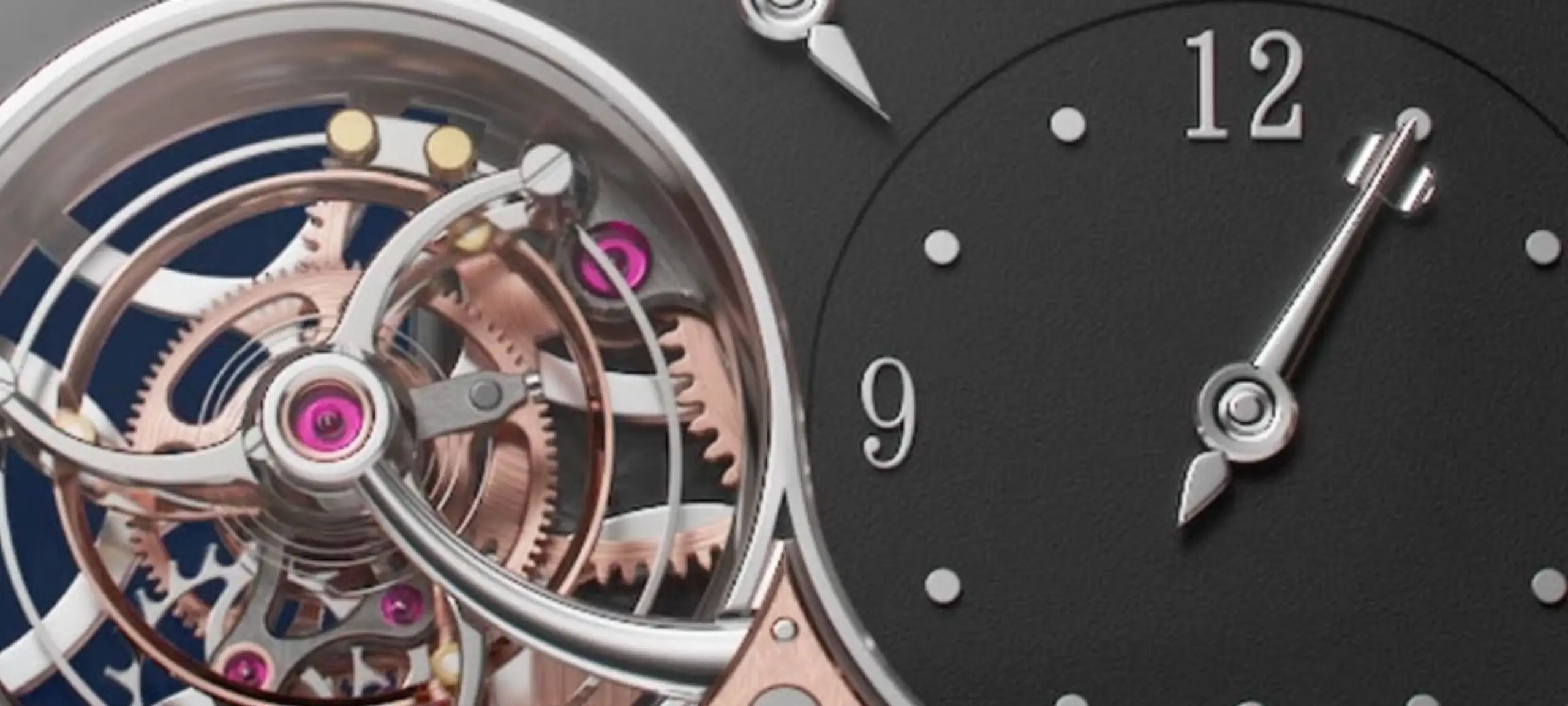
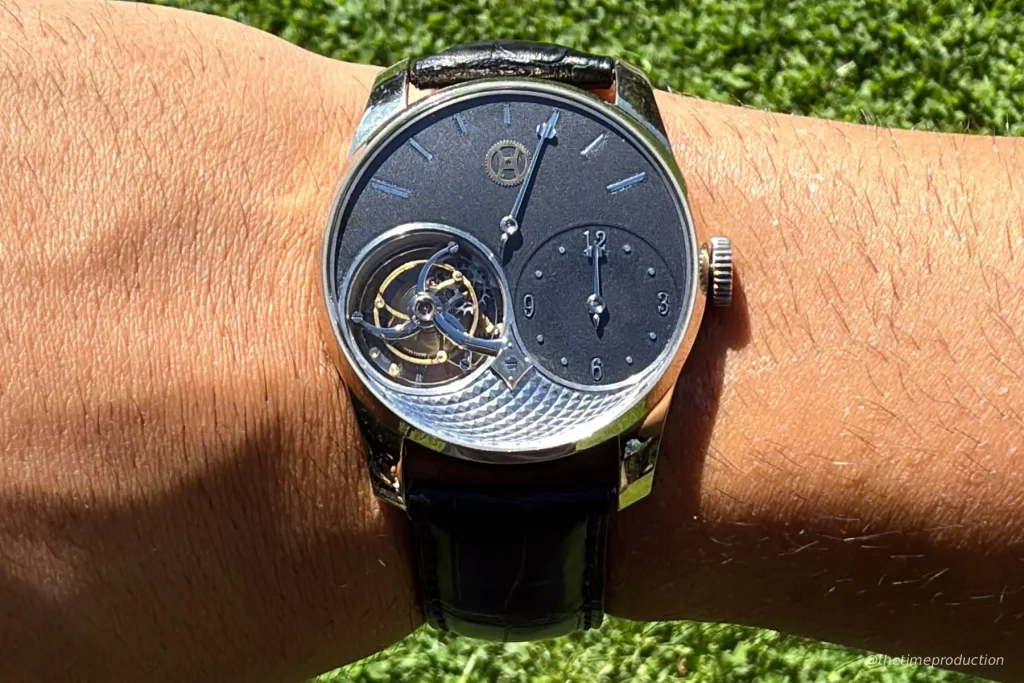
To my eyes, the dial of the Tourbillon Solstitium is one of the most interesting elements of the watch, because it manages to combine real display complexity with a very strong visual balance. What struck me first was clearly its overall architecture. We are looking at an asymmetrical dial, but one that is remarkably well balanced, with the jumping hours subdial on the right, the tourbillon opening opposite it, and the retrograde minute display structuring the whole. Nothing feels gratuitous. Everything seems designed so that the mechanics can express themselves without disorder, and so that the watch retains real coherence despite the richness of its display.
That is precisely what I particularly appreciate here. The dial is not trying to impress solely through the accumulation of visible complications. What it does especially well is organise that information intelligently. The balance between the hours subdial and the tourbillon opening works extremely well, and the guilloché work on the lower half further reinforces that sense of unity. I especially like the shape of that guilloché pattern, precisely because it seems to echo the dialogue between the two main openings of the dial. It gives the whole thing real visual continuity and brings beautiful depth without weighing the design down.
The display system obviously deserves to be highlighted. The hours jump on the large subdial on the right, while the minutes follow a retrograde scale. But what makes this construction particularly interesting is above all its technical evolution. Between the prototype I was able to see and the limited series that will be produced, Machiel Hulsman introduced a major improvement: the bidirectional setting of both the jumping hours and the retrograde minutes. And that, to my knowledge, is particularly rare. Usually, this kind of system remains more constrained, especially on the retrograde side. Here, the fact that the entire display can be adjusted in both directions shows clearly that he did not simply take an idea that looked appealing on paper. He wanted to push it further so that it became more accomplished, more reliable and more coherent in actual use.
I also find the integration of the winding indicator into the logo very intelligent. It is the kind of detail that says a lot about the way this watch has been conceived. Instead of adding a conventional power reserve or another display that might have made the dial feel heavier, Machiel Hulsman chose to hide that information inside the logo itself. When torque from the barrels drops below a certain threshold, namely 10%, the upper part of the logo turns red and indicates that the watch needs winding. Once the watch has been wound, the indicator disappears again. I find that both clever, discreet and very well integrated. It is a real designer’s idea, not just a practical solution.
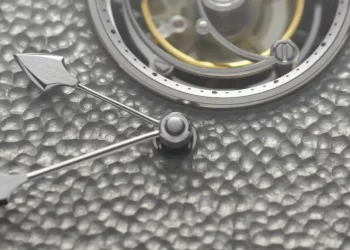
The hands also play an important role in the identity of the dial. They are true character hands. Their spade-like, almost pear-shaped form gives them a strong personality without overdoing it. I find them very well drawn, very coherent with the rest of the watch. They have something distinctive about them, yet remain perfectly legible. Above all, they can be customised in colour, with heat treatments ranging from golden yellow to violet or blue tones. That further strengthens the link between the piece and its future owner, while preserving real aesthetic coherence.
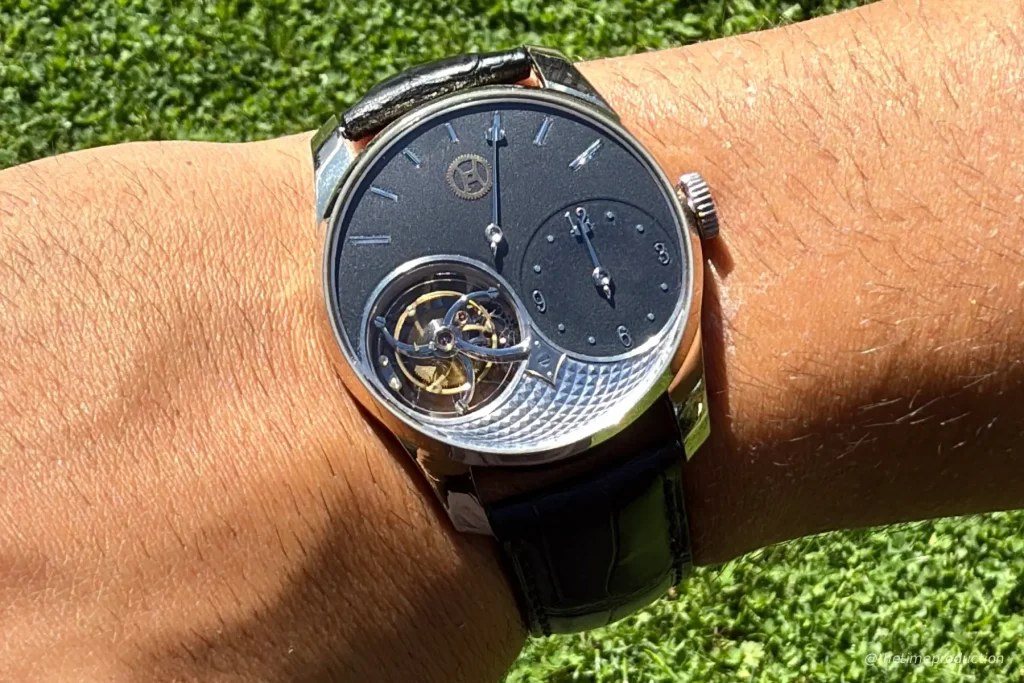
It should also be mentioned that the upper part of the dial, seen here in black on the prototype, will also be available in several colours. That matters, because it clearly shows that even though the Tourbillon Solstitium is now entering a small-series logic, it still retains a genuine dimension of customisation. In the same way, the indices will evolve compared with the prototype shown. Where some images showed diamond indices, the version that will be produced will use applied indices instead. That is a useful detail, because it shows that the project is not frozen and that the watch is still being refined.
On a purely visual level, I find the dial very successful. It is creative, personal, technically intelligent, yet it remains wearable and relatively legible for a watch of this level of complexity. Of course, one does not buy such a piece in order to read the time at a glance like on a simple three-hand watch. But you can still feel that a real effort has been made to keep the complication understandable and the dial reasonably clear.
If I had to nuance one point, I would perhaps say that I would have liked to see a slight additional ring around the minutes subdial, in order to create an even stronger dialogue with the tourbillon opening opposite it. That might have reinforced the visual symmetry of the whole just a little more. But that remains a very minor nuance, because in its current state the dial already works extremely well.
In the end, I find this dial entirely coherent with the identity of the Tourbillon Solstitium and more broadly with the Hulsman project. It expresses creativity, mechanical intelligence, a real sense of design and a fine level of craftsmanship. And above all, it clearly shows that Machiel Hulsman is not simply trying to make things complicated. He is trying to make them personal, intelligent and harmonious. That is precisely what makes this dial so interesting.
Movement
To my eyes, the movement of this Tourbillon Solstitium is one of the most impressive aspects of the watch, because it does not rest merely on the presence of a tourbillon or on spectacular architecture. What makes it truly interesting is the way Machiel Hulsman has thought through it, calculated it and rethought it. This is not just a complicated movement designed to tick boxes. It is a real demonstration of personal horological engineering, with a very clear logic: solve real constraints, manage energy intelligently, and build a calibre that remains coherent, high-performing and, in time, maintainable.
The first point that needs to be stressed is that this hand-wound calibre has been developed entirely in-house from scratch. It is not a modified base or an assembly of existing solutions. The entire movement has been conceived in the workshop, with an architecture that genuinely reflects Machiel Hulsman’s vision. And you can feel that immediately. There is in this movement a real engineer’s mindset, but also a search for mechanical simplicity and efficiency, despite a high level of complexity. That is a very important point, because fundamentally the goal is not simply to make something complicated. The goal is to make something complicated in a way that is intelligible, robust and durable.
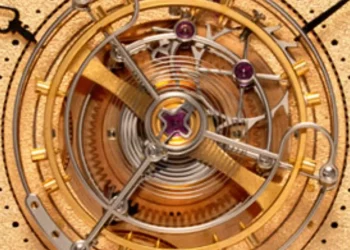
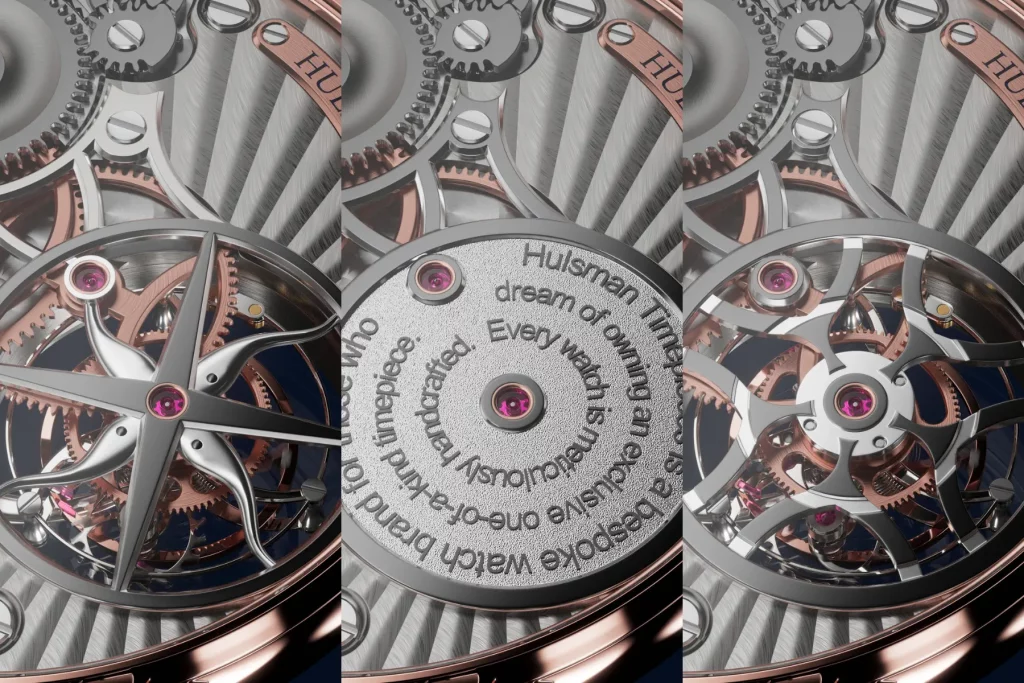
The one-minute tourbillon is of course the visual and mechanical heart of the calibre. Its large 14 mm cage, balanced by gold weights, immediately gives the movement considerable presence. The free-sprung balance, proprietary escapement, twin barrels and 75-hour power reserve already show that we are looking at something particularly ambitious. And yet what seems most interesting to me here is not simply the list of specifications. It is the way Hulsman has solved the problems such a brief inevitably creates.
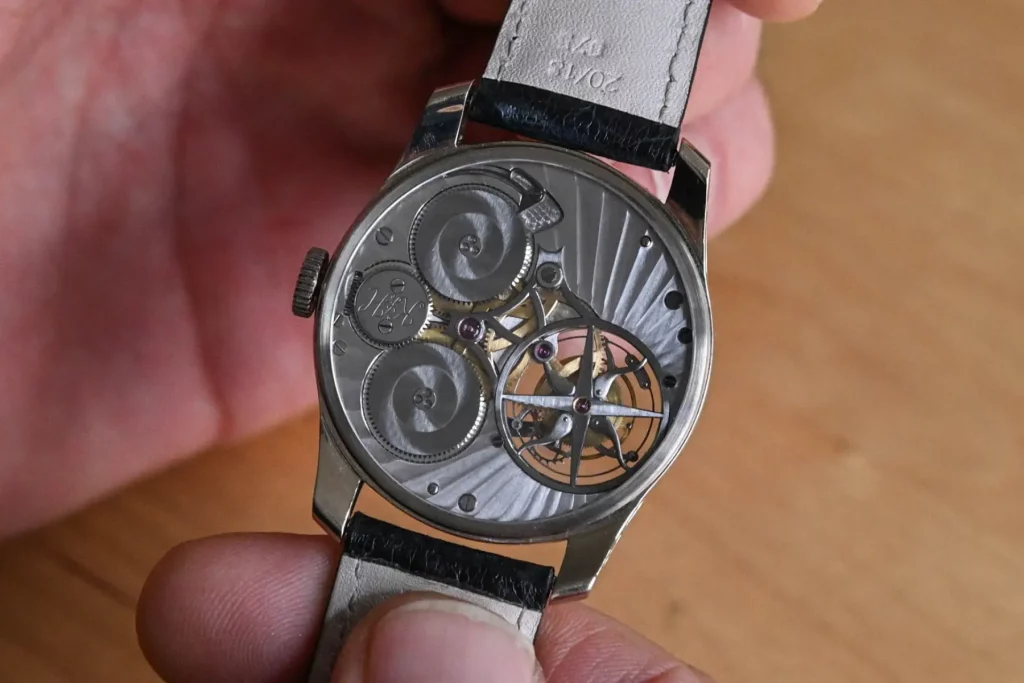
Because this movement has in fact been designed around very specific constraints. On the one hand, it had to manage a fast tourbillon with a relatively large cage. On the other, it had to integrate jumping hours and retrograde minutes, two indications that themselves demand extremely precise energy management. And that is where the full depth of the work becomes apparent. Machiel Hulsman himself explains that he designed and calculated the gear train with around 20% more energy than a standard escapement would require, precisely in order to meet the demands of the tourbillon. He also chose twin barrels so as to ensure a truly comfortable 75-hour power reserve, which is especially appreciable in a watch of this level of complexity.
But the most interesting part, in my view, lies in the escapement. That is probably where one best understands what is personal and genuinely thought through in this movement. At the outset, Machiel Hulsman wanted to pursue a higher frequency, and he spent a great deal of time thinking about speed, wear and the impacts suffered by the system. The problem with a large fast tourbillon is that the cage has to stop at each locking of the escape wheel, which creates major shocks and can generate more wear. To solve that, he imagined a particularly intelligent solution: adding an extra spring directly onto the escape wheel itself.
In practical terms, this small spring allows the escape wheel to recover its own energy from the tourbillon cage driven by the gear train. When the pallet unlocks the wheel, the spring instantly provides the impulse required. Then the cage resumes its movement and progressively tensions the spring again until the next point of equilibrium. At the following lock, that same spring absorbs part of the brutal impact of the stop. The result is a smoother system, with less wear, more available energy, and a mechanically more intelligent mode of operation. Put simply, it almost amounts to creating a kind of shock absorber integrated into the escapement. And that is where this movement becomes truly fascinating, because one sees clearly that the sophistication is not there for decorative effect. It responds to a real problem.
The decision to ultimately retain a frequency of 21,600 vibrations per hour seems particularly coherent to me in this context. That choice shows precisely that Hulsman was not looking for theoretical performance for its own sake, but rather for the best compromise between speed, stability, wear and the overall viability of the system. That is exactly the kind of decision that distinguishes a deeply thought-out movement from one that is merely spectacular.
The other major strength of this calibre is that it has been entirely rethought between the one-off prototype and the 12-piece limited series. And that really has to be emphasised. One might imagine that an already successful watch would simply be reproduced with a few small adjustments. Here, that is not the logic at all. Machiel Hulsman went back to zero to improve the movement, integrate what he had learned from the prototype, and push the technical coherence of the project even further. That shows real standards, but also an interesting form of humility: he did not settle for repeating what already existed, he wanted to do better.
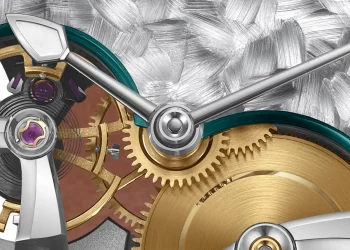
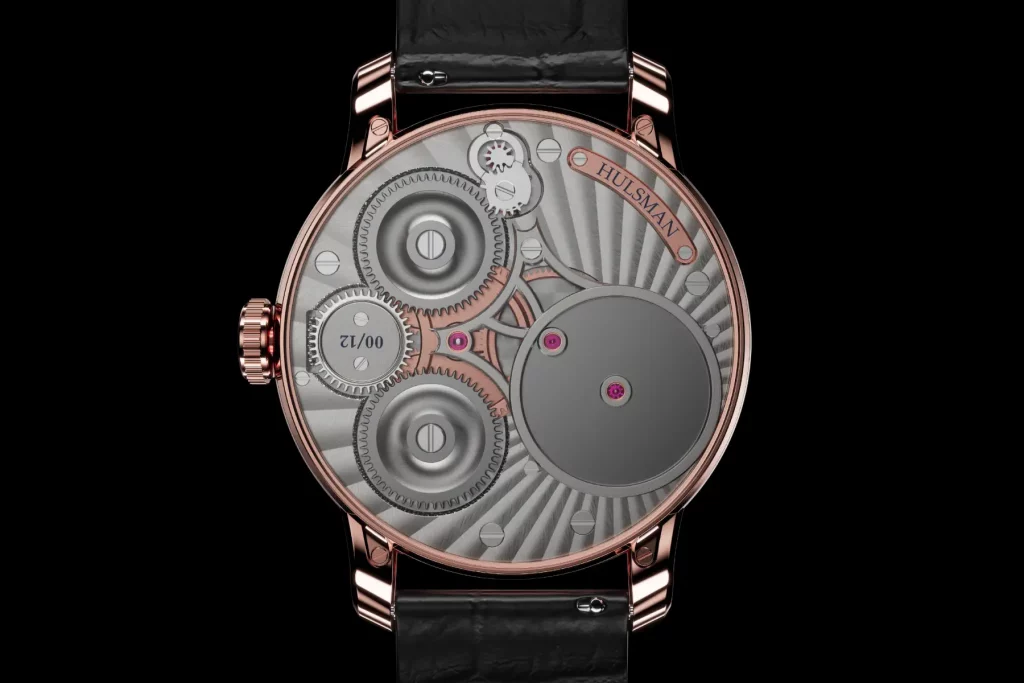
The finishing also deserves attention. The movement showcases a full range of traditional techniques, with Geneva stripes, perlage, circular graining, polished bevels, black polish and other decorative treatments that clearly show the ambition is not only technical. There is also a real will to offer a movement that is visually beautiful, readable and desirable. And what I find particularly interesting is that this decorative dimension never contradicts the engineering. It completes it.
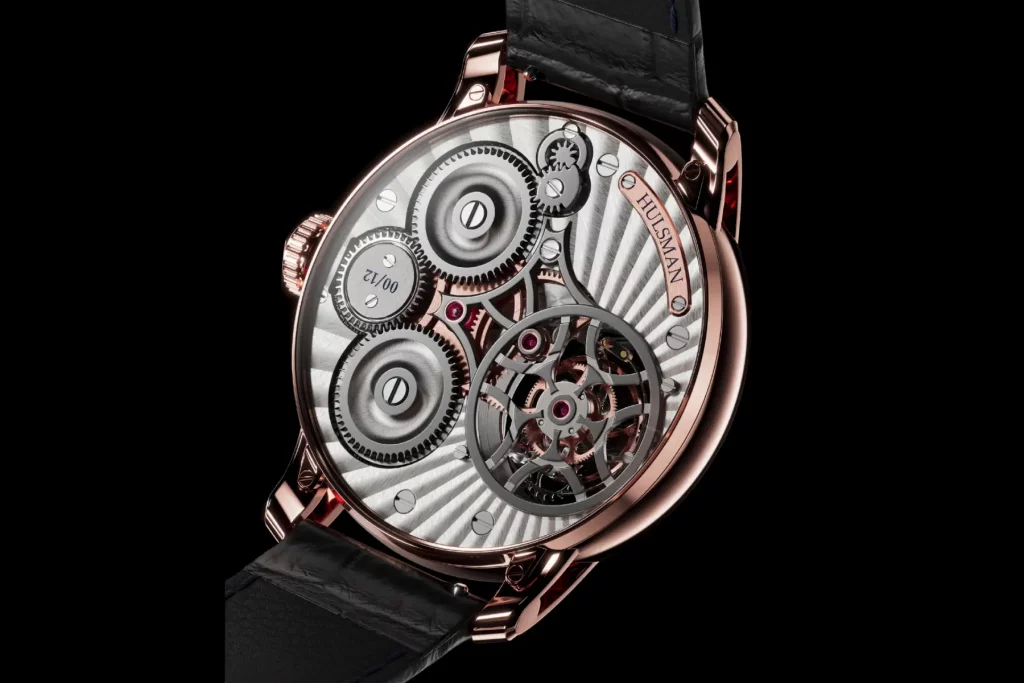
Customisation also plays an important role here. Collectors will be able to choose between different movement finishes, from rhodium to black rhodium, as well as yellow gold or rose gold tones. Above all, the lower tourbillon bridge can be completely rethought according to the client’s wishes, with engravings, initials, symbols or bespoke motifs. I find that very powerful, because it shows clearly that even within the framework of a small series, the project retains a real authorial dimension and a direct dialogue with the collector.
In the end, what a serious collector should retain is not simply that the Tourbillon Solstitium features a tourbillon, jumping hours and retrograde minutes. More importantly, all of these functions have been conceived, calculated and resolved with real technical coherence. The true sophistication of this movement lies in its energy management, in the escapement, and in the way constraints have been absorbed and transformed into personal horological solutions. And that is precisely what makes it so interesting. This is not a mere complicated exercise in style. It is a movement that tries to go further, to do better, and to offer a genuine horological answer to concrete problems. To me, that is where its real strength lies.
Strap
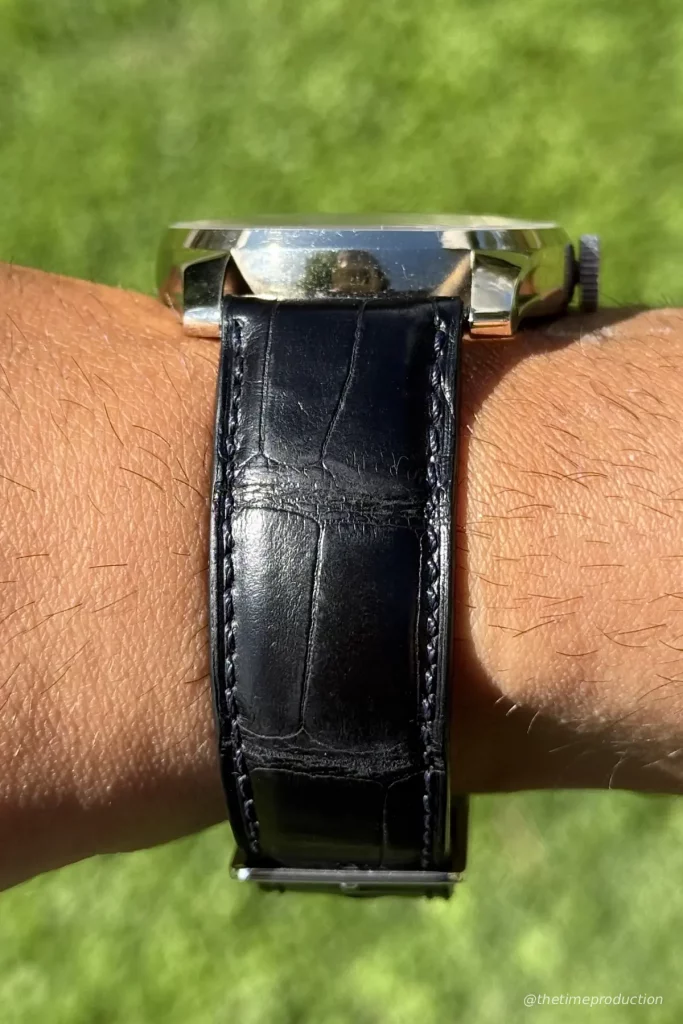
The Tourbillon Solstitium is worn on a black alligator strap that fits perfectly with the overall spirit of the watch. Sober, elegant and comfortable, it does not try to attract unnecessary attention, which feels very right to me on a piece with such strong visual presence. It accompanies the watch discreetly and lets the dial, the case and the movement fully express themselves.
What I found particularly interesting, however, is the evolution between the prototype I was able to see and the final version that will be delivered with the 12-piece series. Whereas the prototype was fitted with a fairly simple fully polished buckle, the final version will receive a folding clasp made in the same material as the case. And that development seems particularly welcome to me.
This new clasp gives the whole thing real personality. It takes up the brand’s logo in a very pronounced way, with a construction that almost evokes a hallmark or emblem. You can distinguish an H in the centre, surrounded by a form that may recall a toothed gear, which gives it far stronger presence without becoming excessive. I found that detail very interesting, because it reinforces the identity of the watch while remaining coherent with the rest of the project.
In the end, this strap does exactly what it should. It remains sober, comfortable and perfectly suited to the watch, while gaining, in its final version, a real extra touch of character thanks to this new personalised clasp.
What is the price of the Hulsman Tourbillon Solstitium?
The Tourbillon Solstitium will be offered as a limited series of 12 pieces, to which will be added a 0/12 example reserved for a charity auction supporting local and environmental initiatives. The price is set at 138,000 euros excluding VAT, a positioning that strikes me as coherent when one considers the watch as a whole, meaning both its complexity, its level of workmanship and the high degree of personalisation it offers.
This type of piece is aimed above all at a seasoned collector of independent watchmaking, someone sensitive to the idea of an author’s watch, highly customisable and conceived in direct dialogue with its creator. That is in fact one of the interesting aspects of the project: buyers will not simply receive a finished watch, they will also be able to follow its creation through regular updates, visit the workshop, and even take part in the making of one component of their own piece. I think that gives the whole thing a genuine added emotional dimension.
The process has been presented very clearly, with a non-refundable 50% deposit at the time of order, or 69,000 euros, followed by a second payment of 25% after one year, or 34,500 euros, before a final balance of 25% due upon delivery. As for the lead time, one should expect around two to two and a half years, which says quite a lot about the nature of the object and the time required to create it.
Hulsman Tourbillon Solstitium: a pivotal, sincere and ambitious piece in the journey of an independent outside the usual framework
With this Tourbillon Solstitium, Machiel Hulsman offers, in my view, far more than a technically impressive watch. He offers a piece that crystallises an entire life path, a very personal way of thinking about watchmaking, and a genuine desire to bring something different to a world that is often highly codified. This is not simply a tourbillon with jumping hours and retrograde minutes. It is a watch that carries within it a sum of choices, renunciations, risks, work and convictions that give it a particular depth.
What I retain first is the overall coherence of the project. The case, with its open lugs and lost-wax-cast construction, immediately gives the watch a strong identity. The dial, asymmetrical yet remarkably well balanced, manages to combine legibility, personality and functional intelligence. The movement goes even further and reveals a true engineering mindset, not simply a taste for spectacular complication. And that is exactly what I like here: every element exists for a reason, every detail seems to fit into a broader logic, and nothing gives the impression of having been added simply to do more.
To my eyes, the Tourbillon Solstitium also has a real visual personality. It is a demonstrative watch, of course, but never gratuitously so. It embraces its character, its architecture and its technical content while remaining wearable, readable and deeply personal. And I think that is a real strength, because it is never easy to make a watch this packed with information and mechanics without tipping into something too heavy or too demonstrative. Here, there is real balance.
The greatest quality of the Hulsman project probably lies in the sincerity of its approach. Machiel Hulsman gave everything up in order to start again from zero. He left behind a comfortable life, sold his possessions, went through difficult years, experienced moments of doubt, financial pressure and projects that stopped halfway through, and yet he kept going. And you can feel that in his work. This is not a brand built around an image or a neatly packaged story. This is someone who chose to rebuild everything around one very simple but very strong obsession: to execute his ideas, push them as far as possible, document what he does, and try to propose solutions that differ from those that have become the norm.
That is also another point I find particularly interesting about him. His philosophy of “fewer parts is better” strikes me as very powerful. It says a great deal about the way he approaches watchmaking. Where others may sometimes try to impress through accumulation or visible sophistication, he also tries to simplify, rationalise, and make things more readable, more intelligent and more robust. And paradoxically, making things simple is often far more complicated. It is precisely that tension that I find so compelling in his work.
The move from the Tourbillon Solstitium as a unique piece to a small limited series feels, in this context, both important and perfectly logical. Important, because it marks an evolution in his journey. And logical, because one clearly understands that a model based exclusively on one-offs remains extremely difficult to sustain over the long term, both economically and organisationally. This small series makes it possible to structure the project better, improve the movement further, give more visibility to his universe, and probably also make the brand’s trajectory more legible. But what I find reassuring is that this transition does not seem to come at the expense of the workshop spirit. On the contrary, Machiel Hulsman clearly wants to preserve what makes his work singular: personalisation, closeness to clients, time spent, and direct involvement.
And this trajectory obviously does not stop with the Tourbillon Solstitium. That is also what makes his journey particularly interesting today. In parallel, Machiel Hulsman is already working on other major developments, especially his perpetual calendar project, the Easy Perpetual, which says a great deal about the way he thinks about watchmaking. Here again, the idea is not simply to add one more prestigious complication, but to rethink it so that it becomes more intuitive, more legible and easier to use. That desire to reinvent known mechanisms and make them more logical without stripping them of their substance feels entirely consistent with what he is already doing with the Solstitium. And above all, it shows that he is not content with one striking creation. Over several years, he is building a real horological vision.
It also becomes clear that the coming years will be largely devoted to advancing and delivering the Tourbillon Solstitium as well as this Easy Perpetual, while continuing to pursue even more ambitious research. And that is probably where the project gains even more scale. Because beyond a single watch, one begins to see a language, a method and a trajectory emerging. It is no longer just about proving that he can do it. It is now about showing where he wants to go.
At heart, that is perhaps what I liked most in this meeting and in this watch. Machiel Hulsman remains very humble and very grounded, even though what he does is objectively far outside the norm. There is in him courage, obsession, perseverance and mechanical intelligence, but also a real human simplicity. And when one sees the quality of the watch, knowing that he did not grow up in this world, that he had to learn everything, build everything and defend everything, I find that commands real respect.
So yes, to my eyes, the Tourbillon Solstitium fully deserves to exist. Not only as a watch, but as the symbol of a journey and of a certain idea of independent watchmaking. A form of watchmaking that thinks differently, allows itself to step outside the established framework, tries to reinvent without betraying, and also proves that very strong things can emerge outside the usual historical centres.
Hulsman Tourbillon Solstitium – Watch Specifications
- Brand: Hulsman
- Model: Tourbillon Solstitium
- Case Material: White Gold, Yellow Gold, Rose Gold or Platinum
- Dial: Customised colours available, Guilloché lower section
- Functions: Jumping-hour, Retrograde Minutes
- Movement: In-house, Manual-Winding, 21’600vph frequency (3Hz)
- Power Reserve: 75 Hours
- Water Resistance: 3 ATM
- Crystal: Sapphire
- Caseback: Sapphire
- Case Dimension: 39mm × 9.3mm
- Strap: Black Alligator with White Gold, Yellow Gold, Rose Gold or Platinum Pin Buckle
- Availability : Subscription model limited to 12 pieces plus one charity piece (Delivery approximately 2 to 2.5 years)
- Retail Price: EUR 138,000 (excluding VAT)
Did you already know Machiel Hulsman, and what do you think of his approach with the Tourbillon Solstitium, and of this way of rethinking classical complications to make them more personal, more legible and more contemporary?
If this article added value or sparked a discovery, you can support the project HERE. Your contribution helps me keep weekly articles and a biweekly newsletter free, accessible, and independent for everyone.
For more information about Hulsman, click here.