
Today, I would like to talk about a creator who, in my view, embodies particularly well what independent watchmaking can produce at its most ambitious when it is built on a real mechanical culture, strong industrial experience, and a very clear vision of what it wants to offer. If I say a French engineer who went through Rolex and then Bulgari, someone who has always been passionate about racing mechanics, and the founder of a brand born from the desire to create a classic, wearable tourbillon deeply rooted in Swiss artisanal know-how, the more attentive among you may already have recognised Didier Cavasino and his Tourbillon FT60-S. And yet, behind this first watch lies far more than a simple brand launch. There is a journey, a long-standing obsession with mechanics, a lasting fascination with the tourbillon, and above all a very precise desire to bring together the finest artisans in order to give birth to a high watchmaking piece that is both traditional and contemporary.
What makes Didier Cavasino’s journey particularly interesting is that he does not come from a traditional watchmaking path at all. Born in 1985 in Marseille, he grew up in a simple environment, far removed from any idea of a life already mapped out in horology. His mother was a French teacher, his father a lawyer, and he was largely raised by his grandparents in a working-class district of Marseille. He often says that he was always a child somewhat lost in his own world, drawn to manual work, to things that could be taken apart, glued, assembled, and made to function. Very early on, he loved touching, taking things apart, building. He made small objects, wooden boats, anything that could take shape in his hands. This taste for the tangible, for gesture and for mechanics was therefore there from the very beginning, long before watchmaking entered the picture.
Alongside that came another passion, perhaps even more overwhelming in his youth: cars and motorcycle racing. Since childhood, Didier has lived in that world of engines, garages, performance and mechanical noise. He spent a large part of his early years hanging around workshops, watching, touching, learning. He took things apart, looked, discovered. Before he was even ten, he was already getting his hands into very practical jobs alongside mechanics in garages. He also grew up not far from the Paul Ricard circuit, attended car and motorcycle events, visited racing teams, and very early on developed a very clear dream: to become a race engineer. This culture of performance, technical detail, the search for efficiency and mechanical beauty would go on to shape the way he sees things in a very deep way.
Watchmaking, for its part, had also been there since childhood, but in a different way. Didier explains that he always had something on his wrist. He particularly remembers his grandmother repeating to him that a watch was a man’s piece of jewellery. As a child, he was already wearing watches without even really knowing how to tell the time properly. Then, as a teenager, one detail struck him: some watches worked without batteries. That idea fascinated him immediately. How could such a small object operate mechanically without any obvious electrical power source? From that point on, he began to search, to read, to document himself, and to spend time on the early forums and collector groups in both France and Germany. But the real founding trigger came in 2001, during a collectors’ dinner in Paris. Someone showed him a Daniel Roth tourbillon. And at that moment, his entire perception of the watch changed. He discovered an object that was at once elegant, easy to wear, beautifully finished, and driven by a mechanical architecture that moved him deeply. For him, that moment was pivotal. There is clearly a before and an after.
And yet, his path did not immediately shift towards watchmaking. True to his taste for practical things, Didier first moved towards engineering studies. He went through preparatory classes and then joined Arts et Métiers in Metz, a school he had very clearly targeted and which suited his personality perfectly. He chose a track very much focused on engineering sciences, mechanics, hands-on work and practical things. Machining, welding, casting, industrial drawing, concrete understanding of processes: all of this nurtured in him a highly applied technical culture. He then went to Germany to complete this path with a second master’s degree, with a dual specialisation that says a great deal about his profile: on one side project management and quality, and on the other internal combustion engines. In other words, the methodical rigour of an industrial engineer combined with an undiminished passion for automotive mechanics.
The start of his career actually took place in that world of car and motorcycle racing, in Germany, with a supplier working for Formula 1 and MotoGP. But his passion for watchmaking never disappeared. On the contrary, it kept growing in parallel, fuelled by reading, encounters, and an increasingly strong fascination for the tourbillon. In the end, it was that thread that led him to Switzerland. Didier joined Rolex as a technical production engineer, focusing in particular on quality management, continuous improvement, costs, processes and the industrialisation of new projects. He stayed there for more than ten years, then became a project manager on the development of new products. This stage was fundamental. It gave him a rare understanding of how the watch industry functions at its highest level of structure, precision and exacting standards.
And yet, after Rolex, he felt the need to move closer to the human side of things, to the gesture and to artisanal know-how. It was in that spirit that he then joined the Vallée de Joux and Bulgari, where he took responsibility for the production of high-end movement components. Once again, his perspective broadened. It was no longer only a question of industrialisation and process robustness, but also of a finer, more embodied approach, one closer to the watch product in what it has of nobility. I think it is also there that the idea of a personal project fully matured. After seventeen years in Swiss watchmaking, within some of its most prestigious maisons, Didier Cavasino had accumulated enough experience to understand both the industry, the constraints of development, quality and processes, as well as the value of artisanal gesture and hand-executed finishing.
It is in that context that the Cavasino brand took shape. And what strikes me as especially strong here is that the project was built from the start on a very clear intention. It was not simply a matter of launching yet another brand, nor of producing a showpiece in order to exist within the independent landscape. The idea was to create a high-end watch aimed at collectors who, beyond haute horlogerie itself, are sensitive to art, tradition, authentic craftsmanship, and the work of passionate Swiss artisans. In other words, Didier wanted to offer a timepiece deeply rooted in the Swiss valleys, easy to wear, faithful to the great horological codes, yet carrying a resolutely contemporary energy. And that is already reflected in the way he speaks about his project: a human project, built on expertise, emotion and respect for time.
Even the logo says something about this story. It is inspired by the old family business of his great-grandfather, who manufactured precision scales at the end of the nineteenth century. The triangle, repeated and mirrored, forms a silhouette that almost evokes an hourglass. This detail is far from anecdotal. It expresses at once the family connection, Didier’s taste for symmetry, and this very personal way of anchoring his project in a mechanical memory that goes beyond him. Once again, you can feel that nothing was thought through lightly.
The Tourbillon FT60-S, the result of three years of creation and development, therefore appears as far more than simply an ambitious first watch. It is the synthesis of a very singular path, of a long-standing fascination with the tourbillon, of a dual culture shaped by both racing mechanics and Swiss high watchmaking, and of a very clear desire to bring together the finest artisanal skills around a single object. That is precisely why this first creation deserves close attention. Now, let us move on to the Tourbillon FT60-S itself.
Table of Contents – Cavasino Tourbillon FT60-S
What are the features of the Cavasino Tourbillon FT60-S?
Case
The case of this Cavasino Tourbillon FT60-S immediately gave me the impression of an object that is far more subtle than it appears at first glance. At first sight, one could almost take it for something rather understated. And yet, as soon as you begin to handle it, wear it on the wrist and, above all, look at it in the light, you realise that it actually hides a real level of sophistication in its construction. What struck me first were clearly the two-part lugs. That is the detail that jumps out right away, but it is also the one that already says a great deal about the level of thought that went into the case design. There is something very technical, very deliberate here, but always fully in the service of the watch’s overall elegance.
What makes this case particularly interesting is precisely the fact that it was designed around the movement. And that is immediately reflected in its proportions. With a diameter of 38.7 mm and a thickness of 10.4 mm, Didier Cavasino clearly wanted to create a watch that would be easy to wear, elegant and never ostentatious, despite the presence of a tourbillon. To me, that is essential. You can feel that nothing has been standardised, that the case is not simply a shell made to house a calibre, but rather a frame designed specifically to give the movement exactly the right presence on the wrist. And that is precisely what explains, I think, the sense of balance it conveys once worn.
The choice of grade 5 titanium is obviously very coherent within that logic. It brings lightness, technicality and a certain discreet refinement. The watch is comfortable, truly very comfortable even, and that lightness contributes greatly to the pleasure of wearing it. It never feels heavy or cumbersome. It is a watch that knows how to disappear through comfort, while still maintaining a real presence thanks to the quality of its design and the play of its finishing.
And those finishes are precisely one of the great strengths of the case. What I liked a lot is the overall contrast between the different surfaces. The top is polished, the sides are satin-finished, the centre is hand-brushed, and the whole thing takes on a very particular depth as soon as the light begins to move across it. This is not a case that tries to impress through an accumulation of visible details at first glance. It is a case that reveals its richness progressively. The more you look at it, the more you understand the precision of its execution and the way each surface was designed to interact with the others.
The two-part lugs contribute enormously to that impression. On one hand, they already form a strong part of the watch’s visual identity. On the other, they also make it possible to achieve very sharp edges and several types of satin finishing along the flanks. But what I find particularly successful is that they are not simply a stylistic effect. They contribute to a real overall coherence. In their design, one finds something that echoes the lines of the dial, as if the structure of the case were already extending certain visual rhythms that will later be found on the watch itself. It is very discreet, but it gives the FT60-S a real sense of unity.
I also liked the bezel a great deal. Its shape, combined with the domed anti-reflective sapphire crystal, creates a very particular impression. I almost had the feeling of recognising the curve of a watchmaker’s loupe, as if the whole thing naturally invited you to move closer and look at what is inside. I found that detail particularly beautiful, because it gives the dial more presence and more life. The domed sapphire does not merely play a standard technical or aesthetic role. It quite literally opens up the watch, making it more alive, more appealing, and deeper.
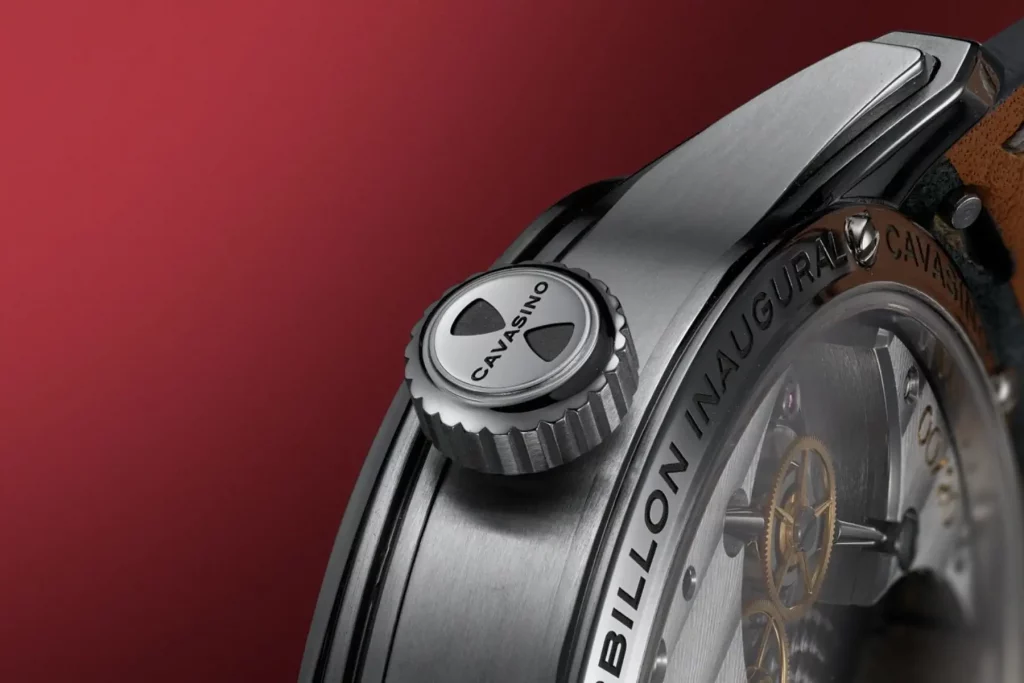
The crown also deserves attention. It features the Cavasino logo with its two triangles forming an hourglass, and I found this reference particularly well integrated. Once again, this is not a gratuitous detail. The crown has very good grip, it is neither too large nor too small, and it offers a genuinely pleasant winding experience. You can feel that it was designed seriously, down to its texture and its relationship with the rest of the case. To me, this is exactly the kind of small detail that shows a watch has been thought through down to the smallest element, without leaving any neutral or generic area.
The screwed and engraved caseback, water-resistant to 30 metres, completes the whole with coherence. And even though we are dealing here with a case that is technically very accomplished, it always remains elegant. That is probably what I like most about this construction: it succeeds in combining a taste for well-built mechanics, a real level of execution, and a constant desire to keep the watch wearable, balanced and refined. In this case, one can feel both Didier Cavasino’s engineering background and his wish to offer a piece rooted in classical codes, yet reinterpreted through a clearly contemporary eye.
Finally, the fact that it was manufactured by Voutilainen & Cattin can of course be mentioned factually, as it adds an obvious layer of credibility to the quality of execution. But what seems most important to me here is that this case does not rely on a name or on the simple prestige of a subcontractor. It relies above all on the rightness of its design.
In the end, I find this case particularly successful. It is highly technical, but never cold. Very elegant, but never visually fragile. Very worked-out, but never falling into gratuitous demonstration. And it is precisely this control of the balance between constructional sophistication, wrist comfort and discreet refinement that makes it, in my view, one of the major strengths of the Tourbillon FT60-S.
Dial
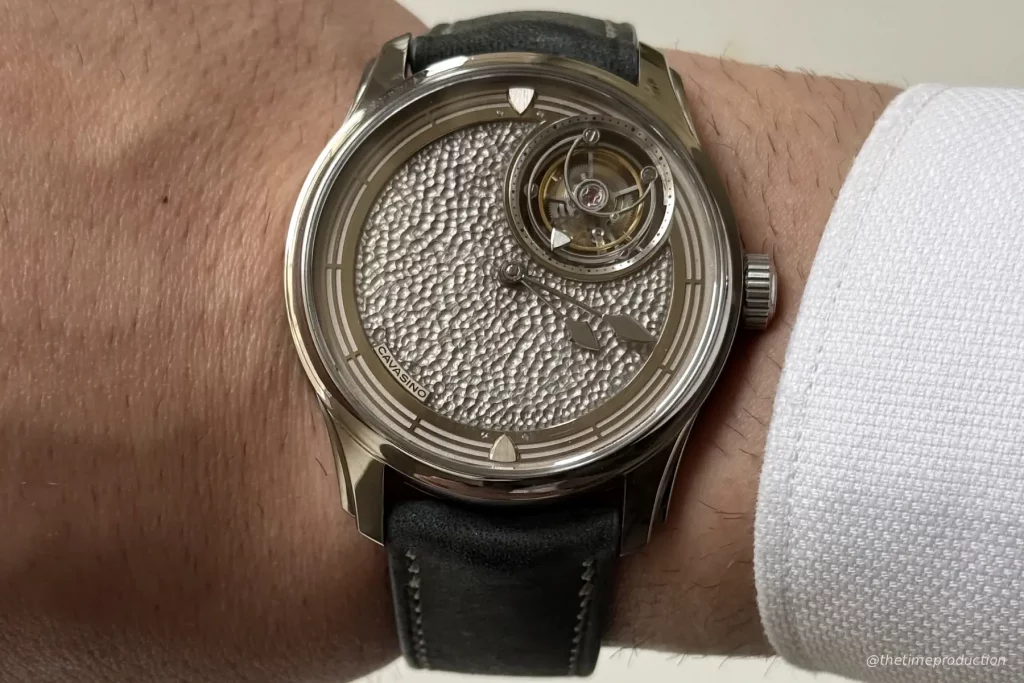
The dial of the Cavasino Tourbillon FT60-S is, in my eyes, one of the most fascinating elements of the watch, precisely because it first gives an impression of near-monochrome restraint before revealing a level of complexity, contrast and craftsmanship far beyond what one initially imagines. What struck me first was very clearly the effect of the translucent enamel on the central section, but also the unconventional positioning of the tourbillon. The latter is not placed there in an arbitrary or decorative way. It immediately contributes to the visual identity of the piece, and one quickly understands that its position also responds to a deeper mechanical logic, particularly in the search for symmetry within the movement.
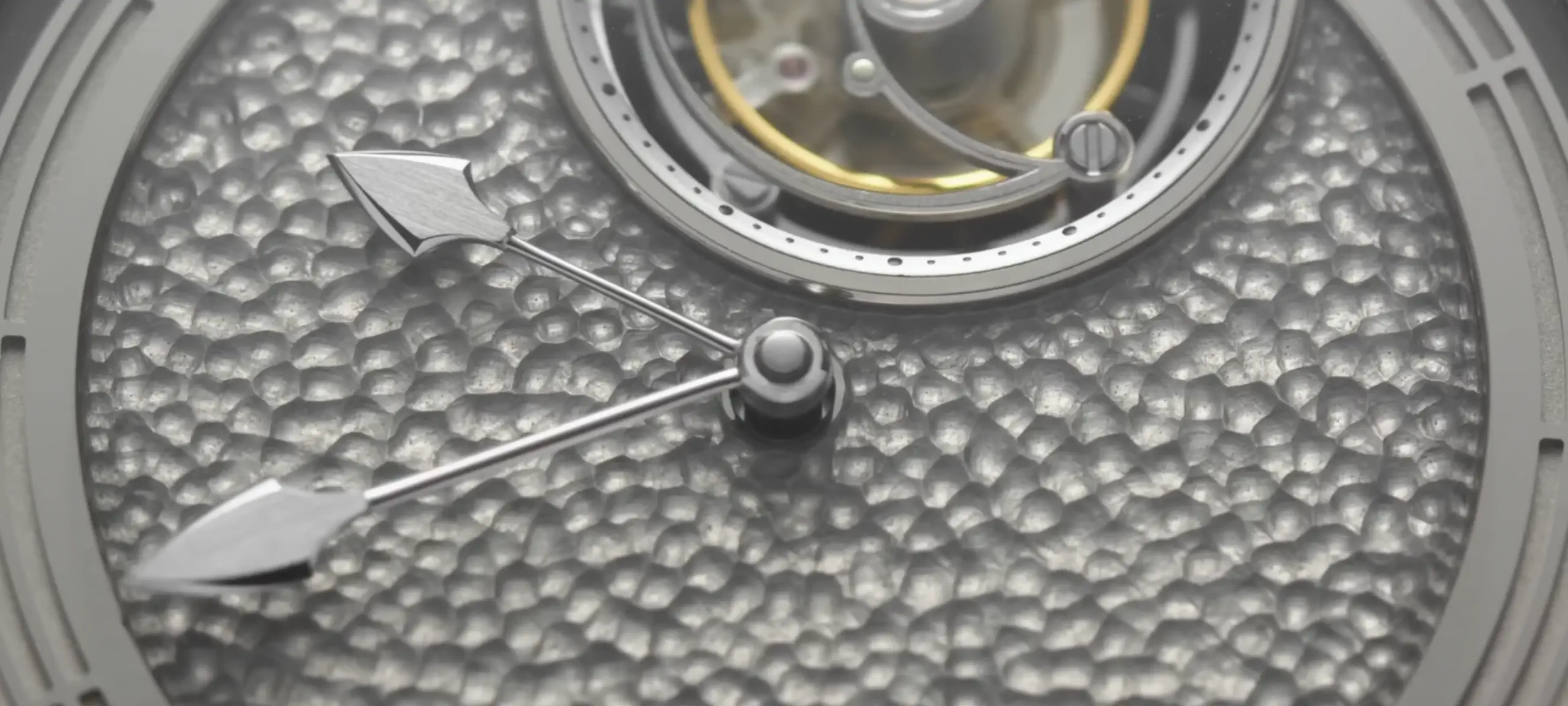
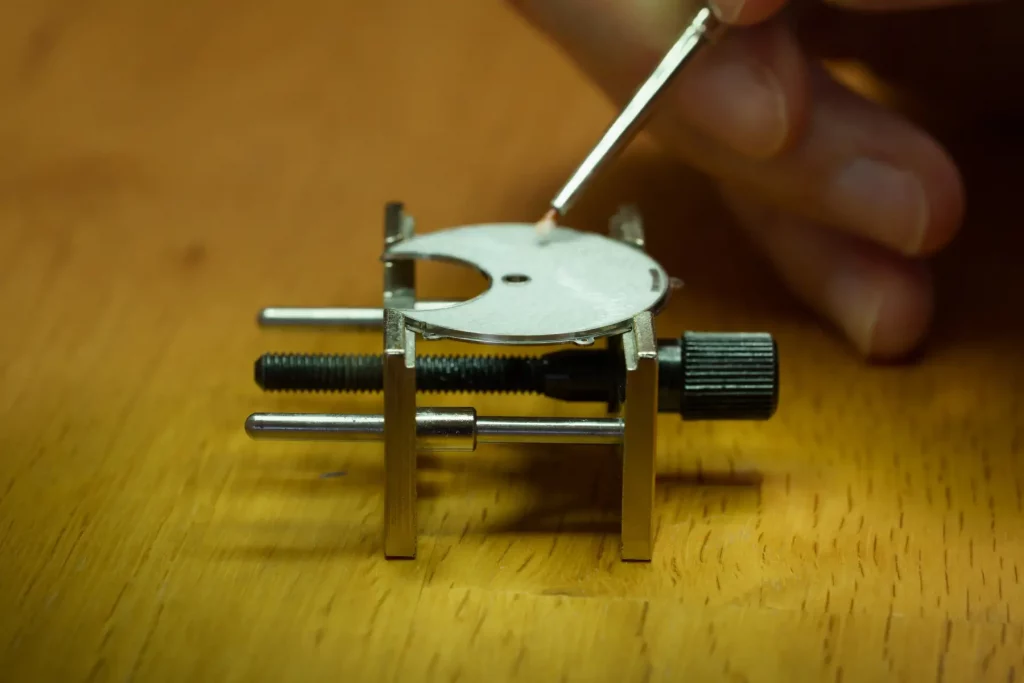
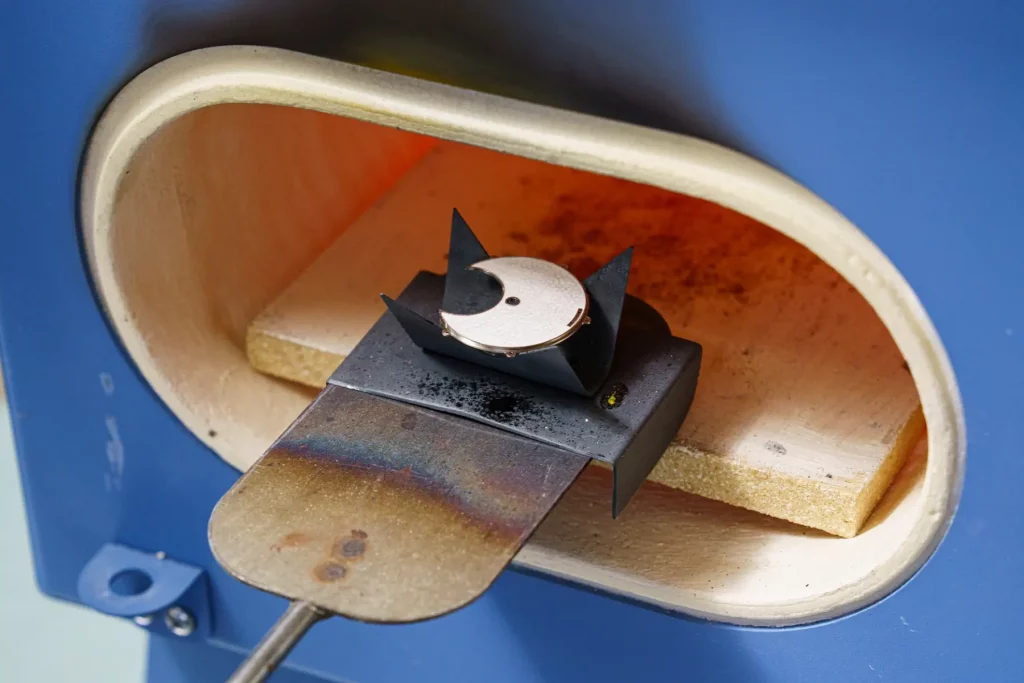
This dial is made of solid gold, and that matters enormously in the way it is perceived. We are not dealing here with a simply decorated surface, but with a small sculptural architecture. The central area, which at first glance could evoke a traditional hammered finish or a form of tremblage, is in reality produced through a very particular technique. The texture is created manually using a rotating electric tool applied to the dial surface at a precise angle, in order to obtain those bright reliefs and that very lively texture. This textured base is then covered with coloured translucent enamel and fired. So we are in the realm of flinqué enamel, where light passes through the enamel layer to reveal the full richness of the worked metal beneath.
And visually, it works remarkably well. What I loved here is precisely the depth that this enamel brings to the surface. It gives the dial real density and real vibration, without ever making it excessive. It also creates a very beautiful separation between the different dial zones. The chapter ring, the tourbillon opening, the seconds indication, all of these elements seem better defined and better organised because the central section gives them a living but structured background. To me, that is exactly what creates the harmony of the dial: a strong material expression, but one that remains in the service of a very clear overall reading.
One of the most interesting aspects here is also the use of materials and shades. Didier Cavasino himself explains that he wanted to work with three different materials, titanium, gold and steel, in order to obtain three distinct shades of grey. And that is immediately perceptible when you observe the watch up close. One might think this is an almost monochrome watch, but in reality the entire dial is built around a very fine play of contrasts between surfaces, textures, reflections and materials. That is precisely what gives it so much richness without resorting to strong colours. The project is extremely controlled: creating contrast without rupture, depth without demonstrative effect, variety without losing unity.
The rehaut and outer ring also play an essential role in that balance. This black-polished 18k white gold ring, combined with a sandblasted surface, frames the dial very powerfully. It structures the whole visually, accentuates the contrast, and acts almost like a clear boundary between the textured central area and the rest of the display. It is not a simple decorative or functional element. It fully participates in the architecture of the dial and in the way the eye moves through its different zones.
The indexes at 12 and 6 o’clock also deserve to be highlighted. They discreetly echo the Cavasino logo, but in a subtle enough way that it does not jump out immediately. It is exactly the sort of identity detail that you discover gradually, and that greatly reinforces the coherence of the project. Once you see it, you understand more clearly how the logo, the indexes, the hands and even certain lines of the case speak to one another. This is not a forced repetition of brand identity. It is a very elegant way of weaving connections between the different elements of the watch.
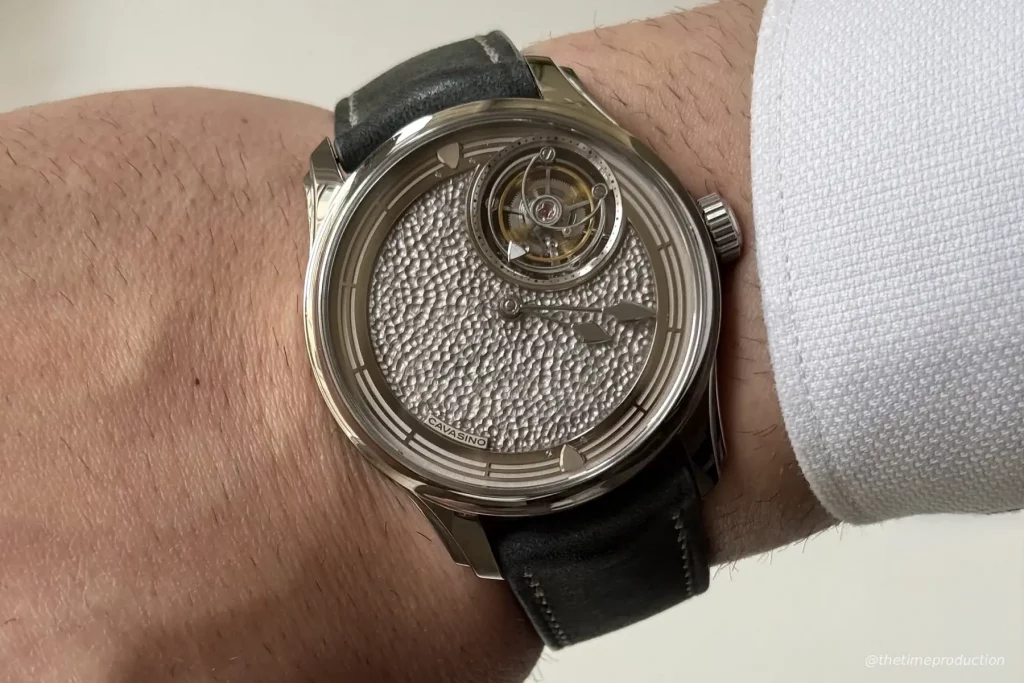
The hands themselves are a very important part of the success of this dial, even if I believe they should be treated here as an integrated part of the whole rather than as a separate chapter. They are made of stainless steel, in two parts, and their level of finishing is impressive. Each hand begins with highly precise machining in order to obtain a perfect geometry for the artisan’s work. Then come more than seventeen hours of manual work: chiselled bevels, mirror-polished angles, satin-finished tips, pearled undersides, not to mention the so-called moving bevel that gives their triangular ends a very distinctive presence. And it shows. The hands are highly coherent with the logo, with the indexes and with the overall spirit of the dial. They are not just beautiful. They are part of the visual grammar of the watch.
The pearlage under the hands is exactly the kind of detail that will speak immediately to the most demanding collectors. It is a finish that remains invisible in everyday use, but says a great deal about the project’s level of commitment. In the same way, the possibility of requesting flame-blued hands, in either traditional blue or deep purple, makes it clear that nothing has been left to chance and that we are here within a true logic of very high artisanal execution.
The integration of the flying tourbillon into the dial is also particularly successful. First through its position, which steps away from the most conventional layouts. Then through the quality of the cage itself, which clearly stands apart from the more standardised tourbillon cages one may find elsewhere. Here, one can feel that this is a proprietary component, designed for Cavasino and not something that will be found on other watches. Its large diameter gives it real presence, and the concave opening surrounding it lets light in in a very intelligent way. That makes it more legible, more alive, and reinforces its integration into the dial as a whole. The seconds indicator, made as one piece with the cage, also contributes to the feeling that the tourbillon is not merely there to be seen, but that it takes full part in the reading and in the overall architecture of the watch.
In the end, what I find particularly strong in this dial is that it succeeds in bringing together three things that do not always coexist this well: architecture, contrast and craftsmanship. Architecture, because everything is very thought out, very structured, very coherent. Contrast, because the watch constantly plays with very fine nuances between materials, tones and surfaces. Craftsmanship, finally, because behind each element you can feel the hand, the time, the gesture and the care. And that is precisely what makes this dial so successful in my view: beneath a relatively sober, almost restrained appearance, it reveals in reality an immense amount of work and true horological depth.
Movement
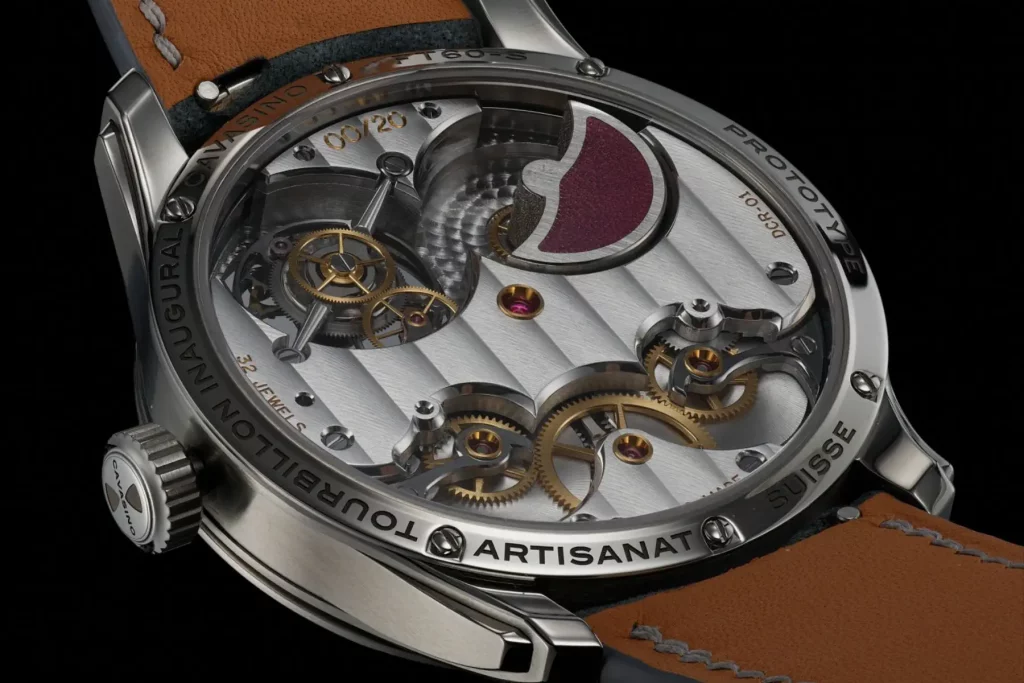
The movement of the Cavasino Tourbillon FT60-S is, in my eyes, one of the most impressive aspects of the watch, and probably also the one that allows the clearest understanding of Didier Cavasino’s intention. What struck me first, very frankly, was the symmetrical architecture of the whole. That is the first thing you read. Then immediately come the hammered and enamelled micro-rotor, the overall visual purity, and finally this level of finishing that makes you want to linger over every detail. For a first watch, it is extremely thoughtful. You can feel that nothing was placed there by chance, and that every choice was made in order to build a movement that is at once highly legible, highly harmonious and highly personal.
This automatic calibre DCR-01 is built precisely around a rigorously symmetrical construction, both vertically and horizontally. And that is immediately visible. All the main axes form an almost perfect square, which gives the movement a very strong harmony from the first glance. But what is especially successful here is that this symmetry is not merely an aesthetic exercise. It also makes the movement much more intuitive to read. The four major functional circles appear almost immediately, almost as an obvious fact. And in a world where some complicated movements can sometimes feel visually confusing, I find that extremely welcome. Here, on the contrary, the mechanics remain legible, structured, almost playful to observe. And that corresponds very well, I think, to Didier’s obsession with well-built mechanics and with a certain form of architectural clarity.
These four functional circles deserve to be explained, because they are at the heart of the DCR-01’s identity. The first is the solid gold micro-rotor, responsible for automatic winding. The next two correspond to the twin barrels, which ensure a stable and regular flow of energy. Finally, the fourth circle is that of the complication itself, the flying tourbillon. From there, the entire movement is organised around this geometric logic. And what is very strong here is that this construction never gives an impression of rigidity. On the contrary, it creates a feeling of order, balance and visual fluidity.
The solid gold micro-rotor is one of the elements that surprised me the most in real life. In photographs, one already senses that it is worked, but once face to face with the watch, one understands much better the level of care that went into it. What marked me most was its hand engraving, but also the translucent cherry-purple enamel that enriches the hammered surface. The contrast between the nobility of the material, the texture of the manual work and the depth of that translucent shade works very well. And once again, there is a real coherence with the dial. The micro-rotor does not seem decorated for its own sake. It speaks to the rest of the watch. The fact that it is screwed from underneath in order to preserve the purity of the decoration is also a very important detail. You see very few screws on the movement side, and that contributes enormously to this feeling of visual purity that I find particularly successful.
The choice of a 4 Hz tourbillon is also very important to the identity of this movement. Didier did not want to create a “classic” movement in the traditional sense of the term. He wanted something modern, reliable and technically coherent. And that 4 Hz frequency fully contributes to that reading. It is not just a specification-sheet figure. It is a true positioning marker. It says that the movement also looks toward a certain form of modernity, even if it remains deeply rooted in the great codes of hand-finished haute horlogerie.
The bridges play a major role in this success. What marked me most, personally, was first the way the screws are hidden. That is a detail that changes the perception of the movement enormously, because it immediately reinforces its purity. You do not get the feeling of looking at a juxtaposition of technical components. You see an architecture. The three large bridges structure the whole very powerfully, and their very sharp angles bring a visual tension that avoids any softness in the design. To that are added the black-polished steel bridges, the curved and bevelled tourbillon bridge, and the large bridge crossing the movement with very strong presence. All of this gives the DCR-01 a very contemporary character in the way it is read, while remaining faithful to very traditional finishing codes.
And precisely, the finishing here is at a particularly high level. To me, everything deserves to be highlighted, because everything matters. The extra-wide Côtes de Genève, the hand-executed anglage, the circular pearlage applied with precision, the deep gold chatons, the wheel finishing prepared with a file and satin-finished chamfers, not to mention the work on the micro-rotor with its hammering, enamel and engraving. All of this creates an ensemble of great richness, without ever giving the impression of decorative excess. And what strikes me as especially strong is that even the hidden components, such as the undersides of the bridges, also receive careful finishing. To me, that is a very strong sign. It says something about the respect shown to watchmaking, to the artisans who assemble the movement, and more broadly to the object itself.
The power reserve, announced at around 70 hours, also seems very coherent to me with the general philosophy of the calibre. You can feel a movement thought through globally, where nothing is isolated from the rest. Nothing seems to have been added merely to impress. Everything fits within an overall logic, and that is precisely what I appreciate here.
If I had to summarise what a collector should retain first and foremost from this movement, I would say four things. First its symmetry, which immediately gives it a very strong identity. Then its visual purity, reinforced notably by the bridge work and by the hidden screws. Then its level of finishing, which is frankly impressive. And finally this 4 Hz choice, which gives the whole a more contemporary reading without ever betraying the great traditional codes.
In the end, the DCR-01 seems to me to achieve something very difficult. It is at once highly contemporary in its construction and highly traditional in its execution. It does not try to look old, but neither does it try to break the codes artificially. It takes the foundations of Swiss haute horlogerie, reinterprets them with rigour, and puts them in the service of a very personal language. And that is precisely why I find it so strong. Beneath this apparent architectural obviousness there is in reality an immense amount of work in design, visual hierarchy and finishing. To me, the three words that define it best are very simple: symmetry, purity and finishing.
Strap
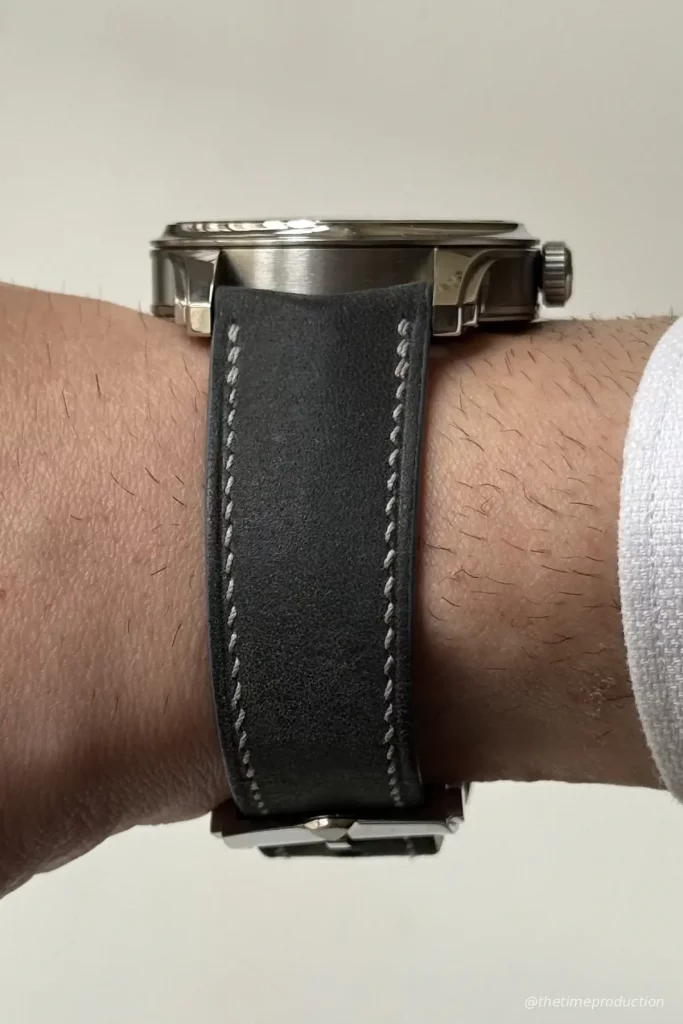
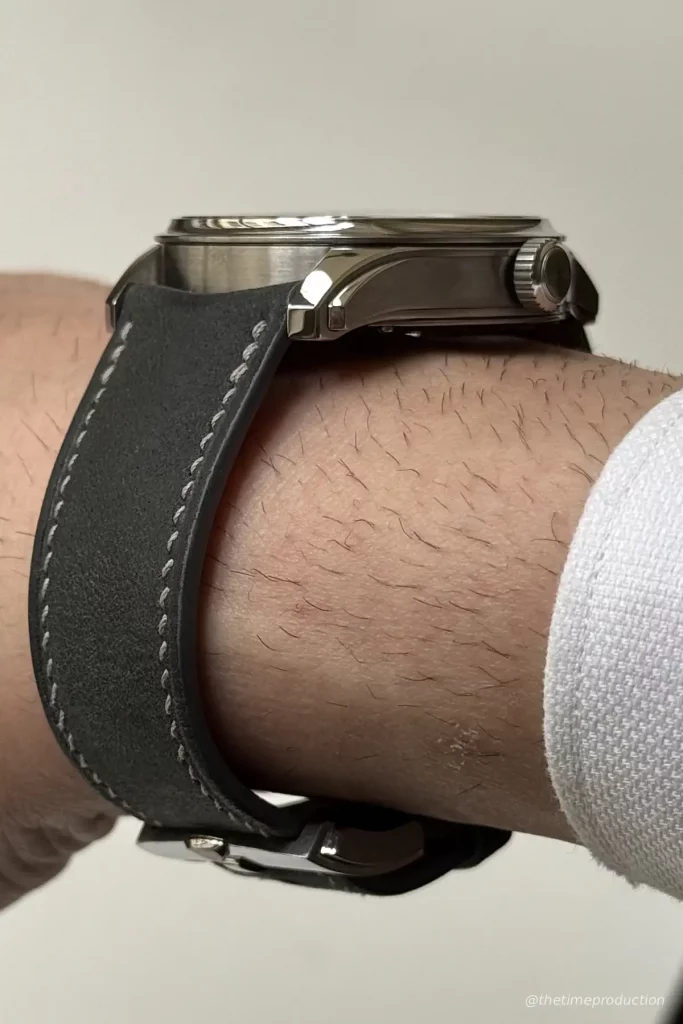
The Tourbillon FT60-S is delivered with a soft grey nubuck strap, a choice that I find particularly well judged within the overall balance of the watch. Didier Cavasino explains that he selected it in order to highlight what he considers the main part of the piece, namely the case, and I think that works very well. This shade remains discreet and elegant, and perfectly accompanies the almost monochrome approach of the watch without disturbing the subtle play of materials and grey nuances already present between the titanium, the gold and the steel.
This strap is made from genuine nubuck, chosen for its velvety touch and natural elegance. It is produced in the same workshop that also makes straps for Akrivia, which of course adds an extra layer of credibility to this part of the project. Each strap is cut, shaped and hand-stitched with saddle stitching, in keeping with the same logic of patient, bespoke work that is found throughout the rest of the watch. And that is immediately felt on the wrist. I found it particularly comfortable, soft on the wrist, but also very high quality in both presence and feel.
I also liked the stitching a great deal, as it seems to lean towards a linen tone. It is a fairly discreet visual detail, but one that works very well with the watch as a whole. It adds just the right amount of contrast and texture without breaking the overall elegance.
The buckle also deserves to be highlighted. What I found very successful is that it echoes the design of the case lugs, which creates a very beautiful visual reminder. It is the sort of detail one might almost fail to notice at first glance, but it greatly reinforces the overall coherence. At the centre, one finds the triangle of the logo, with what seems to be a vertically satin-finished surface, while the rest of the visible face appears polished. Once again, you can feel that nothing has been left to chance.
In the end, this strap does exactly what one expects of it. It is comfortable, very well executed, perfectly coherent with the aesthetic of the FT60-S, and sufficiently high quality to naturally extend the level of exacting attention found in the case, the dial and the movement.
What is the price of the Cavasino Tourbillon FT60-S?
The version I was able to discover and photograph corresponds to the initial titanium subscription edition, a limited series of 20 pieces that is now entirely sold out and was originally offered at 77,000 CHF. And, very frankly, considering the level of execution, the quality of the tourbillon, the movement architecture and the care devoted to every detail, I find that positioning particularly honest. I had even expected the watch to be priced higher.
Since then, the project has naturally evolved with several additional editions built around the same DCR-01 calibre. Didier Cavasino has planned a total production of just 50 movements: 20 pieces in titanium for the original subscription series, 12 in platinum, 8 in rose gold, 5 in stainless steel and 5 additional stainless steel pieces forming a special undisclosed series. Once these fifty movements have been completed, production of the DCR-01 will come to an end.
The market seems to have immediately understood the strength of the project. Most of the production has already been allocated. The titanium and platinum editions are now sold out, while only a limited number of the remaining versions are still available.
Cavasino Tourbillon FT60-S: a first creation that already feels remarkably complete, driven by a clear and deeply human vision
With the Tourbillon FT60-S, Didier Cavasino offers, in my view, far more than just an ambitious first independent watch. He offers a piece that already feels strikingly mature, supported by a clear vision, real overall coherence, and a level of exacting care that can be felt in every detail. What stands out to me here is precisely that the project never feels rushed, nor does it feel like a brand launched too early. On the contrary, one gets the impression that Didier waited for the right moment, the point at which everything was sufficiently mature in his mind, in his experience and within his network of expertise, to bring to life a watch capable of carrying a strong identity from the outset.
And that is probably, at heart, the great strength of the Cavasino project today: the clarity of its vision. You can feel that nothing has been improvised. The case, the dial, the movement, the finishing, the proportions, the use of contrast, the placement of the tourbillon, everything seems to have been thought through with a real hierarchy of priorities. The FT60-S never gives the impression of trying to show everything at once. It does not seek to pile on effects. It seeks instead to build coherence. And that is precisely what, in my eyes, already makes it so convincing as a first creation.
What I also like very much about this project is that it does not rest on marketing fiction, but on a real journey. Didier Cavasino is not a watchmaker in the strict sense of the term, and he does not hide that. But that is exactly where the project becomes interesting. He comes from another world, that of mechanics, engineering, performance and industry, before having spent many years at the heart of Swiss watchmaking with Rolex and then Bulgari. And instead of trying to play a role that was never truly his, he chose to build his project from who he actually is: someone capable of having a vision, of deeply understanding the technical, aesthetic and industrial stakes of a watch, and above all of bringing together the right people around him to bring that vision to life at the highest level.
This is where the human dimension of the project seems essential to me. Behind Cavasino, there is not simply an accumulation of expertise. There is a real ecosystem of women and men, around fifteen crafts and roughly twenty artisans, with whom Didier already shares, in many cases, a genuine history of work and trust. And you can feel it. This does not feel like a project assembled opportunistically by going out to find “the best” in an abstract sense. On the contrary, it feels like a project built around solid human relationships, a shared language and a shared standard of excellence. And that is probably also what gives the FT60-S this sense of unity: the watch is not just well executed, it feels deeply aligned in the way it was conceived and made.
The FT60-S is obviously aimed at a collector who is already well acquainted with independent haute horlogerie, with hand finishing, with the architectural coherence of a movement, and with the strength of a project that is still young but already highly structured. But what feels especially encouraging to me is that beyond the watch itself, one can already sense in Didier a real brand ambition. Not a superficial ambition, nor a desire to move too quickly. Rather, a long-term vision, thought through, controlled, almost methodical. And I think that is a very important point when it comes to inspiring confidence. You can feel that he knows where he wants to go, how he wants to get there, with whom, and above all at what pace.
That is also why the next phase of the project seems particularly interesting to me. Cavasino does not seem willing to remain frozen in a single expression of its identity. And that strikes me as very healthy. August 25 will mark a new step, with the announcement of a new release that, without betraying the house’s DNA, should offer a more contemporary interpretation of it, more technical in its perception, with a different energy. I think that is very well judged. A young independent brand must not only succeed with its first gesture. It must also show that it is capable of evolving its language without losing its line. And from that point of view, Cavasino already gives the impression of entering a new phase in its development.
At the end of the day, that is perhaps what I take away most from this encounter and from this watch. The FT60-S is a very good starting point, but above all it is a credible one. A first creation that does not try to make you forget that it is the first, but that already shows a level of maturity, coherence and identity strong enough to make you want to follow what comes next very closely. And in an independent landscape where many projects emerge, that is not so common.
I would also like to thank Didier, with whom I have been in contact since last year, first remotely, then in person after several conversations, notably around Watches and Wonders. He is someone I have truly enjoyed speaking with, both for his clarity, his sincerity and the very composed way in which he approaches his project. I obviously wish him great success going forward, because this first launch seems to me to establish particularly solid foundations.
Cavasino Tourbillon FT60-S – Watch Specifications
- Brand: Didier Cavasino
- Model: Tourbillon FT60-S
- Case Material: Grade 5 Titanium
- Dial: Solid Gold
- Functions: Hours, Minutes, 60-second tourbillon
- Movement: DCR-01, Self-Winding, 28,800vph frequency (4Hz)
- Power Reserve: 70 Hours
- Water Resistance: 3 ATM
- Crystal: Sapphire
- Case Back: Sapphire
- Case Dimension: 38,7mm (Diameter) x 10,4mm
- Design: Didier Cavasino / Eloise Richet
- Strap: Leather with Grade 5 Titanium Pin Buckle
- Availability : Limited to a total of 50 DCR-01 movements
- Retail Price: Titanium (20-piece subscription series): CHF 77,000 – SOLD OUT ; Platinum (12 pieces): CHF 95,000 – SOLD OUT ; Rose Gold (8 pieces): CHF 95,000 ; Stainless Steel (5 pieces): CHF 88,500 ; Stainless Steel Special Series (5 pieces)
What about you, do you see Didier Cavasino as a new name worth following closely in contemporary independent watchmaking?
If this article added value or sparked a discovery, you can support the project HERE. Your contribution helps me keep weekly articles and a biweekly newsletter free, accessible, and independent for everyone.
For more information about Didier Cavasino, click here.