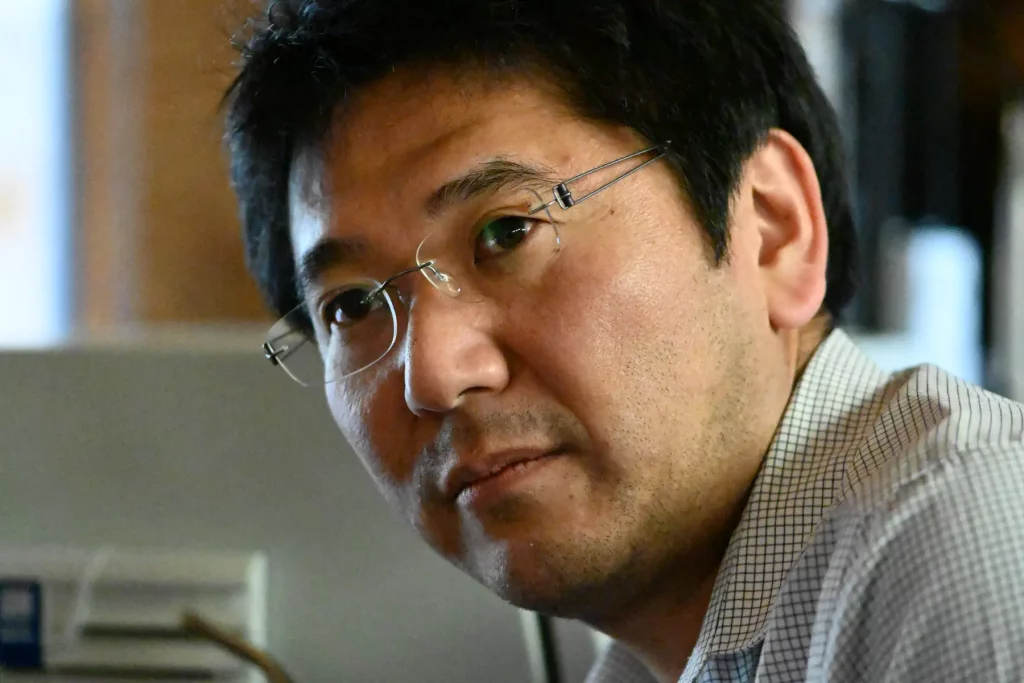
Today, I would like to talk about an independent watchmaker whose journey alone deserves careful attention. If I say a Japanese watchmaker based in Le Locle, a path marked by obstacles between Japan, France and Switzerland, and a first watch conceived as the late flowering of a project matured over many years, the more attentive among you may already have recognised Yosuke Sekiguchi and his Primevère. Before presenting this watch in more detail, let me first go back to the man behind the project, the path that led him to independent watchmaking, the way his vocation was built against the grain, and what gives this first creation such particular depth today.
What strikes one first about Yosuke Sekiguchi is that almost nothing seemed to point him towards an easy trajectory. Born in 1980 in Isesaki, in Gunma Prefecture, around one hundred kilometres north of Tokyo, he grew up mostly in the countryside, in an environment entirely unrelated to watchmaking. His grandparents were farmers, his father worked in banking, and the family moved several times over the years because of his father’s career. He has a brother and a sister, both very sporty and very outward-looking, whereas he describes himself more as a solitary child, preferring to read, study, stay in his room, and cultivate a quiet attentiveness to the world. Very early on, he also developed a taste for old objects, antiques, model making, and later music, especially the tuba, which would occupy an important place in his youth. There is already something in that set of interests that says a great deal about his personality: an attraction to forms, to materials, to patient construction, to things that require time, precision, and a certain quality of attention.
His first encounter with watchmaking, however, was neither theoretical nor institutional. It came at the age of sixteen, almost by chance, when a childhood friend offered him an old broken Japanese clock that had belonged to his deceased grandparents. The family was sorting through the house and was about to throw it away. His friend knew that Yosuke liked antiques, so he gave it to him. The object was fairly large, with no obvious value, but something happened immediately. He began taking it apart to understand how it worked, carried out numerous attempts, searched for the source of the fault, and eventually succeeded in repairing it. That moment seems to have been foundational. As soon as he opened the dial and discovered the movement, he fell in love with that universe. Not necessarily because it was a horological masterpiece, but because he suddenly saw in it a language. The language of small steel parts, shining brass, mechanisms living together, and a technical beauty capable of provoking immediate emotion. That is where his passion was born.
From that moment on, Yosuke Sekiguchi knew he wanted to become a watchmaker. But that conviction immediately ran into a very different family reality. His father wanted him to become a banker, just like him. The path seemed completely mapped out. Suit, tie, higher education, stability. Watchmaking had no place in that framework. When Yosuke first raised the idea of entering watchmaking school, the answer was clear: no. His father first insisted that he complete higher education, with the promise that if he finished his studies properly, he would then support his project. Yosuke complied. Not out of resignation, but because he understood he would have to go through that stage. Poor at mathematics, by his own account, and not comfortable with calculation-based subjects, he turned instead to French literature. He studied at an institute of ancient and modern languages in Tokyo, already with one very clear idea in mind: if he wanted one day to join Swiss watchmaking, he had to truly learn French.
That choice was far from anecdotal. More than a detour, it already constituted a concrete first preparation for his departure. While many of his peers moved towards more conventional careers, he kept in mind this almost crazy project: leaving Japan, learning the language, reaching France and then Switzerland, and finding a place in an industry to which nothing officially yet tied him. At the end of his studies, he even went through the expected process to the end. He applied to a major Japanese bank, passed several stages of recruitment, reached the final interview, and then realised definitively that he did not want that life. He abandoned that path. During his studies, he also gave Japanese lessons, which allowed him to save money to finance his future departure. At that point, the break was complete.
In 2004, at the age of twenty-three, he left Japan alone for France. He first settled in Annecy in order to properly learn spoken French, very different from the more academic French he had studied at university. For six months, he took language classes and already, in his free time, began writing to various manufactures and visiting workshops in Switzerland. He contacted Vacheron Constantin and Audemars Piguet among others. He wanted to understand, to meet people, to see up close the profession he wanted to join. Very quickly, however, he came up against a series of administrative difficulties. He was told he was too old for certain programmes. He was advised to turn towards Besançon, then Morteau. He returned temporarily to Japan to renew his visa, came back to France, moved to Besançon, continued his language studies, bought a small Volkswagen so he could travel around and meet watchmakers. The path was anything but linear.
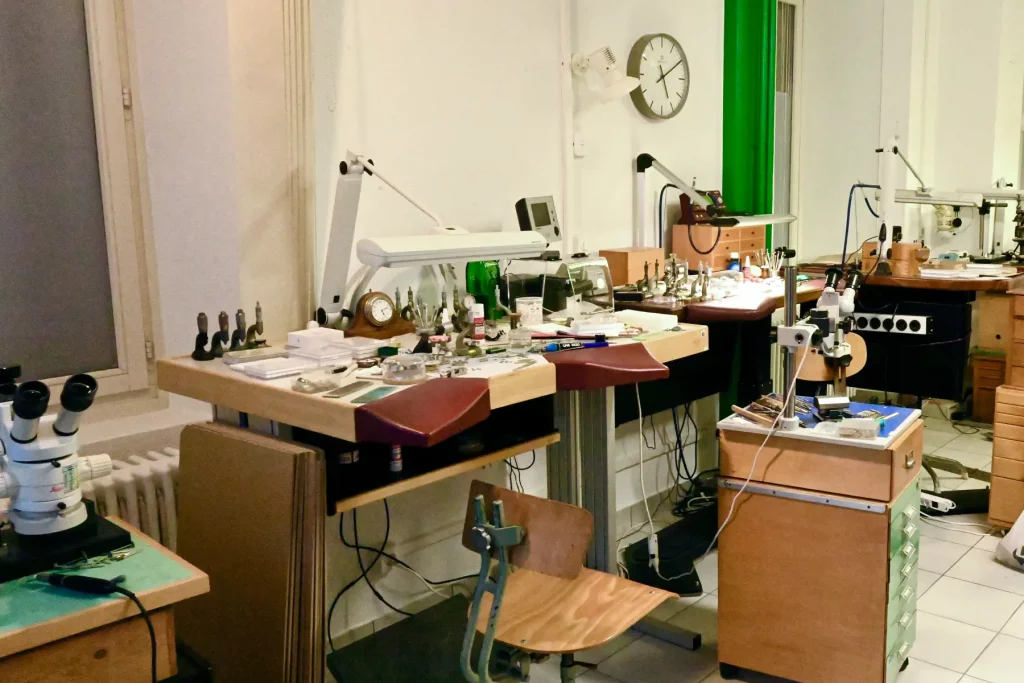
What followed almost looked like a succession of obstacles that he methodically refused to treat as dead ends. In 2006, he passed the entrance examination for a watchmaking programme in Morteau. Three weeks later, he was told that he would ultimately not be allowed to officially follow it because of his visa status. Where many people would have given up, he continued in another way. He remained for a year and a half with one of the school’s teachers with the goal of preparing the CAP watchmaking diploma as an independent candidate. That teacher then ran into serious health problems, and it was largely the students themselves who helped him continue his training. In the end, after a year and a half of work, he obtained his CAP as an independent candidate. That detail is essential because it says everything about one particular way of building oneself: without comfort, without a truly secure institutional path, but with remarkable tenacity.
His first real gateway into Swiss watchmaking came almost through another of his own recurring threads: music. He played in a local orchestra, where he met a watchmaker from La Joux-Perret. That man offered him a job. Yosuke began working there in September 2007. But once again, nothing happened simply. A few weeks after his arrival, his Swiss visa application was refused. His French visa expired shortly afterwards, and he had to leave France in December 2007. Before departing, however, he went back to La Joux-Perret to explain his entire journey, his difficulties, and also to show them his personal creations. Because alongside his training, he was already developing his own horological work at home. The company then agreed to support a new application. He returned to Japan while waiting for the decision, and finally received a positive answer in March 2008. He was then able to join Switzerland definitively and enter La Joux-Perret.
From 2008 to 2011, he worked at La Joux-Perret, and not on minor tasks. He began directly on the assembly and adjustment of a split-seconds chronograph with foudroyante, then progressed to working on tourbillon cages. At the same time, he built his own workbench at home and continued to work every evening after his main job. That intensity says a great deal about his relationship with watchmaking: for him, it is not simply a profession, it is a vocation. He also observed that this mindset was not always shared around him. Where some people strictly separate professional life from personal life, he was already devoting all of his free time to deepening his practice.
The next stage of his career further strengthened his credibility. After La Joux-Perret, he joined Christophe Claret in 2011, a house known for highly complicated movements. He stayed there for five years. The experience was technically extremely formative. He worked there on very high-complexity pieces, in an environment where mechanical demands were extreme. Later, he joined Julien Vallon as a repair watchmaker, and this is where another turning point occurred. Julien Vallon played a decisive role by encouraging him to finally launch his own activity. He explained to him that he now had the skills, the network, and the contacts required. In the meantime, Yosuke Sekiguchi had also restored many antique watches, developed a very fine knowledge of historical calibres, and built up an impressive collection of old movements. All that culture of restoration, dismantling, observation and handwork would naturally feed into his own project.
That is precisely what makes his approach so interesting today. Yosuke Sekiguchi did not arrive in independent watchmaking with an abstract idea or with a brand strategy built from a storytelling exercise. He arrived there after years of learning, restoration, complications, antique watches, repeated gestures, and accumulated culture. His vision of watchmaking is not one of major complications for their own sake. It is one of handwork, without cheating. One of an art form in which theory matters, of course, but in which intuition, sensibility and the hand play a fundamental role. He himself readily compares watchmaking to music or drawing: the first line on a blank page, the first note in a score, the first contact of the graver with rotating steel on the lathe all belong, in his eyes, to the same impulse.
It was in this context that he founded his own brand in 2020. And it was in 2021 that he presented his first model, Primevère. The name is beautiful, and very apt. It refers to the primrose, that flower which blooms early, when the snow melts, announcing the return of life. Etymologically derived from prima rosa, the “first rose”, it carries the idea of beginning, of first flowering, of patient blossoming. For a first independent watch, the symbol is particularly strong. All the more so because the name seems to echo something deeply personal in him, almost organic. Primevère is not only a first model in the chronological sense. It is the slow culmination of an old vocation, planted very early, frustrated many times, and ultimately brought to maturity.
And that is precisely what makes this first creation so interesting even before examining it in detail. Primevère was not born from a passing trend, nor from an opportunistic desire to join the independent scene. It is the fruit of a profoundly human journey, exceptional determination, deep immersion in Swiss watchmaking, and a culture of the hand nourished by antique watches, music, antiques, and handcraft. In other words, it already carries far more within it than a first watch: it carries a trajectory. Now it is time to look at it in detail.
Table of Contents – Yosuke Sekiguchi Primevère
What are the key features of the Yosuke Sekiguchi Primevère?
Case
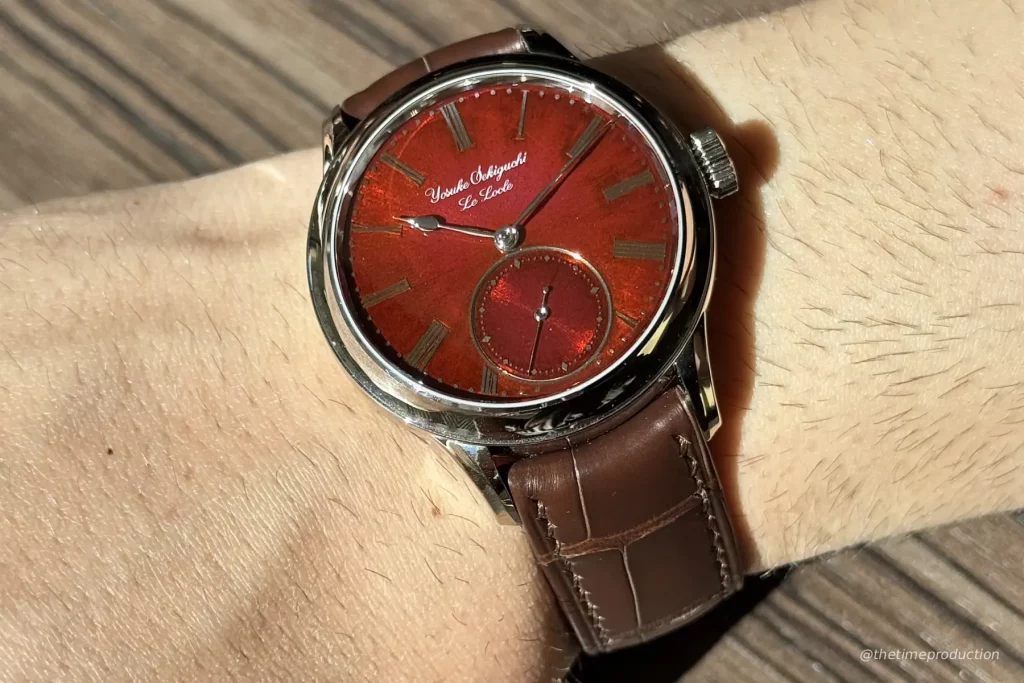
What struck me first about this Primevère was undoubtedly the overall sense of classicism it gives off immediately on the wrist. You instantly feel that you are looking at a watch conceived by someone with a deep understanding of antique timepieces, of how they occupy space, of their proportions, their curves and their presence. At 39.5 mm in diameter and 12 mm thick, it has real substance while remaining very well balanced. The watch has genuine presence without ever feeling bulky, and the whole thing works very well on the wrist.
In the case of the model I tried, it was a white gold version, and that metal reinforces precisely this impression of discreet nobility. The case plays beautifully with the light thanks to its fully polished surfaces, and that gives it real visual life. This is not a demonstrative case in the modern sense of the term, but it is a case that catches the eye through the quality of its lines, the softness of its volumes, and the very subtle way it reflects light depending on the angle.
The construction itself is very beautiful. We find a highly traditional three-part architecture, with a subtly concave bezel, a rounded caseband and a flatter back. The domed sapphire crystal integrates very naturally into the bezel, almost to the point of extending its curve, which gives the case a great deal of fluidity. All of this contributes to a very coherent and harmonious silhouette in which nothing feels forced.
I also really liked the soldered lugs. They fully belong to this historical inspiration, but without ever giving the impression of a nostalgic exercise. They are elegant, well proportioned, and above all very well worked on the sides. The fact that they are slightly faceted adds extra relief and reflection in the light. It is not a hard angle or a sharply marked break, but rather a way of adding an extra nuance to the perception of the case. And I find that particularly successful, because it brings even more sophistication to the whole without harming its purity.
The crown also deserves attention. Its grip is very good, but what interested me most was the level of attention given to its design. It is fluted not only on its functional part, but also on its end, where one finds the initial “Y” at the centre, surrounded by an almost radiant decoration. That may seem secondary, but this kind of detail changes a lot in the overall perception of the piece. You can feel a desire here to go very far in the execution, even in an element that many brands would treat in a far more standard way. And the fact that this crown is based on a construction designed to allow particularly advanced hand polishing makes the detail even more interesting.
What I also appreciate in this case is that it feels completely coherent with the identity of Primevère and with Yosuke Sekiguchi’s project as a whole. One finds an obvious historical inspiration, a real softness in the lines, a traditional elegance, but above all a very strong impression that it was drawn by someone who has spent a long time observing watches of the past. That is immediately apparent. The case is very traditional in spirit, but it is never frozen. It is not there to replay the past. It interprets it with a great deal of sensitivity.
It is also worth emphasising that while Yosuke Sekiguchi designed this case himself, its production was entrusted to Stila SA in La Chaux-de-Fonds. That point is interesting because it shows clearly that Primevère is also part of a network of strong human collaborations. This is not simply a matter of cold outsourcing. Behind this case there are relationships, affinities, trust, and a real coherence among the people involved in the project. And that gives even more meaning to the whole.
In the end, I find this case particularly successful. It expresses a very controlled classicism, a genuine culture of antique watches, and a presence on the wrist that remains elegant without ever becoming rigid. It is a case with character, but a calm, deep and very carefully worked character. And for a first independent watch, I think it already demonstrates very impressive maturity.
Dial
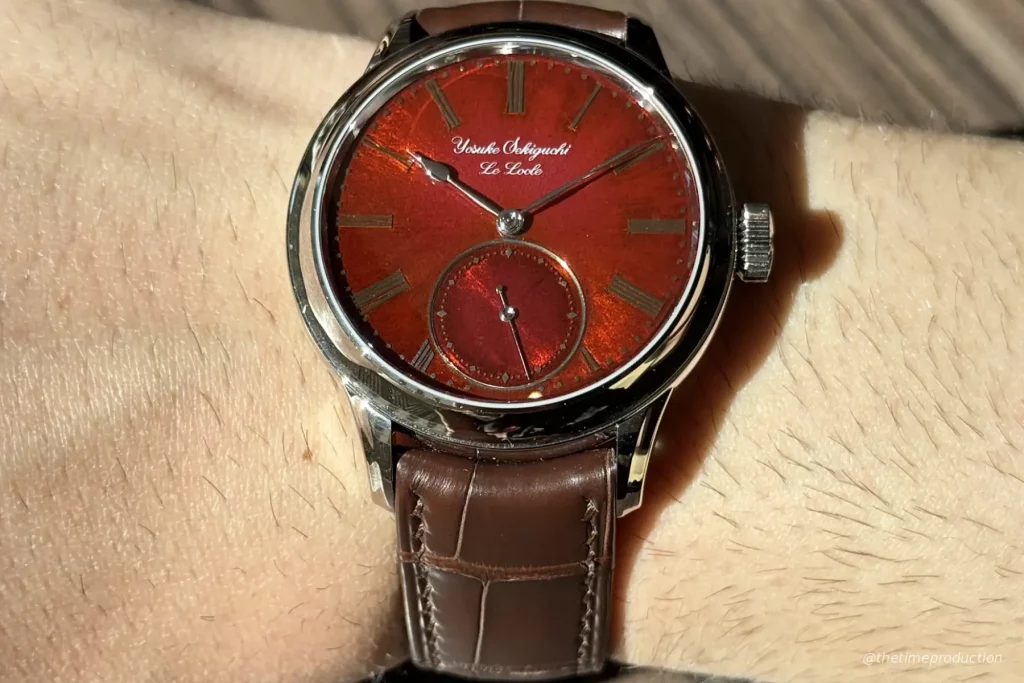
To my eyes, the dial of this Primevère is one of the strongest elements of the watch, because it manages to bring together several things at once: a great decorative tradition, real visual depth, and a very classical elegance that never feels frozen. At first glance, one immediately sees that this is a dial inspired by 19th-century pocket watches. But as soon as you get closer, and above all once you place it in the light, you realise that you are looking at something far more subtle and accomplished.
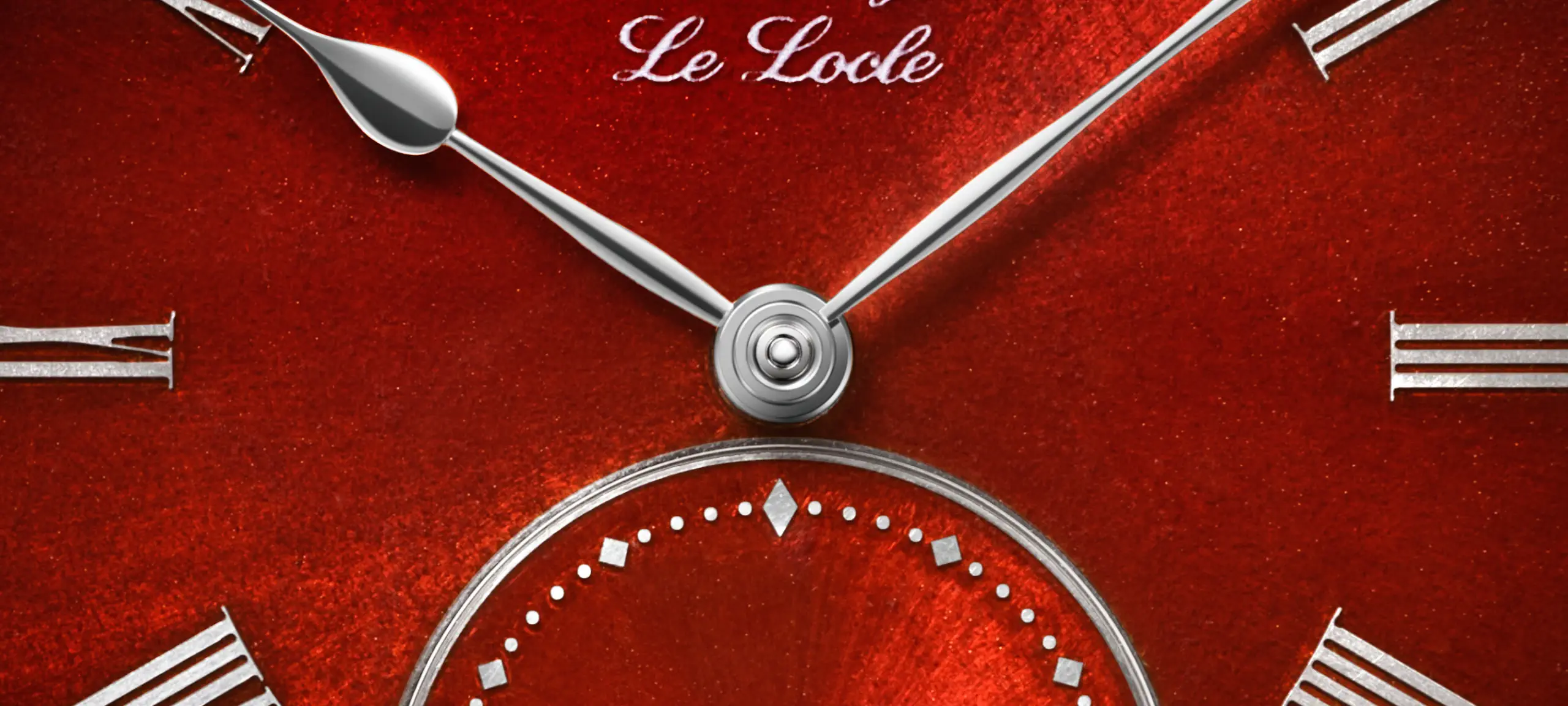
What struck me first was clearly the depth of the enamel. That is what stands out above all else. This Grand Feu champlevé enamel dial has remarkable visual presence, with a very lively burgundy tone that can shift towards dark brown, garnet, or even almost darker shades depending on the light. And that is precisely what makes it so beautiful. As soon as you expose the watch to sunlight, the dial literally radiates. It comes alive, it changes, it gains relief, intensity and richness. This is not a fixed or decorative colour in any flat sense. It is a surface that genuinely lives with the light.
That rendering is obviously linked to the very nature of enamel work itself. And I think it is important to explain that at least a little, because it directly contributes to the beauty of the dial. Before the enamel is applied, the base of the dial, cut from solid gold, is first polished and then hand engraved with a sunburst motif. A red glaze containing a small amount of gold powder is then applied and fired. This process is repeated seven to eight times. It is precisely this layering, this repeated firing, this slow construction of the material that gives the dial its depth, its glow, and its very particular way of reacting to light. One then understands more clearly why such a dial cannot be reduced to a simple beautiful colour. There is real technical and artisanal density behind it.
The role of Donzé Cadrans is of course central here, and I think that should be clearly underlined. We are talking about one of the major Swiss names in enamel dials, and the fact that Yosuke Sekiguchi worked with them strongly reinforces the credibility of the project. But beyond their reputation alone, what seems interesting to me is that there is once again a real human coherence in the construction of Primevère. We find again this same logic of encounters, trust and alignment between the people involved around the watch. That is not anecdotal. It also contributes to the depth of the project.
Visually, the dial is highly classical in its design, yet far from banal. I particularly liked the Roman numerals, very fine, very elongated, left raw, with a delicacy that becomes even more impressive when one knows that their minimum thickness goes down to 0.03 mm. That kind of detail says a great deal about the level of precision sought here. The railway minute track, the recessed small seconds, the dots marking five-second intervals, all of this contributes to a very traditional yet highly refined aesthetic in which every element feels perfectly in place.
I also found the relationship between the main dial and the small seconds subdial very beautiful. The fact that the latter appears slightly darker creates a real visual step between the two parts. That helps structure the reading while subtly enriching the dial’s depth. It is very well judged, because it brings an extra nuance without breaking the overall unity of the composition.
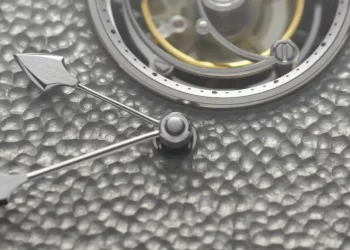
The hands, for their part, naturally extend that same spirit. They do not take over the dial in the text, because here the dial needs to keep its full strength, but they still play an important role. Made by hand by Yosuke Sekiguchi himself, with a saw and a file before being polished and rounded, they have a very beautiful and very right shape that evokes high-end pocket watches and certain marine chronometers, while remaining perfectly suited to a wristwatch. They are not there to create an effect. They are there to extend the elegance of the dial with great coherence.
What I particularly appreciate here is that despite all this work, the dial never tips into demonstration. It remains legible, balanced and serene. The perceived quality is extremely high, but it reveals itself gradually. And that, in my view, corresponds perfectly to the identity of Primevère. One finds a very clear 19th-century inspiration, obvious artisanal refinement, and a traditional elegance that feels neither frozen nor museum-like.
In the end, I find this dial superbly executed. It manages to be immediately seductive through the depth of its enamel and its changing colour, while then revealing, to anyone who takes the time to look at it, a quantity of details and subtleties that give it even more strength. Between the technical work of the enamel, the seven to eight firings, the richness of its tones in the light, the delicacy of the Roman numerals and the decisive contribution of Donzé Cadrans, this is clearly a dial that fully expresses Yosuke Sekiguchi’s level of ambition.
Movement
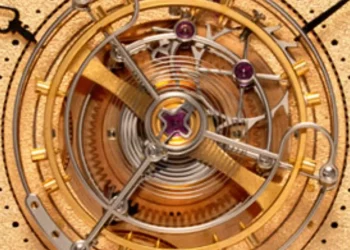
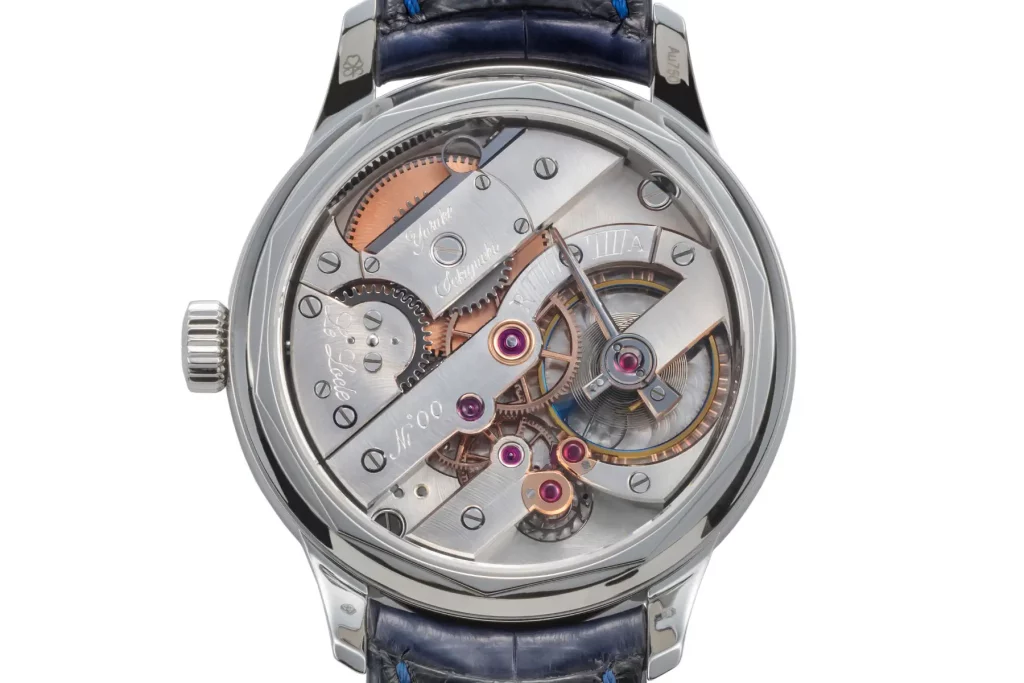
To my eyes, the movement of this Primevère is the most fascinating element of the watch, and probably the one that most clearly reveals the depth of Yosuke Sekiguchi’s project. From the very first look, one understands that this is not simply a pretty or decorative calibre. What first stands out is its overall architecture, deeply inspired by antique pocket watches, and in particular by the spirit of 19th-century Jules Jürgensen movements. That lineage is immediately visible. But what makes the result truly interesting is that this is neither a servile copy nor a historical pastiche. It is a reinterpretation, deeply respectful of that tradition, but rethought for a contemporary wristwatch, with its scale, its constraints and its use.
And that is precisely where the movement begins to take on another dimension. Because the more one looks at it, the more one understands that the full sophistication lies not only in its design, but also in the way it is made and finished. Almost everything here is done by hand by Yosuke Sekiguchi himself, and that obviously changes a great deal in the way the movement is read. One immediately feels that this is not simply a well-designed calibre, but a movement in which every detail has truly been thought through, revisited, refined and worked with extreme patience.
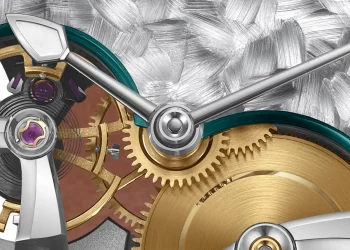
What particularly impressed me was precisely that level of attention given to areas that many people would not necessarily notice at first glance. The six German silver bridges already give the movement a very elegant structure. Their slenderness makes it possible to achieve a visually refined result while preserving real durability. All the bevels are executed, the bridges are polished, and the whole presents a level of execution that becomes obvious as soon as one takes the time to observe it through a loupe. This is not flashy finishing. It is deep finishing, the kind of finishing that rewards attention.
The work on the escape wheel and the lever is particularly remarkable as well. The tips and sides of the teeth are polished by hand under a microscope, as are several areas of the bridge and the lever itself after cutting. This kind of operation demands a considerable amount of time, a great deal of patience, and above all real mastery. And it is precisely this kind of detail that, in my eyes, elevates a movement from being very good to becoming something much rarer. Because one then understands that Yosuke is not simply trying to produce a beautiful old-style movement, but to push the logic of handwork and precision all the way, without unnecessary compromise.
The balance also deserves to be highlighted. Made specifically for Primevère, polished by hand, checked under a microscope, and then treated with care, it contributes enormously to the personality of the movement. The screws are fixed one by one, and the whole then requires very precise adjustment in order to preserve its balance. Once again, this is not the kind of detail that can easily be summed up in a few lines, but when one observes it, one immediately understands that there is a considerable level of patience and expertise behind it.
One of the things I find most intelligent in this calibre is also the way Yosuke Sekiguchi managed to preserve the appearance of an old movement while integrating certain more contemporary solutions where it made sense. The most telling example is undoubtedly the hidden Incabloc. At first glance, one might think this is a very pure construction, almost without visible shock protection, as on certain historical pocket watches. In reality, the anti-shock system is there, but concealed, in order to preserve the overall aesthetic of the movement while providing additional security in daily use. I find that extremely intelligent, because it says everything about the project: respect the old spirit, but without sacrificing what a contemporary wristwatch genuinely requires.
It is also worth mentioning the help of GMG Composants on certain machining operations, especially for the main plate, the bridges and certain gears, at least at the prototype stage. That point is interesting, because it shows that even in a project as personal and artisanal as this one, there are still relationships of trust, friendship and collaboration that make certain steps possible. And that takes nothing away from the strength of the movement. On the contrary, it shows that Primevère is also built within a very coherent human network, in which each person intervenes not as an anonymous supplier, but as part of a wider adventure.
From a purely technical standpoint, the frequency of 18,000 vibrations per hour and the 40-hour power reserve strike me as entirely coherent with the project’s approach. I do not see any weakness here that needs qualifying. Quite the opposite. In the context of a watch like this, those choices further reinforce the impression of watchmaking conceived with accuracy, in respect of an assumed tradition, without trying to chase contemporary standards simply to impress on paper.
At heart, what I particularly like about this movement is that it gives real density to the project without ever throwing it out of balance. It does not crush the dial or the case, but responds to them perfectly. One finds here the same sensibility as in the rest of the watch: a taste for detail, a love of antique forms, the desire to do things seriously, and above all this search for overall harmony. Yes, the movement is magnificent. Yes, it is demonstrative when observed up close. But it is so with intelligence, restraint and depth.
And that is precisely why I find it so strong. Because it does not simply settle for being beautiful or well finished. It expresses very clearly Yosuke Sekiguchi’s vision: watchmaking made by hand, inspired by tradition, demanding in every detail, yet never artificial. Watchmaking without cheating. And when one sees this level of result in Primevère, one immediately understands that this watch is not merely an interesting first independent creation. It is already a true horological statement.
Strap
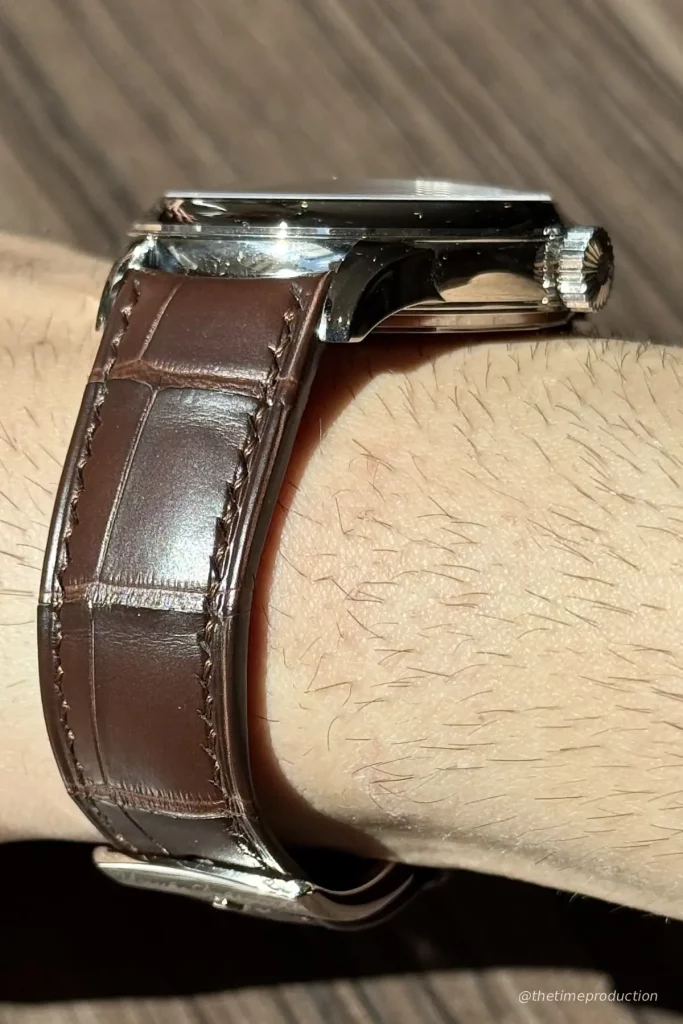
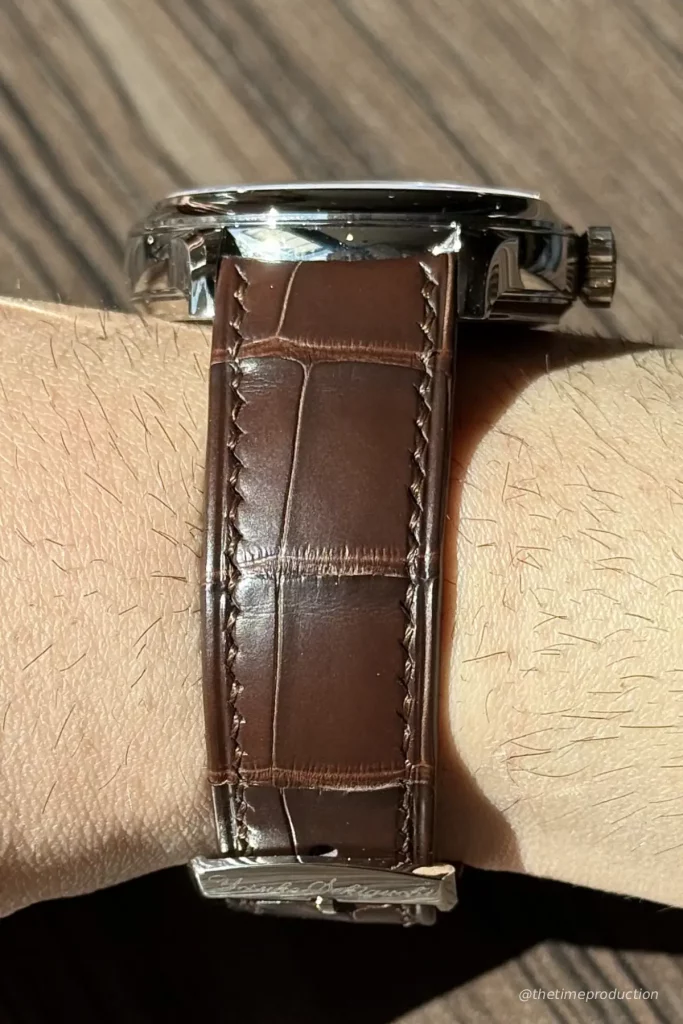
Primevère comes on a beautifully made brown alligator strap paired with a white gold buckle. Like the rest of the watch, the whole remains entirely coherent in spirit: classical, elegant, robust, without trying to do too much. The strap suits the piece very well on the wrist and plays a full part in its overall comfort.
I also found the colour choice particularly right. This brown works very well with the overall aesthetic of the watch and naturally extends its traditional register. As for the buckle, fully polished, it bears the name of Yosuke Sekiguchi, which adds a small extra touch of personality to the whole.
In the end, this is a strap that does not try to steal the spotlight from the watch, but complements it with a great deal of accuracy. And on a piece like Primevère, that is exactly what was needed.
What is the price of the Yosuke Sekiguchi Primevère?
Primevère is priced at CHF 88,000 before tax, with deliberately very limited production of around 15 to 20 watches per year. In my view, that positioning is coherent with the level of work involved, the time required to make it, and more broadly with the very nature of the project. This is not a watch produced according to a volume logic, but a deeply personal piece of independent high watchmaking, where quality clearly comes before quantity.
This type of watch is aimed above all at a knowledgeable collector, someone sensitive to traditional high watchmaking, to handwork, and no doubt also to Yosuke Sekiguchi’s singular journey. Primevère is not simply a beautiful classical watch. It is a proposition that requires a certain horological culture to be fully appreciated for everything it expresses.
One important point should nonetheless be noted: as of today, Yosuke Sekiguchi is the only watchmaker able to service his watches, even if he plans to pass that knowledge on to other watchmakers in the future. This is obviously something a potential buyer must take into account. But in a way, it also further reinforces the singularity of the project: that of a watch still intimately tied to the hand of its creator.
Yosuke Sekiguchi Primevère: a watch of rare sincerity, carried by a true life journey
With Primevère, Yosuke Sekiguchi offers, in my view, far more than a successful first independent watch. He offers a piece with real soul, real depth, and above all a sincerity that can be felt immediately. It is not just an elegant, well-built and superbly executed watch. It is a watch that carries within it a path, years of effort, doubt, obstacles, work, patience and conviction. And that changes a great deal in the way one looks at it.
What I retain first from Primevère is precisely that coherence between the man and the object. Nothing in this watch feels artificial. The case expresses a deep culture of antique watches without slipping into nostalgic reconstruction. The Grand Feu enamel dial has remarkable presence and depth. The movement impresses through its architecture, its level of finishing, and everything it says about Yosuke Sekiguchi’s relationship to handwork. And yet, despite that sum of craftsmanship, the whole remains harmonious. No element tries to dominate the others. Everything is in the service of the same idea, the same language, the same horological integrity.
I also think Primevère achieves something particularly difficult today: making a highly traditional watch without ever giving the impression of being a simple copy of the past. Of course, the 19th-century inspiration is clear. Of course, the love of antique pocket watches is visible. But there is in this piece an interpretation, a sensibility and a life of its own that make it fully personal. And that is precisely what gives it so much strength. You can feel that this watch was not conceived to follow a trend, nor to respond to a fashion within independent watchmaking. It exists because it had to exist this way.
The greatest quality of the project, in my eyes, lies without doubt in that sincerity. A sincerity of gesture, a sincerity of journey, a sincerity of intention. Yosuke Sekiguchi is not trying to impress through communication tricks or a theatricalised strategy of rarity. He makes his watches with the seriousness, the standards and the dedication of someone who has spent his life looking at, taking apart, repairing, understanding and admiring the creations of others, with the idea in mind that one day, perhaps, his own watches might in turn inspire that same respect in future watchmakers.
That is in fact one of the points I find strongest in his approach. He himself now restores antique wristwatches and pocket watches for private collectors. Every day, he is in contact with pieces from the 18th and 19th centuries, and he sees concretely what time reveals about work done properly. That closeness to antique watches does not only nourish his aesthetic taste. It also nourishes his sense of responsibility. One feels that he creates with the idea that his own watches will one day have to be looked at with that same attention. And that gives the project a very rare depth.
So yes, I do believe in Yosuke Sekiguchi’s trajectory. First because he has already thought through future developments, even if he is not yet working on them at this stage. Then because Primevère already lays the foundations of a strong, coherent and credible universe. But above all because his project seems to be moving at the right speed, which is to say his own. He is not trying to produce more in order to exist more. He is not trying to build a brand that will outlive him at any cost. And that is in fact a point that should be stated honestly: Yosuke Sekiguchi does not want his brand to outlive him. That choice may surprise some people, but it also contributes to the deep singularity of the project. It reminds us that this brand is first and foremost the direct expression of one man, his hand, his eye and his life. In a world where many projects immediately seek to structure themselves in order to last beyond their founder, that position has something radical about it, but also something very coherent.
At heart, that is perhaps what touched me most in this encounter. I was honoured to meet Yosuke Sekiguchi as well as his Japanese sales partner, and it is honestly one of the encounters that has marked me the most. Not only because of the quality of the watch, but because of what his path says more broadly. It reminds us that there are extremely difficult roads, filled with administrative obstacles, refusals, misunderstandings and very concrete barriers, but that there is also always, somewhere, a solution, however small, to keep moving forward. And when one has a conviction as strong as his, that small opening can be enough to change an entire life.
In that sense, Primevère wears its name particularly well. It is not simply the first watch of an independent. It is the first flowering of an old project, long held back, long prepared, and finally brought to maturity. And that, in my view, gives this watch a very particular flavour.
Yosuke Sekiguchi Primevère – Watch Specifications
- Brand: Yosuke Sekiguchi
- Model: Primevère
- Model: 39WG-GAWG
- Case Material: White Gold 18K
- Dial: Garnet Grand Feu Champleve enamel, White Gold Roman index dial (Garnet)
- Functions: Hours, Minutes, Small Seconds
- Movement: YS-Y01 (Steel Screw), Hand Winding, 18’000vph frequency (2.5Hz)
- Power Reserve: 40 Hours
- Water Resistance: 3 ATM
- Crystal: Domed Sapphire
- Caseback: Sapphire
- Case Dimension: 39.5mm × 12mm
- Strap: Dark Alligator with White Gold 18K Pin Buckle
- Availability : Limited production of 10 pieces
- Retail Price: CHF 88,000 (excluding VAT)
What do you think of this Yosuke Sekiguchi Primevère and, more broadly, of this kind of deeply artisanal, highly personal watchmaking project, where the sincerity of the journey matters almost as much as the watch itself?
If this article added value or sparked a discovery, you can support the project HERE. Your contribution helps me keep weekly articles and a biweekly newsletter free, accessible, and independent for everyone.
For more information about Yosuke Sekiguchi, click here.