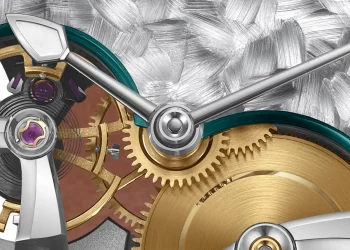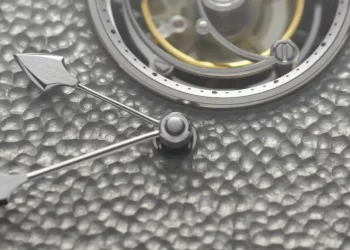

Today, I would like to introduce you to a very special independent watchmaker, one I have followed for a long time and whose work I had wanted to cover for several years, without yet having had the opportunity to experience one of his watches under the right conditions. If I mention a family watchmaking tradition dating back to 1642, an independent watchmaker who still works almost entirely by hand without CNC machines, and a deeply personal vision of time, the most knowledgeable among you will probably have recognised Beat Haldimann and the manufacture that bears his name. I recently had the privilege of discovering a H1 Flying Central Tourbillon at GMT Great Masters of Time in Milan, created specifically as part of their collaboration presented in 2026. Before looking more closely at this edition and what it represents, I felt it was essential to place the watch in its proper context, because with Haldimann, it is almost impossible to separate the object from its history, its philosophy and the man who imagined it.
In my view, every great independent watchmaker eventually develops a language of his own. Some collectors will connect with it immediately, while others may not, but it is precisely this ability not to seek universal approval that allows a creator to build a genuine identity. At the highest level, it is no longer simply a question of design or branding. The watch becomes a direct expression of its creator’s personality, convictions and artistic vision. Beat Haldimann clearly belongs to that category. His work is not defined solely by a recognisable aesthetic or by the repeated use of a particular complication. It forms part of a much broader reflection on how we measure, experience and even think about time.
The history of Haldimann dates back to 1642, when Ulrich and Hans Haldimann, father and son, established a family tradition linked to mechanical watchmaking. Today, the brand presents this continuity as one of the oldest active family watchmaking histories in Switzerland. What makes the story particularly interesting, however, is that Beat Haldimann himself was unaware of this ancestry when he chose his profession. Born in 1964 to a postman father and a nurse mother, he entered watchmaking freely, without being driven by family obligation or by the weight of an inheritance he was expected to continue. Several generations had interrupted the tradition, and it was only after beginning his apprenticeship that he discovered many of his ancestors had also been watchmakers. I particularly like this anecdote because it offers a different reading of his career. Beat Haldimann did not become a watchmaker in order to artificially prolong a family story. He first chose his own path, then realised that he naturally belonged to a continuity far older than himself.
He qualified as a watchmaker and repairer in 1985 before becoming a master watchmaker in 1993. In the meantime, he founded his own company in Thun, in German-speaking Switzerland, in 1991 and spent much of the following years carrying out research, development and various projects for other members of the watch industry. This period was important because it allowed him to refine his expertise while gradually building a highly personal vision of mechanical watchmaking. Where many seek to improve the way time is displayed or to accumulate complications, Beat Haldimann began to explore how a watch might offer a more direct, more sensitive and almost more intellectual experience of passing time.
The first major expression of this research appeared in 2000 with the H101, a clock incorporating two movements oscillating in resonance. This creation featured Haldimann’s patented detached escapement, said to be capable of achieving an accuracy of one tenth of a second per day. The H101 already revealed his way of working. It did not take an existing complication and simply reproduce it in his own style. Instead, it explored a mechanical and physical phenomenon, resonance, while seeking to give it a form that was legible, spectacular and technically coherent. This clock marked an important first milestone, but it was two years later that Beat Haldimann presented the watch that would truly establish his name among collectors.
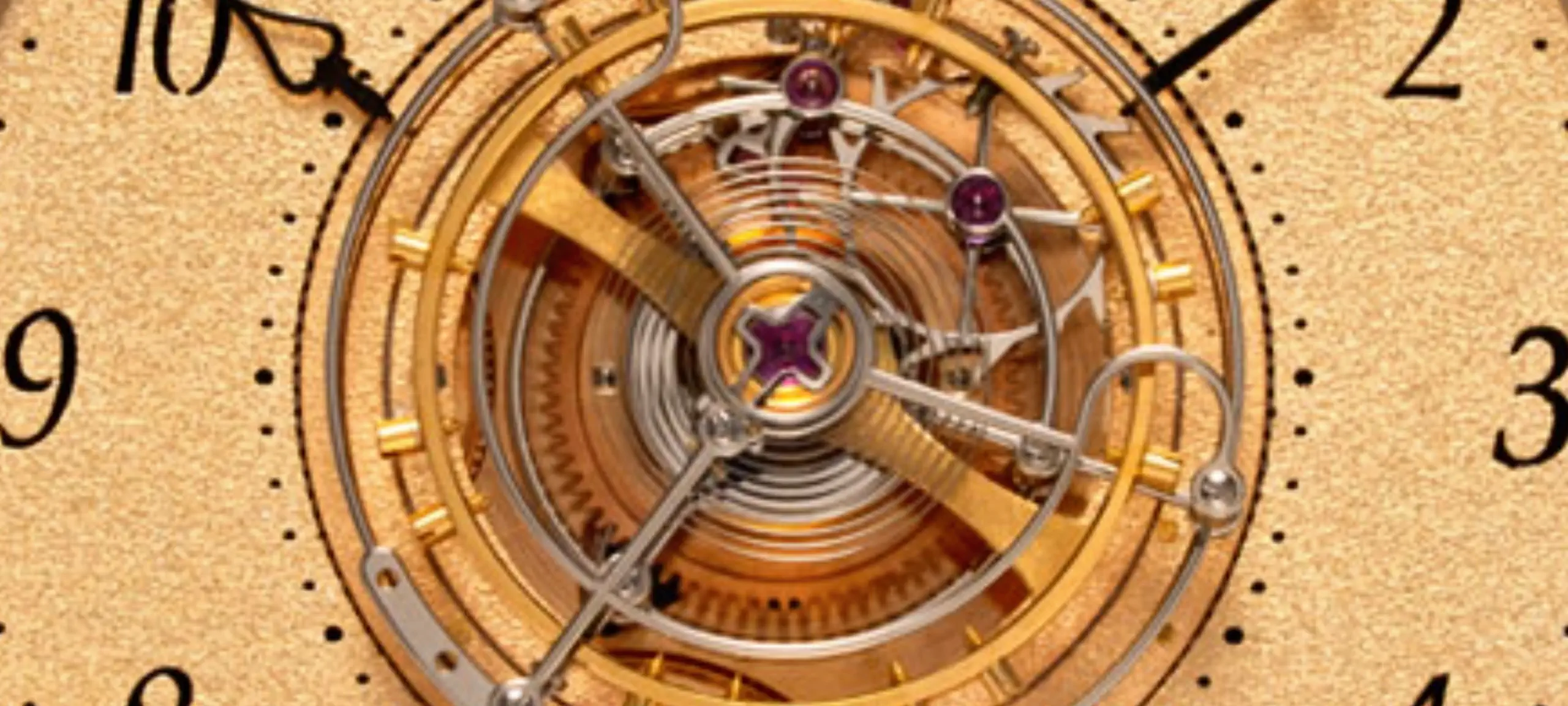
In 2002, he unveiled the H1 Flying Lyra at Baselworld, now known as the H1 Flying Central Tourbillon. Its principle appears almost simple when looking at the finished watch: place a monumental flying tourbillon at the centre of the dial, above the display, inside a cage shaped like a lyre. From a construction standpoint, however, the idea was extraordinarily ambitious. Creating a tourbillon is already a challenge. Designing a flying tourbillon is another. Positioning it at the centre of the watch, with proportions close to those of a tourbillon intended for a 16 ligne pocket watch, while preserving a wearable case, is a genuine technical achievement. It is precisely this contrast between the apparent visual simplicity of the finished watch and the true complexity of its construction that makes the H1 so powerful.
Here, the tourbillon is no longer a discreet complication visible through an opening in the dial. It becomes the absolute centre of the watch, its visual, mechanical and almost emotional heart. Its motion, presence and even the gentle hum it produces transform the relationship one has with the timepiece. The watch no longer simply indicates the time. It invites us to observe it, listen to it and feel it. This is one of the foundations of Haldimann’s thinking. Measuring time remains a function, but the experience of time can extend far beyond the simple reading of two hands.

Beat Haldimann continued this exploration in 2005 with the H2 Flying Resonance, which brought together the two major ideas he had developed up to that point: resonance and the central flying tourbillon. The watch incorporates two flying tourbillons combined with a remontoir d’égalité, oscillating at the same frequency. Once again, the technical difficulty is considerable, particularly because of the mass that the escapement must support. Yet the significance of the watch goes beyond its complexity. It confirms that Beat Haldimann has never sought to build a collection according to conventional commercial logic. Each new piece instead becomes another stage in a reflection on time, mechanics and perception.
His subsequent creations pushed this logic even further. In 2008, the H8 Flying Sculpture reused the tourbillon of the H1 but abandoned the hands entirely. Beat Haldimann created a mechanical object to be worn on the wrist without allowing its owner to read the time. Four years later, with the H9 Reduction, the central tourbillon was entirely concealed beneath an opaque black dial. Where the H8 revealed the mechanics without displaying time, the H9 hid both the mechanism and the indication. These watches may appear radical, even provocative, but they fit perfectly within his philosophy. They ask a simple question: does a watch necessarily need to indicate the time in order to make us feel its passing?
With the H11 and H12, Beat Haldimann then returned to a more classical expression while retaining one of his most characteristic principles: the central positioning of the balance wheel. He managed to place this organ at the centre of a watch fitted with central hands, an especially rare configuration. In 2019, the H3 Flying Sculpture with Minute Repeater combined this visual exploration with a minute repeater. Then, in 2021, the H51 Time-Hora opened a new and even more conceptual chapter. Available as both a wristwatch and a clock, it represents the passage of time through three rotating circles. One symbolises the present and completes one revolution every twelve hours, while the other two evoke the imagined durations of past and future days and nights. Created as a tribute to the astronomer and mathematician Jost Bürgi, the H51 shows how deeply Beat Haldimann considers the watch as a medium capable of expressing the beauty of an idea, something he describes as a form of cognitive aesthetics.
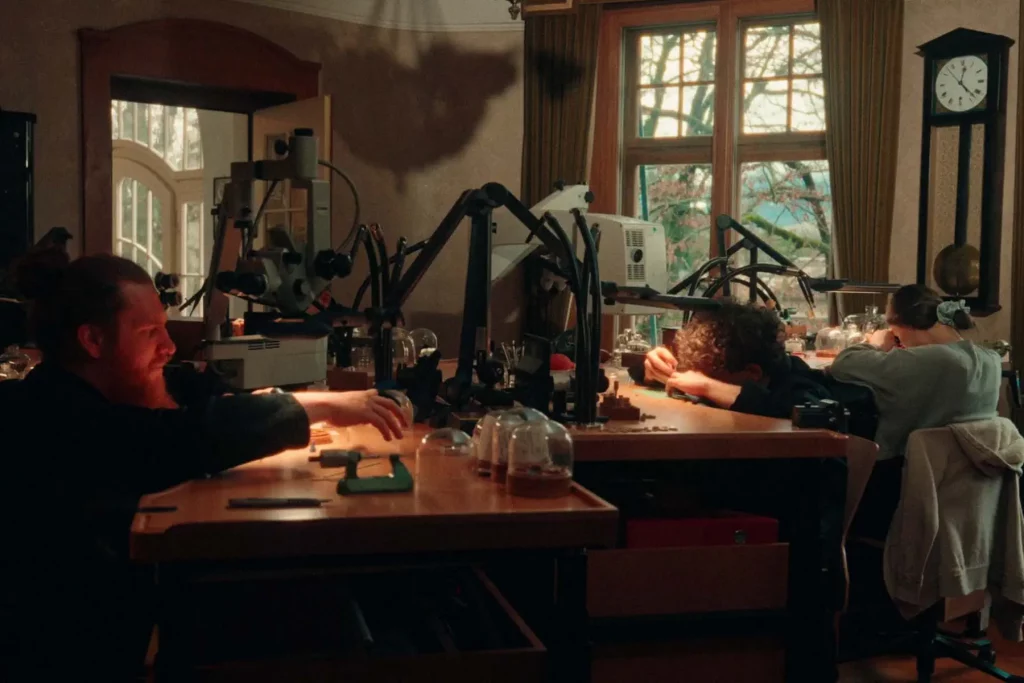
This creative freedom is nevertheless rooted in a profoundly traditional manufacturing method. From his workshop at Villa Nussbühl, a residence built in 1907 near Lake Thun, Beat Haldimann and his small team produce their watches without using the modern digital tools that now structure most of the watch industry. He does not use CNC machines and works with old mechanical equipment, one of the most modern instruments in the workshop reportedly being an optical microscope dating from the 1960s. This choice is neither folklore nor a romantic posture. It imposes considerable constraints, requires more time and demands an extremely deep understanding of every operation. At the same time, it preserves a direct relationship with the material, the tool and every component being made.
This is precisely what makes Haldimann so distinctive in contemporary watchmaking. Beat Haldimann does not reject digital tools in order to play the role of an artisan turned towards the past. On the contrary, his work is profoundly innovative. He simply uses the most traditional methods to create watches that would probably never have emerged from a conventional approach. For him, the past never becomes a limitation. It serves instead as a foundation from which he can challenge established standards, propose new temporal experiences and develop objects whose modernity comes more from thought than from the technology used to produce them.
This approach earned him the Gaia Prize in the Craftsmanship and Creation category in 2009. Often regarded as one of the most important distinctions in watchmaking, the award recognises an entire body of work combining artisanal mastery, innovation and intellectual independence. It does not reward a single watch or isolated invention, but a complete way of approaching the profession. In Beat Haldimann’s case, this recognition feels especially appropriate because his work cannot be reduced to the H1, resonance or the central tourbillon. It is defined by a consistency of thought that runs through all of his creations.
Today, this story also continues as a family endeavour. Beat Haldimann’s children, Iris Olga and Niklaus Anton, have joined the company and now work alongside him. Their presence makes it possible to imagine the transmission of a savoir-faire whose roots reach back to 1642, without that continuity feeling artificially imposed. Beat Haldimann himself freely chose his profession before discovering the history of his ancestors. The next generation now seems to be following the same logic, gradually becoming part of a family project still built on independence, uniqueness, aesthetics, heritage and the constant search for a more meaningful expression of time.
The philosophy of the brand is even reflected in its logo, constructed around twelve lunar phases symbolising different aspects of the Haldimann mindset. This identity is organised around ideas such as independence, uniqueness, aesthetics, essence, value, service, motivation and heritage. Beyond the words themselves, however, what matters most is the way these principles are expressed through the watches. Haldimann does not seek to follow market expectations, multiply references or maintain permanent visibility on social media. The brand operates almost apart from the industry, with enough confidence in its work not to feel the need to overexpose it.
This is also one of the reasons I wanted to dedicate an article to Haldimann. It is one of those brands that does not truly need additional visibility among the most knowledgeable collectors. It creates rare, complex and deeply personal objects for an audience that already knows what it is looking for. Yet this discretion also means that its work is sometimes less extensively documented than that of brands with a much stronger media presence. Being able to experience a H1 properly, handle it, observe it and take the time to understand what it represents was therefore a genuine privilege. For me, it was also an opportunity to offer readers an in-depth article on a watchmaker who occupies a very particular place in the recent history of independent watchmaking.
This discovery was made possible by GMT Great Masters of Time, whose relationship with Haldimann goes far beyond that of a simple retailer and a brand. The GMT concept began in 2007 with the opening of its first boutique in Porto Cervo, created to select, promote and present unconventional watches from independent watchmakers. In 2010, GMT moved to 11 Corso Magenta in Milan’s historic centre before opening a new flagship boutique at 25 Via della Spiga in 2021, in the heart of the fashion district. Over the years, GMT has become one of Italy’s principal destinations for collectors interested in high-level independent watchmaking and in creators whose work is not necessarily available through traditional distribution networks.
The collaboration between Haldimann and GMT therefore feels particularly coherent. Both share the same desire to defend a form of watchmaking built on authenticity, individuality, quality of execution and direct relationships with collectors. GMT is not simply one of the brand’s retailers. It plays a particularly important role in representing Haldimann and almost feels like part of the close family ecosystem built around Beat Haldimann. This proximity gives real meaning to the H1 Flying Central Tourbillon GMT Milano Edition presented in 2026.
The watch is based on what is probably Haldimann’s most emblematic model, the one that placed a monumental flying tourbillon, inspired in principle by the work of Alfred Helwig, at the very centre of the dial as early as 2002. Yet this edition should not be understood as a simple aesthetic variation created for a retailer. It also symbolises a relationship built over time between a watchmaker whose production and distribution remain deliberately rare and confidential, and a partner that has spent almost two decades introducing collectors to some of the most singular expressions of independent watchmaking.
I had the privilege of discovering this piece a few weeks ago at GMT Italia in Milan. Even when you already know the H1 through photographs, encountering the watch in person remains deeply striking. The presence of the central tourbillon, its dimensions, its constant motion and the way it appears to float above the dial immediately create the feeling that you are looking at an object unlike anything else. Beyond its visual impact, however, what becomes most apparent is that every detail stems from a vision developed over several decades, without compromise and without regard for trends or market expectations. The H1 Flying Central Tourbillon GMT Milano Edition therefore represents far more than a collaboration or a new variation. It offers a gateway into Beat Haldimann’s universe, his relationship with time, mechanics and independence. Now, let us take a closer look at the Haldimann H1 Flying Central Tourbillon GMT Milano Edition.
Table of Contents – Haldimann H1 Flying Central Tourbillon GMT Milano Edition
What Are the Specifications of the Haldimann H1 Flying Central Tourbillon GMT Milano Edition?
Case
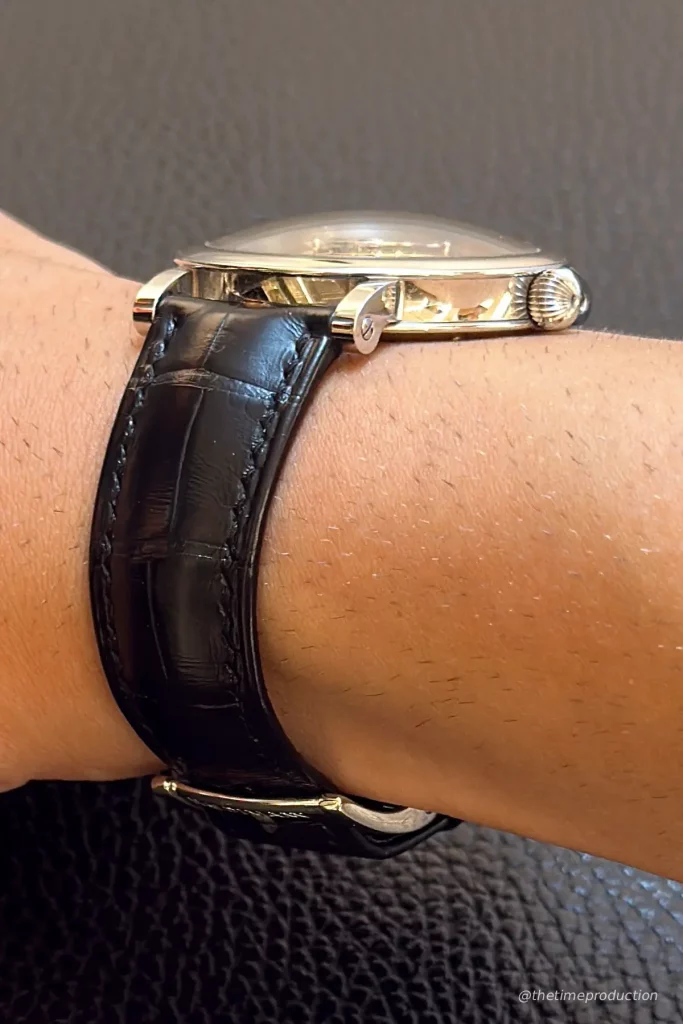
The case of the Haldimann H1 Flying Central Tourbillon GMT Milano Edition is, in my opinion, one of the elements that best summarises the overall philosophy of the watch. Made from platinum, entirely polished and crafted by hand, it measures 39 mm in diameter and 10.8 mm in thickness. On paper, these proportions may appear almost conventional. Yet once the watch is in hand, it immediately becomes clear that the case has a far stronger identity than it first suggests. What struck me first were its concave flanks, a distinctive Haldimann signature that gives the profile of the watch a particular sense of depth and elegance.
This concave caseband completely changes the way the case is perceived from the side. Light does not simply glide across a flat or gently curved surface. It is captured and reflected differently depending on the angle, allowing the fully polished platinum to reveal all its richness without ever becoming ostentatious. This is one of the great paradoxes of the watch. It is made from one of the noblest and densest metals in watchmaking and is entirely polished, yet it still retains a genuine sense of discretion. It never tries to impose its status through an accumulation of visible details or an unnecessarily demonstrative architecture. Everything rests on the purity of the lines, the quality of the proportions and the precision of the execution.
The overall construction of the case contributes greatly to this impression. The bezel, concave caseband and caseback are clearly defined, appearing to fit together through a perfectly controlled sequence of volumes. The lugs seem to be separately formed before being integrated into the caseband with great precision, further reinforcing the artisanal nature of the whole. Nothing appears simplified or standardised. When one considers that Beat Haldimann works without CNC machinery, achieving this level of regularity, sharpness and finishing becomes even more impressive.
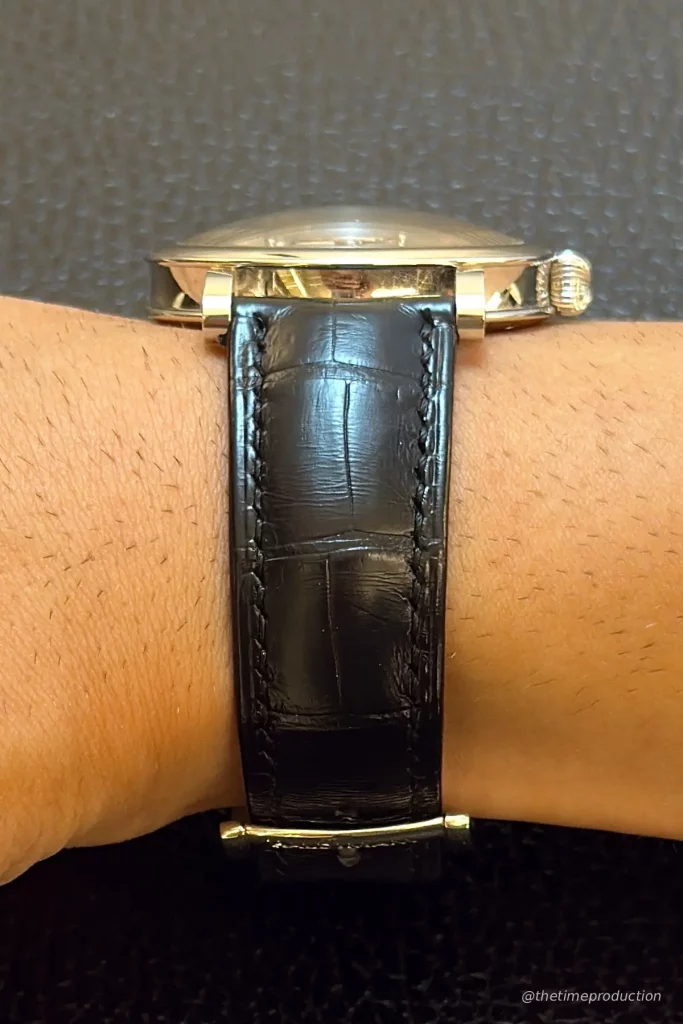
The lugs are another particularly successful element. Their design remains deeply classical, yet they curve sharply enough to extend below the level of the caseback and naturally follow the shape of the wrist. This is precisely what makes the watch so comfortable to wear. Despite the density of the platinum and the presence of an imposing flying tourbillon at the centre of the dial, the H1 never feels overly massive or unbalanced. The 39 mm diameter feels especially well judged, while the 10.8 mm thickness remains remarkably restrained for a watch with such a mechanical architecture.
This work on the lugs also allows the case to retain real presence without becoming intrusive. They are visually assertive, yet their curvature compensates for their length and allows the watch to sit naturally against the wrist. Even the strap attachment system, which appears to use screwed bars, contributes to the impression of classicism and traditional construction. The detail remains discreet, but it fits perfectly within the broader language of the watch, where each component seems to have been conceived with durability and coherence in mind rather than immediate visual effect.
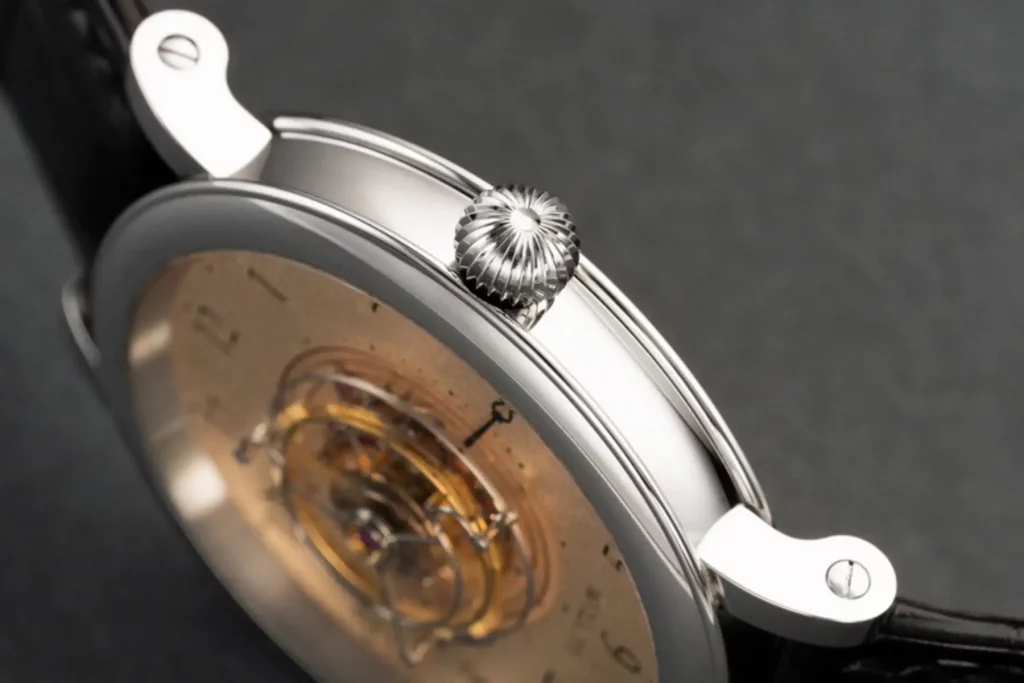
The crown also deserves particular attention. Its slightly onion-shaped form gives it a classical appearance, but unlike some interpretations of this type of crown, it is by no means oversized. It remains perfectly proportioned to the case and almost forms part of its natural continuation, without creating an excessive break in the profile. I am not usually especially drawn to onion crowns, yet I found this one remarkably successful. It gives the watch character, offers an excellent grip and makes manual winding particularly enjoyable, all while retaining great elegance.
The domed sapphire crystal, with double antireflective treatment, also plays an essential role in the construction. It does more than simply protect the dial. Its curvature creates the space required for the central tourbillon to truly come alive above the dial and enhances the sense of depth when observing the watch. I also had the impression that the interior of the case incorporated a kind of continuation or inner flange that naturally accompanied the transition between the caseband and the dial. There is none of the empty space sometimes found between the edge of a dial and the inner wall of a case. Everything instead feels perfectly continuous, as though the case had been built around the mechanism rather than merely designed to contain it.
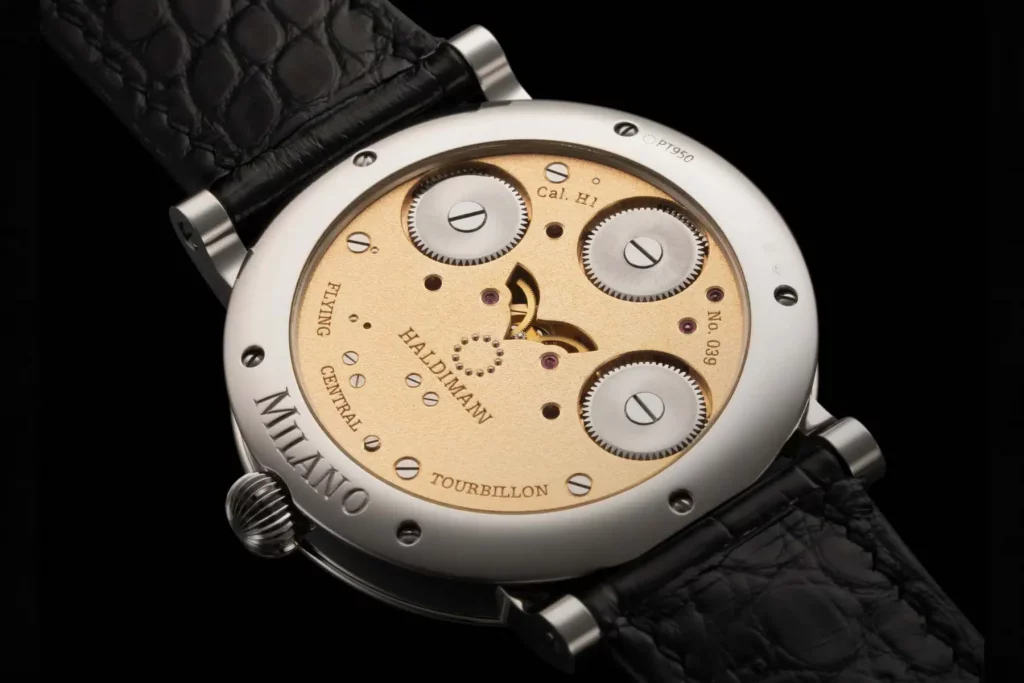
The caseback follows the same restrained approach. The collaboration with GMT Great Masters of Time is not highlighted through an imposing logo, visible dial-side marking or an accumulation of commercial references. The only distinguishing feature is the word “Milano” engraved on the back. This choice feels particularly appropriate. It celebrates the relationship between Haldimann and GMT without ever disturbing the identity of the watch. The collaboration is present, but it is discovered in a more intimate, almost personal way when the piece is turned over. This discretion corresponds perfectly with Beat Haldimann’s philosophy, according to which true luxury does not need to announce itself.
With a stated water resistance of 30 metres, the H1 Flying Central Tourbillon GMT Milano Edition naturally offers the level of protection expected from a piece of haute horlogerie of this nature. Yet the real appeal of the case lies elsewhere. It lies in its ability to combine timeless design, highly personal construction, the nobility of platinum, genuine comfort on the wrist and exceptional execution. The result is classical without being generic, precious without being ostentatious and artisanal without ever feeling imprecise.
Ultimately, I find this case particularly accomplished. It possesses everything one might expect from a great watch designed to endure: balanced proportions, genuine purity, an immediately recognisable signature through its concave flanks, a perfectly integrated crown and a construction considered down to the smallest detail. It does not seek to reinvent the codes of classical watchmaking for the sake of novelty, but it masters them well enough to give them a character of its own. Once experienced on the wrist, with its polished platinum, curved lugs and central tourbillon alive beneath the domed sapphire crystal, it becomes difficult to identify any real weakness.
Dial
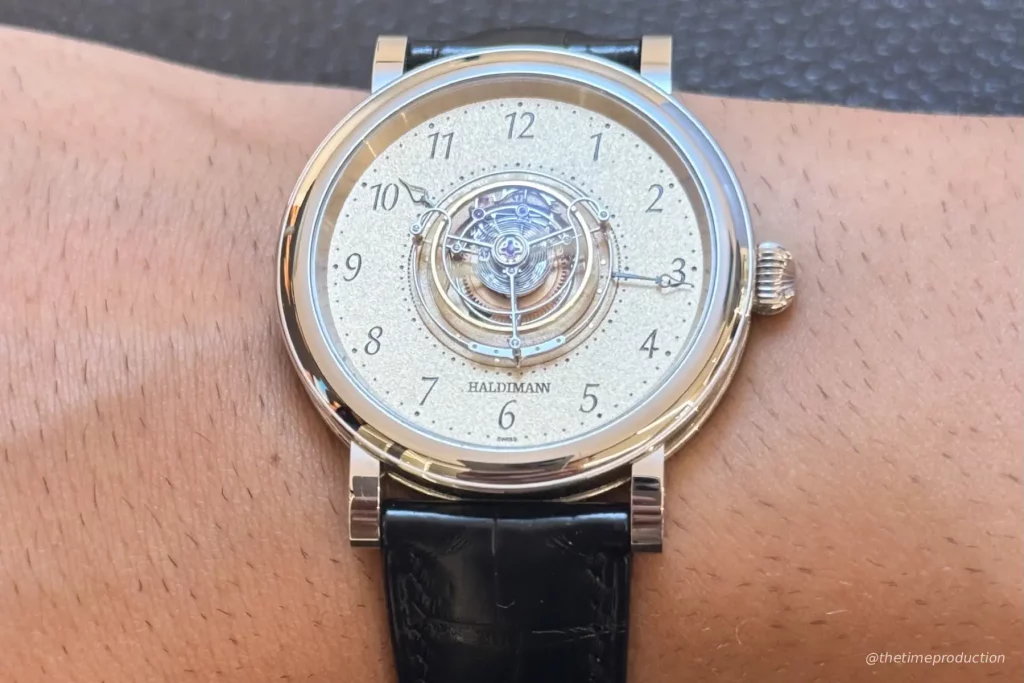
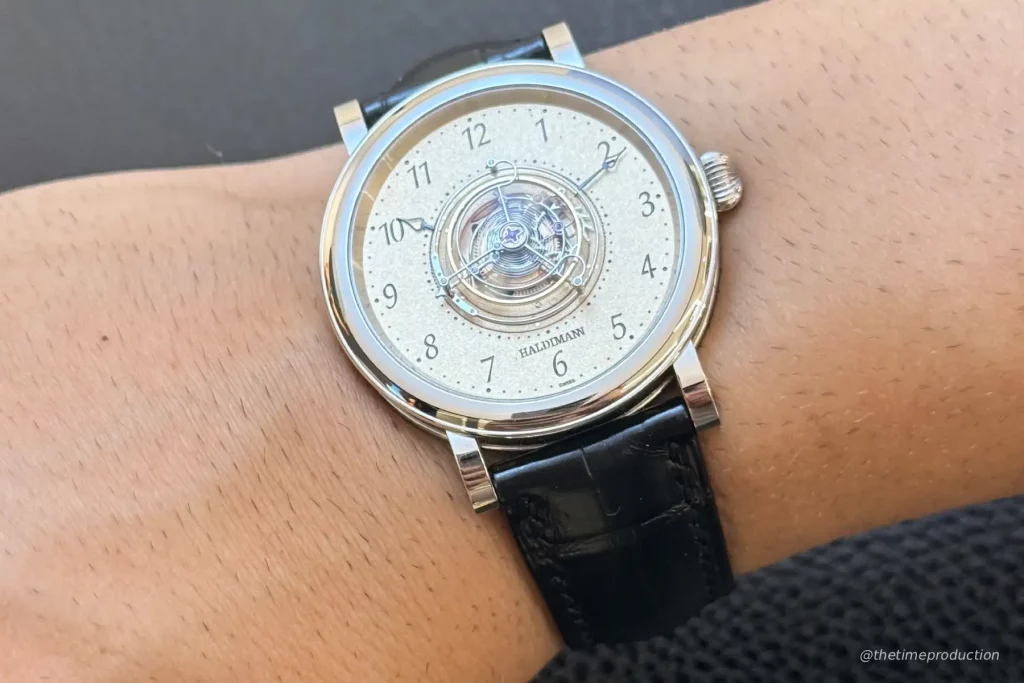
The dial of the Haldimann H1 Flying Central Tourbillon GMT Milano Edition perfectly illustrates the way Beat Haldimann has approached watchmaking for more than thirty years. At first glance, everything appears remarkably simple. A grained finish, numerals, two hands and, at the centre, an imposing flying tourbillon. Yet the longer one spends observing the watch, the more it becomes clear that every element has been designed to serve the mechanics rather than conceal them. Here, the dial does not attempt to compete with the movement. Instead, it becomes the setting that allows the central tourbillon to occupy its natural place at the heart of the watch.
What immediately stands out is this entirely unconventional architecture. On a traditional watch, the hour and minute hands originate at the centre of the dial, where the cannon pinion would normally emerge. On the H1, that element disappears completely. In its place sits the spectacular central flying tourbillon, seemingly suspended above the dial. The two hands almost appear to emerge directly from the cage as it rotates continuously, yet no visible axis interrupts the view. The effect is particularly disorienting during the first few moments spent with the watch. One immediately senses that something is different without necessarily being able to explain why. This feeling contributes enormously to the personality of the H1.
The other major evolution concerns the hour markers. Since the beginning of his work, Beat Haldimann had always favoured Roman numerals. For this GMT Milano edition, he chose for the first time to move away from them and adopt Western Arabic numerals developed in collaboration with his daughter Iris. The change might seem minor, yet it marks an important evolution in the visual identity of the manufacture. The numerals retain all the elegance associated with Haldimann, while giving the watch a more contemporary expression. I particularly like this decision because it subtly modernises the H1 without compromising its timeless character. The watch remains deeply classical, yet it never feels inspired by the past in a nostalgic way.
This ability to remain current while respecting the great codes of traditional watchmaking perfectly summarises Beat Haldimann’s philosophy. His watches draw from history without attempting to reproduce it. They rely on ancestral skills, yet their design remains profoundly contemporary. This idea is perfectly expressed in the H1 GMT Milano Edition. The Arabic numerals modernise the dial, while the hands retain a silhouette directly inspired by a Haldimann Frères pocket watch dating from 1790. This encounter between several centuries of history gives the watch a highly distinctive identity in which tradition and modernity coexist naturally.
The dial itself is made from silver before being entirely worked by hand. The numerals and logo are first engraved and then filled with lacquer, before Beat Haldimann manually applies silver powder to create the superb grained finish. The result is remarkable. The surface possesses an extremely fine texture that captures light with great softness. Unlike a sunburst or brushed dial, it never produces aggressive reflections. Instead, it diffuses light very evenly, further enhancing the sense of calm and purity that emerges from the watch. It is easy to imagine the time and precision required to achieve such a regular texture entirely by hand, without relying on modern industrial processes.
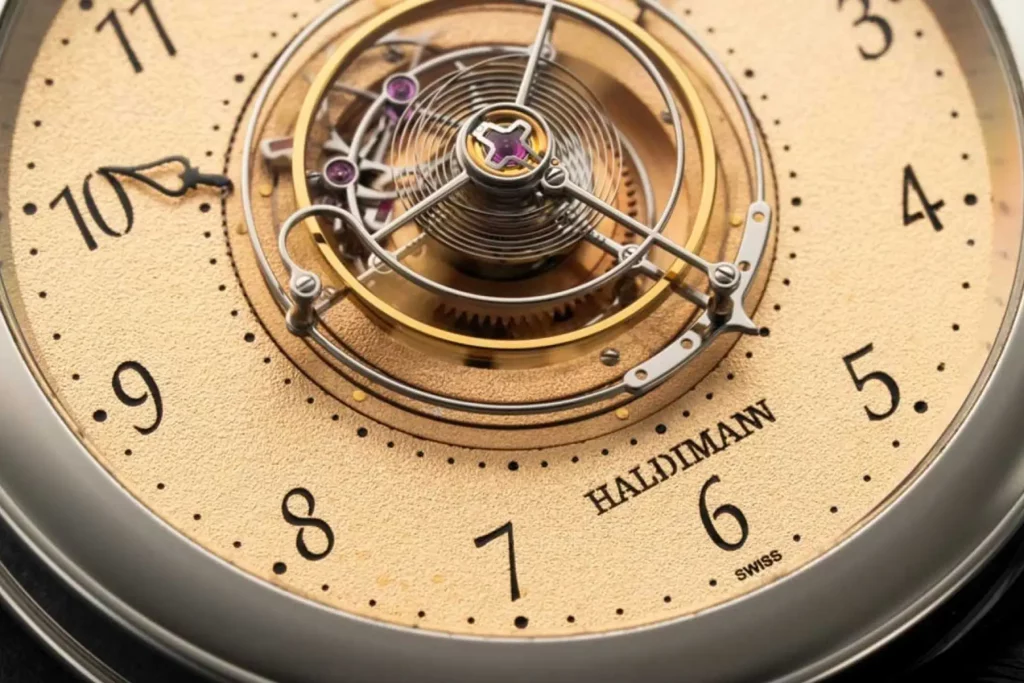
This Milano edition also receives a warm 4N gold tone, which has become one of the signatures of collaborations created with GMT Great Masters of Time. The colour adds considerable depth to the dial. Depending on the light, it shifts between champagne, honey and softly golden tones, creating a particularly successful contrast with the blued hands. Once again, nothing feels demonstrative. The colour remains elegant and simply contributes to the overall balance of the watch.
The hands also deserve closer attention. Exceptionally fine, they travel across the dial with great lightness and seem almost to float above the tourbillon. Their heart-shaped tips are a detail I particularly appreciate. They bring real personality to the display while improving legibility. Despite the permanent presence of the central tourbillon, reading the hours and minutes remains immediate. The blued hands stand out perfectly against the 4N gold background and retain sufficient presence without ever competing with the mechanical animation directly beneath them.
One detail also particularly appealed to me and will probably go unnoticed by many observers. Around the tourbillon is a discreet seconds track, since the cage naturally completes one revolution per minute. Looking more closely, however, one notices that twelve points are slightly more pronounced than the others. This arrangement immediately reminded me of the Haldimann logo, which is itself built around twelve circles representing the twelve lunar phases and the twelve founding values of the manufacture. There is no official confirmation that this reference was intentional, but the correspondence struck me as particularly interesting. Even without the logo appearing on the dial, part of the brand’s visual identity can therefore be found discreetly integrated into the architecture of the display.
This is probably what I appreciate most about the dial. Nothing has been added purely to attract attention. Every element appears to have found its natural place. The grained finish adds depth without becoming demonstrative. The Arabic numerals modernise the whole without breaking with Haldimann’s identity. The hands remain exceptionally elegant while offering excellent legibility. As for the central tourbillon, it naturally becomes the true visual heart of the watch without requiring any additional theatrical elements around it.
Ultimately, this dial perfectly summarises Beat Haldimann’s philosophy. Behind its apparent simplicity lies considerable artisanal work, constant reflection on proportion, legibility and balance, and a desire to evolve his visual language without ever renouncing his heritage. It does not seek to impress at first glance, but gradually reveals its richness as one takes the time to observe it. On a watch as emblematic as the H1 Flying Central Tourbillon GMT Milano Edition, this approach feels entirely appropriate.
Movement
If one element alone could summarise the entire philosophy of Beat Haldimann, it would probably be the movement of the H1 Flying Central Tourbillon GMT Milano Edition. Behind its apparent simplicity lies a particularly profound horological reflection, with every technical decision seemingly guided by one idea: eliminate everything superfluous in order to preserve only what is essential. The movement is not designed to impress through an accumulation of complications or spectacular decoration. Above all, it seeks to highlight the passing of time and the beauty of mechanics in their purest form.
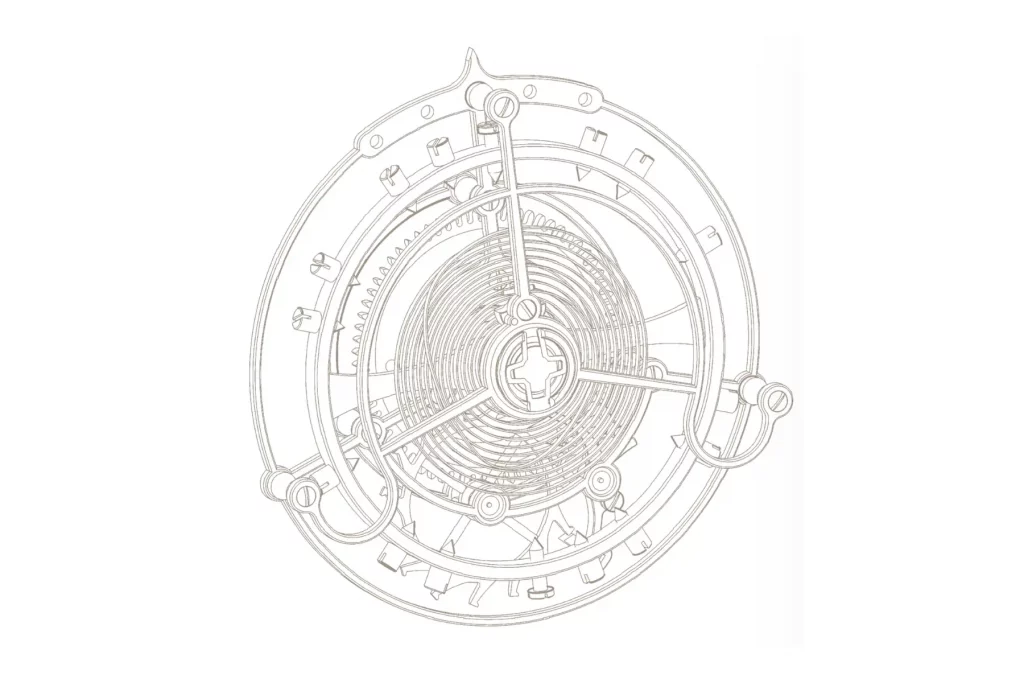
At the heart of the watch is, naturally, its remarkable sixty-second central flying tourbillon. From the very first moment, it is impossible to look away. Positioned exactly at the centre of the dial, it immediately commands all attention and becomes the true point of gravity of the watch. Because it completes one full rotation every minute, it also serves as the seconds indicator, further reinforcing its importance in the display of time. Unlike most tourbillons, usually confined to a small aperture at six o’clock, Beat Haldimann chose to make it the true face of the watch. The entire piece appears to have been built around it.
The choice is all the more spectacular because the tourbillon is exceptionally large. With a diameter of 17.8 millimetres, it could almost belong in a large traditional pocket watch. Directly beneath it sits an imposing 14.5 mm Glucydur balance wheel, while the complete cage assembly measures almost 31.6 mm in diameter. The proportions are impressive without ever feeling demonstrative. They give the tourbillon an almost hypnotic presence that constantly animates the dial.
The architecture of the cage itself also deserves closer attention. Beat Haldimann chose an openworked lyre-shaped cage, which over the years has become one of the manufacture’s most recognisable signatures. The form was obviously not selected by chance. It gives considerable visual lightness to a component of otherwise imposing dimensions and allows more light to pass through the mechanism. With every rotation, the different arms of the cage create a mechanical ballet of remarkable elegance. More than a regulating organ, the tourbillon becomes a genuine kinetic sculpture that could be observed for many minutes without losing its fascination.
Behind this mechanical poetry, however, lies substantial technical research. The ZEN-H1 calibre is powered by three barrels. Two transmit their energy to the tourbillon through two separate gear trains, while the third is dedicated to driving the hour and minute hands. This highly original architecture allows the lateral forces exerted on the fourth pinion to balance one another naturally. The load applied to the tourbillon pivot is therefore reduced to a minimum, improving its operation and contributing to its stability. It is a particularly elegant solution that perfectly illustrates Beat Haldimann’s approach to mechanics: pursue apparent simplicity while concealing exceptionally advanced technical thinking beneath it.
The rest of the movement follows the same philosophy. Entirely developed and manufactured in-house, the ZEN-H1 calibre consists of approximately 310 components and 32 jewels, with a screwed Glucydur balance wheel, a hairspring featuring a Phillips terminal curve and the manufacture’s own Haldi-Bloc shock protection system. It operates at the relatively traditional frequency of 18,000 vibrations per hour, or 2.5 Hz, and offers approximately 38 hours of power reserve. Once again, Beat Haldimann does not attempt to follow modern trends that constantly pursue higher frequencies or longer power reserves. Everything is designed to prioritise balance, smooth operation and the longevity of the movement.
What struck me most, however, becomes visible when the watch is turned over. Through the sapphire caseback, the movement immediately surprises with its remarkable restraint. Where many manufactures would use this surface to display a multitude of bevelled bridges, finely decorated wheels or highly demonstrative Geneva stripes, Beat Haldimann does exactly the opposite. The eye is met by an immense, almost entirely closed plate, interrupted only by a few openings revealing the three barrels, part of the gear train and several jewels. Nothing more.
This restraint is particularly fascinating. It ultimately mirrors the dial observed moments earlier. Both sides of the watch appear to communicate around the same idea: remove everything that might distract from the essential. The plate receives the same grained finish and the same 4N gold tone as the dial, creating a remarkable visual continuity between the two sides of the watch. The whole conveys an impression of balance, calm and purity rarely encountered in contemporary haute horlogerie.
I also appreciate the fact that Beat Haldimann never seeks to demonstrate his expertise through an accumulation of spectacular finishes. There are no omnipresent Geneva stripes and no multiplication of inward angles intended solely to impress the informed collector. The movement remains extremely classical in its presentation, almost timeless. This is probably where its strength lies. In fifty, one hundred or even one hundred and fifty years, this architecture will most likely retain exactly the same elegance it has today. Nothing appears to have been designed to follow a fashion or respond to current aesthetic trends.
This approach becomes even more meaningful when one considers that every component is made using entirely traditional methods. In the Thun workshop, the tourbillon cage, the various movement components and their adjustment are all carried out by hand without the use of any CNC machinery. At a time when the overwhelming majority of manufactures rely on highly precise industrial processes, achieving this standard of execution while remaining faithful to historical methods commands genuine respect.
Finally, it would be difficult to discuss this movement without mentioning its almost sensory dimension. Beat Haldimann often explains that his watches are not merely intended to measure time. They must also allow it to be felt. This naturally happens through the continuous observation of the tourbillon, but also through its sound. The escapement produces a calm, regular and almost hypnotic rhythm that discreetly accompanies the visual animation. This combination of the movement of the cage, the slow beat of the balance wheel and the mechanical melody creates an experience that very few watches are capable of offering today.
Ultimately, the ZEN-H1 calibre perfectly illustrates what Haldimann represents today. Behind its deliberately restrained architecture lies an absolutely exceptional level of thought, technical mastery and craftsmanship. Every component has a reason to exist, every mechanical solution follows a precise logic and every aesthetic decision stems directly from that philosophy. More than simply a movement, it is the mechanical translation of Beat Haldimann’s vision: timeless watchmaking, deeply artisanal and stripped of everything that is not absolutely essential.
Strap
The Haldimann H1 Flying Central Tourbillon GMT Milano Edition is fitted with a hand-stitched black alligator leather strap measuring 20/18 mm, a choice that fits perfectly with the timeless character of the watch. Once again, Beat Haldimann does not attempt to draw attention through a demonstrative strap. Its role is above all to accompany the piece discreetly, leaving the case and spectacular central tourbillon to occupy centre stage. This restraint is perfectly consistent with the overall philosophy of the manufacture, where every element is designed to serve the whole rather than exist independently.
On the wrist, the strap is particularly comfortable. The alligator leather quickly conforms to the wrist and contributes fully to the excellent wearing experience already offered by the 39 mm case. The entire watch feels remarkably balanced, to the point that one almost forgets the presence of a central flying tourbillon of such substantial dimensions. This sense of natural ease perfectly complements the refinement of the H1.
The pin buckle also deserves a few words. Made from platinum like the case, it is more than a purely functional component. Its design subtly repeats some of the watch’s codes, particularly through an architecture that evokes the shape of the lugs. The two outer sections appear to rise slightly around the central part, which is engraved with the Haldimann name, creating a discreet play of volumes that gives it greater character. Entirely polished, it naturally extends the finishing of the case and integrates elegantly with the watch as a whole.
As with the rest of the watch, nothing has been left to chance. Without attempting to reinvent the strap or buckle, Beat Haldimann favours a classical, timeless and perfectly executed approach. It is a choice that corresponds entirely with the spirit of the H1 Flying Central Tourbillon GMT Milano Edition, where every detail is designed to endure rather than follow a passing trend.
What Is the Price of the Haldimann H1 Flying Central Tourbillon GMT Milano Edition?
The Haldimann H1 Flying Central Tourbillon GMT Milano Edition was produced as a strictly limited edition of only five pieces. This exceptionally small number perfectly reflects Beat Haldimann’s philosophy. With annual production of only twenty to thirty watches, each creation requires a considerable amount of time and receives entirely artisanal attention. Unsurprisingly, this special edition created in collaboration with GMT Great Masters of Time was allocated extremely quickly and is now completely sold out.
Priced at approximately 210,000 euros, the H1 Flying Central Tourbillon GMT Milano Edition naturally occupies one of the most exclusive segments of independent watchmaking. At this level, the price can no longer be assessed solely through technical specifications or the number of complications. It must also be considered in relation to the philosophy of its creator, the standard of craftsmanship involved and the rarity of the production. Beat Haldimann is now one of the very few watchmakers capable of designing and manufacturing watches almost entirely by hand, according to traditional methods that have become exceptional in contemporary watchmaking. For collectors who connect with this approach, the H1 represents far more than a watch. It embodies a savoir-faire built over several centuries.
Each piece is finally delivered in a beautiful presentation box, hand-turned in Thun from fine walnut wood and produced to the same exacting standard as the watch it contains. Haldimann also provides every creation with a lifetime warranty, a particularly rare commitment that reflects the absolute confidence Beat Haldimann places both in his work and in the longevity of his watches.
Haldimann H1 Flying Central Tourbillon GMT Milano Edition: A Different Way of Experiencing Time
Discovering a Haldimann watch is ultimately unlike any other horological experience. Before handling this H1 Flying Central Tourbillon GMT Milano Edition, I was of course already familiar with the history of the manufacture, its family heritage dating back to 1642 and Beat Haldimann’s reputation among some of the world’s most discerning collectors. Yet nothing truly prepares you for what you feel when encountering this watch in person.
At first glance, it appears almost surprisingly discreet. Its platinum case remains remarkably understated, its dial never seeks to impress through an accumulation of details, and its exceptional movement refuses any form of spectacular display on the caseback. Then, little by little, the logic of the whole begins to reveal itself. Every detail has a reason to exist. Every technical decision responds to an aesthetic reflection. Every element seems to have been retained only because it was essential. This impression of absolute coherence is probably what struck me most throughout the experience.
I also greatly appreciated the way Beat Haldimann approaches his craft. At a time when the watch industry constantly communicates about innovation, new materials and technical performance, he follows an almost opposite direction. His workshop, located inside his villa in Thun, still operates according to deeply artisanal methods, without CNC machines, with a small team producing each watch almost entirely by hand. This approach is never used as a marketing argument. It is simply the natural way he has worked for more than thirty years.
This philosophy can be found in each of his creations. Haldimann watches never attempt to display their value. They are made from the noblest materials and produced in extremely limited quantities, yet their true richness lies elsewhere. It lies in the hundreds of hours required to create them, in the mastery of skills passed down through generations and in the constant desire to produce objects capable of enduring without ever following the trends of the moment. At Haldimann, value comes from the work itself, never from marketing. I find this vision particularly inspiring in contemporary watchmaking.
This collaboration with GMT Great Masters of Time perfectly illustrates that philosophy. Nothing is ostentatious. There is no intrusive logo and no excessive signature. The discreet “Milano” engraved on the caseback is enough to recall the privileged relationship between Beat Haldimann and one of the leading specialists in independent watchmaking. It is a collaboration built on shared values, where the pursuit of excellence clearly matters far more than the pursuit of visibility.
Ultimately, the H1 Flying Central Tourbillon GMT Milano Edition is probably intended for a very particular kind of collector. Not necessarily someone looking for the most complicated, the most demonstrative or the most widely publicised watch. It will appeal more to enthusiasts who appreciate creations in which every detail has a genuine purpose, where history, craftsmanship, philosophy and mechanics are in constant dialogue. More than a timepiece, this H1 offers a different way of approaching time, one that is more contemplative, more sensory and profoundly human.
For my part, I came away from this experience with enormous respect for the work achieved by Beat Haldimann and his team. I sincerely hope that one day I will have the opportunity to visit their manufacture in Thun, as such a visit would undoubtedly offer an even deeper understanding of the philosophy that has guided each of their creations for more than three decades.
I would also like to warmly thank Jacopo Corvo and the entire GMT Great Masters of Time Milano team for giving me the opportunity to discover and experience such an exceptional watch. Encounters like this remind us that independent watchmaking is, above all, a human adventure built on passion, transmission and trust.
Haldimann H1-Flying Central Tourbillon GMT Milano Edition – Watch Specifications
- Brand: Haldimann
- Model: H-1 Flying Central Tourbillon GMT Milano Edition
- Case Material: Platinum
- Dial: 4N gold finish, GMT, black western Arabic numeral hour markers
- Functions: Hours, Minutes
- Movement: ZEN-H1, In-house, Manual-Winding, 18’000vph frequency (2.5Hz), 32 jewels and 310 parts
- Power Reserve: 38 Hours
- Water Resistance: 3 ATM
- Crystal: Sapphire
- Caseback: Sapphire
- Case Dimension: 39mm × 10.8mm
- Strap: Black Alligator with Platinum Pin Buckle
- Availability : Limited pieces of 5 pieces – SOLD OUT
- Retail Price: Around 210,000 euros
What do you think of the Haldimann H1 Flying Central Tourbillon GMT Milano Edition? Are you drawn to this almost philosophical approach to watchmaking, where the pursuit of the essential takes precedence over technical demonstration, or would you imagine a different interpretation of a true haute horlogerie watch? Feel free to share your thoughts in the comments. I would be delighted to continue the conversation.
If this article added value or sparked a discovery, you can support the project HERE. Your contribution helps me keep weekly articles and a biweekly newsletter free, accessible, and independent for everyone.