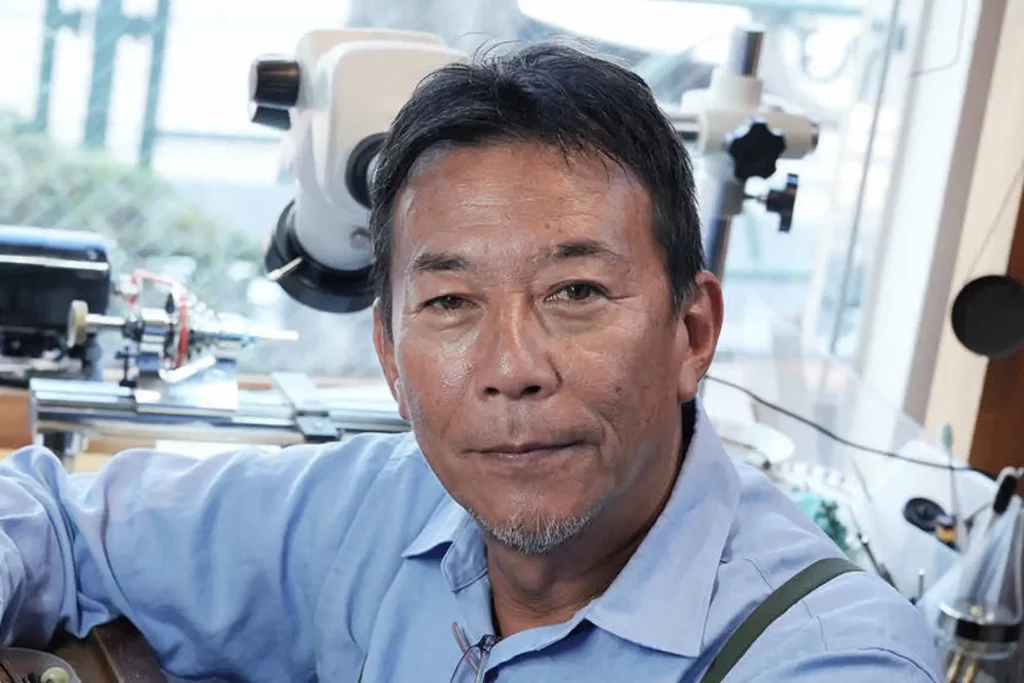
Today, I would like to talk about a Japanese workshop whose trajectory clearly deserves a closer look. If I say former diver turned self taught watchmaker, love of the sea and fishing, and watches designed to last and be passed on, the more attentive among you may already have recognised Masa & Co. and its Kamon model. Before presenting this watch in more detail, let me first go back to the man behind the project, the path that led him into watchmaking, the way his workshop has been built over the decades, and the reason why Masa & Co. now fits into something far deeper than simply being another new independent brand.
To understand Masaharu Nakajima, one almost has to begin far away from the image one might have of a traditional Japanese watchmaker. His story does not begin in a Tokyo workshop, in a watchmaking school, or in an environment where watches occupied a central place from the start. It begins in California in the 1980s, while he was living in Los Angeles and leading a life far removed from watchmaking. At the time, Masa was a diver. He loved the sea, the sun, the American West Coast, and more broadly that mobile kind of life that also took him to the Philippines and Indonesia. The sea is not just a backdrop in his journey, it seems to be a constitutive part of his personality. Even today, he still goes fishing every week and has done so for decades, and everything in the way he speaks about himself suggests that he may still feel more like a man of the sea than a watchmaker.
And yet, it was there, almost by chance, that watches entered his life. In the United States, he crossed paths with a dealer who bought antique pocket watches and resold them to Japanese collectors. That encounter acted as a trigger. The young diver became fascinated by antiques, flea markets, old curiosities, and more specifically pocket watches. This was not yet an entry into watchmaking in the technical sense of the word, but one could already sense a sensitivity taking shape. Something in those old objects, in their mechanics, their history, their presence, began to hold him.
Then came his return to Japan in 1990, under circumstances that feel almost novelistic. A phone call from home brought him back to Tokyo. He left behind his Californian life, his car, his habits, the people around him, and returned to his hometown of Higashimurayama, west of Tokyo. He was still only in his twenties and founded his own shop, which he called Masa’s Junkyard. The name is worth pausing on for a moment. “Junkyard”, literally a scrapyard or dump, may sound surprising, even deliberately provocative. But it already says something about Masa’s humility, his attraction to neglected objects, to things that seem worthless at first sight, and to that very particular ability to see living material in what others might discard.
At first, the shop was not devoted exclusively to watches. It dealt in antiques more broadly. But gradually, the business specialised in vintage and antique watches. Ten years passed between the first watches sourced in Los Angeles and the moment when the shop turned more clearly towards horology. The problem at that stage was that Masa still did not know how to repair the pieces he was selling himself. He entrusted them to older watchmakers, local craftsmen who were often highly experienced but also close to retirement. Repairs were not always up to standard, customers complained, returns piled up, and Masa found himself facing a very concrete dead end. That was the turning point.
Instead of accepting the situation, he decided to learn for himself. Not out of romanticism, nor because he suddenly dreamed of becoming a watchmaker, but because he no longer really had another choice. He began buying as many books as possible, mainly from the United States, gathered old watchmaking tools, dismantled, cleaned, reassembled, experimented. He taught himself. Entirely by himself. This is a fundamental point, because everything that followed with Masa & Co. is rooted in that origin: a self taught path born from a real need, a very concrete frustration, and an almost stubborn determination not to depend on anyone else in order to bring old watches back to life. For several years, he worked only on his own pieces before deciding he could finally begin working on those of his clients.
It was also around that time that Masa’s Junkyard became Masa’s Pastime. The change of name was not insignificant. The jumble of objects became a pastime, or at least something more intimate, more personal, more fully embraced. And it was during this phase of structuring that the team began to take shape. The arrival of Katsu Iwata is especially revealing of the way Masa built his workshop. He did not necessarily recruit profiles shaped by the usual codes of the industry. Iwata originally came from carpentry, from the Gifu region. But he was known for being extremely skilful with his hands, already able at a young age to repair broken watches. That choice says a lot about Masa: what he looks for first is not a pedigree, but intelligence of the hand, sensitivity to gesture, a real capacity to make things. Over time, other profiles joined the workshop, including watchmakers trained at schools such as Hiko Mizuno College in Tokyo, and the team gradually expanded until it counted around ten people.
Over all those years, the workshop accumulated considerable experience. First in the restoration of antique pocket watches and wristwatches, then in the making of custom wristwatches built around antique pocket watch movements, and later in the production of dials, cases and components, combining traditional techniques with more modern machining methods. In reality, long before becoming a proper watch brand, Masa & Co. was already a place where an enormous amount of know how had been concentrated. And that is precisely what makes the next step so logical. Creating their own watch was never a whim. It was the natural result of decades of restoration, repair, making, and close observation of the great watches of the past.
The dream of an in-house movement truly began to take shape around 2013. Masa’s vision was clear: to create a calibre that would be manufactured as fully in house as possible, limiting outside components to elements such as jewels, the mainspring and the hairspring. In other words, the aim was not to start from an existing base and then rework it, but to build something from scratch. That is an extremely rare ambition, even in independent watchmaking. The difficulty was immense. Developing the escapement, the balance, the escape wheel, the pallet stones, all of this demanded an extraordinary level of rigour, especially as Masa refused easy solutions and wanted everything to be made within his own workshop.
It was during this phase that another important figure entered the picture: Fabien Pellet, a Swiss watchmaker living in Japan for a time. For around three months, they worked together on a first movement project. The design was good. The project moved forward. Then came a decisive meeting, the one with Philippe Dufour. During a visit to the workshop, Masa showed him the prototype and the technical drawings of the movement under development. The Swiss master observed for a long time, studied the plans, and eventually delivered a judgment that was as valuable as it was unsettling. The movement was good, he said, but it lacked a Japanese sensibility. Something that would distinguish it from what one might find in a Swiss watch. That remark hit hard. Masa realised that if he wanted to go all the way with his approach, he could not simply produce a beautiful movement. He had to produce a movement that truly carried his identity, the identity of his workshop, his culture, his own way of making watches. The first project was therefore abandoned, and everything almost started again from scratch.
It would take nearly ten years for that new movement to finally come into being. Ten years to secure materials, develop the critical components, refine the choices, remake what did not satisfy him, and carry the project all the way to the desired level. That is how the MP1 calibre was finally born in 2024, the workshop’s first true in house movement. In the meantime, Masa’s Pastime created Masa & Co., the house’s own original watch brand. And that launch was far from insignificant. It marked both the culmination of more than thirty years spent with antique watches, and a new beginning.
Ultimately, what makes this project especially compelling is not simply the existence of a new Japanese movement or a new independent brand. It is the depth of the road that led there. Masaharu Nakajima is not a young creator arriving in watchmaking with a seductive idea and a good story. He is a man who has spent his life restoring, observing, dismantling, understanding, repairing and making. Someone who has seen hundreds of pocket watches pass through his hands, studied their technical solutions, understood their weak points, and built with his team a workshop capable not only of preserving those objects, but now of creating new ones with the same idea in mind: to make watches designed to last, to be repaired, to be passed on, and in turn to become heirlooms themselves.
It is in this context that the Kamon appears today. And if this model deserves a closer look, it is precisely because it does not come from nowhere. It belongs to a long story, deeply human, deeply Japanese, shaped by the sea, by restoration, by self taught mastery, by stubborn determination, and by the simple but powerful idea that a watch only has real value if it can continue to live far beyond its first owner. Let us now turn to the watch itself.
Table of Contents – Masa & Co. Kamon
What are the key features of the Masa & Co. Kamon?
Case
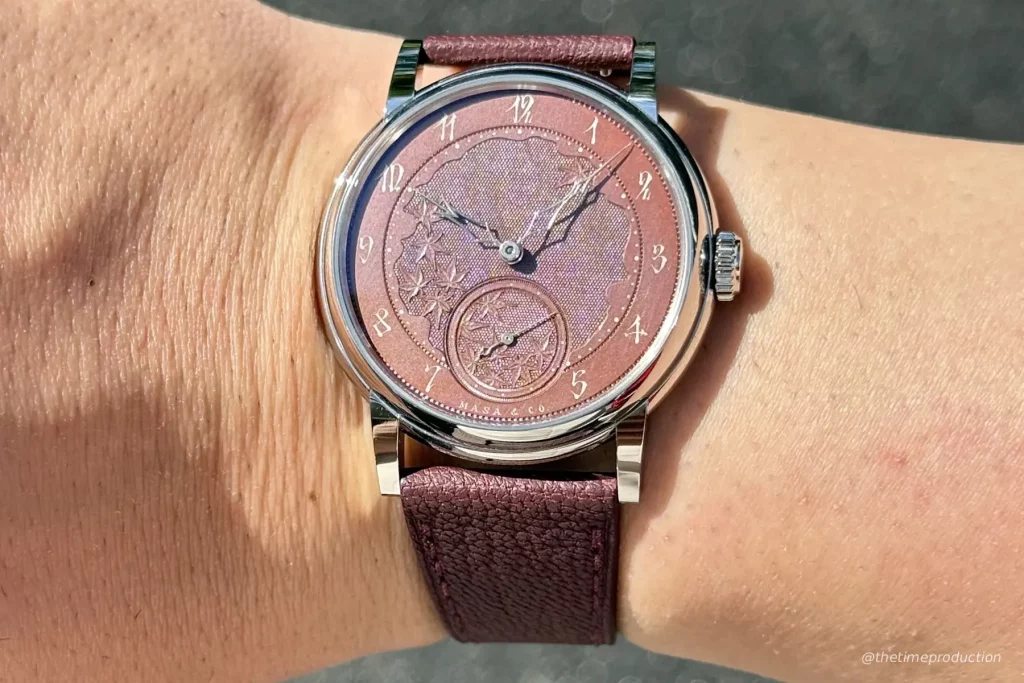
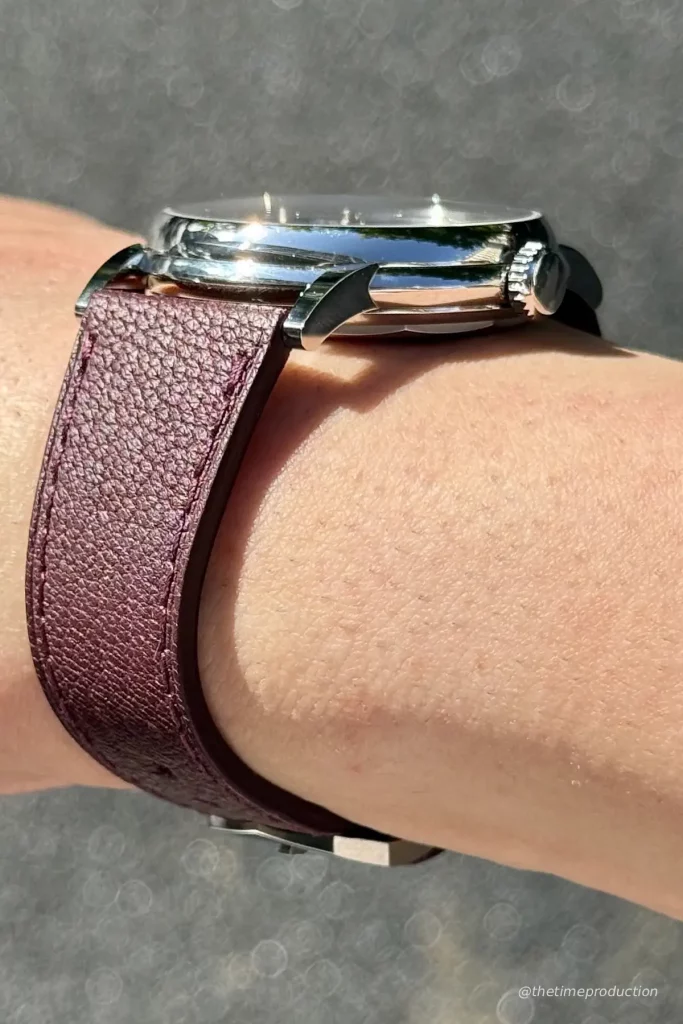
With this Masa & Co. Kamon, what struck me first was really the accuracy of its proportions. At 38 mm in diameter and around 10 mm thick, this is a watch that wears extremely well. On my wrist, which is not particularly large, I found the balance very convincing. The watch has that immediately comfortable, natural, almost obvious feel, while still keeping a real presence. And that is precisely what I liked. It is something very classical in spirit, yet it never feels small or absent on the wrist, notably thanks to fairly assertive lugs that give the whole watch more grounding.
What I particularly appreciated was the overall construction of the case. Everything is fully polished, yet it never gives off a cheap or overly simple impression. On the contrary, thanks to the different shapes, the curves and the changes in volume, you can very clearly distinguish the various elements of the case. The bezel, also fully polished, is very beautiful, especially since the sapphire crystal sits almost flush with it, which gives the whole watch a lot of visual finesse. Then the caseband develops another shape, almost like a half-circle, which gives the case a little more presence and depth without making it heavier. It is very well thought out, very harmonious, and it works really well visually.
I also found the lugs very successful. They seem to anchor directly into the caseband rather than into the bezel, which gives the watch a very pure and coherent silhouette. Above all, they slope down slightly, which plays a major role in comfort on the wrist. This is exactly the kind of detail that does not necessarily jump out at first glance, but changes a great deal once the watch is actually worn. It also contributes to that general feeling of a watch that is well born, well built, and designed to be enjoyable to wear over time.
More broadly, I think this case carries very well the idea of legacy that Masa & Co. is trying to defend. There is something very classical in the lines, almost a direct link with those watches built around pocket watch movements that the workshop long transformed for wristwear. There is real restraint in the design, but a restraint that never prevents the watch from having character. One senses a desire to make a durable, timeless watch, rooted in a certain tradition, without falling into pastiche or forced retro styling.
If I really had to qualify one point, I would say that I might have liked a very slight reinforcement or recess at the level of the caseband to integrate the crown even better. Not because it is unsuccessful, far from it, but simply because a little more work in that area might have made it sit even more discreetly within the overall profile. That remains a minor detail, however, because overall the crown works well and does nothing to disturb the balance of the case.
In the end, I find this case very successful. It is classical, elegant, perfectly wearable, yet sufficiently well built never to feel ordinary. Above all, it seems to me completely coherent with the overall identity of the Kamon and with the Masa & Co. project as a whole. It is a case that does not try to do more than necessary, but does exactly what it needs to with great precision, and that is precisely what makes it strong.
Dial
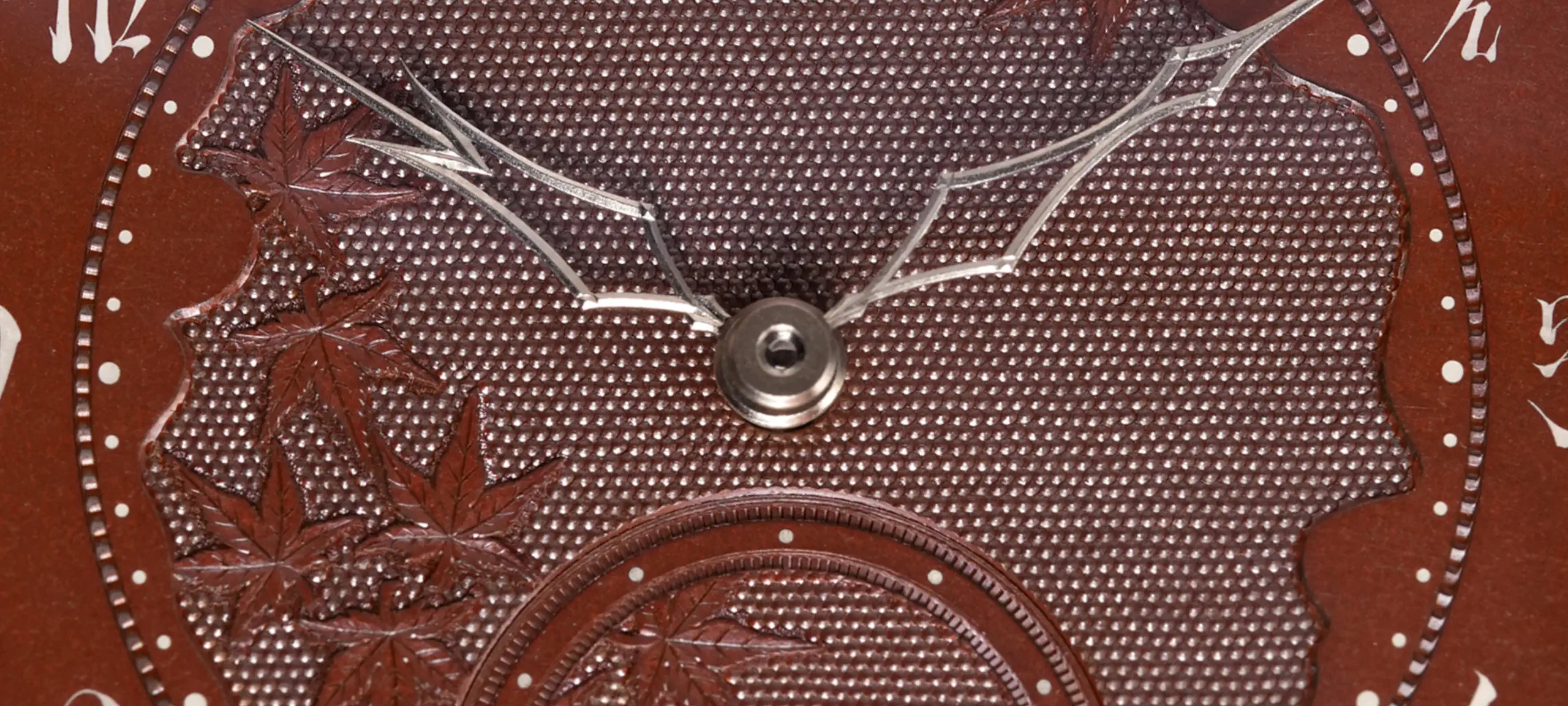
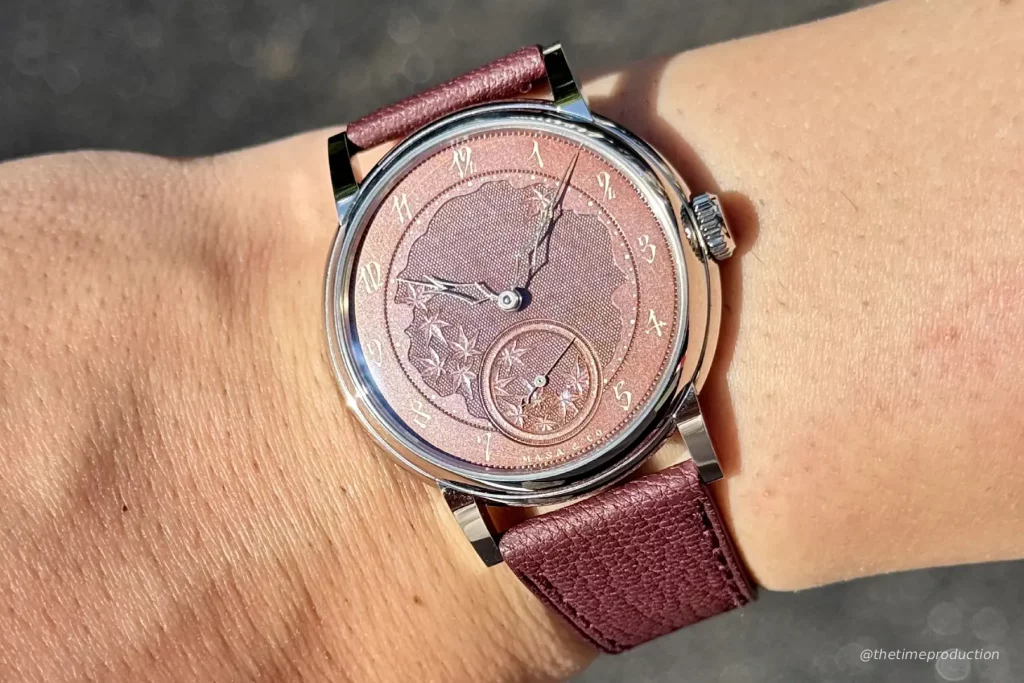
The dial of this Masa & Co. Kamon is, in my eyes, one of the strongest elements of the watch, and probably also the one that most clearly expresses the Japanese sensibility that Masaharu Nakajima was precisely trying to bring out in his creations. What struck me most, visually as much as conceptually, was first the work on the maple leaves, but also that very particular copper patina, which gives the dial truly magnificent depth and vibration. This is not simply a decorated dial. It is a genuine work of craftsmanship, where material, colour, engraving and light are in constant dialogue.
The choice of the name Kamon also makes complete sense here. It suggests the idea of a motif, a symbol, almost an emblem, and that corresponds perfectly to the way this dial was conceived. We find hand engraved maple leaves on a pure copper base treated chemically according to a traditional method, with that hand punched nanako texture bringing incredible richness to the whole. This background is never static. Depending on the light, the dial seems to shift subtly in tone, moving from aged copper to pinker, more violet shades, at times almost purplish. And that is precisely what makes it feel so alive.
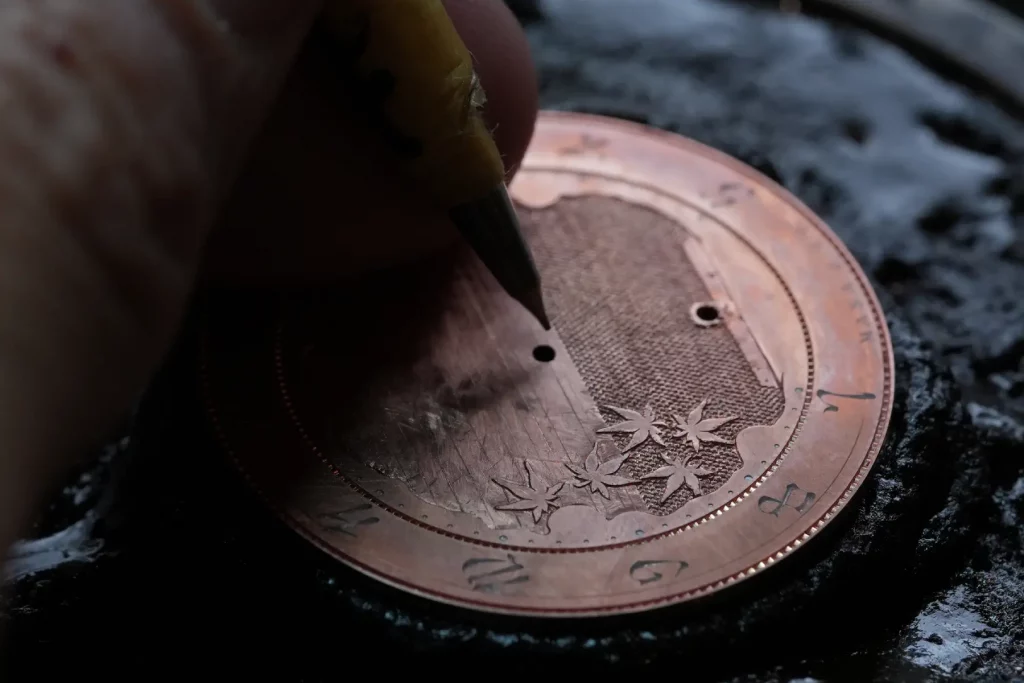
What I find particularly successful is that this decorative richness never harms legibility. Quite the opposite. Despite the level of detail, despite the finesse of the work, despite the patina and the relief, reading the time remains excellent. The hands stand out perfectly, and that owes a lot both to their design and to their execution. These are obviously not standard hands. They are handmade in platinum, with a style that is rare today, and their presence on the dial is truly superb. There is something both very refined and very coherent in the way they interact with the decoration. They stand out clearly without breaking the overall harmony, which was not necessarily easy on such a richly worked dial.
I also really liked the typography. It is truly unique, and I find that it subtly echoes the design of the hands. That gives the dial very strong visual unity. Nothing seems placed there by chance. Even the logo at six o’clock is especially well integrated. This is typically the kind of detail that can seem secondary, but it makes a real difference in the overall balance of the dial. Here, everything feels exactly where it should be.
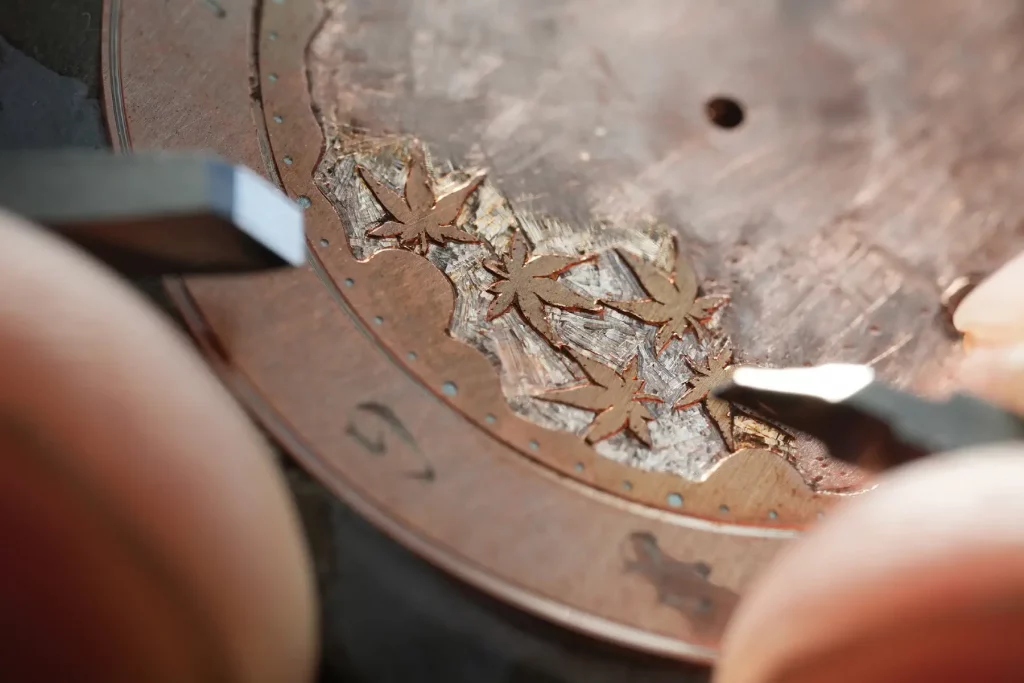
What also works very well, in my opinion, is the immediate artisanal feeling that comes from the whole. You understand right away that you are not looking at a dial produced in series through standard industrial processes. Kei Tsujimoto’s work is absolutely central here, and it really deserves to be highlighted. You can feel in this dial the hand of an engraver, the precision of the gesture, but also a real decorative sensibility. And that is, in my eyes, one of the great strengths of this watch: it is not only trying to be beautiful, it is trying to offer something that cannot be found in a large industrial brand, however well executed it may be.
If I had to qualify something, honestly, it would be difficult. The dial is indeed very decorated, but never overly decorative. It keeps real poise and real elegance without tipping into excess. For some tastes, one might imagine that such a high level of work could feel a little too expressive, but in reality the whole remains extremely coherent. And that is precisely what seems strongest to me. The dial never gives the impression of trying to impress gratuitously. It carries something deeper, more cultural, more personal.
In the end, I find that this dial brings something genuinely distinctive and memorable compared to many other watches in the same register. First through its technique, then through the Japanese sensibility it expresses, and finally through the quality of Kei Tsujimoto’s work, which really deserves to be underlined. It is a dial that combines craftsmanship, legibility, coherence and identity. And to me, that is precisely what makes it so successful.
Movement
The movement of this Masa & Co. Kamon is, in my eyes, one of the most important aspects of the watch, and probably also one of the most revealing of the workshop’s overall approach. Because here, we are not simply talking about a beautiful calibre placed behind a sapphire caseback. We are talking about the MP1, the team’s first real movement after an extremely long gestation period, developed with the very clear ambition of creating something almost entirely designed and manufactured in house. And that obviously changes everything in the way the piece is understood.
What struck me most when looking at this movement was first its level of finishing, but also the fact that it genuinely feels born from the workshop, from its history, from its years of restoration work, and from the experience it has accumulated through hundreds of antique watches. You feel that immediately. This is a movement that does not come out of an abstract design exercise, but from a very deep understanding of what makes a good classical calibre, one that is durable, repairable and well built. For me, it therefore adds real value to the watch, far beyond the discourse alone. This is not a movement one admires only because it is rare or because it is “in house.” One admires it because it is coherent, credible and very well executed.
What a serious collector should retain first and foremost is that this MP1 was developed from scratch, with an almost stubborn determination to make everything in the workshop except for a few very specific components such as the hairspring, the mainspring and the jewels, which still come from outside suppliers, mainly in Switzerland and Germany. But to me, that in no way diminishes the scope of the effort. On the contrary, it also shows a certain intelligence. Wanting to make absolutely everything in house at any cost would not necessarily make much sense here. The essential point is that everything that can reasonably be designed and produced in the workshop is in fact made there, and that is already immense.
This movement is also fascinating because it perfectly reflects the experience accumulated over decades of restoration. Masa and his team have spent their lives taking apart, observing, repairing, remaking and understanding old watches. They know which parts wear out, which ones fail, which architectures age elegantly and which ones do not. And that comes through very clearly here. The MP1 does not try to be spectacular through an unnecessary complication. First and foremost, it seeks to be right, durable, repairable and deeply rooted in a tradition of sound horological construction. That is a fundamental point.
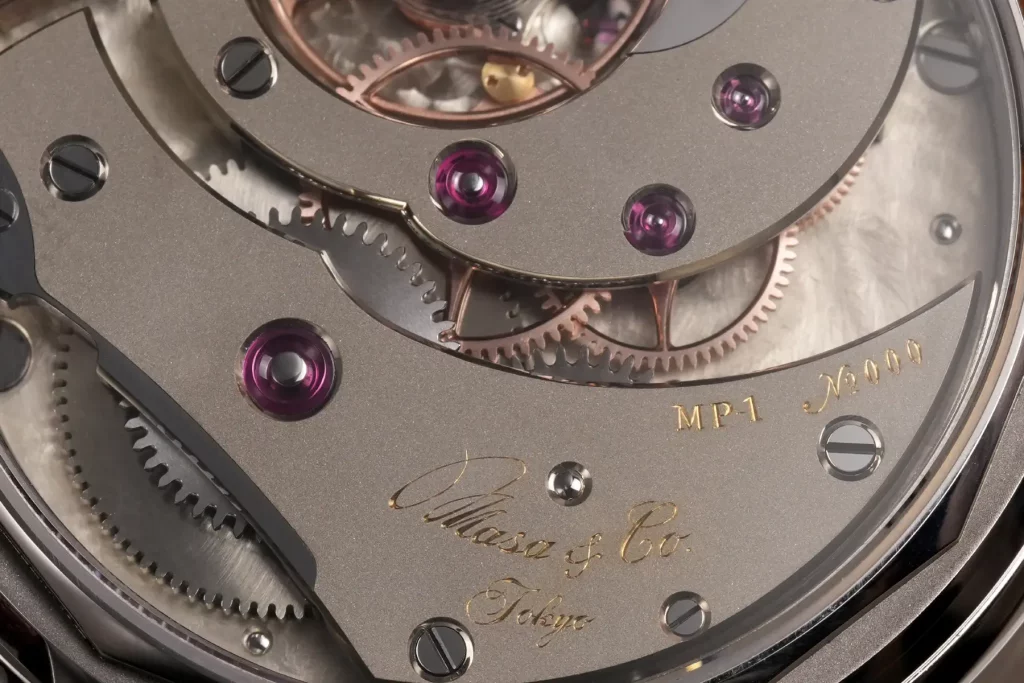
Aesthetically, the architecture draws very naturally from great vintage Swiss calibres, and that is no surprise. When you have spent so many years restoring the great movements of the past, you end up almost unconsciously absorbing their language. But what I like here is that this is not merely a repetition of classical codes. There is also a personal intention. Masa notably wanted to introduce a deliberate imbalance in the negative space of the movement, rather than aiming for a uniformly filled and overly polite plate layout. This detail may seem secondary to some, but I find it very interesting. It says something about a sensibility, about a desire not simply to reproduce an existing grammar, but to shift it slightly in order to impose a more personal character.
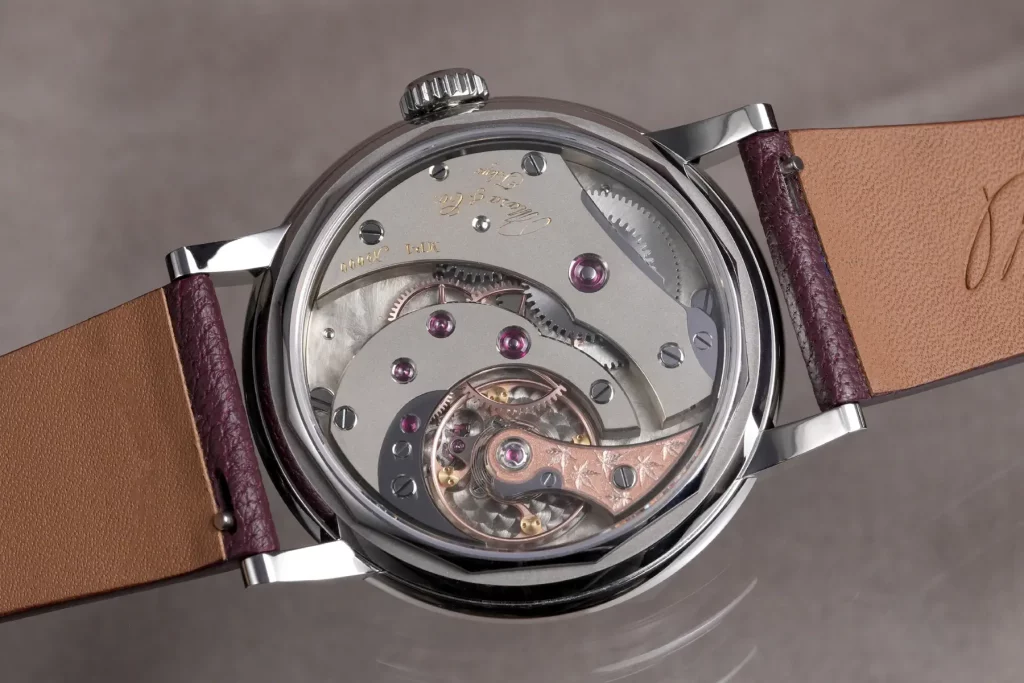
The level of finishing is especially convincing as well. We find a frosted finish specific to this Kamon version, a hand engraved cock with maple leaf motifs, carefully executed anglage, mirror polished steel parts, and above all that very beautiful gold gear train, which immediately gives the movement a particular visual presence. The copper beryllium balance with its timing screws and gold weights, the lever escapement, and the critical components manufactured in the workshop all show that this is a first movement that was not conceived halfway. For a first in house base, it is already extremely solid.
The role of the stop-work on the barrel must also be underlined, since it regulates the actually usable portion of the mainspring in order to favour more stable operation over around 32 hours. Yes, the power reserve remains relatively modest on paper, and some may point that out. But honestly, I do not think that is the main subject of this watch. When you look at what Masa & Co. is trying to do, you quickly understand that this is not the kind of watch one comes to for a modern specification sheet designed to impress through numbers. You come here for a logic of operation, reliability, mechanical coherence and artisanal beauty. And within that framework, that power reserve is not an issue for me.
What I especially appreciate, finally, is that this movement feels both like an achievement and a point of departure. An achievement, because it took them years of work, trials, reassessments and development to get here. And a point of departure, because you can clearly feel that this MP1 is not an end in itself. It is the first true stone in a horological language that can later evolve, become more complex, and explore other complications and other architectures. And I find that very important in the way the project is read.
In the end, this movement is one of the Kamon’s strongest arguments. Not only because it is almost entirely manufactured in house, nor only because it is beautifully finished, but because it synthesises the whole history of the workshop: restoration, patience, stubbornness, the search for a distinctly Japanese sensibility, and the desire to create a watch that can endure for a very long time. And for me, that is precisely what makes it so compelling.
Strap
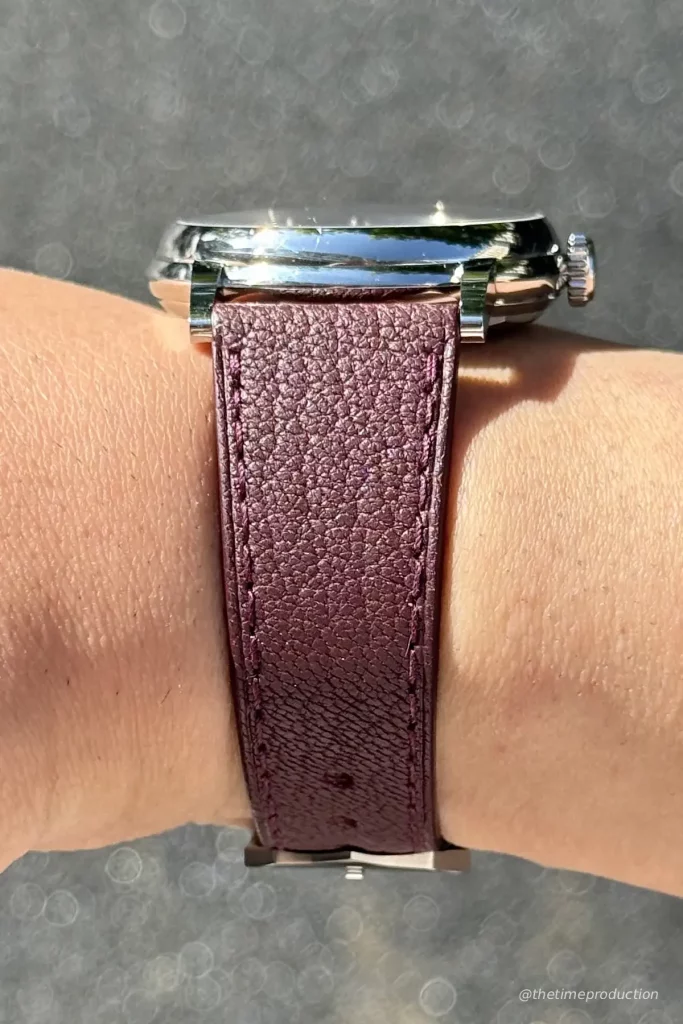
The strap of this Masa & Co. Kamon also felt completely up to the level of the watch. We have here a strap in a coppery burgundy tone, very well chosen, that interacts perfectly with the shades of the dial. This is exactly the kind of detail that matters on a watch like this, where the whole must work coherently. The stitching, also in burgundy tones, reinforces that visual link without ever overdoing it. The result remains elegant, refined and above all very well judged.
On the wrist, I found it very comfortable. It sits well, remains fairly slim, and does not try to overplay the precious or demonstrative side that some alligator straps can sometimes have. Here, we are dealing with something more discreet, supple, well executed, that accompanies the watch without stealing the spotlight. And I think that is exactly what was needed. There is also a quick release system, which is always appreciable in daily use.
I also really liked the buckle in 316L stainless steel. It is not entirely classical in its design, and that is precisely what makes it interesting. Instead of a simple upper arc, it develops a more angular geometry, with several breaks that give it a more worked silhouette, almost like a motif of small flames or battlements. It is subtle, but it adds a real extra touch of personality to the whole.
In the end, I find this strap fulfils its role perfectly. It is comfortable, coherent, well finished, and sufficiently restrained to let the dial and the watch express themselves fully. Once again, one senses a real mastery in the way they make something simple, but right.
What is the price of the Masa & Co. Kamon?
The Masa & Co. Kamon is priced at 10,500,000 yen, plus 10% tax, with production limited to 7 pieces for 2027 and a stated delivery time of 12 months after receipt of a 50% deposit.
At the current exchange rate, this represents roughly CHF 52,000 to CHF 52,300, depending on the rate used at the time of conversion.
To me, this positioning is coherent with the overall proposition of the watch. We are talking here about a piece produced in a very small quantity, supported by genuine craftsmanship, an internally developed movement born from many years of research, and an approach that remains deeply artisanal. The rarity is therefore not artificial. It simply comes from time, the level of execution and the workshop’s real production capacity. And that is precisely what gives this Kamon its full meaning, in my eyes.
Masa & Co. Kamon: a highly accomplished piece that confirms the depth of a project already firmly underway
With this Kamon, Masa & Co. is obviously not presenting its first watch in the strict sense. And that is precisely worth pointing out. The workshop had already introduced several other models before, and that is immediately noticeable. The Kamon is nothing like a first attempt. On the contrary, it feels like a highly accomplished piece, carried by a project that has already had time to lay its foundations, refine its language, and build real coherence. That is also why I find it particularly interesting: it does not appear out of nowhere, it belongs to a continuity.
What I found especially strong about this project is that it rests on something deeply credible, deeply human, and above all deeply lived. We are not talking here about a brand born from a good marketing concept or a simple desire to enter independent watchmaking because the timing seems right. We are talking about a man who has spent decades restoring, repairing, observing, learning and passing things on, and who now arrives with watches that condense all of that into something genuinely coherent.
That is probably what touched me most about Masaharu Nakajima. Beyond the watch itself, there is a person. A simple, direct, likeable person, very straightforward as well, with real humility and real depth in the way he approaches things. I had the chance to meet him in Geneva a few weeks ago, and it was a moment I truly appreciated. There was something very sincere in the way he spoke about his work, his journey, his desires, and even his doubts. And that comes through immediately in what he makes. Nothing about him feels forced. Nothing feels performed. And that is precisely why his project feels so interesting to me.
The Kamon is, in my view, a very successful watch because it perfectly embodies that overall coherence. The case, dial, movement and strap all seem to move in the same direction. There is obvious artisanal depth, a genuine Japanese sensibility, yet never treated in a folkloric or decorative way in the pejorative sense. And that is, to my mind, one of the project’s great strengths. Masa & Co. is not trying to make a “Japanese watch” in a caricatural way, nor to produce a souvenir object for foreign collectors looking for something exotic. On the contrary, the workshop is trying to integrate that sensibility with subtlety, restraint and real intelligence in the details. And that changes everything.
In the end, that is perhaps what I retain most from Masa & Co. today. A project that is not trying to rush things. A project that has taken its time. A project built on real horological experience, real standards, and a genuine sense of purpose. And within that context, the Kamon appears not as an isolated starting point, but as a highly accomplished piece that confirms the depth of a project already firmly underway.
I would also like to sincerely thank Masaharu Nakajima for his time, his kindness, and that almost timeless moment I had the chance to share with him. And I truly hope I will have the opportunity later this year or next year to visit him in his workshop in Japan and discover even more deeply what he is building there with his team.
Masa & Co. Kamon – Watch Specifications
- Brand: Masa & Co.
- Model: Kamon
- Case Material: Stainless Steel
- Dial: Pure copper dial traditionally treated in the chemical solution
- Functions: Hours, Minutes, Small Seconds
- Movement: MT1, Manual-Winding, 21 jewels
- Power Reserve: 32 Hours
- Water Resistance: 3 ATM
- Crystal: Sapphire
- Case Back: Sapphire
- Case Dimension: 38mm (Diameter) x 10mm
- Strap: Burgundy calf with Stainless Steel Pin Buckle
- Availability : Limited to 7 pieces only for the 2027 production
- Retail Price: around CHF 52,000 (excluding VAT)
What do you think of this Masa & Co. Kamon and, more broadly, of this kind of watchmaking project born from restoration, transmission, and a very personal vision of what a watch made to last should be?
If this article added value or sparked a discovery, you can support the project HERE. Your contribution helps me keep weekly articles and a biweekly newsletter free, accessible, and independent for everyone.
For more information about Masa and Co., click here.