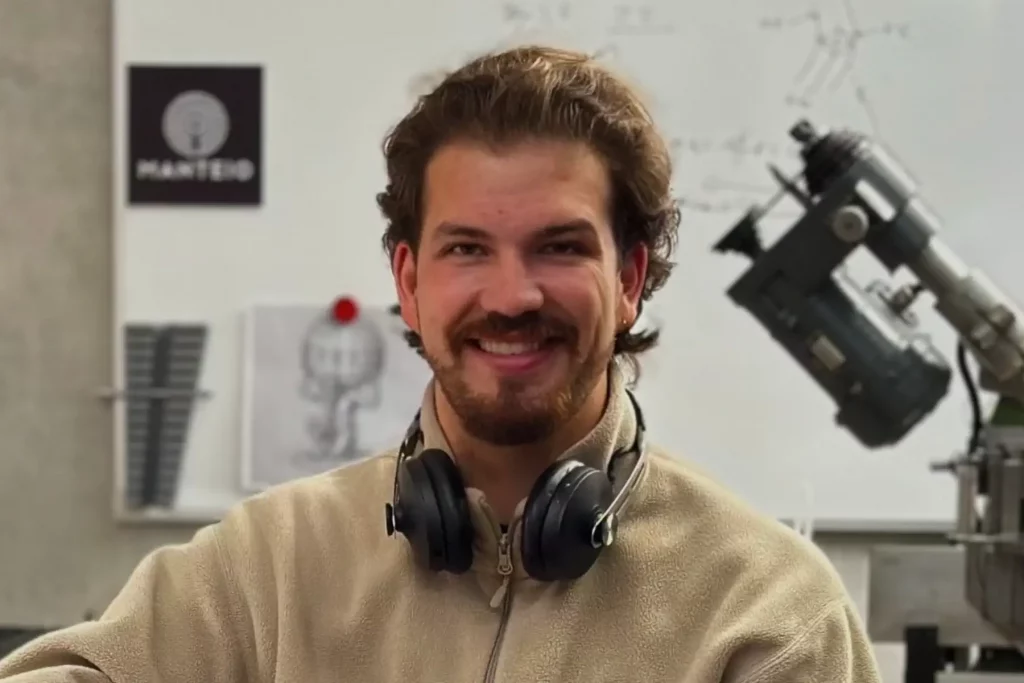
Today, I would like to talk about a young independent creator whom I had the opportunity to meet in Geneva a few weeks ago. If I say Greek mythology, watchmaking craftsmanship and narrative design, the more attentive among you may already have recognised Manteio and its Zeus. Before presenting this watch in more detail, let me first go back to the person behind the project, the way his passion took shape, the path that led him from mechanical engineering to watchmaking, and the way he sought to turn his first watch into a true story worn on the wrist.
With Alex Goetschi, everything seems to begin with a very early fascination for objects, the way they are made, and the way they can carry a particular presence within them. As a child, he was already drawn to how things worked, to mechanics, to the idea of understanding how an object takes shape and how it can be built by hand. He grew up in a small town in Switzerland, with the kind of practical curiosity that often appears in those who later develop a deep affinity for craftsmanship. But when it comes to watchmaking, there was also a more precise and more intimate trigger, and as is often the case, it came from his father. His father always wore watches, and one day he came home with a piece made by a local watchmaker, fitted with a hand-skeletonised and hand-engraved Unitas movement, an enamel chapter ring and beautiful old-style hands. Seeing the mechanics so openly displayed, and understanding that such an object could be transformed, decorated and shaped by the hand of a craftsman, was a real turning point for Alex. That was the moment when watchmaking began to become something more than a simple interest in well-made objects.
It is also worth saying that even before that turning point, the watch already held a particular place in his life. For his first year at school, his parents had given him a football-themed watch with a yellow strap, and he remembers never leaving home without it. So that attachment to a worn object, to its daily presence, goes back a long way. But what truly changed the nature of his relationship with watchmaking was the discovery of visible mechanics, of the movement as spectacle, of craftsmanship as a language.
And yet Alex Goetschi does not come from the watchmaking world in the traditional sense of the term. He trained as a mechanical design engineer, and that is a very important point when it comes to understanding his project. He does not approach the watch only as a watch enthusiast fascinated by tradition, but also as someone who thinks in terms of structure, composition, function and formal coherence. And I believe that can already be felt in the way he conceives his watches. Where a pure watchmaker might sometimes begin with the movement or with the tradition of the trade, he also seems to pay very close attention to the meaning of forms, to the place of each detail within a broader story, and to the capacity of an object to convey something beyond its mere function.
The real turning point came during the Covid period. Before that, Alex was deeply involved in sport and high-level competition. With the sudden halt of competitions, he began looking for another passion, something that could occupy him, stimulate him and perhaps also open up a new field of expression. He bought a watchmaker’s lathe, a few simple tools, some books, and started setting up his workshop. At first, it was simply about learning, exploring and making something with his hands. But very quickly, that curiosity became a real passion. He spent long hours repairing old movements, making replacement parts and experimenting. One day, while trying to shape a steel hand using only manual tools, he realised just how long the road would be before he could create a complete watch that would meet a level of quality he would be proud to sell. But rather than discouraging him, that realisation seems instead to have confirmed the depth of his commitment.
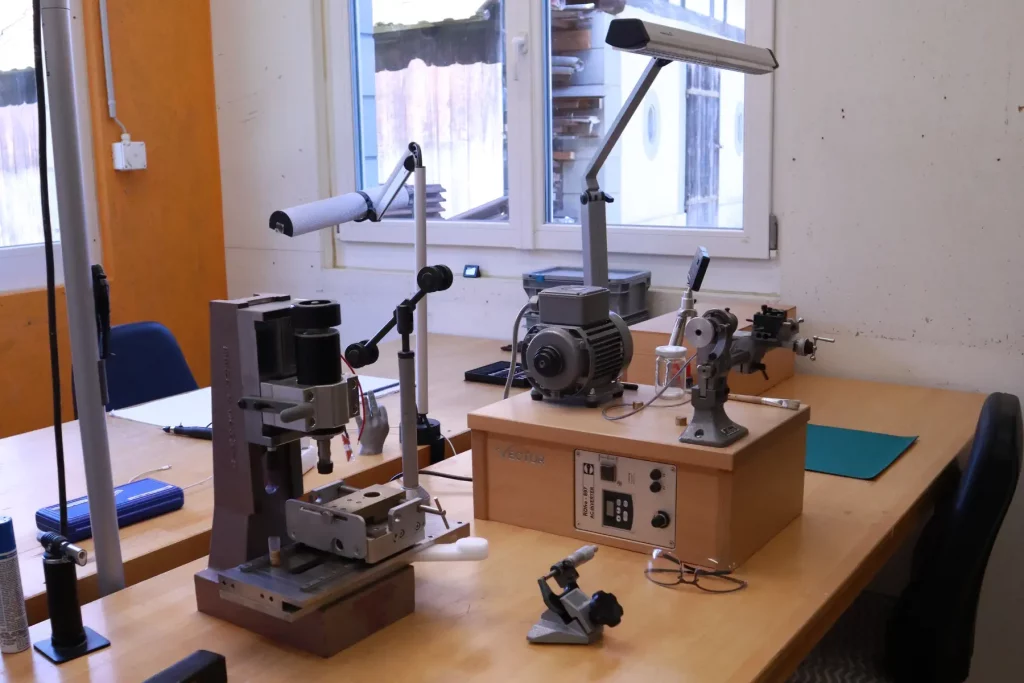
It was also during that period that the project truly began to take shape. Because Alex did not stop at teaching himself watchmaking. He also started imagining a brand capable of bringing together several of his passions: Greek mythology, traditional watchmaking and craftsmanship. Stories and myths had always fascinated him. Even as a child, he devoured all kinds of fantasy narratives. Later, he discovered that many of those books found their roots in Greek myths, and he began to immerse himself in that world, first through Stephen Fry’s Mythos, then more deeply through Homer and the classical texts. That narrative dimension did not remain external to the project. It gradually became its core.
The decisive spark seems to have come one evening while reading the passage in Mythos about the marriage of Zeus. At that moment, the idea came to him almost as an obvious one: to tell these ancient, fascinating and still deeply human stories through works of mechanical art worn on the wrist. From there, the Manteio project truly began to take form. The first sketches showed a relatively simple watch, with a few references to Greek architecture and a few allusions to Zeus. But by talking about it around him, by showing his drawings to close friends and explaining the meaning behind the details, Alex quickly realised that every element of the watch could help tell part of the story. The design then evolved progressively into what it has become today.
That process took time. Nearly five years passed between the first ideas and the final watch. And that matters, because it shows clearly that Manteio was not born from an intuition immediately turned into a finished product. It is a project built through maturation, trial and error, experimentation and refinement. Alex first imagined other case shapes, worked on dials that never made it to production, tried different approaches, made, corrected and started again. It is almost an initiatory journey, in which each stage served to clarify the vision of the project a little more.
The very name of the brand says a great deal about that ambition. Manteio comes from the Greek word meaning oracle. Alex chose that name because he does not see his watches as simple instruments for measuring time, but as objects carrying meaning, conceived to invite contemplation, tell a story and become companions for the wearer’s own journey. The logo extends that same logic: it is inspired by the floor plan of a tholos, the circular temple in which oracles received their prophecies. The lines of the logo represent the inner and outer walls of the temple, while the dots mark the position of the columns. Once again, nothing is arbitrary. Every element contributes to building a world.
It is in that context that Zeus appears, the first timepiece in Manteio’s Mythos collection. It is not merely the brand’s first watch, but the opening chapter of a much broader ensemble intended to tell, over time, the stories of the gods, heroes, titans and creatures of ancient Greek mythology. And there was a certain logic in beginning with Zeus. Because he is the one who brings the reign of the Titans to an end and inaugurates that of the Olympians. Because he is the sixth child of Rhea and Cronos, the one who escapes his fate as a devoured child thanks to the stratagem of the stone wrapped in swaddling cloth. Because he grows up hidden, secretly nourished, before returning to fulfil the prophecy and overthrow Cronos. And because, in the end, this story of destiny, survival, patient construction and the taking of power resonates particularly well with the very logic of a first watchmaking project.
In the end, what strikes me as especially interesting about Manteio is precisely this desire to make the watch into something more than a simply beautiful object. Alex Goetschi is not merely trying to create a piece that is aesthetically successful. He is trying to propose a watch that tells something, where every line, every texture and every detail is part of a broader narrative. And that is precisely what makes this first creation so compelling. Now, let us turn to the presentation of the watch itself.
Table of Contents – Manteio Zeus
What are the key features of the Manteio Zeus?
Case
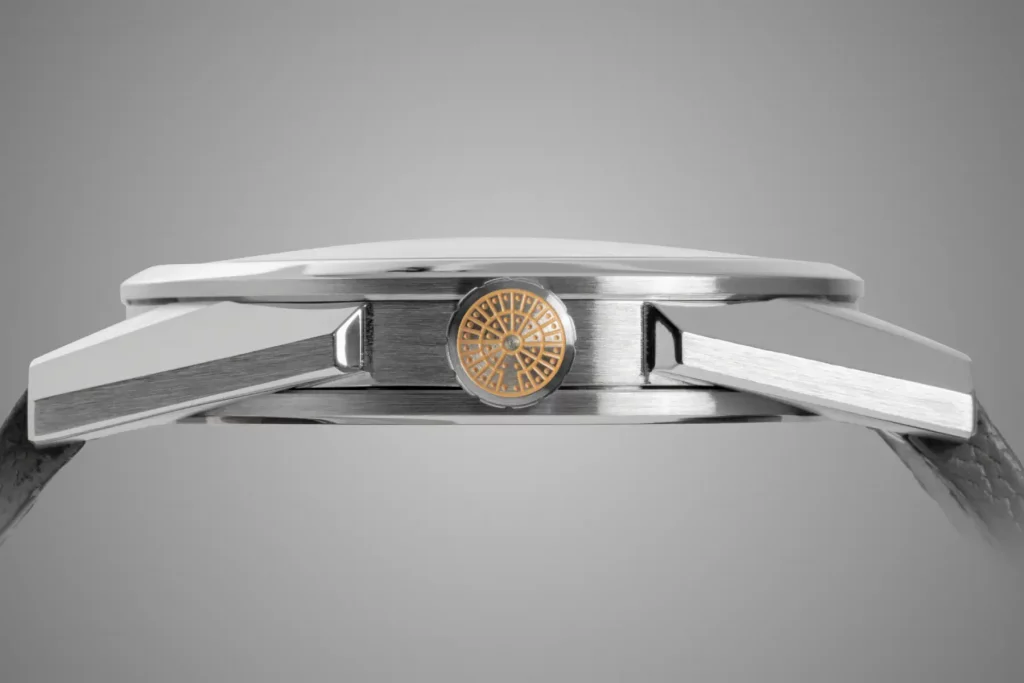
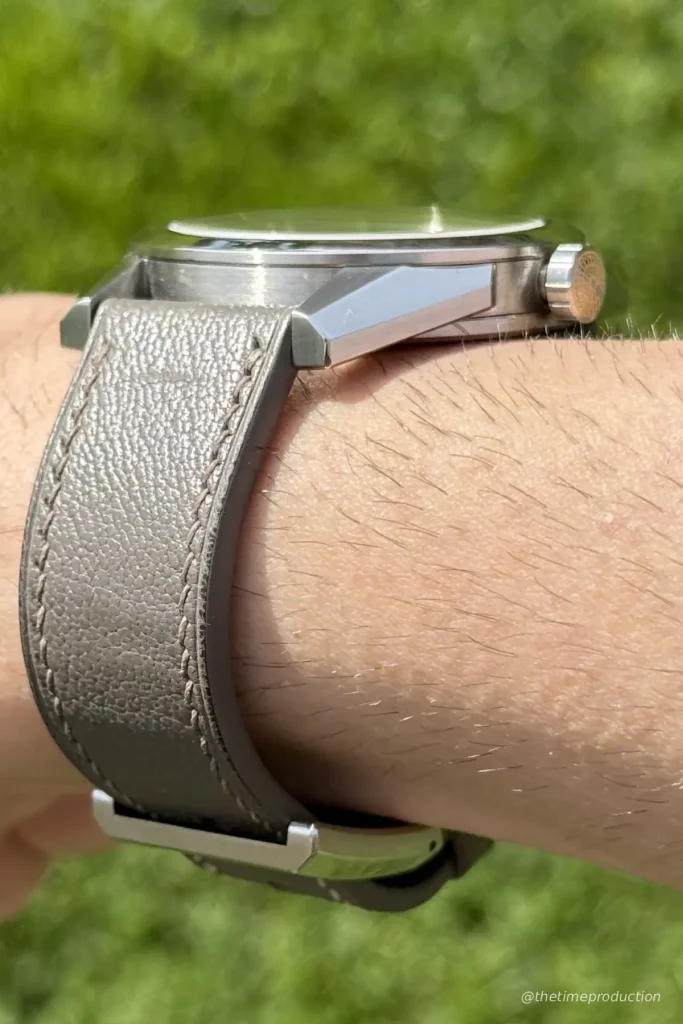
What struck me first about this Manteio Zeus was really the construction of the case. On paper, one might almost think it is a fairly simple, fairly direct case, but in reality it reveals far more complexity as soon as you look at it closely or wear it. There is this constant interplay between polished and satin-brushed surfaces, between very assertive edges and more fluid volumes, which gives the whole watch real personality. And on the wrist, even though the watch measures only 39 mm in diameter and 9.7 mm in thickness, it still has a fairly strong presence. That comes largely from the lugs, which are quite pronounced, fairly long, but above all very well executed. It was precisely this mix of strength, structure and refinement that appealed to me immediately.
What I particularly appreciated is that this case fully embraces its character without ever becoming heavy-handed. The lugs are imposing, yes, but they are also very well drawn. The fact that they are integrated into the caseband rather than attached already brings a real nobility to the construction. Above all, it gives the case very strong visual coherence. You can feel that there was real thought behind their architecture. And when you know they were designed to evoke the pediment of a Greek temple seen in profile, that becomes even more legible. You really find this idea of architecture transposed to the scale of a watch. And that is probably what makes the whole thing so successful: there is a real intention, but it is never artificially imposed on the object.
The other strong point, in my view, is the finishing work. Honestly, for a watch of this kind, I find the level delivered on the case extremely convincing. I have already seen far more expensive watches with cases that were much less interesting. Here, there is a real interplay of surface treatments, and that makes all the difference. The large polished facets visually lighten the lugs, which might otherwise have appeared too massive. It is especially well judged, because it avoids any risk of heaviness or excessive ruggedness. Even if the construction remains virile, assertive and fairly masculine in its expression, there is always a form of refinement that balances the strength of the design. And in sunlight, it works particularly well. The case catches the light, the lines stand out, the edges come alive, and you understand even more clearly the care that went into its shaping.
I also found the crown very well integrated into the whole. It is neither too large nor too demonstrative, it offers good grip, and the small engraved logo brings just enough personality without overloading the piece. Once again, you feel that nothing has been left to chance. There is even a small subtlety in the way the lug seems to lift slightly away from the caseband, which almost gives the impression that a reinforcement has been created to better accommodate the crown. It is a detail, but a detail that contributes to the overall impression of a very carefully studied case.
If I had to qualify one point nonetheless, I would say that personally, on my wrist, I might have imagined slightly shorter lugs. Not because the current proportions are wrong, quite the opposite, I find them very coherent, but simply because on a wrist like mine, it might perhaps have lightened the overall presence a little. That said, this remains a very personal reservation. Because in absolute terms, the proportion works well, and it is precisely this lug length that allows the case to preserve its very architectural identity without appearing too compact.
In the end, this case seems totally coherent to me with the overall identity of the watch and the project. One very clearly finds here the codes of architecture, mythology, Greek temples and this desire to create a watch that carries meaning. There is something timeless in the design. The watch is neither too small nor too big, it does not try to follow a trend, and it has real singularity without falling into excess. For me, it is an atypical, very successful case with a lot of character, and even if it may be a little imposing for my own wrist, I find that it contributes enormously to the strength of the Zeus.
Dial
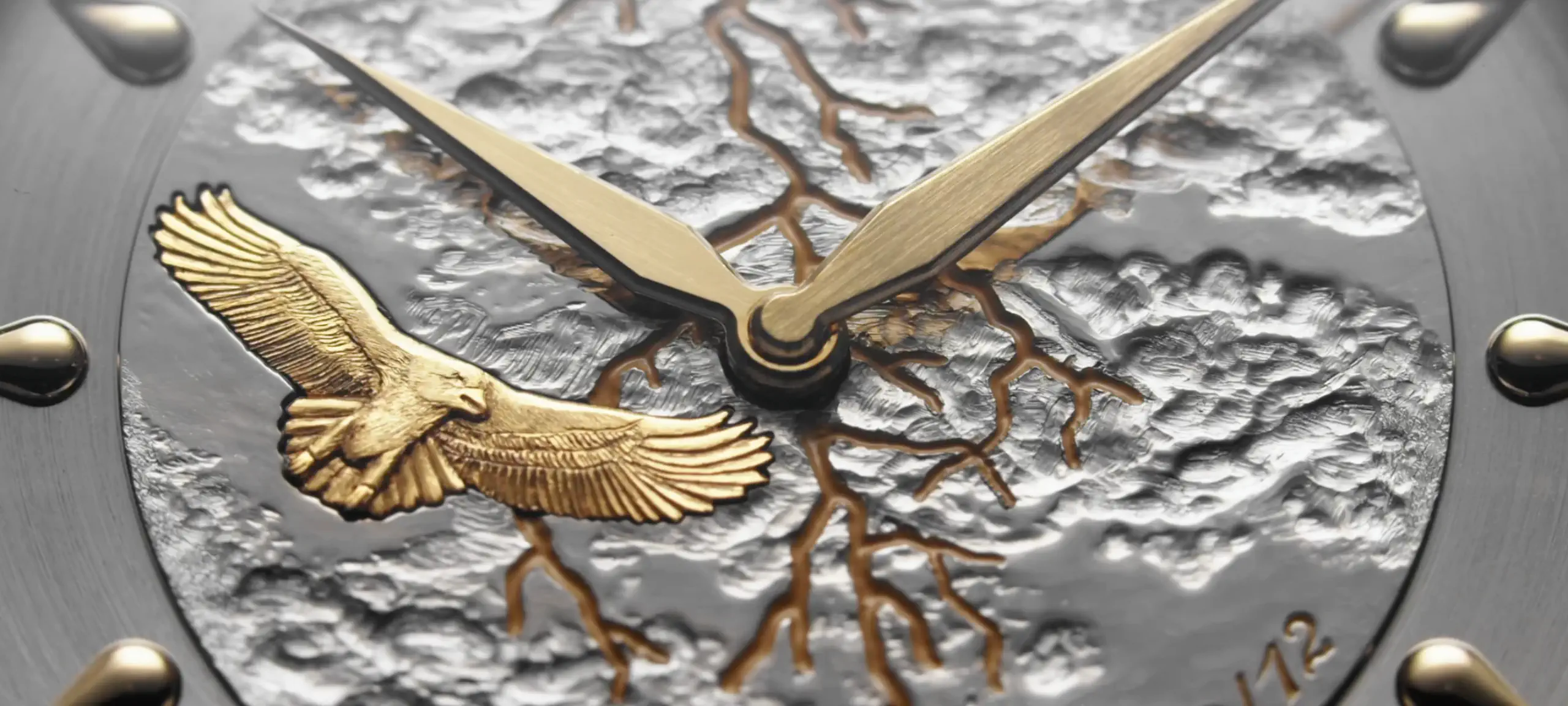
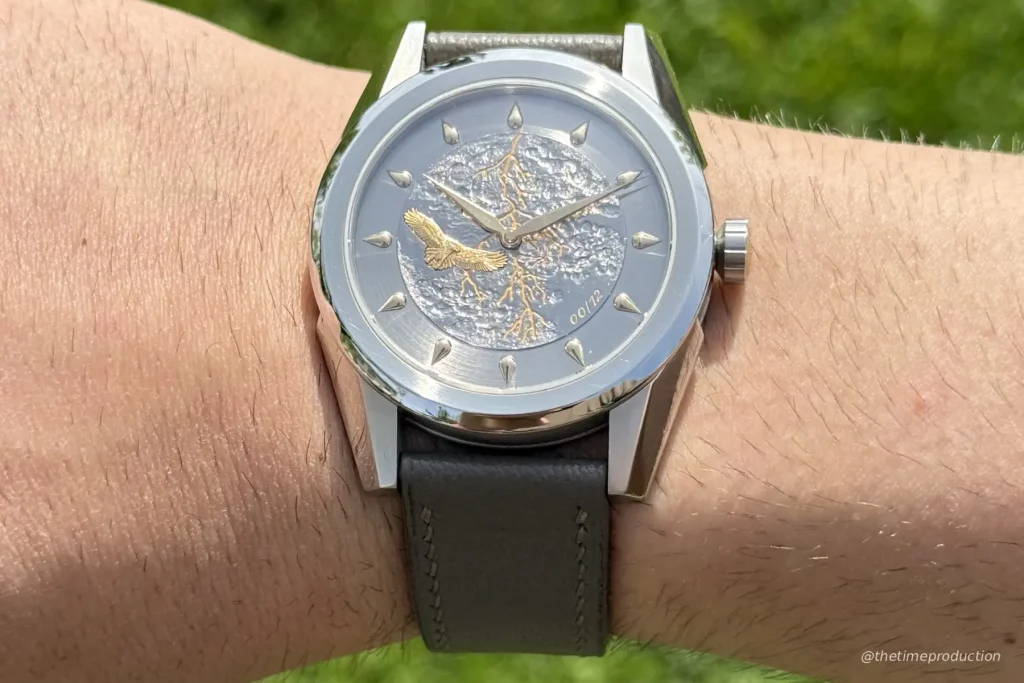
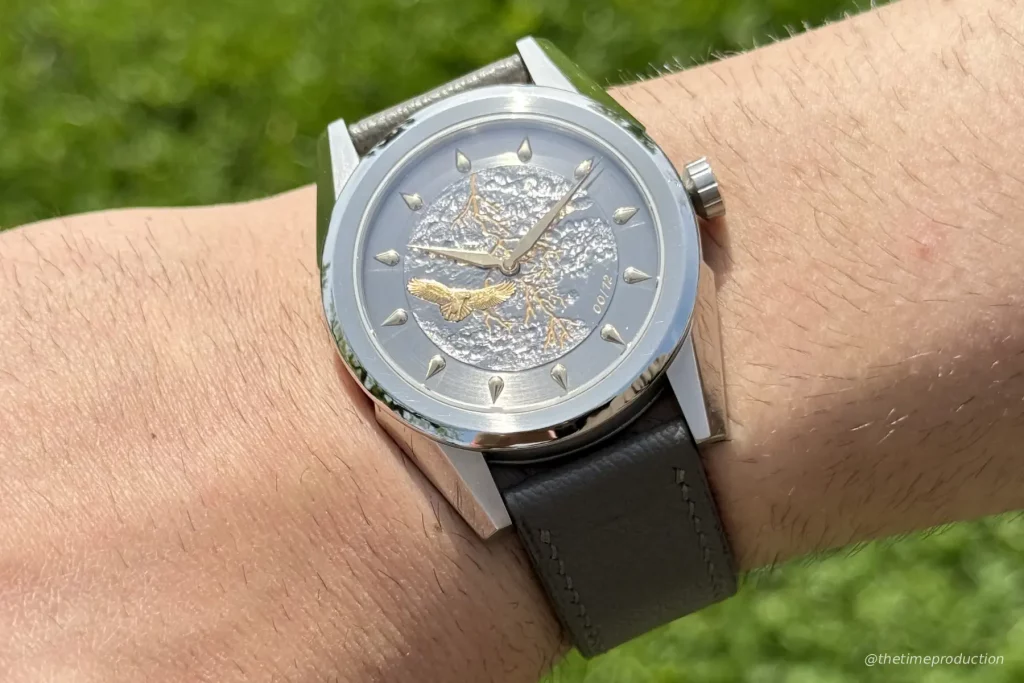
The dial of this Manteio Zeus is, in my view, one of the strongest elements of the watch, and probably even its true narrative centrepiece. What struck me immediately, both visually and conceptually, was of course this central scene with the eagle in full flight, wings spread, crossing the storm through the lightning bolt. That is really the image that stays with you. And what is particularly strong here is that the effect does not rely only on a beautiful motif or on spectacular decoration. It relies on a real work of material, depth and staging that gives the dial a rather rare presence.
What I found especially successful is precisely the way this dial combines narrative and legibility without ever becoming overloaded. You can feel that it is built on several levels, with on one side this central disc where the clouds, the lightning bolt and Aetos Dios unfold, and around it a peripheral disc that carries the applied indices. And it is really this central section that impressed me the most. The engraving work is magnificent, the eagle spreads its wings with incredible force, and the whole composition gives the impression of a moment frozen in full tension. It is very alive, very visual, but also very poetic in the way it brings the narrative to the surface.
The other detail I really liked is the raindrop-shaped indices. At first, this is not necessarily something you identify immediately, and that is precisely what makes the idea even more interesting. Visually, you perceive original shapes, very well drawn and very coherent with the watch. Then, once you understand the storytelling of the dial, everything becomes much more legible: the storm, the lightning, the rain, and then these drops falling toward the centre. And I think that is extremely well thought out. All the more so because these indices are fully polished, which makes them stand out clearly against the rest of the dial, and because their drop shape ending in a sharp point also allows for very precise reading of the time. It may seem like a small detail, but it is exactly the kind of thing that shows just how deeply the narrative has been integrated into the functional elements themselves.
I also greatly appreciated the surface work on the dial itself. The cloud texture, developed after long months of research, brings real depth to the whole. It catches the light in a very subtle way, changes according to angle and intensity, and almost gives the impression that the sky is transforming over time. It is very beautiful, but also very intelligent, because it reinforces the idea of a living dial, never entirely identical depending on the moment you look at it. And the fact that each dial is slightly unique due to the hand engraving only strengthens this artisanal and singular dimension.
The hands also work very well within this whole. Their alpha-inspired design brings something sharper and more incisive, which interacts well with the energy of the dial. I also found interesting the contrast between their brushed top surface and their polished bevels, which allows them to stand out clearly without breaking the coherence of the composition. Once again, you feel that everything has been thought through with a real logic of composition.
If I had to qualify one point, I would say that at one moment I wondered whether the addition of a very discreet railway minute track or a slight intermediate ring between the dial and the case might have brought an even more marked transition, or perhaps a little extra legibility for some. But that remains more of a question than a criticism. Because as it stands, the dial already works very well as it is. And the fact that one passes almost directly from the engraved decoration to the case also contributes to the general purity of the piece.
In the end, I find that this dial brings something truly distinctive and memorable compared with many other proposals in the same category. First because hand-engraved dials of this kind remain rare today. Then because here, the engraving is not simply there to embellish the watch, but to tell something profound, coherent and personal. And above all because this dial fits completely within the world of Manteio. It could not be on another watch. It is inseparable from Zeus, from its story, from its symbolism, and from this desire to make the watch as much a narrative object as a horological one. And that is precisely what, in my eyes, makes it so strong.
Movement
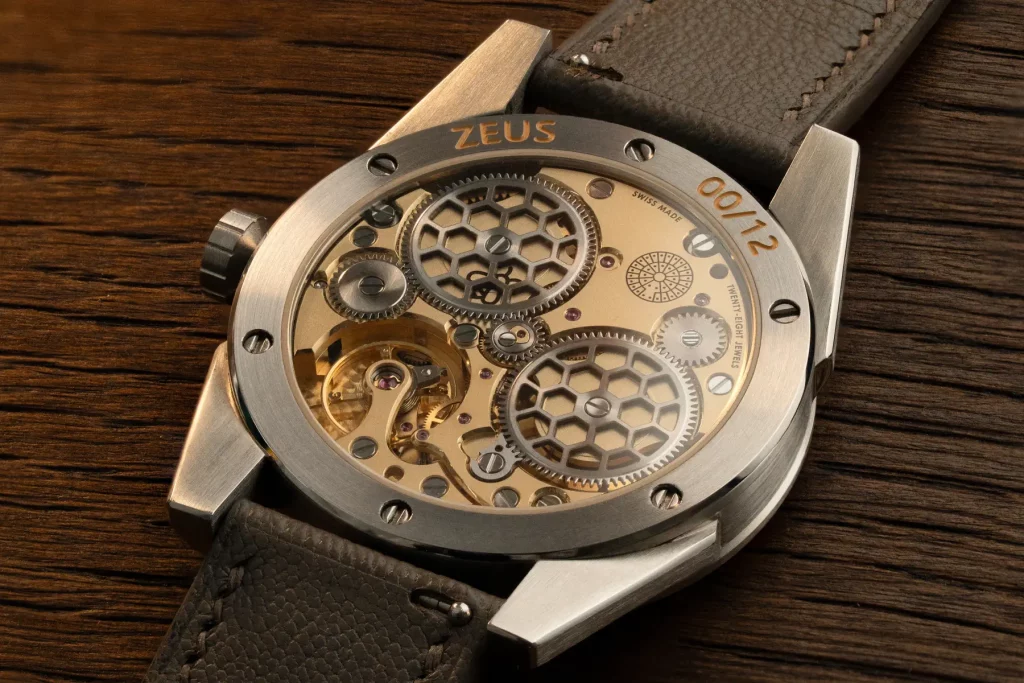
The movement of this Manteio Zeus brings, in my view, real value to the watch. It does not merely serve as a coherent engine placed behind a strong dial. On the contrary, it extends the narrative by opening another chapter of the storytelling that neither the case nor the dial had yet really addressed. And that is precisely what I find so successful here. The model is called Zeus, but each part of the watch actually tells a different facet of its world. The case speaks of strength and architecture, the dial stages the storm, the lightning bolt and Aetos Dios, while the movement tells the story of Zeus’s childhood through the image of honey and Melissa. This narrative continuity is, in my opinion, particularly intelligent.
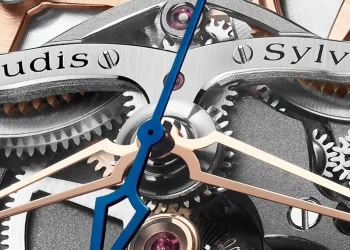
On the technical side, the MYTH-001 calibre is a hand-wound movement developed in collaboration with Chronode, under the direction of Jean-François Mojon, based on the C101 calibre. Chronode in fact presents the C101 as a manual twin-barrel movement offering more than seven days of power reserve, with different possible display configurations, which confirms the strength and credibility of this base. In the case of the Zeus, that architecture was reworked to meet technical, aesthetic and narrative requirements specific to the project. And for me, that is a real strength. This is not a movement chosen out of convenience, but a recognised and proven base that allows the watch to be grounded in something reliable and serious, while still leaving room for genuine interpretation.
What a serious collector should retain first and foremost is precisely this: the Zeus does not rely on a generic movement simply decorated for the occasion. It builds on a Chronode base that already has full technical legitimacy, and then reworks it to serve a very personal horological project. Chronode is not a secondary name in independent watchmaking, and Jean-François Mojon has over the years designed or developed movements for major maisons and projects on the contemporary scene. That obviously gives weight to the project. And in the specific case of the Zeus, I find that this collaboration was very well judged, because it allows Alex to rely on a very solid base while preserving the coherence of his universe.
What I found particularly beautiful is precisely the way the movement was conceived as an extension of the narrative. At first glance, I had already found it visually very successful. But once you understand the full story behind it, it takes on even more meaning. The idea of making the movement an evocation of a small honey pot is, in my eyes, very strong. In the story that inspired the creation of Manteio, Melissa and honey play an important symbolic role, and the fact of translating that into the construction of the movement makes the whole even more coherent. The ratchet wheels whose spokes evoke beehives, the bridges and mainplate whose semi-matte texture recalls crystallised honey, the golden tone obtained through the 2N coating, and above all that tiny almost hidden detail of the bee Melissa engraved on the barrel bridge: all of this contributes to giving the calibre real narrative depth.
And that is where, in my opinion, the project becomes truly interesting. Because the movement is not only beautiful or well finished. It tells something as well. And this is not storytelling applied after the fact to an existing calibre. On the contrary, one feels that there has been real thought about how to articulate narrative and mechanics. Even the fact that certain functions such as the power reserve and the seconds display were removed in the final version feels very right to me. Instead of accumulating indications or trying to show everything, they preferred to respect the overall coherence of the watch and keep only what truly served the project. I find that very intelligent. There is a kind of discipline in the design here that I appreciate a great deal.
In terms of finishing, I found the level very convincing. Without overdoing it, the movement already offers what is needed to rise to the level of the project. One finds anglage, hand engraving, perlage, microblasting, satin finishing, black polishing, as well as nice work on the jewels, set in polished sinks. The whole does not try to become demonstrative at all costs, and that is a very good thing. The language of the watch is not one of decorative excess. It is subtler. And within that register, the movement works very well.
In the end, I find this movement totally coherent with the Zeus. It gives the watch real technical credibility, excellent autonomy thanks to its twin barrels and seven-day power reserve, and above all an additional layer of meaning. It is a movement that does more than support the watch: it enriches it. And that is precisely why I find it successful.
Strap
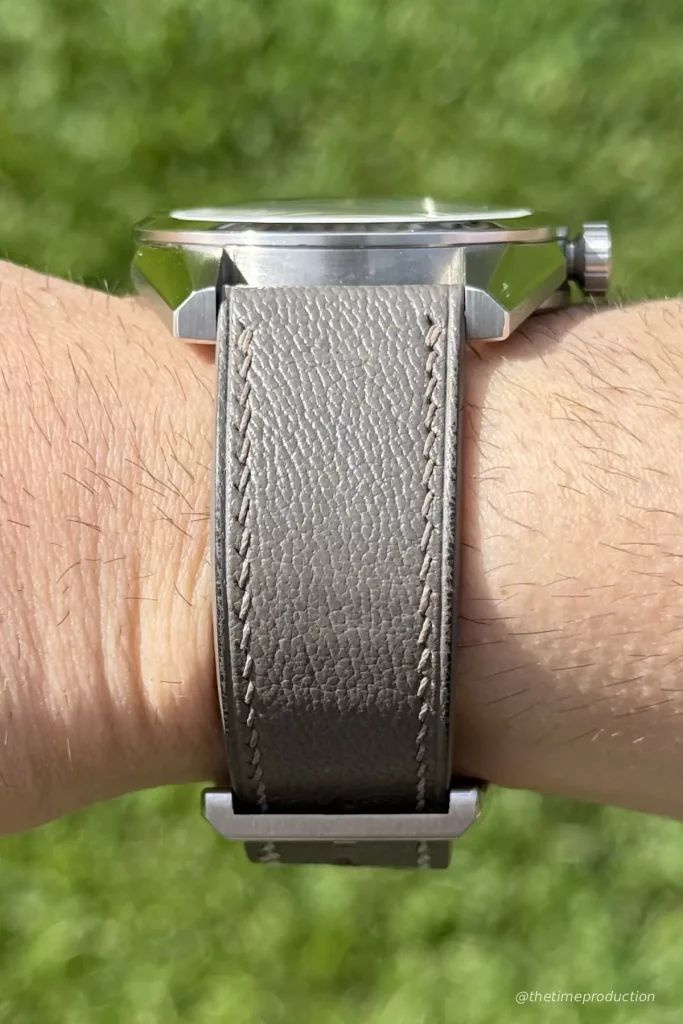
The strap of this Manteio Zeus felt particularly successful to me, and that is all the more interesting because it does not play a secondary role here. Quite the opposite, it completes the watch with rare coherence. In terms of comfort, I found it very good. It falls well on the wrist, naturally accompanies the presence of the case, and truly contributes to the overall balance of the piece. In terms of perceived quality as well, I find the proposition very convincing. You can feel that the choice of leather, proportions and buckle was not made as an afterthought, but within a perfectly controlled overall logic.
What I especially appreciate is that the strap also extends the narrative of the watch. The choice of goat leather is obviously not neutral here, since it refers to Amalthea, the divine goat who nourished Zeus as a child and whose skin later served, according to legend, to shape the aegis. And it is precisely this kind of detail that I like in this project. Nothing seems left to chance. Even something as classic as a strap becomes part of the overall narrative logic of the watch. For me, that shows just how thoroughly the project was studied as a whole, with this desire to give meaning to every component.
I also found the proportions very well judged. The choice to begin with a 20 mm width between the lugs and taper to 18 mm at the buckle feels particularly well balanced. It gives something refined, more elegant than 20-20, which would probably have made the watch visually heavier, while also avoiding too drastic a reduction that would have thrown the buckle off balance. Here, the strap accompanies the watch very naturally. It remains structured, but without heaviness.
The pin buckle itself also works very well. On a watch like the Zeus, there was in my opinion no reason to seek unnecessary complications or an overly demonstrative solution. A fine pin buckle was the right option, and the fact that it directly reprises the vocabulary of the case is a real strength. The proportions, the bevels, the finishes, everything seems thought through in a very coherent visual continuity with the lugs and with the case as a whole. It is a detail, of course, but a detail that makes all the difference when one is trying to build a truly complete watch.
In the end, I find that this strap genuinely reinforces the personality of the Zeus. It does not simply accompany the watch. It completes it. It almost constitutes its final narrative and aesthetic touch, the one that allows the project to close with coherence. And that is precisely why I find it so successful.
What is the price of the Manteio Zeus?
The Manteio Zeus is priced at CHF 29,800 excluding taxes, as part of a limited edition of only 12 pieces. Given the complexity of its production, the level of detail brought to each component, and the symbolic scope of the project as a whole, this price positioning seems coherent to me with the overall proposition of the watch. We are talking here about a very singular piece, produced in an extremely small series, with real work on the design, the dial, the finishing, the movement and the entire world surrounding it. And within that context, the price feels fair to me.
What I also appreciate is that one can feel that this project was not conceived within a logic of classical commercial optimisation. This is not about producing several colour variants or versions of the watch in order to artificially extend the collection and generate more volume. The Zeus exists as a complete piece, within a precise vision, with a defined execution, and that is also what gives strength to its positioning. In my eyes, that further reinforces the impression of dealing with a watch that was truly conceived as a complete, coherent and almost indivisible object in its concept.
For me, this piece is aimed above all at someone looking for a very personal watch with a strong cultural dimension. Of course, it can appeal to an independent watch enthusiast, but I also think it can speak to a somewhat broader audience precisely because it does not rely only on a purely horological discourse. It also draws on mythology, craftsmanship, symbolic objects and narrative. And that gives it a broader reach than a simple collector’s watch in the strict sense.
Rarity obviously plays an important role here. Only 12 pieces will be produced, and a large part of them has already been allocated. That clearly shows that the project has already found an echo among collectors sensitive to this singular proposition. But what I find even more interesting is the way Manteio has extended the experience beyond the watch itself. Each piece is accompanied by a numbered book, which also serves as a certificate of authenticity. This book does not merely document the watch: it also contains an original short story revisiting the key myths of Zeus, accompanied by illustrations created especially for Manteio. In other words, the watch is conceived as a complete work, with its narrative and documentary extension.
And that is not all. Each watch can also be presented on a hand-carved stone column made by a Swiss stone mason, following the Doric order, the architectural style most frequently associated with temples dedicated to Zeus. Once again, we are well beyond simple packaging. This is not just a slightly more refined wooden box. It is a true extension of the project, a pedestal that participates in the object, its world and its staging. And that is precisely the sort of detail that makes the Zeus especially interesting in my eyes. It is not simply sold as a watch. It is presented as a total object, thought through in all of its extensions.
Manteio Zeus: a rare watchmaking project where every detail has a reason to exist
With the Zeus, Manteio offers, in my view, a truly singular project, and that is precisely what makes it interesting. You immediately feel that this is not a watch to which a theme or narrative layer has simply been added afterwards to make it more appealing. Here, the storytelling does not sit on top of the watch. It structures the project as a whole. The case, the dial, the movement, the strap, the book, the presentation on the stone column, everything seems to have been conceived in the same direction. And that is probably what struck me the most: the overall coherence.
What I find especially strong is precisely the way Alex Goetschi has managed to bring together around this first watch a group of artisans and partners capable of giving real substance to the project. Very often, you see collaborations or well-supported watches where the whole still ends up feeling somewhat empty in meaning. Here, it is the opposite. The project was first thought through with a story, an intention, a symbolism, and then realised within that logic. And that changes everything. It gives the Zeus real depth. You feel that every detail has been placed there for a reason, not simply to create a beautiful effect.
The greatest quality I would retain from Manteio is undoubtedly this deeply unique character, but also its ability to potentially speak to a wider audience than that of independent watch collectors alone. Of course, the watch can appeal to a lover of horology, craftsmanship or fine finishing. But it can also touch someone sensitive to meaningful objects, to sculpture, architecture, mythology, or more broadly to a strong cultural approach. And I find that very interesting. It gives the project a different kind of reach. It is not only a watch made to appeal to a small circle of insiders. It is also an object that can resonate in other spheres.
What I also appreciate very much is the fact that Alex did not try to create a watch that simply fits the mood of the moment. The Zeus was not conceived to follow a trend for a few years before fading away. On the contrary, one feels a real search for timelessness, in the design, in the construction, and in the choice of movement. It is a watch meant to last, to be worn, understood and passed on, and that immediately gives more weight to the project. Even if, personally, I am not especially drawn to Greek mythology as a subject, I found the approach intelligent and accomplished enough to become genuinely interested in the project. And for me, that is already very revealing of its strength.
So yes, I do believe in the trajectory of the project going forward. Because this first model does not feel like an isolated first attempt. It already belongs to a much broader vision. The fact that Alex wants to continue with other models, other case shapes, other complications, other styles of watches, while remaining faithful to this principle of integrated storytelling, clearly shows that he is not merely trying to make a beautiful first piece. He is trying to build a real brand, with an identity, a DNA and a coherent whole. And that is precisely what I like here. You can feel that the Zeus may become the opening chapter of something much more ambitious.
The idea of developing Athena next, and then more broadly an entire collection built around the twelve Olympians, Hestia and Hades, also gives the project real depth. There is a vision of saga, continuity and progressive development here that can inspire confidence in a collector. And the fact that Alex is also working in parallel on a table clock project shows clearly that his approach is not limited to a single type of object. Once again, you feel in him a genuine desire to create and to build over time.
In the end, that is probably what makes Manteio particularly interesting today. The project is not simply trying to produce a successful watch. It is trying to build a universe, with coherence, rigor and meaning. And in a landscape where many first watches can be attractive yet struggle to suggest a real trajectory, I find that especially valuable.
Manteio Zeus – Watch Specifications
- Brand: Manteio
- Model: Zeus
- Case Material: 316L Stainless Steel
- Dial: 18k 2N Gold
- Functions: Hours, Minutes
- Movement: MYTH-001, developed for MANTEIO by Chronode, based on the C101, Manual-Winding, 21,600vph frequency (3Hz), 29 jewels
- Power Reserve: 7 Days
- Water Resistance: 3 ATM
- Crystal: Sapphire
- Case Back: Sapphire
- Case Dimension: 39mm (Diameter) x 9,7mm
- Strap: Goat Leather with 316L Stainless Steel Pin Buckle
- Availability : Limited to 12 pieces only
- Retail Price: 29,800 USD (excluding VAT)
And what do you think of this Manteio Zeus and, more broadly, of this type of horological project where storytelling, craftsmanship and symbolism become just as important as the watch itself?
If this article added value or sparked a discovery, you can support the project HERE. Your contribution helps me keep weekly articles and a biweekly newsletter free, accessible, and independent for everyone.
For more information about Manteio, click here.