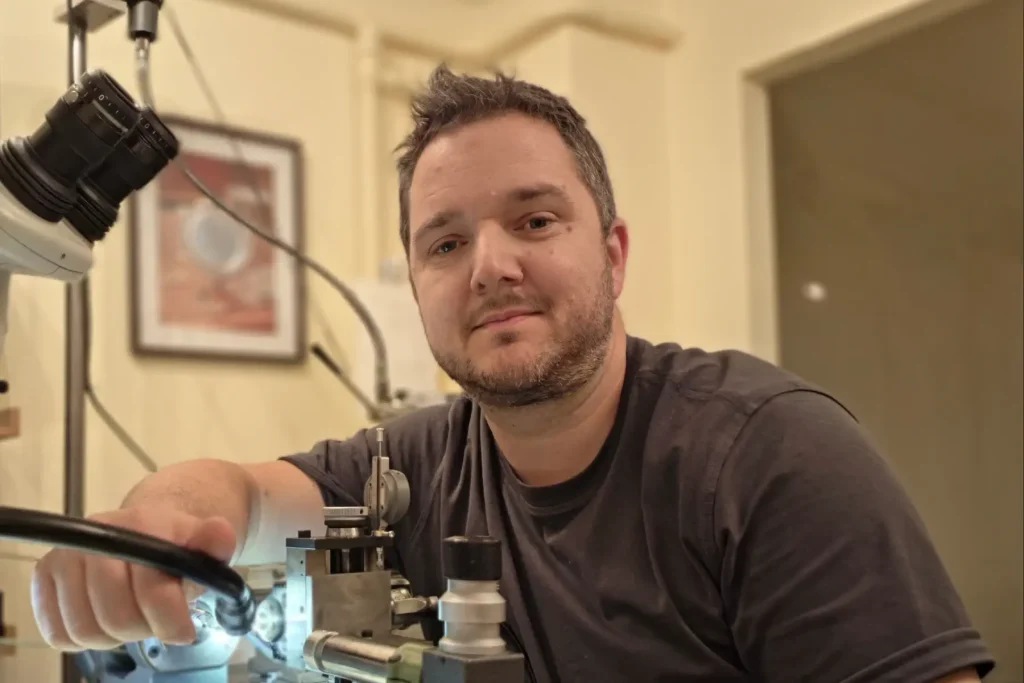
Today, I have the pleasure of introducing an independent watchmaker whose work I have been following on Instagram for several years. If I mention a former project manager in the watch industry, a guilloché dial made on a machine he built himself, and an annual output of just a few watches, some of you may already recognise Stefan Schaerer. We finally met in person this year during Geneva Watch Days. I had the opportunity to handle, photograph and film the prototype of his Pyramis Sapphire Blue. I was struck by his humility and by just how much of the work he carries out himself. His explanations helped me understand the decisions and difficulties behind this first creation. Before taking a closer look at the watch, I would like to explore his background and what led him to want to make a watch of his own.
Stefan’s father was a micromechanic, accustomed to working with the small components used in precision engineering. His earliest watch memories are of the battery-powered Swatches that were so common around him in Grenchen. They were often given to him for birthdays, in a town where many of the people his family knew had connections to Swatch Group. At around seven or eight, it was his grandfather’s automatic watch that introduced him to the idea of a mechanical watch that could run without a battery. He began to wonder how its mechanism worked. He enjoyed Lego and Meccano construction sets, particularly the gears. Football and skateboarding were also part of his childhood, with skateboarding becoming a particular passion from around the age of twelve into his late teens. His interest in watches became more focused when he had the chance to discover watchmaking as a profession.
At fourteen, he undertook work experience placements to discover how professional watchmakers worked. He immediately enjoyed the work, which led him to a four-year apprenticeship with a watch manufacturer in Grenchen. His training reflected the industrial approach to watchmaking established in that region. He stayed with the company afterwards, taking on various roles, from watch head assembly to running the quality department. He continued his studies to become a watchmaking technician, then moved into product design and development as a project manager. Work also took him to Baselworld, where he would make a point of visiting the AHCI and its independent watchmakers. He enjoyed these responsibilities, but as more of his working day shifted to a computer, he began to miss working with his hands at the bench.
He bought a small lathe so that he could make components in his spare time. Alongside this desire to return to manual work was a personal ambition: to own a fine watch. A Breguet Tradition was among the first watches he remembers truly admiring, although he no longer recalls the precise reference. Other financial priorities, however, came before such a purchase. He began imagining a watch he could make for himself, built to the standard of quality he hoped to achieve. At first, the project was a hobby. Making the first components created a need for further equipment, existing tools were replaced or supplemented, and the workshop gradually took shape. Stefan even speaks of another passion that emerged along the way: “collecting tools”.
The early work he shared around 2016 reflects this progression. To learn how to make the parts he needed, he searched online, watched videos and enlarged photographs to identify a tool, a machine or a particular working method. He recalls spending a great deal of time on this research, at a time when technical information was difficult to obtain. Some of the people he spoke to in the industry doubted that he could make a movement in his own workshop, given the considerable resources available to established manufacturers. The challenge encouraged him to keep going. He also remembers their surprise when, later on, he was able to show them the watch he had made.
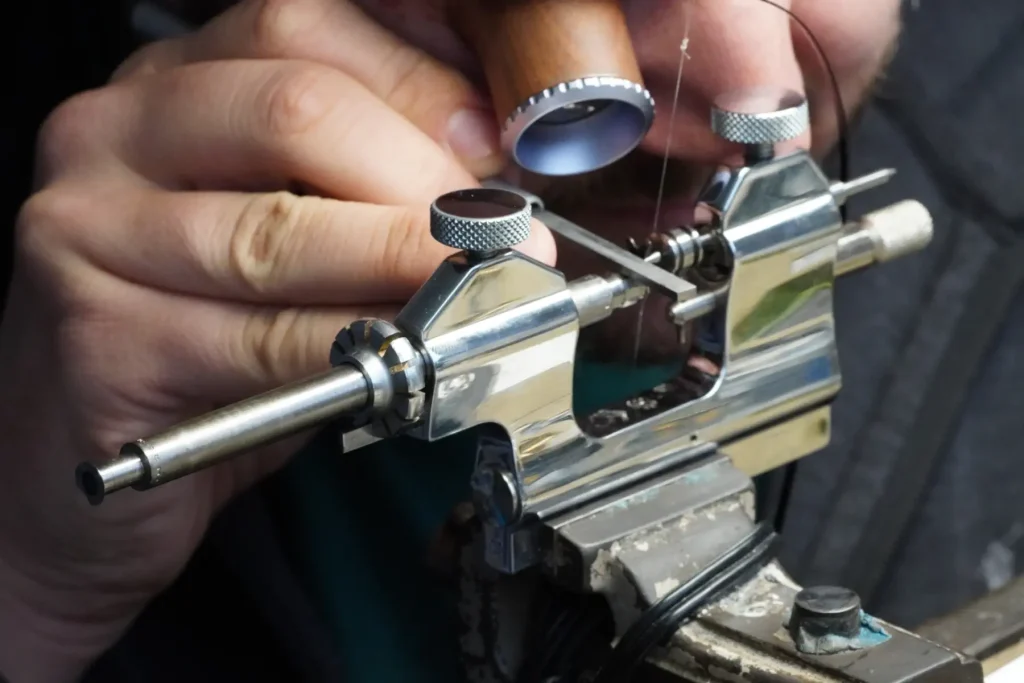
In 2018, he began the specific work that would lead to the Pyramis. The project developed through successive drawings, experiments and components that sometimes had to be made again. His training and professional experience gave him an understanding of watches, but making their individual parts himself required additional skills. He also needed to bring together the right production equipment. Faced with the scarcity and cost of traditional engine-turning lathes, he built his own guilloché machine. He also made a machine for applying Côtes de Genève. Producing the watch therefore involved developing the very tools that would allow him to achieve the decorative finishes he had in mind.
As this work progressed, Stefan’s Instagram posts began to attract interest from collectors. He started to consider whether he could turn the project into his profession. He eventually decided to leave his job in 2022 to devote himself to independent watchmaking. He describes the transition as “ten times more difficult” than he had imagined.
The design of the Pyramis reflects the capabilities of this workshop, which Stefan explains he established without taking out a bank loan. His ambition was to develop his watch from an initial sketch and retain control over each stage leading to a finished component. He chose a simple time display and kept in mind what he could realistically make with his own equipment. Shapes, dimensions and finishes evolved through experimentation. This way of working allowed him to revisit a component whenever it fell short of what he wanted. It also meant learning to solve the problems encountered at every stage, from the raw material through to assembly.
This control over production lies at the heart of Stefan’s own understanding of independence. He works alone and wants to retain the skills and equipment that allow him to make the case, dial, hands and a very large proportion of the movement. He can adapt his designs and working methods to meet his own standards. He also wants to limit the consequences of a supplier ceasing deliveries. Certain supplies and specialised treatments are still entrusted to outside partners. His aim is to preserve as much freedom as possible over both the making of the watch and its final execution. The time he spends on each piece also makes its delivery deeply personal. He describes it as passing a part of himself on to the collector.
The Pyramis was presented on YouTube in early February 2024. The prototype I handled in Geneva shows how these manufacturing choices carry through every part of the watch. It is this first creation that I would now like to examine in greater detail.
Table of Contents – Schaerer Pyramis Sapphire Blue
What are the features of the Schaerer Pyramis Sapphire Blue?
Case
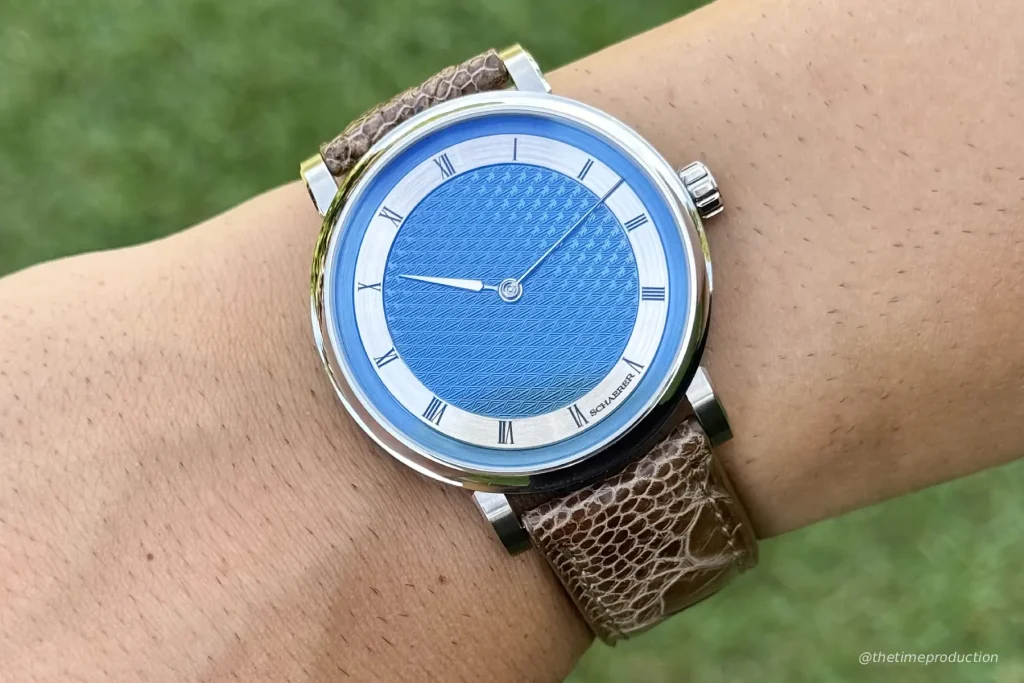
The Schaerer Pyramis Sapphire Blue has a stainless steel case measuring 39.5 mm in diameter and 8.2 mm in thickness. Water resistance is rated at 3 ATM. Its slimness was the first thing that caught my attention when I handled the prototype. The overall profile remains compact, with relatively short lugs and carefully judged curves. I particularly appreciated their shape, defined by a polished outer edge that gives the points where the strap meets the case a crisp outline. These proportions suit the watch’s understated appearance.
Stefan designs and makes the case himself. The lugs are individual components that fit into recesses in the case middle. This construction makes it easier for him to work on the surfaces, including the less accessible corners, and to refine the finishing before bringing the parts together. He also points out the freedom it gives him to adjust the dimensions and overall thickness.
The polished concave bezel is another detail I particularly enjoyed. Its inward curve adds depth around the dial and brings changing reflections to the upper part of the case. On the reverse, the metal surfaces are also polished and follow a slightly concave profile. I like this connection between the two sides of the watch, which becomes apparent as you turn it over.
The crown bears the brand’s logo and has fairly widely spaced teeth. I found it easy to grip while handling the prototype, an important consideration on a manually wound watch. Its design carries the character of the case through to this functional component.
Dial
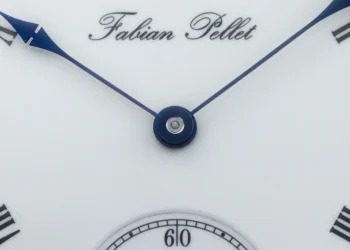
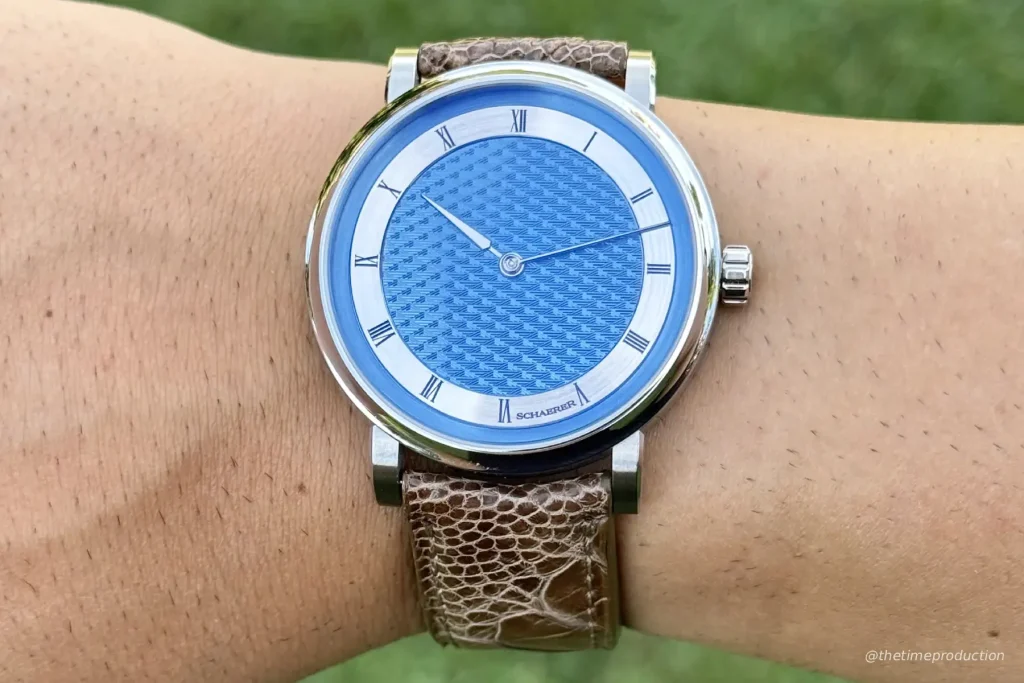
The dial is made on a base of 925 silver, with a blue guilloché centre and a smooth blue outer area. A separate ring carrying the hour indications sits over the junction between these two surfaces. This layout gives the decoration room to be appreciated while keeping the time easy to read. The hour markers are engraved and then filled with lacquer. The Schaerer signature sits between the 5 and 6 o’clock positions, a slightly unconventional placement that I found especially appealing. It adds a personal touch to an otherwise very restrained composition.
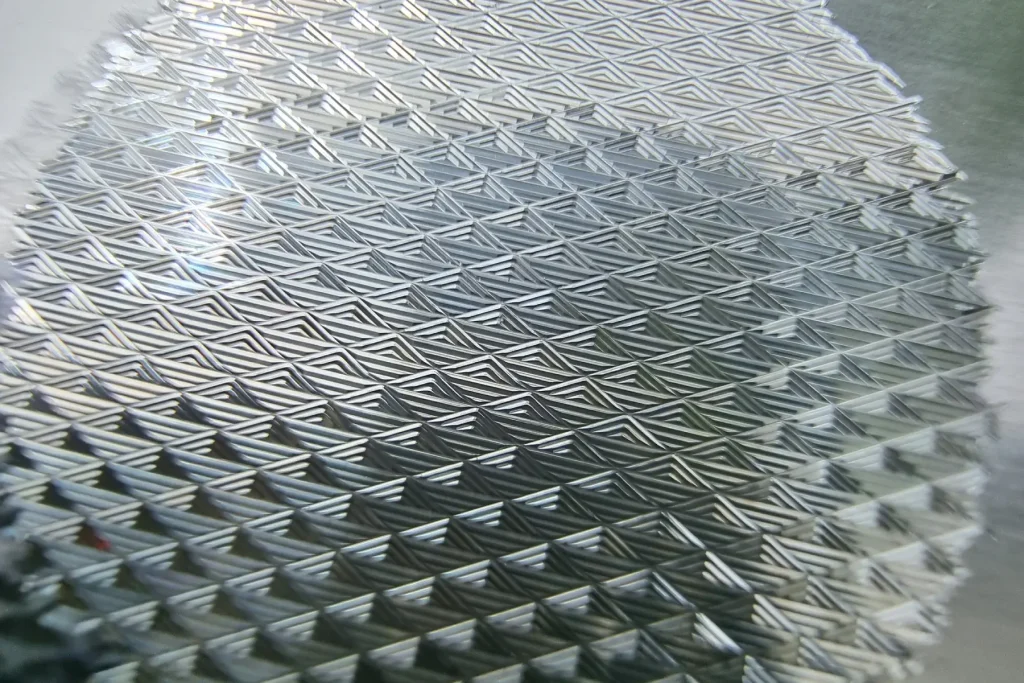
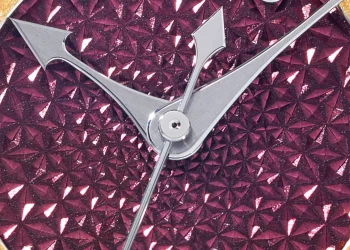
Stefan makes the dial and carries out the engine turning in his workshop, using the machine he developed himself. The pattern brings the blue surface to life as the light changes, producing shifting reflections that sometimes appear iridescent and give the dial a sense of depth. The surface treatment is entrusted to an outside specialist. This operation contributes to the dial’s final appearance, while Stefan handles the rest of its manufacture.
I particularly like the way the long, slender hands complement the guilloché. Their fine proportions reinforce the minimalist display, while their length makes the indications around the dial easy to follow. Positioned close to its surface, they also contribute to the impression of slimness. Stefan makes both the hour and minute hands, giving them bevelled edges and a black polish. This finish causes their surfaces to shift from bright to dark as the light changes. On components as narrow as these, the finishing of the edges and the quality of the polish become details worth examining closely.

His workshop has also benefited from some fortunate discoveries. In the abandoned premises of Schmitz Frères, a former watch case manufacturer in his hometown, he found a Gebrüder Sallaz polishing device. He tracked down its owner and acquired the device for his own workshop.
Movement
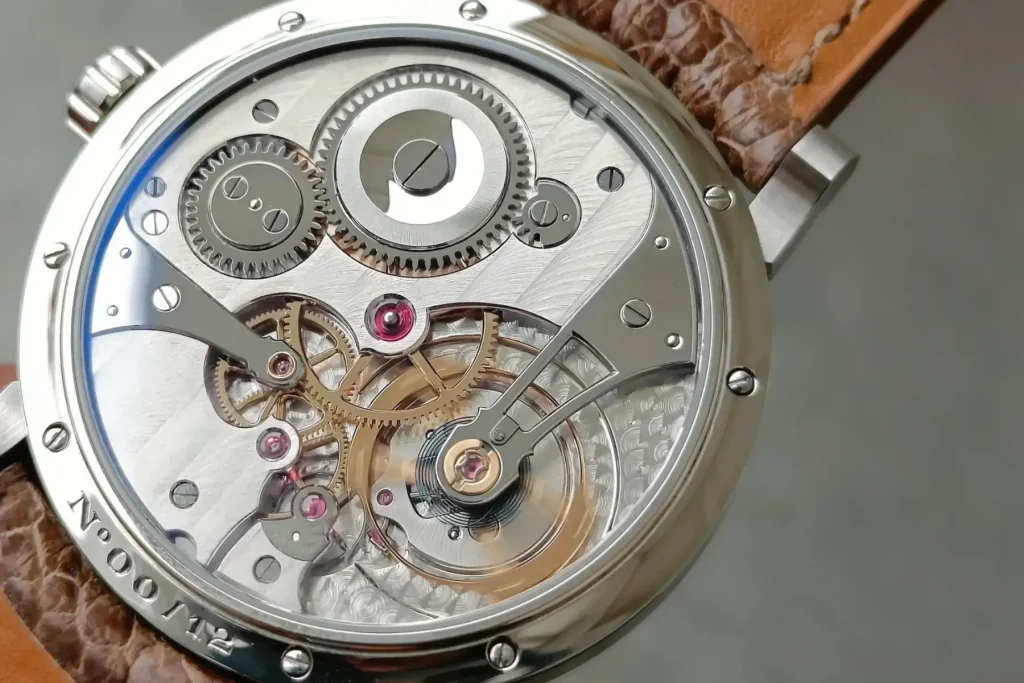
Turning the prototype over was one of the most memorable moments of my introduction to the Pyramis. Its movement has a classical architecture, recalling constructions from the 1950s and 1960s, with a strong emphasis on polished surfaces. The shapes of the bridges, the different levels and the contrasting finishes create a view that I found particularly beautiful. The longer you spend looking, the more your eye moves between the individual elements, revealing the extent of the work involved.
Stefan designs this manually wound calibre and makes the mainplate, bridges, parts of the gear train and the balance wheel in his workshop. Across the watch as a whole, more than 97% of its components are said to be made in-house. He orders new hairspring material specifically for his movement and carries out the shaping himself. The mainspring, jewels, sapphire crystals and gaskets are among the externally supplied components used in the watch.
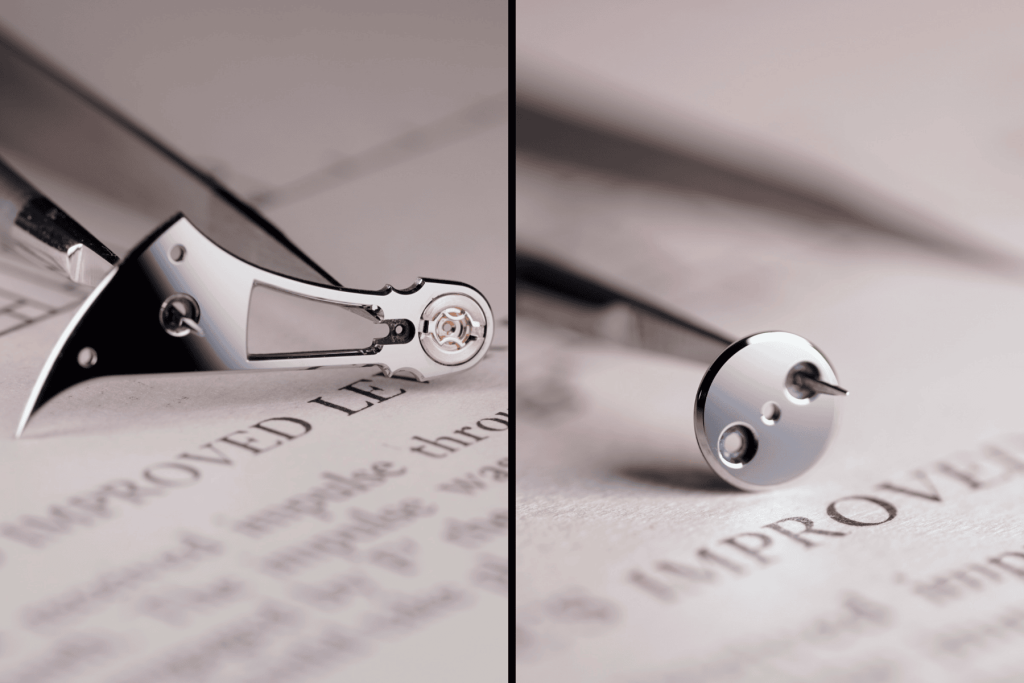
The balance wheel, designed and made by Stefan from a copper alloy, has a distinctive shape and is fitted with four weights in 18-carat gold. This oscillating component, which governs the rhythm of the movement, therefore has a role in the calibre’s visual composition as well as its operation. The wheels of the gear train are made from 14-carat rose gold, in keeping with historical watchmaking practice. This gold specification applies to the wheels, not their pinions. These touches of precious metal add to the variety of materials and reflections visible through the back of the watch.
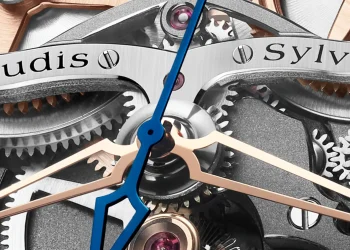
The bridges are made from German silver and rhodium-plated. They receive Côtes de Genève, for which Stefan seeks a particularly flat appearance. He applies this decoration using a machine of his own construction. The perlage on the mainplate can be seen below, while polished bevels and inward angles give definition to the contours. One bridge is a particularly good illustration of this attention to edges and surfaces. I greatly appreciated the variety of finishes and the way they complement the architecture. Decorated surfaces and polished areas help distinguish the components from one another while preserving the coherence of the movement as a whole.
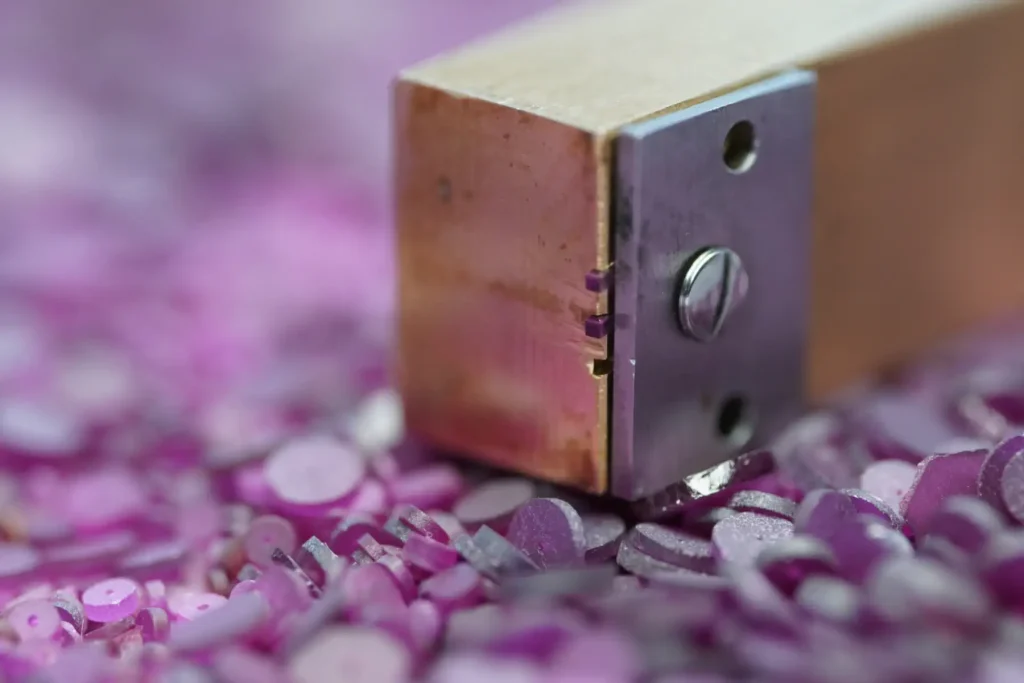
During a visit to Philippe Narbel’s workshop, Stefan learned the fundamentals of creating properly finished inward angles. Mirror polishing plays an important role in this watch, with each shape presenting its own demands. During our conversations, he singled out the concave part of his ratchet wheel as one of the details he is particularly pleased with. He appreciates its mirror effect and the absence of distortion he observes in the reflection. On this component of the winding mechanism, the consistency of the polished surface matters as much as its brilliance.
Moving from the prototype to production also required him to rethink his workflow. Stefan initially tried making certain components for all twelve watches in a single batch. When a problem emerged, the affected parts had to be reworked and sometimes made again. He now prefers to make two or three examples of the same component at a time. He then carries out the finishing watch by watch. This change offers a practical insight into the learning process that continues throughout production of the series.
Stefan guarantees his clients a power reserve of at least 38 hours. His approach to this figure also reflects his own habits as a collector: with a manually wound movement, he knows he will be winding his watch regularly.
Strap
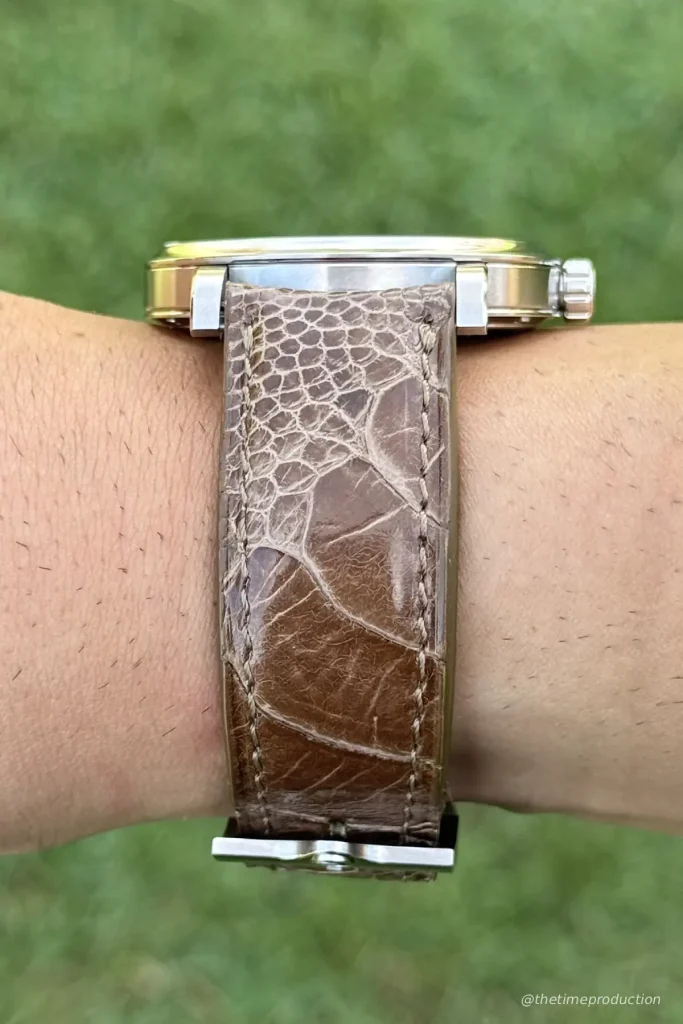
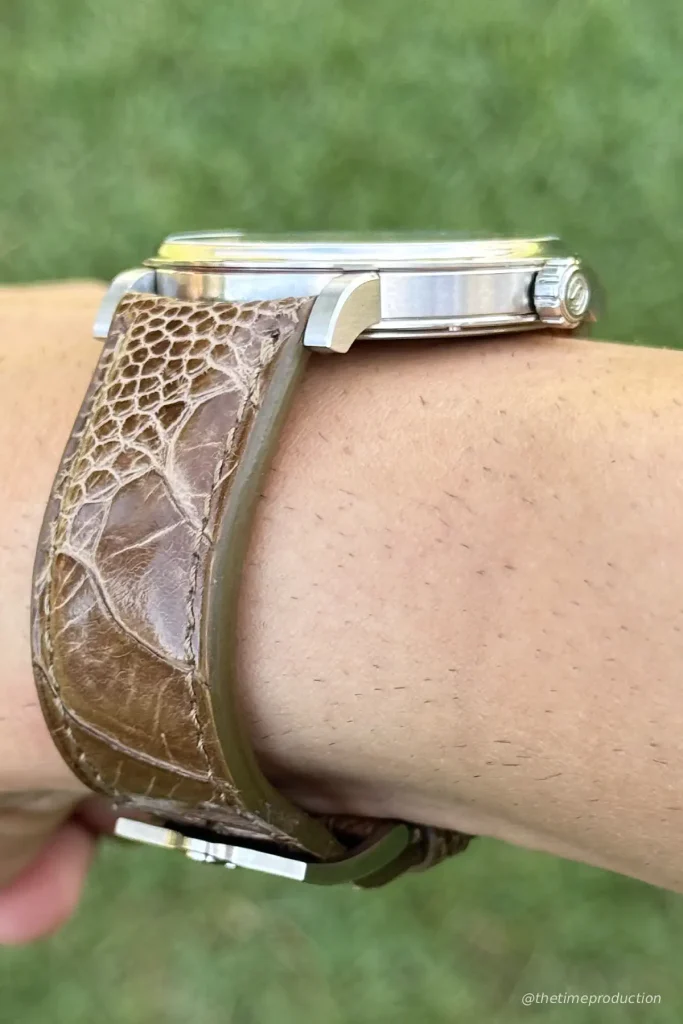
The prototype I photographed was fitted with a brown ostrich leather strap made by Atelier Petrov. I found it beautifully made, with a slightly raised centre section that gives it presence. The texture and colour of the leather work well with the blue dial and the polished surfaces of the case. The strap has quick release spring bars, a useful detail that makes changing it easier. A buckle with its own distinctive design completes the ensemble. I appreciated the care given to this element and its visual harmony with the watch, including the way the strap continues the proportions of the case.
How Much Does the Schaerer Pyramis Sapphire Blue Cost?
The Schaerer Pyramis Sapphire Blue was priced at CHF 35,000. This first series of twelve watches is fully allocated. His current priority is making and delivering the watches ordered by his first clients. This timeframe gives a sense of the capacity of a workshop in which one person is responsible for so many stages of production.
Stefan spoke candidly about how he had arrived at his original price. Once the prototype was finished, he estimated how many watches he thought he could make each year and considered that figure against the income he needed to earn a living. The difficulty emerged when actual production proved lower than he had initially expected. His experience illustrates the challenge of pricing a first series while the methods of making it are still being refined. To me, the appeal of this watch lies in the amount of personal work it brings together, the quality of its execution and the direct relationship with its maker. The details of the case, dial and movement take on another dimension when you understand just how extensively Stefan is involved in their manufacture.
Schaerer Pyramis Sapphire Blue: The Independence of a Complete Watchmaker
Discovering the Pyramis Sapphire Blue prototype left me with the impression of a first creation that already feels remarkably coherent. I enjoyed the slim case and legible dial, and spending time studying the movement’s forms and finishing. Understanding how Stefan designs and makes these elements adds to my appreciation of the watch.
It is this personal command of the manufacturing process that I find most compelling about his project. Stefan has gradually brought together the skills and tools he needs to practise watchmaking in the way he wants. He speaks openly about experiments and components that need to be revisited. When a difficulty arises, he knows it is his responsibility to find a solution by working on his design or his methods. His humility goes hand in hand with that responsibility. He also understands how a substantial increase in production would change his daily life, potentially bringing back the management duties that had taken him away from the bench. He remains open to the idea of taking someone on one day, but believes production would need to at least double to pay that person, which would require significant investment. Keeping his own work at the bench central to the business remains a guiding consideration.
There is a family side to this story, too. Stefan has three sons, who are proud of the family business and of seeing their shared surname on a watch or in Marco’s video about his work. Some of his sons have already spent a day working alongside him during a day off from school, an experience they enjoyed. It is still too early to know whether any of them will one day choose to join the business, but I found their interest and pride particularly touching.
Making this first series is already helping him identify what he might improve. Some polished components require a great deal of work. He is considering other ways of making them or different finishes, while hoping to preserve as many of the surfaces he values as possible. Stefan also knows that once the twelve watches are complete, he will need to offer something new. He is working on drawings and exploring ideas, with both their design and technical details still open to change.
We discussed meeting again, possibly in April 2027. Depending on how his thinking develops, he might then have some early ideas to show me on his computer. I like the prospect of continuing our conversations at a stage when a project is taking shape and its direction remains open. Personally, I am curious to see how his experience with the Pyramis will inform his future creations and what he might develop from this movement architecture. Stefan wants to give these ideas time to mature while devoting the necessary attention to the watches he still has to deliver.
The reorganisation of his workshop offers a very tangible picture of his daily working life. Stefan told me that he used to have to cycle five minutes to the space where he kept his production machinery. He would modify a component there, then return to his watchmaking benches to continue the work. Much of that machinery has since been moved into the house, bringing component manufacture, engraving and assembly closer together. Some heavy machines are still in the separate workshop, and the reorganisation is ongoing.
Stefan also welcomes collectors who want to discover his work and see how his watches take shape. To me, this relationship is an important part of appreciating his approach. These conversations help explain the time required to make a watch, the difficulties encountered and the decisions he makes himself. The watch then becomes part of a story shared with its maker. I would like to visit him in the near future to discover this working environment and continue our conversations.
I would like to thank Stefan warmly for his time, his willingness to answer my questions and the detail of his explanations. I particularly appreciated the ease of our conversations and his willingness to speak about both the successes and the more difficult stages of his journey. The Pyramis has made me want to follow his work closely and continue sharing this approach to watchmaking with you.
Schaerer Pyramis Sapphire Blue – Watch Specifications
- Brand: Schaerer
- Model: Pyramis Sapphire Blue
- Case: Made In-House by Stefan Schaerer, with Separately Manufactured Lugs
- Dial: Blue Guilloché Dial Made In-House on a Machine Built by Stefan Schaerer, Featuring Engraved, Lacquer-Filled Roman Numerals and Hands Made in His Workshop
- Functions: Hours and Minutes
- Movement: In-House Hand-Wound Movement Developed by Stefan Schaerer, Featuring 14K Gold Wheels and a Balance Wheel with Four 18K Gold Weights. Hand Finishing Includes Flat Côtes de Genève, Perlage and Mirror-Polished Steel Bridges with Interior Angles
- Power Reserve: At Least 38 Hours
- Case Dimensions: 39.5mm (Diameter) x 8.2mm (Thickness)
- Production: First Series Limited to 12 Pieces – SOLD OUT
- Launch Price: CHF 35,000 (Excluding VAT)
When considering a watch and its maker’s philosophy, how important is it to you that the watchmaker makes the components personally? I would be delighted to hear your thoughts and continue the conversation in the comments.
If this article added value or sparked a discovery, you can support the project HERE. Your contribution helps me keep weekly articles and a biweekly newsletter free, accessible, and independent for everyone.