
Today, I’m pleased to introduce Dan Royter, an independent American watchmaker based in Brooklyn, New York. If I mentioned music, vintage gold lighters and chronographs bought on eBay, founding a watch brand might not be the first thing that came to mind. Yet all three are part of his story. Dan and I had been in touch for some time, but it was last September in Geneva that we finally met for the first time. I found him warm, open and happy to share his passion. Before taking a closer look at his Legacy Nova Edition, I’d therefore like to tell the story of how he came to make his own watches.
The Royter name takes us back to his family roots. It belonged to his great-grandmother, Blyuma Royter, who was born in 1907 in a small Ukrainian village. Dan says she fled Ukraine to take refuge in Russia during the war, escaping the Holocaust. She later helped raise both him and his sister and played a central role in their childhood. He remembers her as a strong, generous woman who was always there for her family. When he began thinking about launching a brand, Dan chose her surname as a tribute and a way to keep her memory alive for future generations. That family history also gives the name Legacy its meaning.
His interest in watches also goes back to childhood. When Dan was about ten, his father bought an Orient with styling reminiscent of certain Rolex watches of the period, its day displayed in red and its date in black. Dan admired it until his father gave it to him for his twelfth birthday. He wore it throughout his youth before eventually losing it. Another watch left a lasting impression after his family moved to New York, when he was in high school. Dan became fascinated by his barber’s Movado Esperanza, with its distinctive little yellow dot. At the end of high school, his mother agreed to buy him one from Ashford for $1,200, a significant sum to him at the time. He wore it through university before giving it to his brother, who still enjoys it today.
After university, Dan could not see himself pursuing a corporate career and wanted to work for himself. He worked in sales, while his love of music led him to DJ in various clubs. He also spent a year studying audio engineering, then worked in a recording studio, handling recording and mastering. Alongside this, he looked for a way to earn some extra income through eBay. He began buying vintage lighters in 18-carat yellow gold, restoring, polishing and reselling them. These objects gave him his first experience of restoration and finishing.
Around 2004 or 2005, his searches shifted towards watches. Drawn to chronographs, he began exploring Breitling and bought a Chronomat from the 1990s with a blue dial, pairing it with a matching strap. The watch was quite worn: he restored it, polished it, photographed it and resold it on eBay. Photography was already one of his interests, and here it found a practical purpose. That first sale encouraged him to continue. For more than a decade, buying and selling watches allowed him to discover different models, understand what buyers were looking for and refine his own tastes. After handling so many other people’s creations, he eventually wanted to make his own.
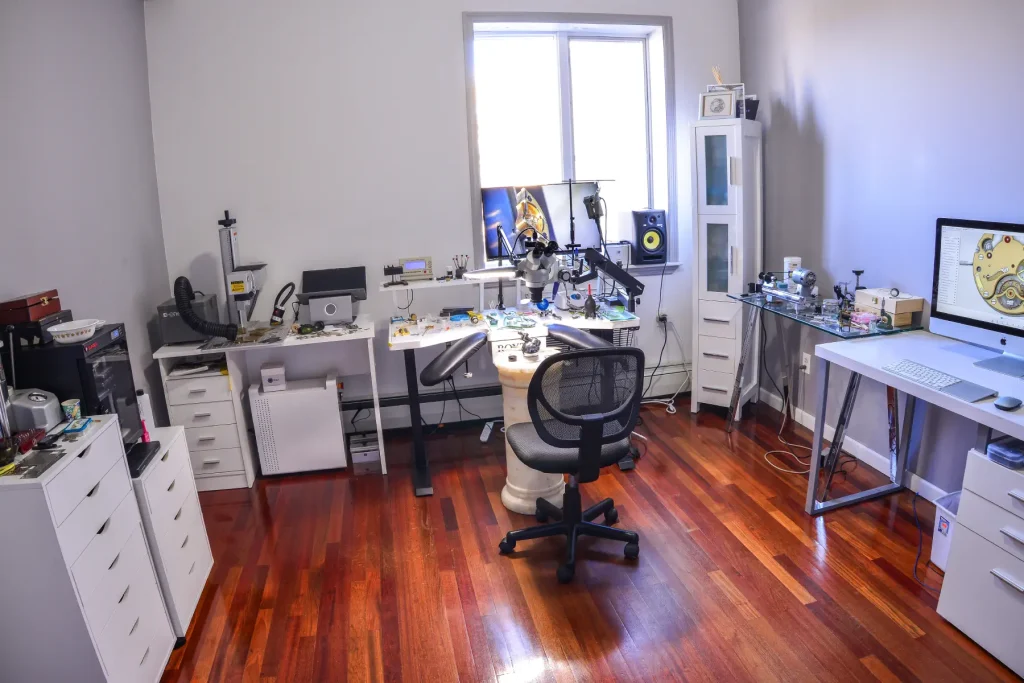
For his first chronographs, he chose the Valjoux 7750, encouraged by the reliability of his Breitling. He also appreciated how familiar the calibre was to watchmakers: he wanted to make a watch that could be serviced without difficulty. Dan did not attend watchmaking school. He learned by reading books, watching YouTube tutorials and, above all, spending many hours taking movements apart and putting them back together. He then progressed to cleaning, lubrication and regulation. He recalls the difficulties of learning, the broken parts and the jobs that had to be started again, with this observation about lost components: “It’s always the spring.” That small anecdote reflects the repetition needed to build confidence at the bench.
For his first watch builds, he says he spent about a year looking for the right components. He used parts already available on the market, including cases sourced in Germany, along with existing dials, hands and movements. His watches appealed to friends who had previously shown little interest in watchmaking, and they began asking him for their own. He saw this as a way to share his passion. Some were gifts, while others were sold for a token sum. According to Dan, one of those early recipients still wears his watch. The brand was founded in 2017, with the aim of developing watches that reflected his own ideas while allowing collectors to take part in their design.
In 2019, Dan travelled to Switzerland for the first time to attend Baselworld with a few friends. There, he met a supplier with whom he would build a lasting relationship and began working on designs and technical drawings for his watches. About a year later, five prototypes were ready. The DR01 had a case measuring 44 mm in diameter and around 15 mm thick, a fluted bezel and an onion crown. Around ten examples went to people close to him. Dan decided not to make further examples of this first model.
With the DR02, he reduced the diameter to 42 mm, a size he preferred and felt better suited the growing interest in smaller watches. Personalisation became more prominent, as did movement decoration. Dan learned bevelling, Geneva stripes and perlage so that he could finish the movements himself. As these watches took shape, his ambitions became clearer: he wanted his own designs and handwork to play an ever greater role in the watches bearing his name.
The Legacy Nova Edition takes that progression much further. Here, Dan pairs a hand-engraved dial with the BNR-01, a hand-wound calibre developed for Royter with Swiss specialist UhrTeil, in a watch displaying the hours, minutes and seconds. His work on those chronographs has led to a watch whose design and finishing represent a clear move upmarket. Seeing it, I felt that those years of learning had come together. To my mind, the Nova marks a new beginning for the brand and gives a much clearer sense of what Dan wants to build. When I asked about the project’s main challenge, he spoke about the difficulty of bringing every element into harmony. He had a clear vision of the result, and reaching it took repeated experimentation. Let’s now take a closer look at the watch.
Table of Contents – Dan Royter Legacy Nova Edition
What are the features of the Dan Royter Legacy Nova Edition?
Case
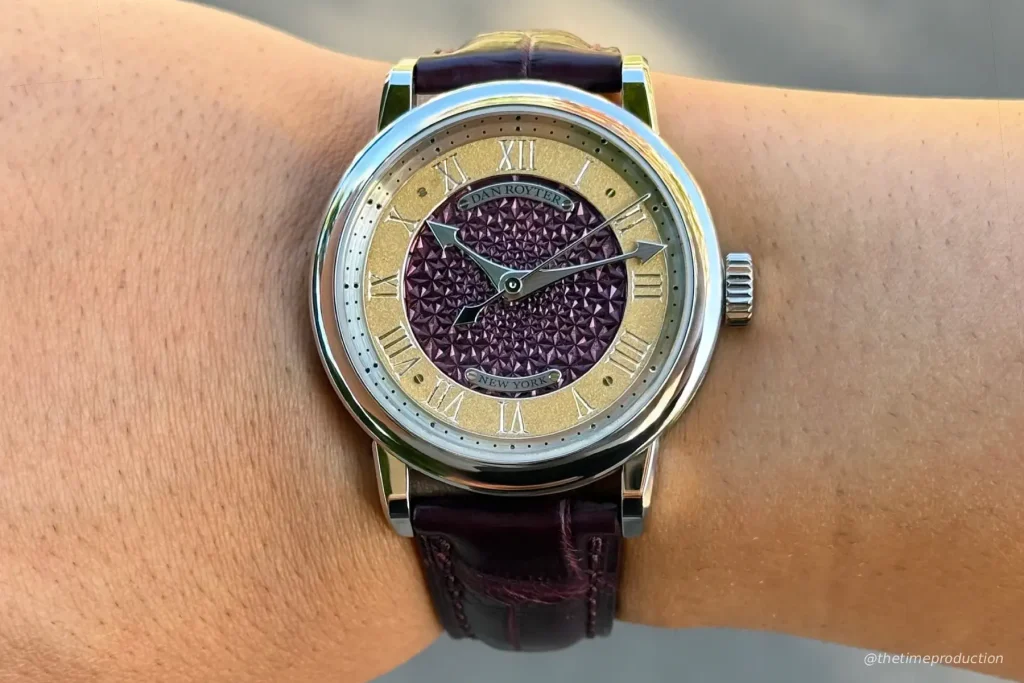
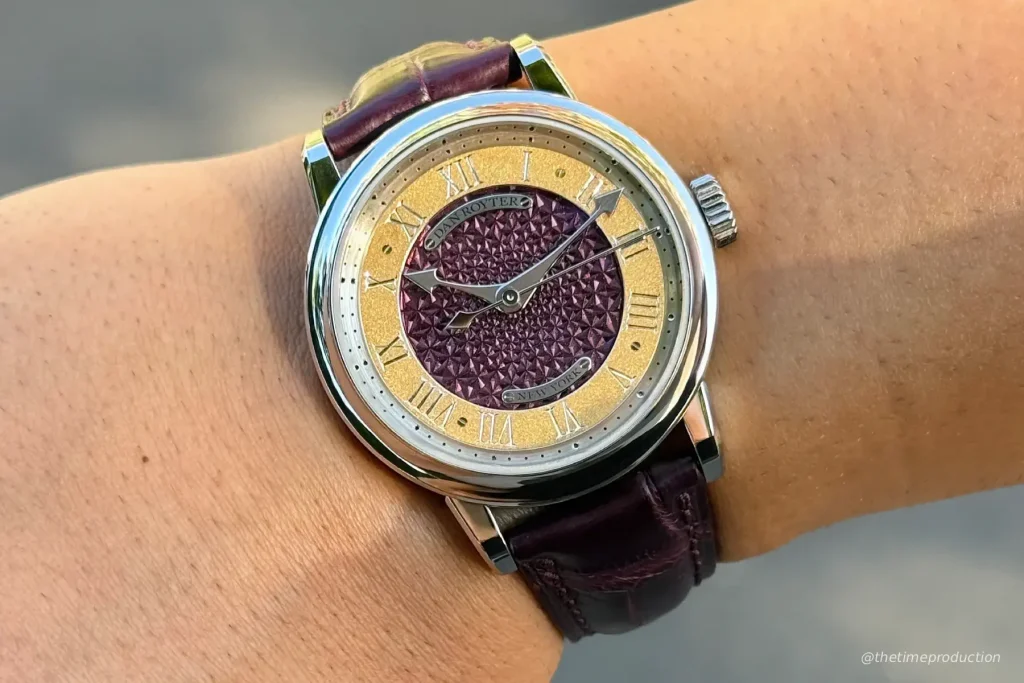
The Dan Royter Legacy Nova Edition has a 316L stainless steel case designed by Dan, measuring 39.3 mm in diameter and 9.7 mm thick, including the crystal. The lug width is 20 mm. These proportions felt right on my wrist immediately: the watch is compact, slim and well balanced.
The contrast between the brushed case middle and the polished surfaces gives the design a strong sense of definition. The concave bezel is fully polished, as are the separate, detachable lugs. I liked the way they seem to continue the line of the case before turning sharply down towards the wrist. Their edges and bevels define the silhouette, and the polishing extends even to their undersides, visible from the back. The junction with the case middle also struck me as particularly well executed. Dan polishes and brushes every case himself, by hand.
The polished crown fits neatly into this profile, offering a good grip without looking too thick. I enjoyed the feel of winding the watch by hand, along with the sound that accompanies it. Over the dial, the slightly domed sapphire crystal provides a very clear view. Both the front and rear crystals have antireflective coatings, and I also found the watch easy to photograph.
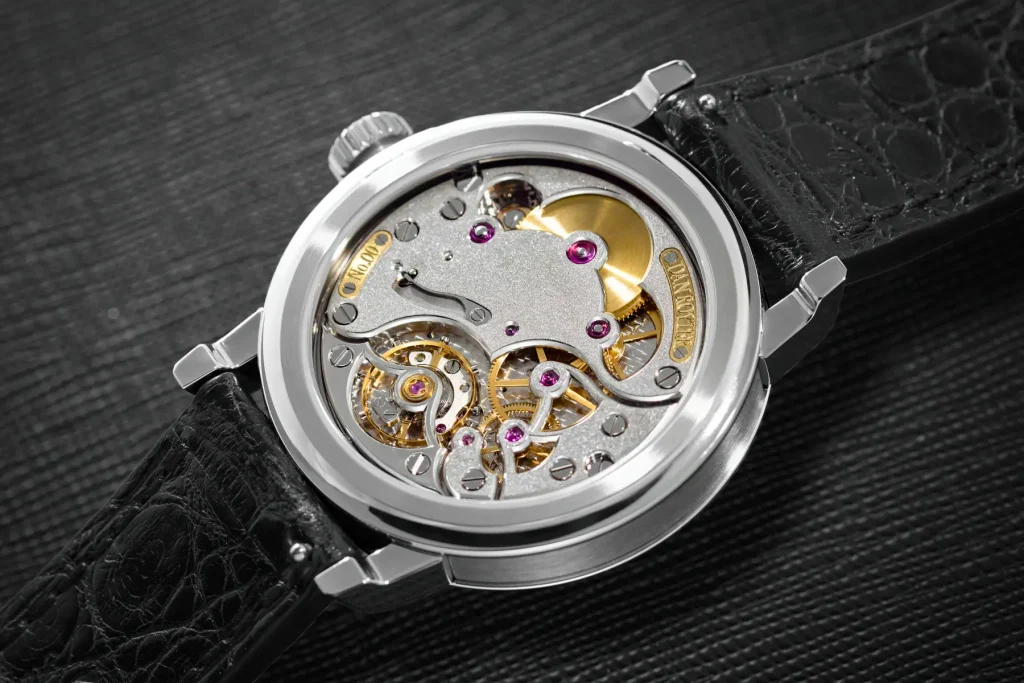
At the back, circular brushing surrounds the sapphire crystal, while the outer section of the caseback echoes the bezel’s concave shape and polished finish. This creates continuity between the front and back of the case. The caseback of the example I handled has no inscriptions. I found that restraint unusual, and it leaves the movement free to take centre stage. Water resistance is stated at 50 metres.
Dial
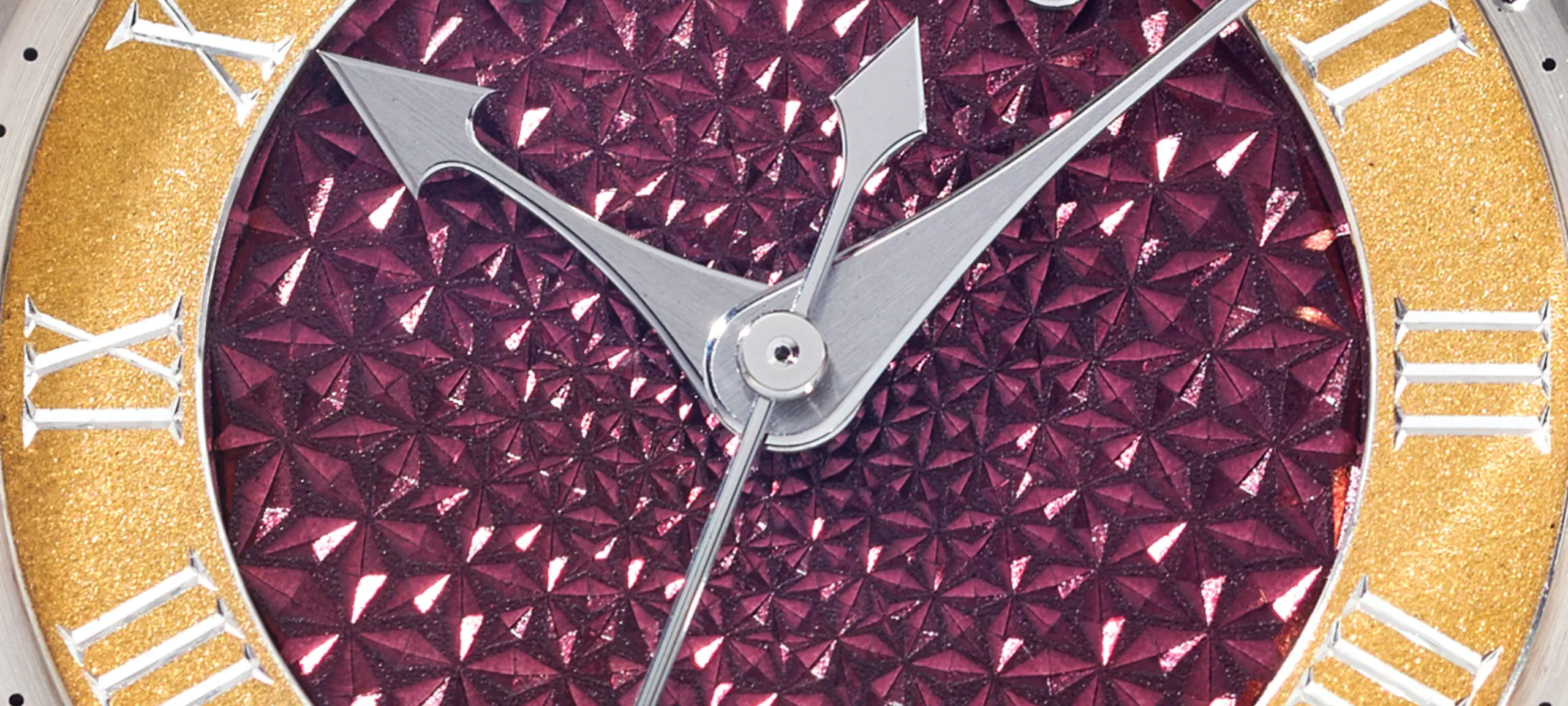
The Legacy Nova Edition’s dial changes noticeably with the light. Its burgundy colour shifts from dark shades to brighter reds, while the relief of the central pattern reveals itself as the watch is tilted. In sunlight, it becomes particularly lively. It was this combination of colour, engraving and the depth of the lacquer that I found so successful.
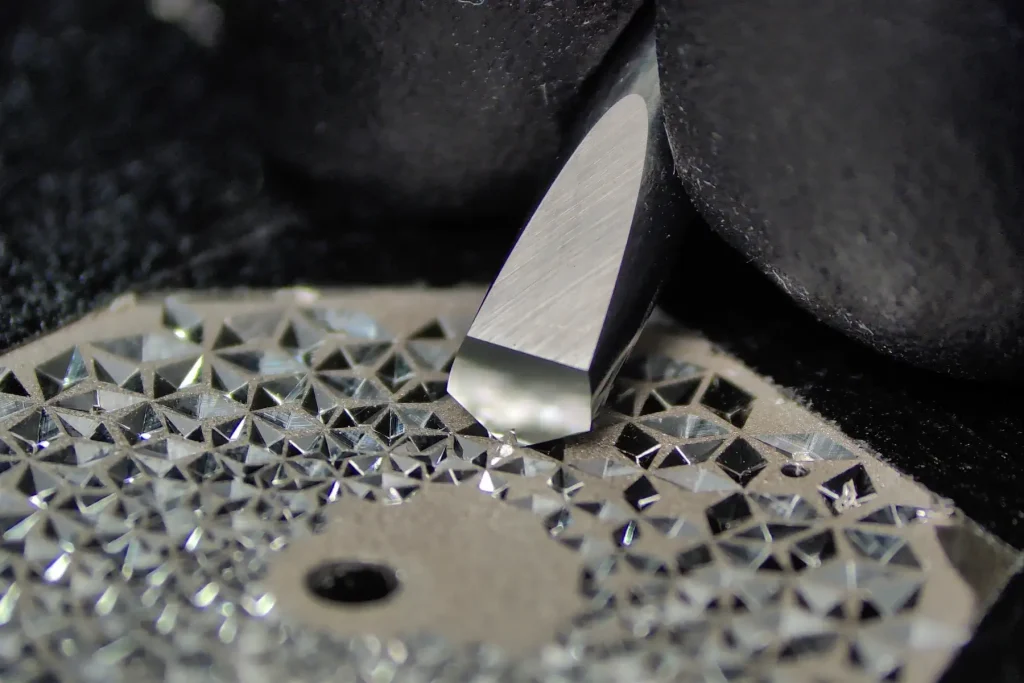
The dial base is solid silver. Dan entrusted the engraving to Artur Akmaev, a watchmaker and engraver based in California who also makes his own watches and has collaborated with Josh Shapiro on some projects. The two met in 2022 and became friends, a relationship Dan describes as an important part of this project. Artur uses a graver to create a radiating pattern of around 400 diamond-shaped motifs. Each requires four to six passes of the tool to shape its facets. Maintaining consistent depth and spacing from one motif to the next is another challenge, essential to achieving the even relief that reacts to the light. The brand quotes more than 40 hours of work for the complete dial, including around 20 hours spent engraving the base. The starburst design echoes the Nova name, a reference to a star’s sudden increase in brightness.
Dan then mixes the burgundy lacquer himself and applies it by hand in 13 layers. These layers add visual depth above the engraved metal while allowing its relief to bring the colour to life. He also shared an anecdote about his choice of shade: it reminds him of his first car, a burgundy Nissan Maxima.
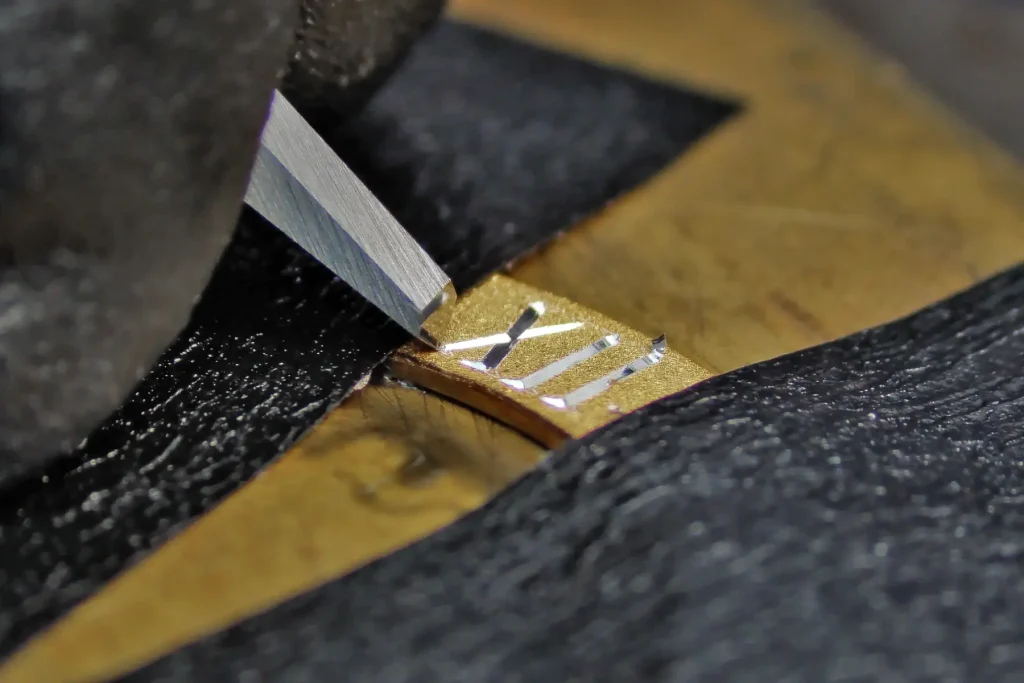
A gilt silver hour ring with a matt finish sits above the engraved base. Its yellow gold tone, almost sandy in colour, contrasts with the burgundy centre. The Roman numerals are engraved by hand, the graver cutting through the gilding to reveal the silver beneath and create the contrast needed to read them. The inner and outer edges are bevelled. Four functional steel screws with black-polished heads, each 0.6 mm in diameter, secure the hour ring to the dial base. At twelve o’clock and towards the bottom of the dial, the “DAN ROYTER” and “NEW YORK” plaques are each held by two further screws. The “NEW YORK” inscription is a nod to his workshop’s home in Brooklyn.
The steel hour and minute hands taper from fairly broad bases to tips that suggest the shape of a spear. Cut from a sheet of steel, they are then bevelled by hand using files and pegwood. Their upper surfaces are brushed, while their bevels are polished. I particularly liked their design and the way the different surfaces stand out against the dial. The central seconds hand looks simpler at first, but its counterweight echoes the shape of the other two hands’ tips. I appreciated that small connection between all three. A bevelled, black-polished central cap completes the assembly.
Around the perimeter, the minute track combines larger markers at five-minute intervals with smaller dots for the minutes in between. These markings complement the Roman numerals and allow the time to be read precisely. Despite the richness of the decoration, I found the dial harmonious, with a particularly pleasing combination of steel hands, gilt hour ring and burgundy centre.
Movement
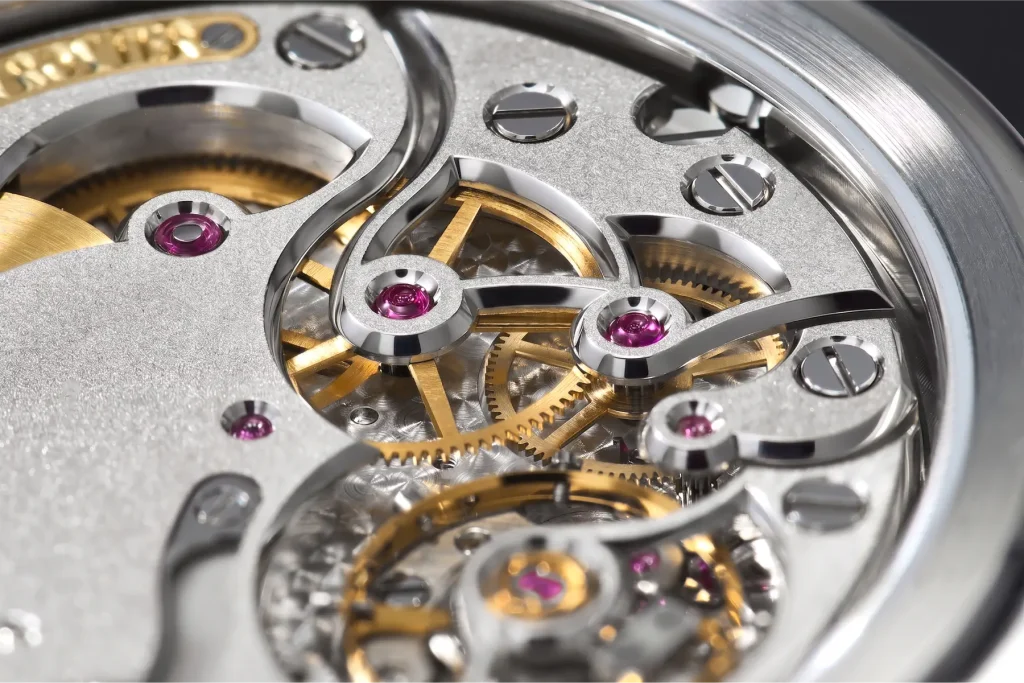
Visible through the caseback of the Legacy Nova Edition, the BNR-01 reveals workmanship that I found particularly refined. The shine of the bevels, the inward angles and the sharp points of the outward angles highlight the shape of the bridges. Asked which details matter most to him, Dan emphasises their flowing lines and the way the surfaces respond to light. The contours and their finishing were therefore conceived together. Developed for Dan Royter, this hand-wound movement measures 30 mm in diameter and comprises 139 components and 17 jewels. The absence of a rotor provides an unobstructed view of the bridges and their finishing.
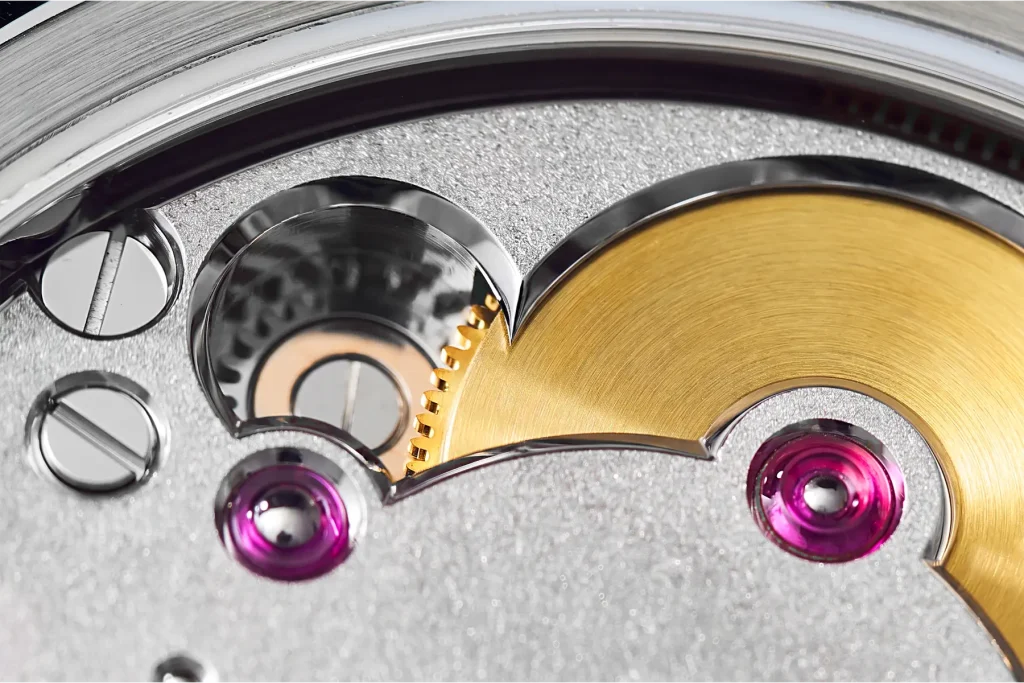
To understand how it came about, I asked Dan about the origins of his collaboration with UhrTeil AG, the company headed by Swiss watchmaker and movement designer Andreas Strehler. He explained that he had contacted Andreas in 2023 to help develop his new calibre. He wanted an architecture specific to Royter and had drawn the bridges for this watch. Andreas agreed to work with him, leading to discussions, development work and component manufacturing, until the project reached completion in 2026. The unfinished components are manufactured in Switzerland and supplied by UhrTeil. Dan then carries out the finishing, assembly and adjustment in his Brooklyn atelier.
The BNR-01 displays the hours, minutes and seconds centrally, with a stated power reserve of 60 hours, or two and a half days. Its stop-seconds mechanism halts the seconds hand during time setting to make synchronisation easier. It has a free-sprung balance, regulated by adjusting the balance wheel’s moment of inertia while leaving the active length of the hairspring unchanged. The brand also specifies adjustment in six positions. The rate is checked in different orientations, both horizontal and vertical, with the aim of making it as consistent as possible. These are two distinct aspects of adjustment: one describes how the balance is regulated, the other how the movement is adjusted for different positions.
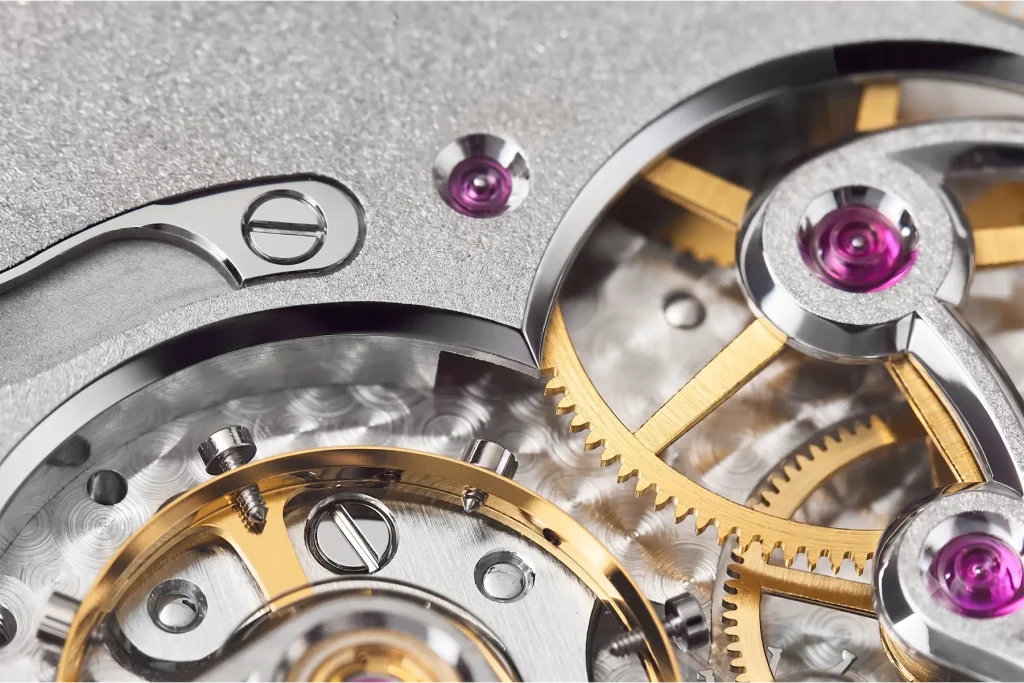
The rhodium-plated brass bridges have surfaces with a frosted appearance, contrasting with the polished bevels and the golden tones of the gear train. Geneva stripes are also available on request. The brand counts 22 inward angles and 18 outward angles, including four of each on the balance bridge. Bevelling involves shaping the edge between a component’s upper surface and its side to form a bevel, then polishing it. At inward angles, the bevels meet in a recess; at outward angles, they form an external point. Beyond the number of angles, the consistency of the bevels, the definition of these junctions and the continuity of the polish are what reveal the quality of the work. That is precisely what I liked here: the angles look well defined, and the care given to the contours lends a delicacy to the architecture.
Dan also recalls a bevelling workshop led by Philippe Narbel at Josh Shapiro’s premises, which he attended alongside Artur Akmaev. Discussing that experience, he emphasises how much these artisans’ precision and mastery contributed to his progress. Artur’s place in the story extends from Dan’s training in finishing to the creation of the Nova’s dial.
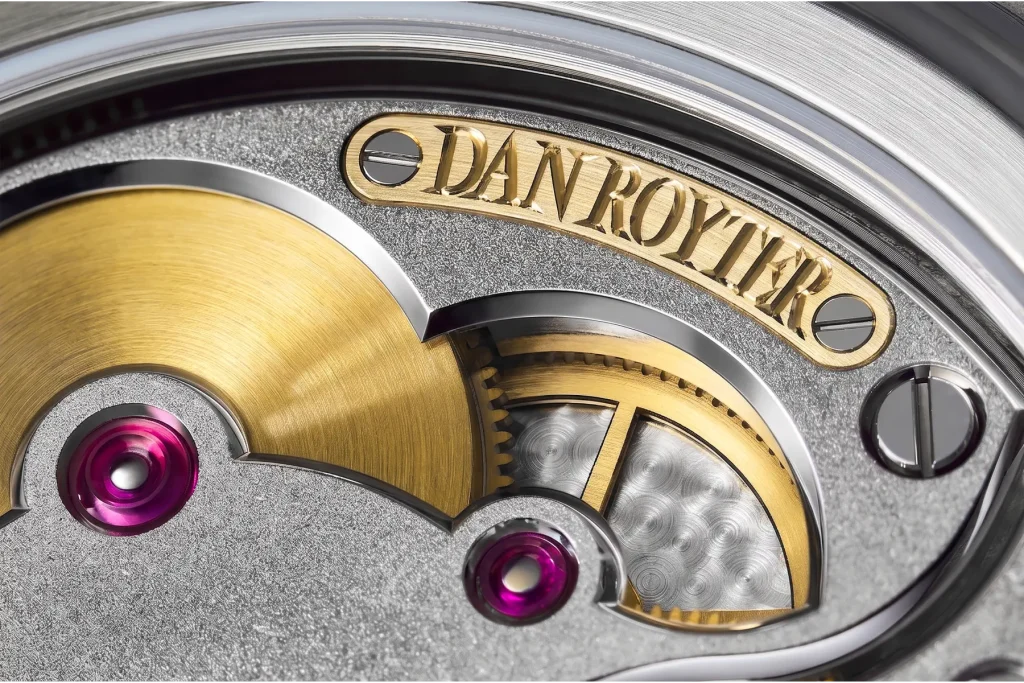
The polished screw-head recesses are another detail I appreciated. These recesses, shaped to accommodate the screw heads, are then polished using wooden tools and diamond paste. Their shine stands out against the surrounding matt surfaces and highlights the clean edges of each opening. The screw heads and the custom-made steel click spring receive a black polish. This finish requires a very flat, carefully polished surface. Depending on its angle, it reflects light towards the viewer or in another direction, making the same steel appear as bright as a mirror or almost black. The central hand cap on the dial side receives the same finish. These contrasts are subtle at a distance but become much more interesting when the movement is viewed up close.
The gilt, grained wheels have bevelled spokes, while the barrel is decorated with perlage. The brand specifies that both sides of the mainplate also receive perlage, including the dial side. Some of this decoration therefore remains hidden once the watch is assembled. Finally, two small, hand-engraved plates in solid 18-carat gold add a more personal touch: one bears Dan Royter’s name, the other the watch’s number. I like this way of signing a piece without drawing attention away from the mechanics.
Strap
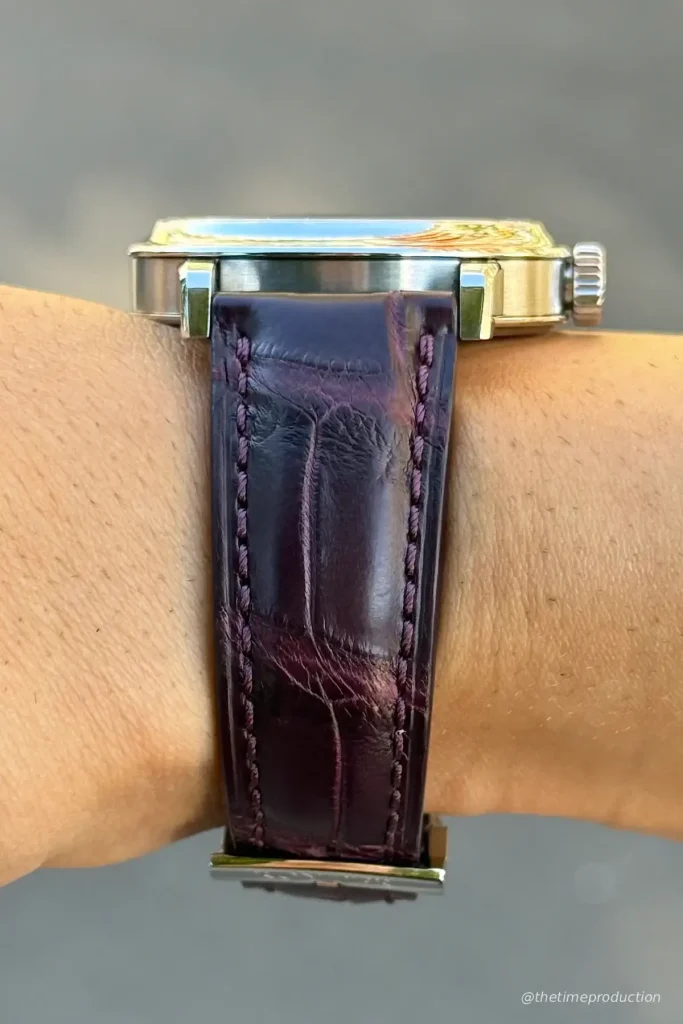
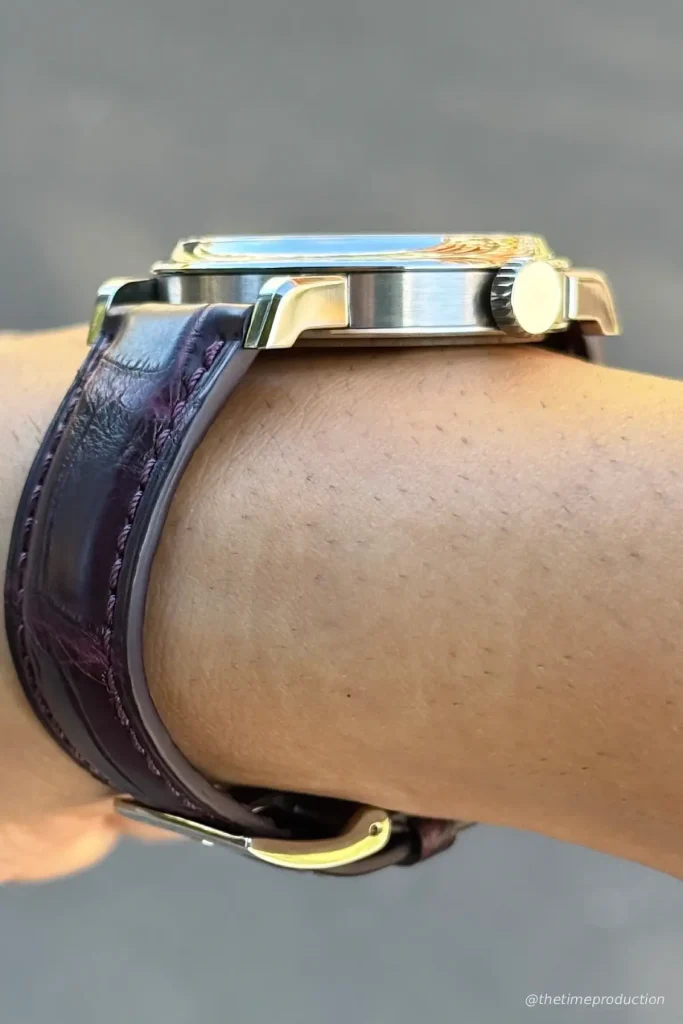
I tried the Legacy Nova Edition on a burgundy leather strap that picks up the colour of the dial. I found it very well made and well suited to the watch. The stitching is also burgundy, including on the alligator lining, a detail I appreciated. The fully polished stainless steel pin buckle has a simple shape and is engraved with the ROYTER name.
Dan confirmed that his straps are still made in Odessa, Ukraine, by the same artisan he has worked with for seven years. Made to order, they are cut and stitched by hand, with a choice of colours and textures. Their dimensions can also be tailored to the future owner’s wrist. The brand quotes more than forty stages in their production. Dan speaks highly of the strapmaker’s work and remains loyal to him. He also explained how much it matters to him to support Ukrainian talent and preserve a connection with a country that holds an important place in his family’s history.
How Much Does the Dan Royter Legacy Nova Edition Cost?
The Dan Royter Legacy Nova Edition starts at USD 68,000, with production limited to 12 watches per year, according to the brand. This scale reflects the time devoted to each piece and Dan’s wish to maintain a direct relationship with the collectors who wear his creations.
The difference from his first models, priced at around $5,000 to $6,000, is considerable and may understandably come as a surprise. For my part, considering the work on the case, dial, movement and strap, I find the price consistent with the quality of the watch as a whole. The move upmarket is tangible in its execution, particularly the dial engraving and the finishing of the calibre.
Dan Royter Legacy Nova Edition: A Brooklyn Watchmaker’s Signature
I really enjoyed the Legacy Nova Edition, with its proportions, burgundy dial and refined movement. On the wrist, I found it as pleasant to wear as it was interesting to examine closely. The case and dial draw the eye first, then the finishing of the BNR-01 makes you want to turn the watch over and spend time with it. I also appreciated how legible it remained despite the elaborate dial.
What interests me about this approach is being able to connect a design choice with the person who made it, then discuss it directly with him. In his answers, Dan explains both his original intentions and the difficulties he faced in bringing them to life. This closeness to the creator is part of the pleasure of discovering an independent watchmaker’s work.
I also asked him what he had in mind for the future. Dan is exploring several directions for the coming years, but his priority remains the Nova and the orders he has received. He wants to fulfil those orders and give each watch the time it needs before embarking on another project.
My warm thanks to Dan for answering my many questions, for his generosity with his time and for the warmth of our conversations. The Nova has made me want to follow his work more closely, and I look forward to sharing more with you as it develops.
Dan Royter Legacy Nova Edition – Watch Specifications
- Brand: Royter
- Model: Legacy Nova Edition
- Case Material: 316L Stainless Steel
- Dial: Solid Silver Base with a Hand-Engraved Star Motif (20 Hours of Engraving), 13 Layers of Deep Burgundy Lacquer and a Hand-Frosted Gilded Chapter Ring with Hand-Engraved Roman Numerals
- Functions: Hours, Minutes and Central Seconds with Hacking Function
- Movement: Exclusive Hand-Wound Calibre BNR-01, Designed In-House and Developed in Collaboration with Andreas Strehler’s UhrTeil AG, Featuring 139 Components, 17 Jewels, a Free-Sprung Balance, Swiss Lever Escapement and Adjustment in Six Positions
- Power Reserve: 60 Hours
- Water Resistance: 50m (5 ATM)
- Crystal: Slightly Curved Sapphire Crystals
- Case Dimensions: 39.3mm (Diameter) x 9.7mm (Thickness)
- Lug-to-Lug: 47mm
- Strap: Exotic Leather with a Stainless Steel Pin Buckle
- Edition: Limited to 12 Pieces
- Retail Price: Starting at USD 68,000 (excluding VAT)
What do you think of the Legacy Nova Edition and Dan Royter’s approach to watchmaking? I’d love to read your thoughts and discuss them with you in the comments.
If this article added value or sparked a discovery, you can support the project HERE. Your contribution helps me keep weekly articles and a biweekly newsletter free, accessible, and independent for everyone.
For more information about Dan Royter, click here.